Dog Training Treat Pouches: How to Choose the Right One
A dog training treat pouch might appear to be a simple accessory, but the right pouch can make a noticeable difference to the way training is organised and delivered. When rewards need to be available immediately, the handler should not have to stop training, search through pockets or struggle with packaging.
Effective training depends heavily on timing. When a dog performs the behaviour the handler wants, the reward needs to follow clearly and efficiently. A practical treat pouch keeps rewards accessible so the handler can concentrate on communication, timing and the dog rather than managing equipment.
Dog Training Treat Pouches: How to Choose the Right One explores the purpose of a treat pouch, the features worth considering, how different attachment options work and how to integrate a pouch into puppy training, obedience and outdoor training.
RECOMMEND PRODUCTS

- RELATED ARTICLES
- Dog Training Treats: Choosing the Right Rewards for Training
- Obedience Dog Training: Equipment, Commands & Techniques
- Dog Toys & Rewards: Choosing Toys for Training & Play
The Purpose of a Dog Training Treat Pouch
Fast Reward Access
One of the primary purposes of a treat pouch is simple: keeping rewards within immediate reach.
Imagine teaching a dog to look towards you. The dog makes eye contact, the handler marks the correct response, and the reward is delivered almost immediately.
Now imagine the reward is inside a sealed packet in a jacket pocket. The handler has to reach into the pocket, find the packet, open it and retrieve a treat.
That extra movement can interrupt the training sequence.
A pouch removes much of this unnecessary handling. The reward is already prepared and accessible.
Training Efficiency
Training sessions often involve many repetitions. Even a simple exercise can require repeated reward delivery while the dog learns what behaviour is expected.
A practical pouch allows the handler to prepare the rewards before training begins and maintain a consistent rhythm throughout the session.
The handler can therefore focus on:
- The dog’s body language.
- Timing the marker.
- Delivering the reward.
- Giving the next instruction.
- Managing the training environment.
The equipment becomes part of the training system rather than a distraction from it.
Keeping Rewards Accessible
Accessibility becomes especially important when moving around.
During indoor training, a handler might have a treat container nearby. Outdoors, that becomes less practical.
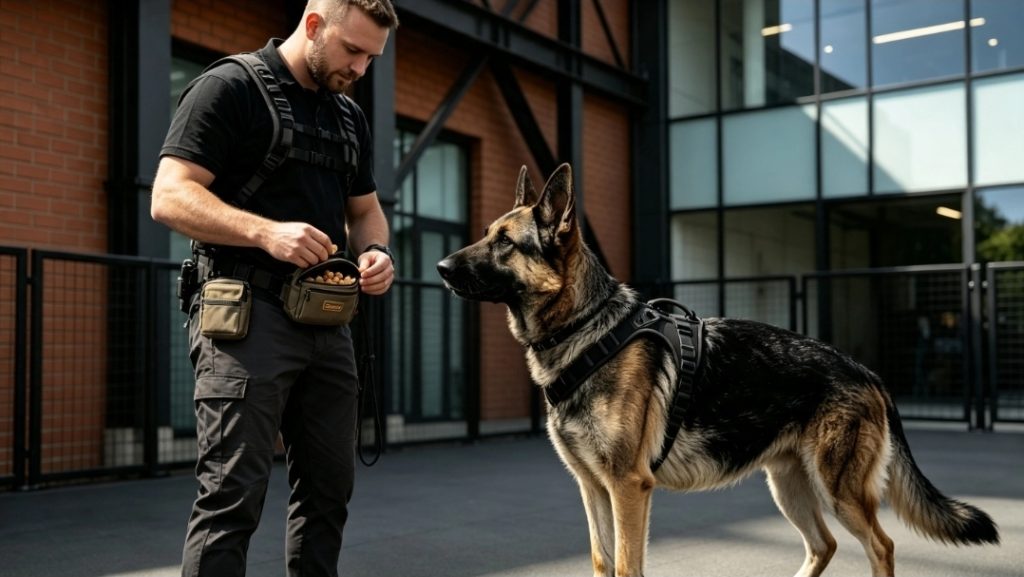
A pouch worn around the waist, attached to a belt or positioned across the body allows the handler to carry rewards while remaining mobile.
This is particularly useful for recall, loose-lead walking, obedience and puppy training.
Dog Training Treats: Choosing the Right Rewards for Training connects directly with this subject because the pouch is only useful when it contains rewards appropriate for the individual dog and training exercise.
Features to Consider
Capacity
Capacity should match the type of training being performed.
A small pouch may be ideal for a short training session where only a limited number of rewards are required. A larger pouch can be useful during longer sessions or when several different reward options are needed.
However, bigger is not automatically better.
A pouch that is excessively large can become bulky and uncomfortable. It may also encourage the handler to carry more treats than necessary.
The goal is sufficient capacity without creating unnecessary weight or bulk.
Opening Mechanism
The opening needs to allow rapid access.
Some pouches have wide openings that remain easily accessible. Others use drawstrings, magnetic closures, zips or other mechanisms.
Consider what happens during an actual training session.
If the handler needs both hands to manage the dog, the pouch should still be simple to access with minimal effort. A complicated closure may become frustrating when rewards need to be delivered quickly.
Waist Attachment
A waist-mounted pouch can be particularly practical for structured training.
Positioned around the waist, it remains close to the handler’s hands and can be accessed without removing attention from the dog.
It also leaves the handler’s pockets free for other essential items.
The position should be comfortable and secure enough that the pouch does not continually move while walking, bending or changing direction.
Belt Attachment
Some pouches are designed to attach directly to a belt.
This can provide a secure alternative to wearing a separate waist strap. It may be particularly useful for handlers who already wear suitable outdoor clothing or equipment with a belt.
The attachment should remain secure during movement. A pouch that repeatedly shifts position can become more of an irritation than an advantage.
Shoulder Options
Shoulder or cross-body options can provide another carrying method.
These designs may suit handlers who prefer not to wear equipment around the waist or who need additional carrying capacity.
However, accessibility remains important. If the pouch sits too far away from the hands, reward delivery can become slower.
The best attachment method is therefore largely dependent on the handler’s training style, clothing and movement.
Pockets
Additional pockets can increase versatility.
A pouch might include separate storage for keys, a clicker, waste bags or other small training accessories.
However, separate storage should not compromise the primary purpose of the pouch. The reward compartment should remain easy to access.
Cleaning
Treats can leave crumbs, grease or moisture inside a pouch.
Regular cleaning is therefore an important practical consideration.
A washable or wipe-clean material can make maintenance easier, particularly when the pouch is used frequently.
A clean pouch also helps prevent old food residue from accumulating inside the reward compartment.
RECOMMEND PRODUCTS
- RELATED ARTICLES
- Dog Training Treats: Choosing the Right Rewards for Training
- Obedience Dog Training: Equipment, Commands & Techniques
- Dog Toys & Rewards: Choosing Toys for Training & Play
When choosing a treat pouch, prioritise accessibility, secure attachment, suitable capacity and easy cleaning. The pouch should work with the handler rather than requiring constant adjustment during training.
The ideal design is the one that allows the handler to retrieve an appropriately sized reward quickly and return attention to the dog.
Using a Treat Pouch During Training
Reward Timing
Timing is one of the strongest reasons to use a treat pouch.
A dog performs the desired behaviour. The handler recognises it. The behaviour is marked. The reward follows.
The shorter and clearer this sequence becomes, the easier it can be for the dog to understand which behaviour produced reinforcement.
A pouch does not automatically create good timing, but it can remove a practical obstacle to achieving it.
Luring
A treat pouch is particularly useful when training involves food luring.
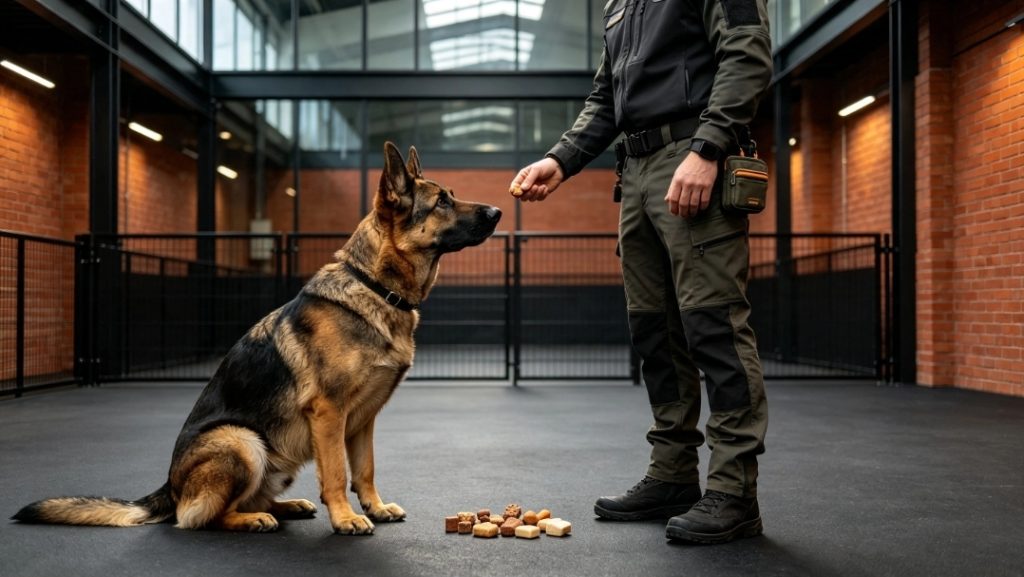
A reward can be taken from the pouch before or during an exercise and used to guide the dog into a position.
For example, when teaching a puppy to sit, the handler can retrieve a small treat, use it to guide the puppy’s movement and then deliver the reward once the desired behaviour is achieved.
As training progresses, the visible lure can be reduced so the dog learns to respond to the handler rather than simply following food.
Outdoor Training
Outdoor training creates additional demands.
The handler may need to walk, change direction, increase distance, manage distractions and reward desirable behaviour without constantly stopping.
A securely attached pouch keeps rewards available while allowing the handler to remain mobile.
This connects naturally with Dog Walking Essentials: Equipment for Safe Outdoor Adventures, particularly when training equipment needs to work alongside everyday walking equipment.
RECOMMEND COURSE
Fundamentals 1 is directly relevant to using a treat pouch during early training because foundational exercises often involve frequent reinforcement. Having rewards immediately accessible helps the handler practise accurate timing while establishing basic behaviours and engagement.
Obedience and Structured Training
A treat pouch becomes particularly useful when training develops beyond isolated commands.
During obedience work, the handler may reward attention, position, movement, recall or calm behaviour at different points throughout a session.
For example, during loose-lead walking, the handler may reward the dog for remaining in an appropriate position rather than waiting until the end of the walk.
During recall training, the reward may need to be available immediately when the dog reaches the handler.
During distraction training, the handler may need to reinforce calm attention before the dog becomes overwhelmed by the environment.
In all these situations, accessibility helps maintain the rhythm of training.
Obedience Dog Training: Equipment, Commands & Techniques provides a natural next step for readers who want to understand how rewards and equipment fit into a broader obedience programme.
RECOMMEND PRODUCTS
- RELATED ARTICLES
- Dog Training Treats: Choosing the Right Rewards for Training
- Obedience Dog Training: Equipment, Commands & Techniques
- Dog Toys & Rewards: Choosing Toys for Training & Play
Dog Training Treats: Choosing the Right Rewards for Training
A treat pouch and training treats should be considered together. The pouch should allow the handler to carry rewards that are small, practical and appropriate for the exercise.
Different training situations may require different reward values, so a pouch with sufficient capacity can be useful when the handler wants to carry more than one option.
RECOMMENDED COURSE
Fundamentals 2 is relevant when the handler begins developing greater reliability and expects the dog to work around more challenging circumstances. Accessible rewards can help maintain reinforcement timing as training becomes more demanding.
Puppy Training and Treat Pouches
Puppies can benefit from frequent, clearly timed reinforcement while learning basic behaviours.
A puppy may be learning its name, developing attention towards the handler, practising sit or beginning loose-lead walking.
Because puppies are learning many new behaviours, the handler may need to reward correct responses regularly.
A treat pouch allows the handler to keep small rewards readily available without repeatedly stopping to retrieve food.
However, puppy training should not become a constant process of waving food in front of the puppy.
The reward should support learning rather than become a permanent distraction.
As the puppy understands the behaviour, the handler can gradually change how and when the reward is presented.
This links directly with Puppy Training: Essential Skills, Equipment & Techniques, which covers the broader foundations of puppy training and the equipment used alongside those foundations.
RECOMMEND PRODUCT
- RELATED ARTICLES
- Dog Training Treats: Choosing the Right Rewards for Training
- Obedience Dog Training: Equipment, Commands & Techniques
- Dog Toys & Rewards: Choosing Toys for Training & Play
Puppy Essentials: Everything You Need for a New Puppy
A treat pouch can form part of a wider collection of practical puppy equipment. For a new puppy owner, having training rewards organised and accessible can make short training sessions easier to structure throughout the day.
Practical Considerations
Comfort
A pouch may be worn for extended periods, so comfort matters.
A waist strap should not dig into the handler, while a belt attachment should remain stable. Cross-body designs should sit comfortably without repeatedly swinging into the handler or dog.
The pouch should also remain practical when the handler bends, walks, kneels or changes direction.
Durability
Training equipment is exposed to regular movement and handling.
Stitching, attachment points, straps, clips and closures should all be considered before purchase.
A pouch that looks suitable when new but cannot withstand frequent use will quickly become impractical.
Weather Resistance
Outdoor training means equipment may encounter rain, mud and damp conditions.
A weather-resistant exterior can help protect the contents, while washable materials can simplify cleaning after outdoor sessions.
The exact level of weather protection required depends on where and how frequently the pouch will be used.
Accessibility
Accessibility remains the central consideration.
A technically sophisticated pouch is not necessarily useful if the handler struggles to reach it.
Before choosing one, consider:
- Where will it sit?
- Can it be opened quickly?
- Can rewards be retrieved with one hand?
- Does it remain secure during movement?
- Can it be cleaned easily?
- Is the capacity appropriate?
- Does it interfere with other equipment?
The best treat pouch is ultimately one that becomes almost invisible during training because the handler can use it naturally without disrupting the session.
Integrating the Treat Pouch Into Structured Training
A treat pouch should be prepared before training begins.
The handler can decide what rewards are appropriate, place a suitable quantity into the pouch and then enter the training environment with everything immediately accessible.
This creates a more deliberate training process.
Instead of reaching for food whenever the dog does something, the handler can establish clear objectives for the session.
For example, a short session might focus on engagement. Another might concentrate on loose-lead walking. Another could work on recall around controlled distractions.
The pouch supports the process by making reinforcement readily available.
For more advanced tracking work, food may form part of a wider reinforcement strategy, but the training objective should determine the reward system rather than the equipment itself. Advanced Tracking may be relevant where structured tracking work forms part of a dog’s training progression.
RECOMMEND COURSE
90-Day Transformation
The 90-Day Transformation course is relevant to handlers who want to turn individual training exercises into a consistent programme. A treat pouch becomes particularly useful when training is carried out regularly because it keeps the reinforcement system organised across repeated sessions.
What the Reader Learns
Understanding Dog Training Treat Pouches: How to Choose the Right One means looking beyond appearance and choosing equipment based on practical training requirements.
The most important considerations are:
- Accessibility: rewards should be easy to reach.
- Capacity: carry enough without creating unnecessary bulk.
- Attachment: choose a waist, belt or shoulder option that suits the handler.
- Opening mechanism: quick access supports better reward timing.
- Cleaning: washable or wipe-clean materials simplify maintenance.
- Durability: attachment points and construction should withstand regular use.
- Comfort: the pouch should remain comfortable during movement.
- Weather resistance: outdoor training may require additional protection.
- Training purpose: the pouch should support the specific exercises being taught.
A treat pouch does not train the dog by itself. Its value comes from making good training practices easier to perform consistently.
When the correct reward is immediately accessible, the handler can respond to desirable behaviour with greater precision. When the pouch is comfortable and secure, the handler can concentrate on communication rather than equipment. And when rewards are organised before training begins, sessions can become more structured and purposeful.
The right equipment should make training simpler.
That is the real purpose of a good treat pouch.