

Socialising a puppy is one of the most important parts of raising a confident and well-behaved dog.
However, many owners misunderstand what puppy socialisation actually means.
Some believe that socialising a puppy means allowing them to meet as many people and dogs as possible.
Others think their puppy needs to experience everything immediately.
Neither approach is necessarily correct.
How to socialise a puppy correctly is about carefully introducing your puppy to the world while allowing them to experience new situations in a controlled and positive way.
People, dogs, sounds, surfaces, environments, vehicles and everyday experiences can all become part of your puppy’s education.
The goal isn’t to force your puppy to interact with everything.
The goal is to help your puppy develop confidence, appropriate behaviour and the ability to remain calm when experiencing something new.
What Is Puppy Socialisation?
Puppy socialisation is the process of introducing a puppy to different experiences during their development.
This can include:
- People
- Children
- Other dogs
- Different animals
- Vehicles
- Traffic
- Household noises
- Different surfaces
- New environments
- Veterinary handling
- Grooming
- Car journeys
- Different sights and smells
- Everyday situations
Good socialisation teaches your puppy that the world around them is normal.
It also teaches them how to respond appropriately.
A well-socialised puppy doesn’t necessarily need to greet everyone.
They should be able to see a person, dog, bicycle or unfamiliar environment without automatically becoming overexcited, frightened or difficult to control.
When Should You Start Socialising a Puppy?
Puppy socialisation should begin early.
Your puppy’s breeder will already have an important role in providing appropriate early experiences before your puppy comes home.
Once your puppy arrives with you, the process continues.
You don’t need to wait until your puppy is older before beginning appropriate socialisation.
However, you should always take your puppy’s vaccination status and local disease risks into consideration.
If your puppy isn’t fully vaccinated, speak to your veterinary professional about which environments and interactions are safe.
There are still many ways to introduce a young puppy to the world without unnecessarily exposing them to unsafe environments.
Socialisation Doesn’t Mean Meeting Everyone
One of the biggest mistakes owners make when learning how to socialise a puppy correctly is believing that their puppy needs to say hello to every person they meet.
They don’t.
Your puppy needs to learn that people can exist around them without automatically becoming part of an interaction.
Allow your puppy to observe people.
Reward calm behaviour.
Allow appropriate people to interact with your puppy when the situation is suitable.
Most importantly, don’t force your puppy towards somebody who wants to touch them.
Your puppy should be allowed to develop confidence at their own pace.
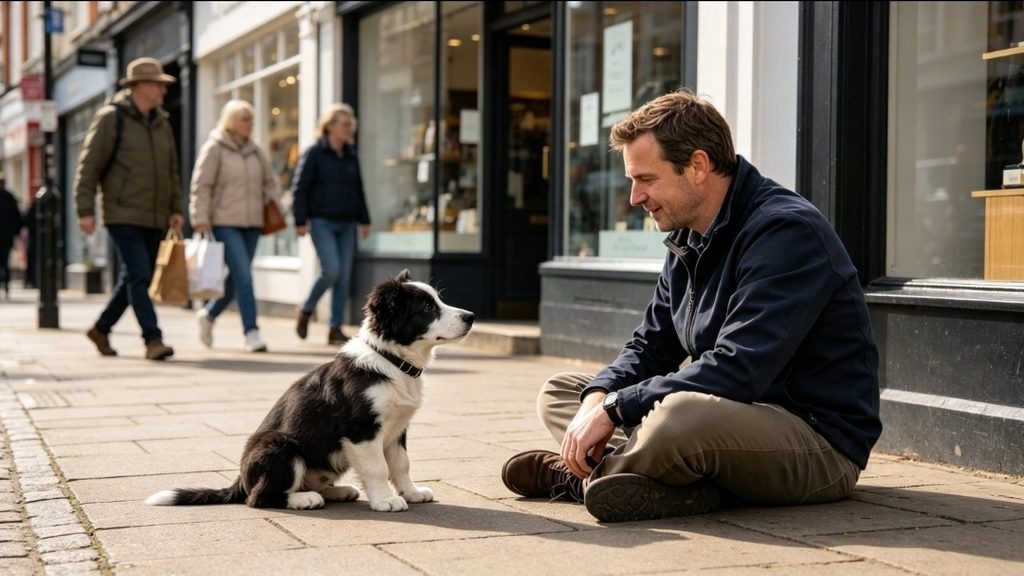
Don’t Force Your Puppy to Say Hello
A puppy may be curious about a new person.
They may also be unsure.
If your puppy backs away, hides behind you or appears uncomfortable, don’t force the interaction.
Give them space.
Allow them to observe.
You can gradually decrease the distance when your puppy becomes comfortable.
The same principle applies to children.
Children can be unpredictable from a puppy’s perspective.
They may run, shout, move quickly or attempt to touch the puppy suddenly.
Teach children how to interact appropriately.
Never assume that your puppy should tolerate being hugged, chased or picked up simply because they are young.
Your Puppy Doesn’t Need to Meet Every Dog
Another common mistake is allowing a puppy to greet every dog they encounter.
This can create several problems.
Your puppy may begin to believe that every dog is an opportunity to play.
They may start pulling towards dogs.
They may become frustrated when prevented from greeting them.
They may also have an unpleasant interaction with another dog.
Instead, choose your puppy’s interactions carefully.
A calm, stable and appropriate adult dog can provide a much better experience than an uncontrolled or overly excitable dog.
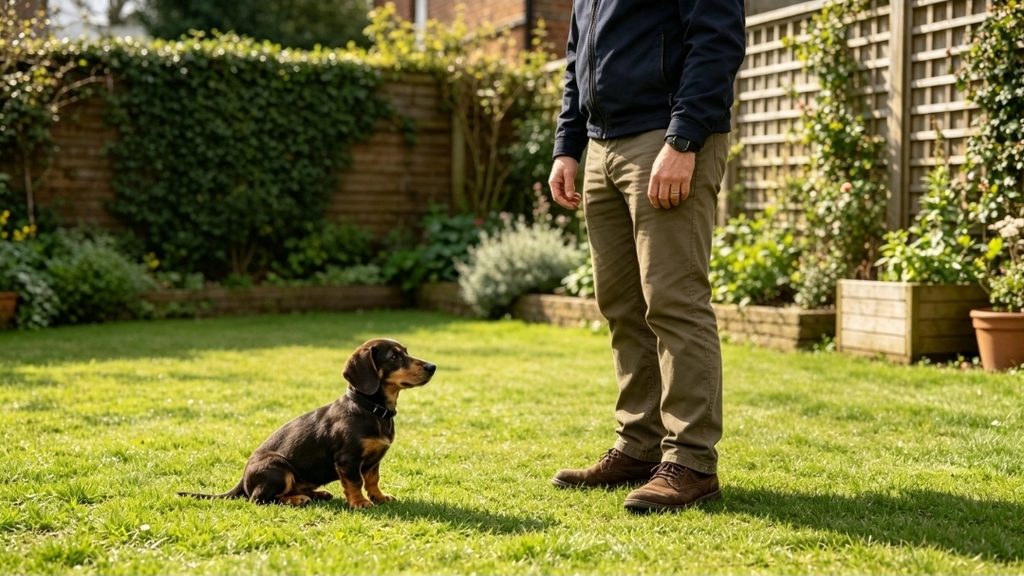
Watch Your Puppy’s Body Language
Learning how to socialise a puppy correctly means learning to read your puppy.
Your puppy cannot tell you:
“I’m uncomfortable with this.”
They communicate through body language.
Watch for signs such as:
- Moving away
- Hiding
- Freezing
- Excessive licking
- Yawning
- Trembling
- Tucked tail
- Avoiding interaction
- Excessive vocalisation
- Trying to escape
- Becoming unusually quiet
If your puppy is showing signs of discomfort, increase the distance or end the interaction.
Socialisation should not be about forcing your puppy to endure something they find frightening.
Don’t Overwhelm Your Puppy
More socialisation isn’t necessarily better.
Imagine taking a puppy into a busy town centre and exposing them to dozens of people, multiple dogs, traffic, loud noises, bicycles and unfamiliar buildings all in one session.
That’s a huge amount of information for a young dog.
Instead, break experiences down.
One new environment.
One new sound.
One new type of person.
One appropriate dog interaction.
Give your puppy time to process the experience.
Short, successful experiences can be far more useful than overwhelming your puppy.
Introduce Different Environments
Your puppy’s world shouldn’t be limited to your home and garden.
As it becomes safe and appropriate to do so, gradually introduce different environments.
These might include:
- Quiet streets
- Parks
- Countryside
- Car parks
- Pet-friendly businesses
- Different buildings
- Busy streets
- Different walking routes
Start with easier environments.
As your puppy becomes more confident, gradually introduce more challenging situations.
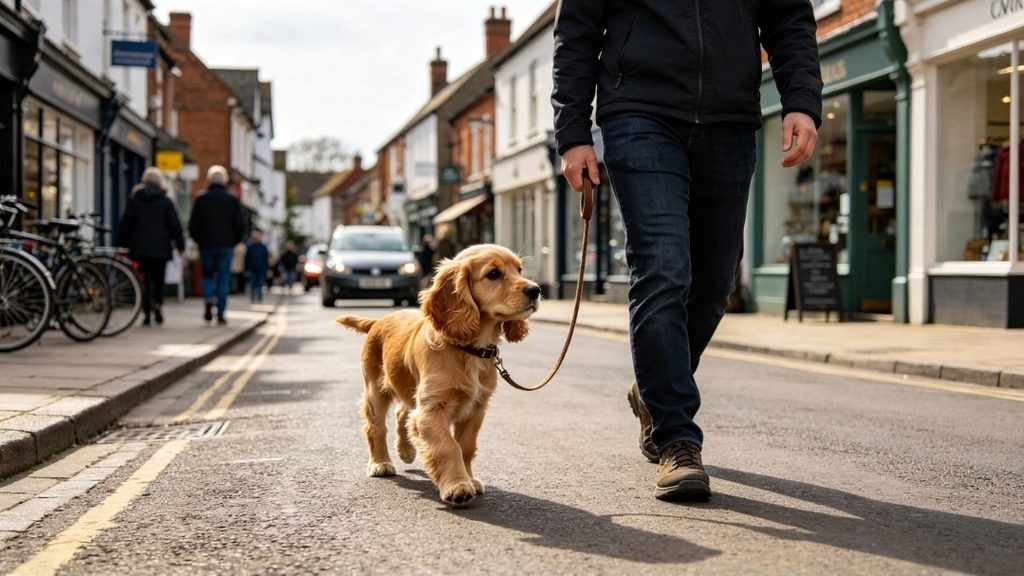
Introduce Your Puppy to Different Sounds
Your home contains hundreds of sounds that your puppy may initially find strange.
Consider gradually introducing:
- Vacuum cleaners
- Washing machines
- Doorbells
- Hairdryers
- Televisions
- Traffic
- Buses
- Trains
- Children playing
- Construction sounds
- Thunder
- Fireworks
Don’t suddenly expose your puppy to an extremely loud sound.
Start at a level where your puppy remains comfortable.
Reward calm behaviour.
Gradually increase the intensity as your puppy becomes more confident.
Introduce Different Surfaces
A puppy may eventually encounter many different surfaces throughout its life.
Grass.
Concrete.
Wood.
Carpet.
Gravel.
Sand.
Rubber flooring.
Different surfaces can feel strange under a puppy’s feet.
Introduce them gradually and safely.
Allow your puppy to investigate.
Don’t drag your puppy across a surface they are reluctant to walk on.
Give them time.
Car Travel Is Part of Socialisation
Car journeys are another important experience.
Your puppy may eventually travel to:
- Training
- The vet
- Holidays
- Walks
- Boarding facilities
- Family visits
Start with short journeys.
Use appropriate safety equipment.
Allow your puppy to become comfortable with getting into the vehicle.
Gradually increase the duration of journeys.
The goal is to make travelling a normal part of life rather than something unfamiliar and stressful.
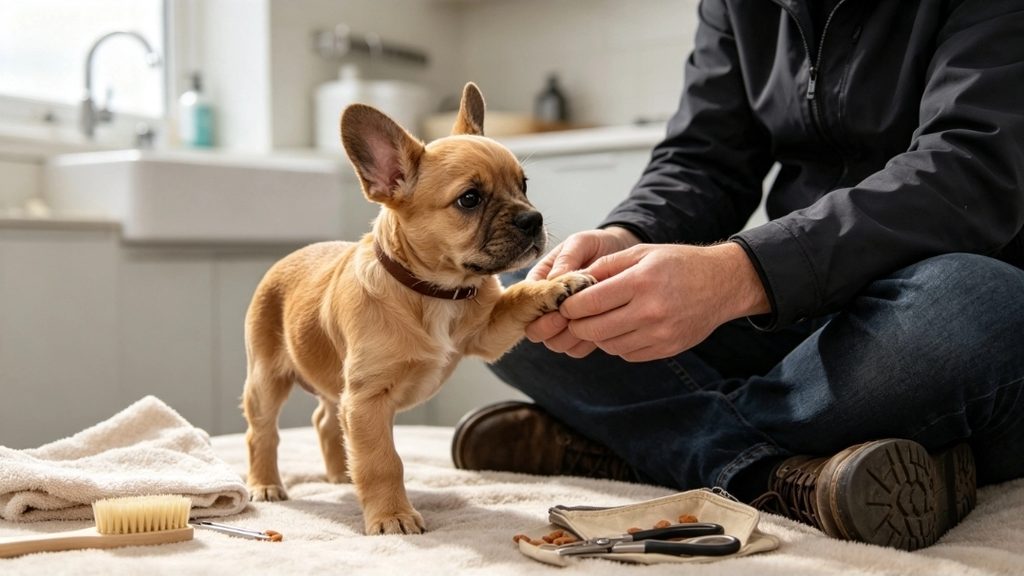
Veterinary Handling Should Be Introduced Early
Your puppy will need veterinary care throughout its life.
That means handling should become a normal part of your puppy’s education.
At home, calmly practise touching:
- Paws
- Ears
- Mouth
- Tail
- Legs
- Body
Keep sessions gentle and brief.
Reward cooperation.
This can help prepare your puppy for future grooming, examinations and veterinary treatment.
Introduce Your Puppy to Different People
Don’t only expose your puppy to people who look and behave like your immediate family.
Appropriate experiences can include people who:
- Wear hats
- Wear glasses
- Carry bags
- Use walking sticks
- Wear uniforms
- Wear coats
- Move slowly
- Move quickly
- Have different voices
- Have different appearances
Again, the goal isn’t for everyone to touch your puppy.
Your puppy can simply observe people from a comfortable distance.
This teaches an important lesson:
Different people are normal.
Introduce Your Puppy to Children Carefully
Children can be unpredictable.
A child may run towards a puppy.
They may shout.
They may try to pick the puppy up.
They may grab at their ears or tail.
Young children may not understand when a puppy needs space.
Always supervise interactions.
Teach children how to behave appropriately.
Allow the puppy to move away.
Never leave a young child and puppy together without appropriate supervision.
Don’t Encourage Chasing
Your puppy may naturally want to chase moving objects.
Cars.
Bicycles.
Joggers.
Birds.
Cats.
Livestock.
Other dogs.
This is why socialisation should be combined with training.
Your puppy should learn that seeing something move doesn’t automatically mean chasing it.
Create appropriate distance.
Get your puppy’s attention.
Reward calm behaviour.
Over time, your puppy can learn to observe distractions without automatically reacting to them.
Socialising Around Other Animals
Other animals need to be introduced carefully.
Cats, horses and livestock can all trigger different reactions.
Never assume your puppy should immediately interact with another species.
If you’re around livestock, keep your puppy appropriately controlled.
A puppy that learns to chase animals can develop a serious problem as it gets older.
Teach your puppy that other animals can be present without becoming something to chase.
Puppy Classes and Socialisation
A well-run puppy class can provide useful controlled experiences.
Your puppy may experience:
- Other puppies
- Different people
- New environments
- Training equipment
- Distractions
- Basic obedience exercises
However, a puppy class shouldn’t simply be a free-for-all where every puppy is allowed to play continuously.
Structured training can help puppies learn how to remain engaged with their handlers while other dogs are nearby.
Socialisation and Obedience Should Work Together
A common misunderstanding is that socialisation and obedience are completely separate.
They work together.
Your puppy should learn that when something interesting happens, they can look towards you.
A dog appears.
Check in with the handler.
A bicycle passes.
Remain calm.
A stranger approaches.
Stay controlled.
A new environment appears.
Investigate while remaining connected with the handler.
These are valuable foundations for everyday life.
Don’t Reward Over-Excitement
Your puppy sees another dog and immediately pulls towards them.
They reach the dog.
They get to play.
Your puppy may learn:
Pulling gets me to dogs.
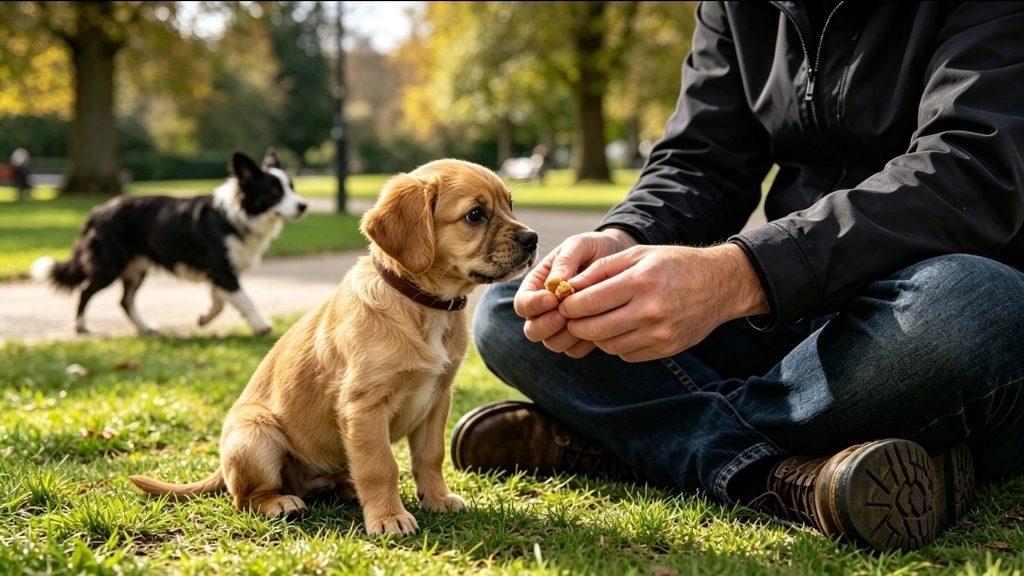
Instead, teach your puppy that calm behaviour provides access to things they enjoy.
Wait for appropriate behaviour.
Reward engagement.
Then allow appropriate interaction where suitable.
Your puppy learns that self-control can produce positive outcomes.
Give Your Puppy Time to Rest
Socialisation can be mentally tiring.
Your puppy doesn’t need to experience something new every minute of the day.
Puppies need plenty of sleep and downtime.
After an exciting experience, allow your puppy to return to a calm environment.
Let them sleep.
Let them relax.
Give them time to process what they’ve experienced.
A tired puppy can become overstimulated and much harder to manage.
Socialisation Should Continue Beyond Puppyhood
Socialisation doesn’t suddenly end when your puppy reaches a certain age.
Your dog will continue encountering new experiences throughout life.
New environments.
New people.
New situations.
New sounds.
Continuing to expose your dog to appropriate experiences can help maintain confidence and adaptability.
Training should develop alongside those experiences.
The Biggest Puppy Socialisation Mistakes
Mistake 1: Forcing Your Puppy to Interact
Never force a nervous puppy towards a person, dog or unfamiliar object.
Mistake 2: Letting Every Dog Greet Your Puppy
Your puppy doesn’t need to interact with every dog.
Mistake 3: Allowing Uncontrolled Play
Not every dog is an appropriate playmate.
Mistake 4: Ignoring Stress Signals
Your puppy’s body language is telling you how they are experiencing the situation.
Mistake 5: Doing Too Much Too Quickly
Too many new experiences can overwhelm a puppy.
Mistake 6: Only Socialising With People
Socialisation includes environments, sounds, surfaces, handling and everyday situations.
Mistake 7: Encouraging Your Puppy to Chase
Chasing can become a powerful behaviour that becomes increasingly difficult to manage.
Mistake 8: Forgetting About Rest
Puppies need significant amounts of sleep and downtime.
Mistake 9: Allowing Poor Behaviour in the Name of Socialisation
Socialisation doesn’t mean allowing your puppy to jump on people, pull towards dogs or behave uncontrollably.
Mistake 10: Expecting Immediate Results
Your puppy is learning.
Confidence and appropriate behaviour develop through repeated experiences.
A Simple Puppy Socialisation Routine
Step 1: Choose One New Experience
Don’t overwhelm your puppy.
Step 2: Start at a Comfortable Distance
Give your puppy enough space to remain relaxed.
Step 3: Watch Their Body Language
Look for signs of confidence and signs of discomfort.
Step 4: Allow Your Puppy to Observe
They don’t have to interact with everything.
Step 5: Reward Calm Behaviour
Reinforce appropriate responses.
Step 6: Keep Sessions Short
Finish while your puppy is still comfortable.
Step 7: Allow Your Puppy to Rest
Give them time to recover.
Step 8: Repeat the Experience
Build confidence through repetition.
Step 9: Gradually Increase Difficulty
Move from easy environments to more challenging ones as your puppy develops.
How GPK9 Can Help With Puppy Socialisation
Socialisation is only one part of raising a well-trained puppy.
Your puppy also needs to develop communication, engagement, focus, obedience and appropriate behaviour around distractions.
These skills can make socialisation much easier to manage.
GPK9 Fundamentals 1 – 6 Weeks to 6 Months
For puppies between 6 weeks and 6 months, GPK9 Fundamentals 1 – 6 Weeks to 6 Months is the most relevant GPK9 course for this stage of development.
The course focuses on building important early training foundations while your puppy is developing.
This complements puppy socialisation because your puppy isn’t simply learning to experience new people and environments.
They’re also learning how to communicate with their handler, focus, respond to training and develop appropriate behaviour.
You can continue your puppy’s training with:
Fundamentals 1 – 6 Weeks to 6 Months
What If Your Puppy Is Nervous?
Some puppies are naturally more cautious than others.
Don’t compare your puppy with another dog.
One puppy may confidently walk into a new environment.
Another may need considerably more time.
That’s okay.
Give your puppy distance.
Allow them to observe.
Reward calm behaviour.
Don’t force interaction.
If your puppy is consistently frightened by normal everyday experiences, professional behavioural support may be appropriate.
What Does a Well-Socialised Puppy Look Like?
A well-socialised puppy doesn’t have to greet everyone.
They don’t have to play with every dog.
They don’t need to be completely fearless.
Instead, look for a puppy that can experience new situations while remaining reasonably calm and responsive to their handler.
They can see another dog without immediately losing control.
They can observe strangers without becoming overwhelmed.
They can walk through different environments.
They can experience new sounds.
They can accept appropriate handling.
They can recover from unfamiliar experiences.
They can focus on their handler when required.
That’s the foundation you’re trying to build.
Final Thoughts: How to Socialise a Puppy Correctly
Learning how to socialise a puppy correctly isn’t about exposing your puppy to absolutely everything as quickly as possible.
It’s about creating appropriate experiences.
Introduce your puppy to different people.
Introduce appropriate dogs.
Expose them to different environments.
Gradually introduce sounds, surfaces, handling and travel.
Watch their body language.
Give them space.
Allow them to investigate.
Don’t force interactions.
Don’t overwhelm them.
Don’t confuse socialisation with allowing poor behaviour.
And remember that socialisation should work alongside obedience training.
The ultimate goal isn’t to create a puppy that believes everyone and everything is there to play with.
It’s to develop a confident dog that can experience the world while remaining calm, controlled and connected with its handler.
Quality experiences matter more than quantity.
Start early.
Go gradually.
Reward appropriate behaviour.
Build confidence.
And keep training as your puppy grows.
For puppies between 6 weeks and 6 months, continue developing those important early foundations with Fundamentals 1 – 6 Weeks to 6 Months


