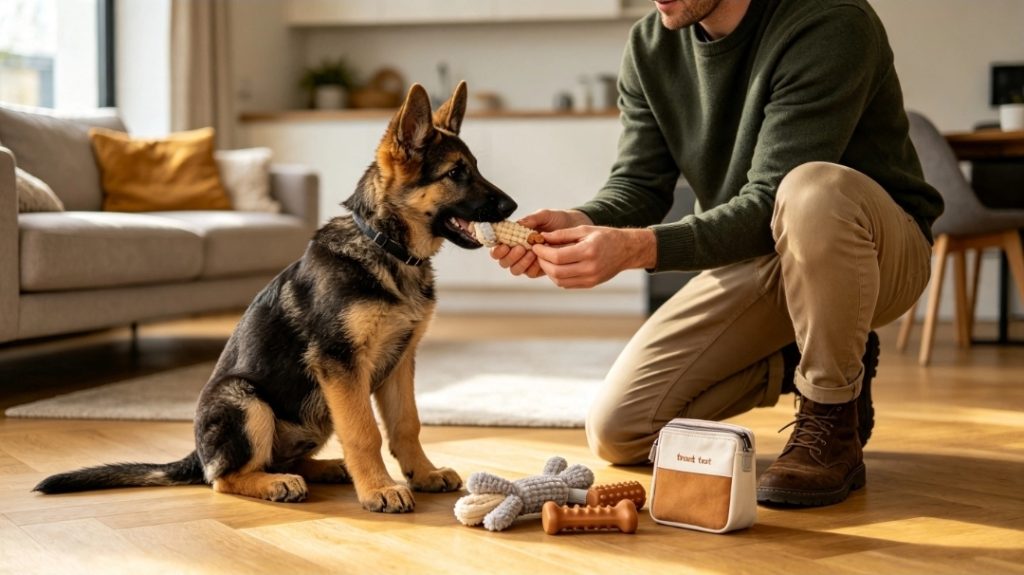
If you’ve recently brought a puppy home, one of the first things you may discover is just how much they like to use their teeth.
Your puppy may bite your hands, chase your feet, grab your clothes, chew furniture or suddenly launch themselves at you during play. Those tiny teeth can be surprisingly painful, leaving many new owners asking the same question:
How do you stop a puppy biting?
The good news is that puppy biting is usually a normal part of puppy development. Puppies use their mouths to explore their environment, play and interact with people and other dogs. Teething can also increase their desire to chew and mouth objects.
However, normal does not mean that you should simply allow the behaviour to continue.
Your puppy needs to learn what is appropriate to bite, how to control their excitement and how to interact appropriately with people.
In this guide, GPK9 explains how to stop a puppy biting, why puppies bite, the mistakes owners commonly make and how you can begin teaching your puppy better habits from an early age.
Why Do Puppies Bite?
Before you can understand how to stop a puppy biting, you need to understand why puppies bite.
Puppies explore the world with their mouths. They also learn through play and interaction with their mother and littermates.
Mouthing, chewing, grabbing and play biting can all form part of normal puppy development.
Teething can also make puppies particularly interested in chewing. Providing suitable puppy-safe toys and appropriate chewing outlets can help redirect this natural behaviour.
However, puppies also quickly learn which behaviours get them attention.
If biting your hands results in an exciting game, attention or chasing, your puppy may learn that biting people is rewarding.
That is why early training is important.
The goal isn’t simply to stop the puppy using its mouth. The goal is to teach your puppy where that behaviour is appropriate and where it isn’t.
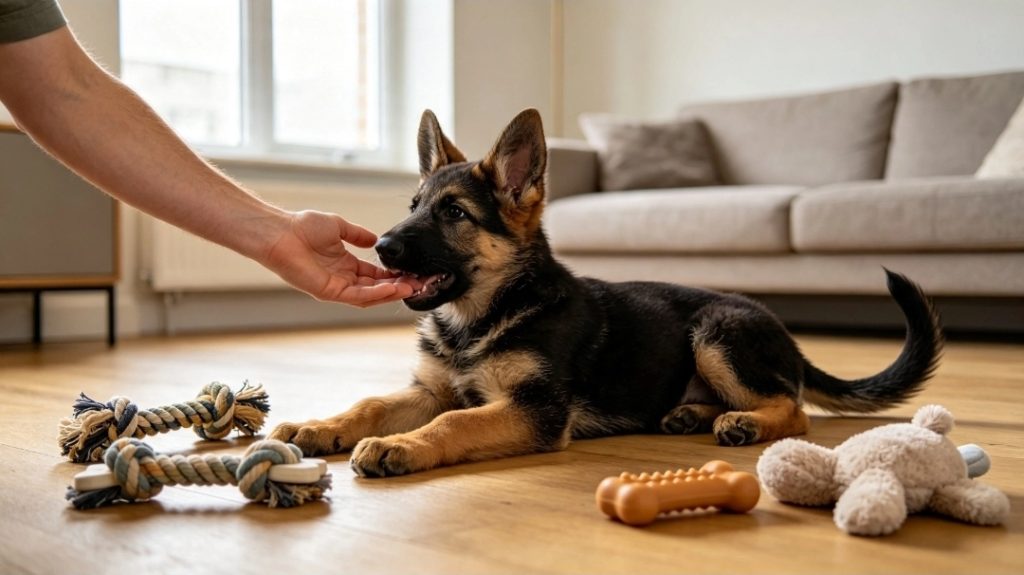
Is Puppy Biting Normal?
For most young puppies, biting and mouthing are normal behaviours.
A puppy may:
- Bite your hands during play
- Chase your feet
- Grab your trousers
- Chew furniture
- Bite toys
- Mouth your fingers
- Become more mouthy when excited
- Become more interested in chewing during teething
- Bite more when tired or overstimulated
The important thing is to teach your puppy what is acceptable.
You don’t want your puppy learning that human hands are toys.
Instead, appropriate toys, play and training should become the outlets for your puppy’s natural desire to bite and chew.
How to Stop a Puppy Biting Your Hands
One of the most common questions from new dog owners is how to stop a puppy biting your hands.
The first step is to stop making your hands part of the game.
It can be tempting to play with your puppy using your fingers, encourage them to chase your hands or allow them to gently nibble because they are small and cute.
But your puppy doesn’t understand that the rules will change when they get older.
If biting hands is allowed today, it can become much harder to convince your dog that biting hands is unacceptable later.
Instead, use an appropriate toy during play.
If your puppy moves towards your hand and starts biting, calmly redirect them towards the toy.
When your puppy chooses the toy instead, reward the behaviour through continued play, praise or another reward your puppy values.
You are teaching a simple lesson:
Biting people does not continue the game. Appropriate play does.
How to Stop Puppy Biting During Play
Play is one of the situations where puppy biting can become particularly intense.
A puppy may become excited, grab a toy, miss the toy and catch your hand instead.
Rather than becoming angry, calmly redirect the puppy.
Keep suitable toys available so you can quickly change the target of the behaviour.
Avoid deliberately wrestling with your puppy using your hands or encouraging them to chase fingers.
The more consistent you are, the easier it becomes for your puppy to understand the rules.
Don’t Accidentally Make Puppy Biting More Exciting
This is a mistake many owners make without realising it.
Imagine your puppy grabs your trousers.
You pull your leg away.
The puppy grabs harder.
You move away.
The puppy chases you.
You push the puppy away.
The puppy jumps back at you.
From your perspective, you’re trying to stop the behaviour.
From your puppy’s perspective, you’ve just started an exciting game.
Movement, noise and attention can all increase excitement.
When trying to stop puppy biting, stay calm and avoid turning the behaviour into a chase.
Redirect your puppy towards an appropriate activity and reward calm, controlled behaviour.
How to Stop a Puppy Biting Your Feet and Clothes
Puppies love movement.
Walking across the room can suddenly become an invitation to chase.
Your puppy may attack your shoes, grab your trousers or bite your ankles.
If this happens regularly, look at what triggers the behaviour.
Does your puppy do it when:
- You walk past?
- You come home?
- You start playing?
- Your puppy becomes excited?
- Your puppy is tired?
- Your puppy wants attention?
Identifying the trigger can make puppy biting much easier to manage.
If your puppy repeatedly attacks your feet when you walk around the house, avoid chasing them or physically pushing them away.
Instead, calmly interrupt the behaviour and redirect them towards an appropriate toy or training activity.
Management is particularly important during the early stages of puppy training.
Puppies Can Become More Bitey When They Are Tired
One of the biggest mistakes new puppy owners make is assuming that an increasingly wild puppy needs more exercise or more play.
Sometimes the opposite is true.
A tired or overstimulated puppy may become:
- More excitable
- More mouthy
- Less responsive
- More likely to jump
- More likely to chase
- Less able to concentrate
If your puppy suddenly turns into a little land shark, consider whether they actually need more stimulation or whether they need help settling down.
Rest is an important part of puppy development.
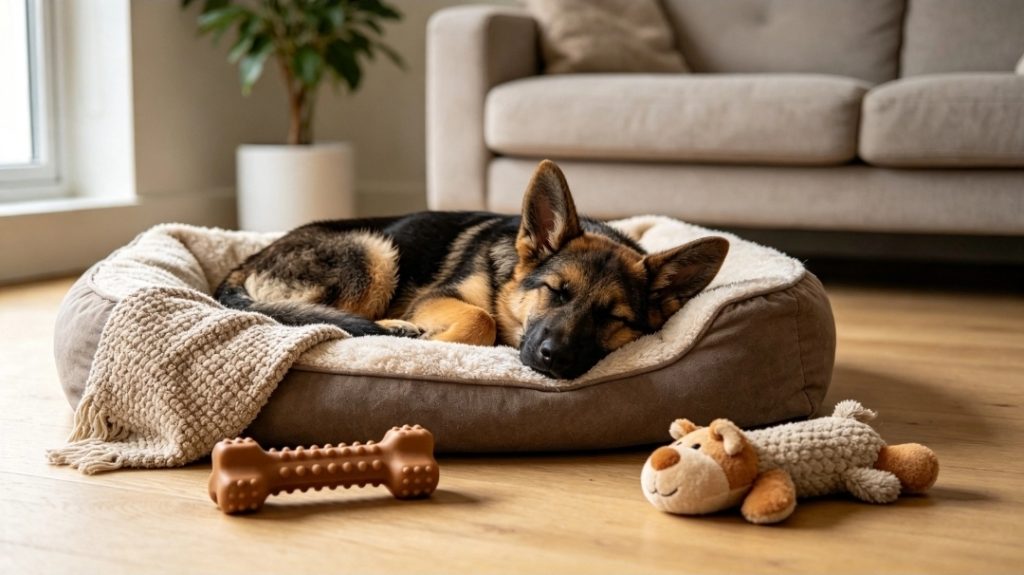
Give Your Puppy Appropriate Things to Bite
You cannot expect a puppy to completely lose the natural desire to chew and mouth.
Instead, provide appropriate alternatives.
Have suitable toys available so that you can redirect unwanted biting.
When your puppy chooses an appropriate toy, reinforce that choice.
This is an important principle of dog training:
Don’t just teach your puppy what not to do. Teach your puppy what you want them to do instead.
The more opportunities your puppy has to practise appropriate behaviour, the easier it becomes for that behaviour to become a habit.
How to Teach a Puppy Self-Control
Stopping puppy biting is only one part of puppy training.
A puppy also needs to learn how to control excitement.
You can begin teaching self-control through everyday activities.
For example:
- Ask your puppy to sit before receiving food.
- Encourage your puppy to wait before starting a game.
- Reward your puppy for settling on their bed.
- Teach your puppy to focus on you.
- Reward calm behaviour around distractions.
- Teach your puppy to respond to their name.
- Encourage appropriate toy play.
- Practise basic obedience in short sessions.
These foundations help your puppy learn that calm behaviour produces positive outcomes.
This is also where a structured puppy training programme can make a significant difference.
GPK9 Fundamentals 1
If you’re struggling with puppy biting or you’re looking to establish better foundations from the beginning, GPK9 Fundamentals 1 provides structured training to help develop the foundations of a confident, well-mannered dog.
The course focuses on important areas including early socialisation, basic obedience, engagement, leash manners, recall, focus and building a strong relationship between dog and handler.
You can continue your puppy’s training with “GPK9 Fundamentals 1” (https://gpk9.co.uk/product/fundamentals-1/).
FUNDAMENTALS 1
Puppy biting shouldn’t be treated as an isolated problem. Building communication, engagement, obedience and self-control gives your puppy a stronger overall foundation.
How to Stop Puppy Biting Without Punishment
When a puppy bites, it can be frustrating.
The natural reaction may be to shout, push the puppy away or physically correct them.
However, frightening or physically punishing a puppy isn’t the objective of good training.
Instead, teach the puppy what behaviour you want.
If your puppy bites your hand, calmly redirect them.
If they choose their toy, reward them.
If they become overly excited, reduce the stimulation.
If they are tired, help them settle.
The objective is to create clarity.
Your puppy should learn:
This behaviour gets rewarded. That behaviour doesn’t.
Consistency is one of the most important parts of puppy training.
Should You Bite Your Puppy Back?
No.
You don’t need to bite, pin down, intimidate or physically overpower your puppy to teach them not to bite.
These approaches can create fear and confusion and may damage the relationship between dog and owner.
Instead, focus on communication, management, appropriate redirection and reinforcement of desirable behaviour.
The aim is to teach your puppy, not to frighten them.
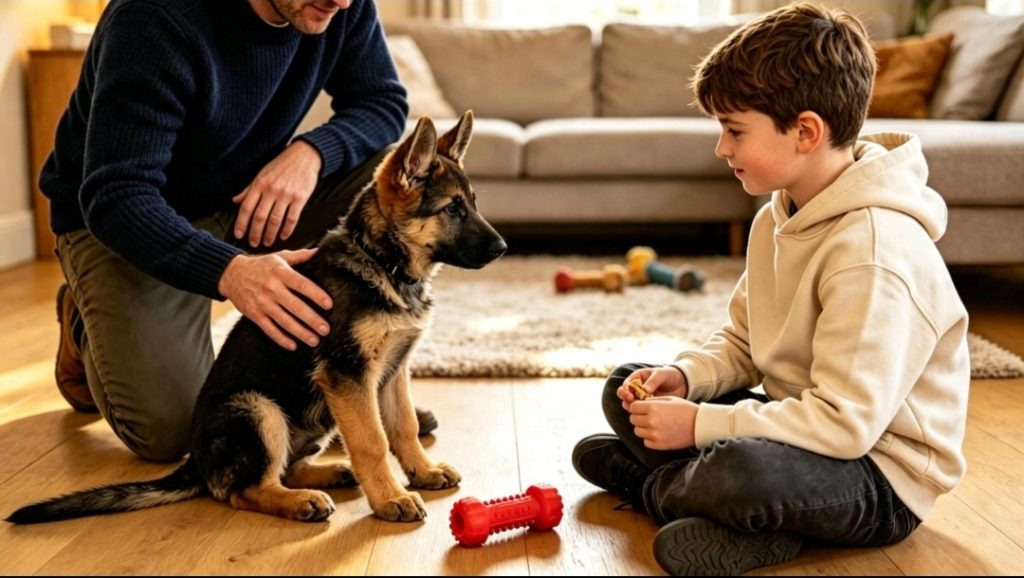
Puppy Biting and Children
Extra care is needed when puppies and children live together.
Children may naturally scream, run away or wave their hands when a puppy bites.
Unfortunately, these reactions can make the puppy even more excited.
Never expect a young child to manage puppy biting independently.
Adult supervision is essential.
Create safe spaces where your puppy can settle, and teach children appropriate ways to interact with the puppy.
A Simple Puppy Biting Training Plan
If you want to know how to stop a puppy biting, consistency is more important than constantly changing techniques.
Use this simple process.
- Identify the Trigger
Work out when your puppy is most likely to bite.
- Manage the Environment
Prevent unnecessary opportunities for your puppy to practise unwanted behaviour.
- Redirect
Have an appropriate toy available.
- Reward the Alternative
When your puppy chooses the toy or settles calmly, reinforce that decision.
- Stay Calm
Don’t turn puppy biting into a chase or exciting game.
- Allow Rest
If your puppy is becoming increasingly mouthy and unable to concentrate, consider whether they are tired.
- Be Consistent
Everyone in the household should follow the same rules.
Common Puppy Biting Mistakes
Letting the Puppy Bite Because They Are Small
Your puppy will not remain small forever.
The habits you allow during puppyhood can become much harder to change as your dog grows.
Using Your Hands as Toys
Avoid encouraging your puppy to chase, grab or bite your fingers.
Chasing the Puppy
If your puppy grabs your clothing and you chase them, you may accidentally reward the behaviour.
Shouting
A loud reaction may increase excitement rather than teach the correct behaviour.
Ignoring Sleep
An overtired puppy can become significantly more difficult to manage.
Inconsistent Rules
If one person allows hand biting while another person prohibits it, your puppy receives conflicting information.
Expecting Instant Results
Puppy training takes time.
Your puppy is learning how to live in a human environment, and mistakes are part of the learning process.
How Long Does Puppy Biting Last?
There is no exact age at which every puppy suddenly stops biting.
Every dog is different.
Puppy biting should generally reduce as the puppy matures, learns appropriate behaviour and develops better self-control.
The important thing is what your puppy is learning during this period.
Don’t simply wait for the behaviour to disappear.
Use the puppy stage to establish good habits.
The foundations you build now can influence your dog’s behaviour as they mature.
When Should You Get Professional Dog Training Help?
Most puppy mouthing is normal.
However, professional help may be appropriate if you are struggling to manage the behaviour, if the biting appears fearful or defensive, if the behaviour is becoming increasingly intense or if you are simply unsure how to train your puppy correctly.
A professional can look at the individual dog, the environment, the triggers and the owner’s handling of the situation.
If you are concerned that a sudden change in behaviour could be related to pain or illness, speak to your veterinary professional.
Puppy Biting Is Only One Part of Training
When owners search how to stop a puppy biting, they often focus entirely on the teeth.
But puppy training is much bigger than that.
Your puppy needs to learn:
- How to focus on you
- How to respond to their name
- How to walk appropriately on a lead
- How to recall
- How to settle
- How to interact with people
- How to interact appropriately with dogs
- How to control excitement
- How to make good choices
- How to respond to basic obedience
These skills all contribute towards creating a well-mannered adult dog.
This is why building foundations early is so important.
Building Better Foundations With GPK9
At GPK9, we believe dog training should be about developing clear communication between the handler and the dog.
Puppies need structure, consistency and appropriate outlets for their natural behaviour.
Owners also need to understand how their own actions can influence what their puppy learns.
Puppy biting is therefore not something that should be considered completely separately from obedience, engagement, recall, socialisation and general behaviour.
These foundations work together.
If you’re looking for a structured way to start developing those skills with your puppy, take a look at “GPK9 Fundamentals 1” (https://gpk9.co.uk/product/fundamentals-1/).
Final Thoughts: How to Stop a Puppy Biting
Learning how to stop a puppy biting requires patience, consistency and an understanding of why the behaviour is happening.
Your puppy isn’t born knowing the rules of your household.
They have to learn them.
Puppy biting is often a normal part of development, but that doesn’t mean you should simply tolerate it.
Redirect inappropriate biting towards suitable toys, reward desirable behaviour, manage excitement, provide adequate rest and make sure everyone in the household follows the same approach.
Most importantly, don’t turn puppy biting into a battle.
Your goal isn’t to overpower your puppy.
Your goal is to teach your puppy.
The puppy stage provides an important opportunity to establish the foundations for the adult dog you want to live with.
Start early, stay consistent and focus on teaching your puppy what you want them to do.
For further structured puppy and foundation training, explore GPK9 Fundamentals 1.