
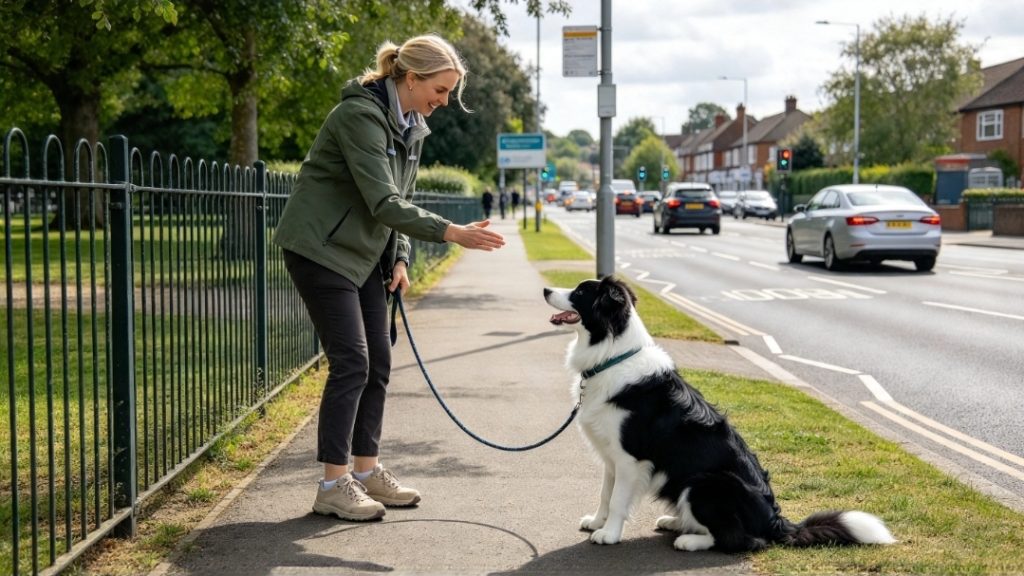
Why Does My Dog Know a Command at Home but Not Outside?
Why does my dog know a command at home but not outside? Because dogs do not automatically generalise a behaviour from one environment to another. Your dog may understand a command in a quiet, familiar home but struggle to respond outside because the environment contains different smells, sounds, people, animals, movement and distractions.
This does not necessarily mean your dog has forgotten the command. It usually means the behaviour needs to be practised and reinforced in gradually more challenging environments.
RECOMMENDED PRODUCTS

Why does my dog listen at home but ignore me outside?
Home is often a controlled environment with fewer distractions.
Your dog may already be familiar with the sounds, smells and routines in your home, making it easier to concentrate on you.
Outside, there may be:
- Other dogs
- People
- Traffic
- Wildlife
- New smells
- Unexpected noises
- Movement
- Food or objects on the ground
- Unfamiliar surroundings
These distractions compete for your dog’s attention.
If your dog has only practised a command at home, expecting the same response immediately outside can make the exercise too difficult.
Has my dog actually learned the command?
Not necessarily.
A dog performing a command in one location does not automatically mean the behaviour is reliable everywhere.
For example, your dog may sit immediately when you ask at home but hesitate when you ask in a busy park.
The dog may understand the cue but have little experience responding when distractions are present.
A useful way to think about training is:
Learn the behaviour → practise the behaviour → change the environment → increase distractions → build reliability
Should I teach the command again outside?
You should reintroduce and practise the behaviour outside, but that does not mean starting completely from the beginning.
Move gradually from an easy environment to a more difficult one.
For example:
Living room → garden → quiet outdoor area → quiet public space → busier environment
At each stage, allow your dog to become comfortable and successful before increasing the difficulty.
How do I train my dog to listen outside?
Start somewhere outside that has relatively few distractions.
Ask for a behaviour your dog already understands, such as sit or look at me.
When your dog responds correctly, reward immediately.
Repeat the exercise several times and keep the session short.
Once your dog is responding reliably, gradually introduce more distractions.
Do not move directly from a quiet living room to the busiest park you can find.
How can I make outdoor training easier?
Control the difficulty rather than expecting your dog to cope with everything immediately.
You can adjust:
- Distance from distractions
- Number of distractions
- Duration of the behaviour
- Training location
- Time of day
- Your dog’s level of freedom
If your dog struggles, increase the distance from the distraction or return to an easier environment.
What should I do if my dog will not respond outside?
Do not keep repeating the command.
If your dog is too distracted to respond, make the exercise easier.
Increase your distance from the distraction, reduce the difficulty or move to a quieter area.
Wait for your dog to regain focus and then try a behaviour that you know your dog can perform successfully.
The aim is to create successful repetitions rather than repeatedly asking for a behaviour your dog cannot currently perform in that situation.
Why does my dog ignore me when it sees another dog?
Another dog can be a very powerful distraction.
Your dog may be interested, excited, nervous or highly focused on the other animal.
The closer you are to the distraction, the more difficult it may be for your dog to respond.
Start at a distance where your dog can still notice the other dog while remaining able to focus on you.
Reward appropriate attention and gradually reduce the distance only when your dog remains responsive.
Should I use treats when training outside?
Food can be useful when teaching and reinforcing behaviours outside, particularly when the environment is more distracting.
The reward needs to be meaningful enough to compete with the surrounding distractions.
However, food should not be used to repeatedly lure your dog through every behaviour once the dog understands what you are asking.
Use rewards to reinforce the behaviour you want your dog to repeat and gradually develop reliability.
Does my dog need more training or fewer distractions?
Often, the answer is fewer distractions first.
If your dog can perform a command successfully at home but cannot perform it outside, the jump in difficulty may simply be too large.
Make the environment easier rather than assuming your dog needs more repetition.
For example:
Home → quiet garden → quiet street → quiet park → busier park
Progress only when your dog is coping successfully at the current level.
RECOMMENDED PRODUCTS
How long does it take for a dog to generalise a command?
There is no fixed timeframe.
Some dogs may adapt quickly to a new environment, while others need considerably more practice.
The important factor is not how many days have passed but how consistently your dog can perform the behaviour under increasing levels of difficulty.
A command is becoming reliable when your dog can respond across different locations, distances and distraction levels.
Should I practise the same command in different places?
Yes.
Changing the environment helps your dog understand that the behaviour applies in different situations.
For example, practise sit:
At home → in the garden → on a quiet walk → in a quiet public area → around controlled distractions
Do the same with other important behaviours such as recall, wait, stay and leave it.
What if my dog only listens when I have treats?
If your dog only responds when it sees food, the food may have become a lure rather than a reward.
Work on giving the cue without showing the food first.
When your dog performs the correct behaviour, provide the reward.
As the behaviour becomes stronger, you can gradually vary when rewards are provided while continuing to reinforce good responses.
Common mistakes when training outside
Moving to a difficult environment too quickly
Give your dog time to succeed in easier locations before adding major distractions.
Repeating the command
Repeatedly giving the same cue can teach your dog that the first cue does not matter.
Getting too close to distractions
If your dog cannot focus, create more distance.
Expecting home-level performance immediately
Outdoor environments are often considerably more challenging.
Training for too long
Short, successful sessions are usually more productive than prolonged sessions where your dog becomes overwhelmed or loses concentration.
Only training in one location
A dog needs opportunities to practise behaviours in different environments.
How do I know when my dog is ready for more distractions?
Your dog should be able to perform the behaviour consistently at the current difficulty before you make the exercise harder.
Look for:
- Quick responses to the cue
- Good attention
- Successful repetitions
- Ability to remain focused around mild distractions
- Recovery when something briefly takes your dog’s attention
Then increase the difficulty gradually.
RECOMMENDED PRODUCTS
Does my dog need to relearn every command outside?
No.
Your dog does not necessarily need to relearn the behaviour from the beginning. Instead, you need to generalise the behaviour by practising it in different environments and gradually increasing distractions.
The more varied your training becomes, the more your dog learns that the cue has the same meaning regardless of where you are.
Conclusion
If your dog knows a command at home but not outside, it does not automatically mean your dog is disobedient or has forgotten the training.
The most likely problem is that the behaviour has not yet been generalised to a more distracting environment.
Start outside in an easy location, reward correct responses, gradually introduce distractions and increase difficulty at a pace your dog can handle. Build reliability through successful progression rather than repeatedly testing a behaviour your dog is not ready to perform.
The goal is not simply for your dog to obey commands in the living room. The goal is for your dog to understand the cue and respond reliably in the environments where you actually need the behaviour.




