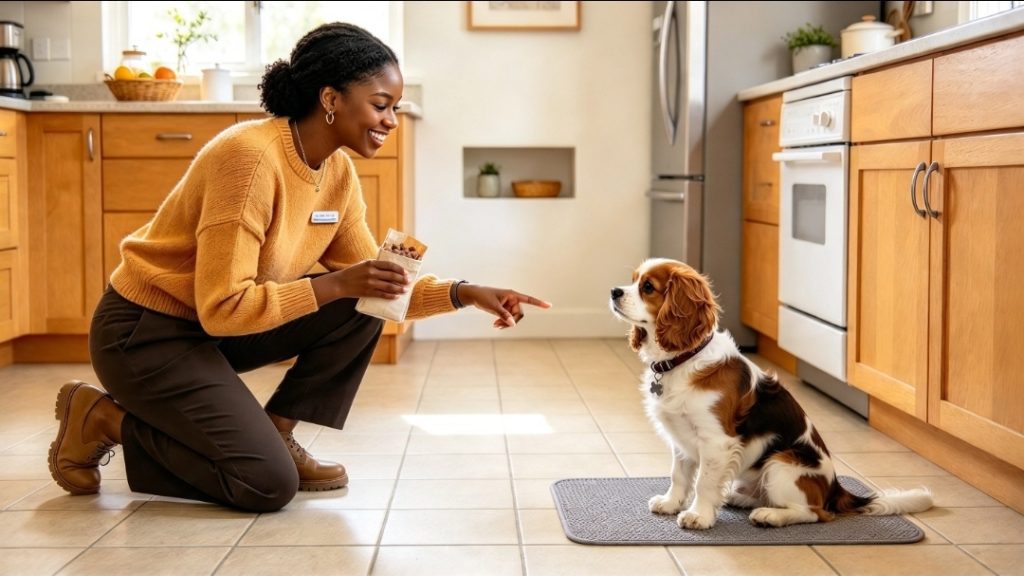
Why Do I Need a Dog Placemat?
Why do I need a dog placemat? A dog placemat provides a defined location where your dog can learn to settle, remain calm and understand where appropriate behaviour is expected. Used correctly, a placemat can help the handler communicate through the environment, reinforce calm behaviour and gradually develop the dog’s ability to remain settled while household activity continues. This article explains what a dog placemat is used for, when to use one, how to introduce it correctly, how to teach your dog to stay on it, how long your dog should remain there and how it can work alongside a dog crate, playpen or dog gate.
RECOMMENDED PRODUCTS

What Is a Dog Placemat Used For?
A dog placemat is used to provide a clearly defined location where a dog can learn calm behaviour and appropriate positioning within the home.
The placemat gives the dog a consistent location that the handler can use to reinforce calm behaviour.
The objective is not simply to make the dog lie on a particular surface. The objective is to teach the dog that a defined area can represent calm behaviour, rest and controlled freedom.
A placemat can therefore become part of the dog’s normal household routine.
This makes the placemat particularly relevant to Golden Rule 1, where the handler learns to manage household behaviour, communication, boundaries and calm behaviour within the home.
When Should I Use a Dog Placemat?
A placemat can be used when the dog needs to learn how to remain calm and settled while the household environment continues around it.
This can include:
- During normal household activity.
- When visitors are present.
- During periods of controlled household movement.
- When the handler is teaching calm behaviour.
- When the dog needs a defined location.
- When the handler wants to reinforce settling.
- When the dog is learning to remain calm around appropriate household stimulation.
The handler should observe the dog’s behaviour and decide whether the placemat is appropriate.
The GPK9 approach uses CATEGORY → STATUS → DRIVE → CONTROL and the handler’s ability to OBSERVE → INTERPRET → DECIDE → COMMUNICATE → OBSERVE RESPONSE → REASSESS.
The placemat is therefore not simply a piece of equipment. It is part of the environment the handler can use to communicate where calm behaviour is expected.
How Do I Use a Dog Placemat Correctly?
Use the placemat as a defined location for calm behaviour rather than as a punishment area.
Your dog should be introduced to the placemat gradually and positively. The dog should learn that going onto the placemat is a normal part of everyday life.
Do not use the placemat because you are angry or frustrated with the dog.
The handler should observe the dog, assess what is happening and communicate clearly.
When the dog is calm and remaining appropriately on the placemat, the handler can reinforce that behaviour.
Food can be used appropriately during training. Timing is important because the handler should reinforce the behaviour the dog is actually performing at the moment the reward is delivered.
The same communication principles apply throughout GPK9 training: observe what the dog is doing, communicate clearly and observe the dog’s response.
How Do I Teach My Dog to Stay on a Placemat?
Begin by helping the dog understand that the placemat is a defined location.
When the dog moves onto the placemat, the handler should observe the behaviour and appropriately reinforce the dog for being in the desired position.
The handler should initially work with short periods before gradually increasing the duration.
The objective is not to force the dog to remain on the placemat indefinitely.
The objective is to develop understanding, reliability and calm behaviour progressively.
If the dog leaves the placemat, the handler should observe what happened and decide what communication or adjustment is required.
This principle is closely connected with Golden Rule 2, where understanding, responsiveness, reliability, timing, reward, release and control are developed together.
Can a Placemat Help My Dog Calm Down?
Yes. A placemat can provide a defined location that helps the dog understand where calm behaviour is expected.
However, the placemat should not simply be used to contain a dog that is becoming increasingly distressed without first understanding why the dog is struggling.
The handler must observe the dog’s behaviour and assess the reason for the change in behaviour.
If the dog is becoming increasingly stimulated, the handler should consider whether the current environment is providing too much freedom or too much stimulation.
The placemat can provide a controlled location for calm behaviour when the dog is capable of remaining settled.
This is particularly relevant to Golden Rule 1, where the handler learns to recognise changes in behaviour and manage the home environment appropriately.
Can a Placemat Help My Dog Settle?
Yes. A placemat can help establish a predictable location where the dog can learn to settle.
The dog can begin to understand that the placemat is associated with calm behaviour rather than constant movement or interaction.
The handler should reinforce appropriate calm behaviour and avoid unnecessarily turning the placemat into an exciting event.
The objective is to help the dog develop the ability to remain settled while normal household activity continues.
Calm behaviour should be developed through clear communication, appropriate timing and progressive training.
How Long Should My Dog Stay on a Placemat?
The appropriate length of time depends on the individual dog, its age, training, understanding, reliability and circumstances.
The handler should begin with an amount of time the dog can successfully manage before gradually increasing duration.
A dog that repeatedly leaves the placemat may be communicating that the current duration, environment or level of distraction is too difficult.
The handler should therefore observe the dog rather than relying on one fixed period for every dog.
The objective is to develop reliable calm behaviour progressively rather than simply keeping the dog on the placemat for as long as possible.
RECOMMENDED PRODUCTS
What Should I Do If My Dog Keeps Leaving the Placemat?
If your dog keeps leaving the placemat, the handler should first observe what is happening.
The dog may not yet understand the behaviour being requested, the duration may be too long, the environment may contain too much stimulation or the handler may not be communicating clearly enough.
The handler should reassess the situation rather than repeatedly forcing the dog back onto the placemat without understanding the reason.
The handler should:
OBSERVE → INTERPRET → DECIDE → COMMUNICATE → OBSERVE RESPONSE → REASSESS
The handler may need to reduce the duration, reduce distractions, improve timing or return to an easier stage of training.
The objective is to build understanding and reliability rather than create frustration.
This is directly connected with Golden Rule 2, where progressive development and appropriate control are central to training.
How Do I Know When My Dog Needs the Placemat?
The handler needs to learn to recognise when the dog would benefit from a defined location for calm behaviour.
Signs that the placemat may be appropriate can include:
- The dog is calm but moving unnecessarily around the home.
- The dog needs to learn how to settle.
- The dog is becoming distracted by normal household activity.
- The dog needs a clear location where calm behaviour can be reinforced.
- The handler wants to develop the dog’s ability to remain settled while activity continues.
- The dog is capable of managing the current level of freedom but needs clearer communication about where to settle.
The correct response is not simply to place the dog on the placemat automatically.
The handler should assess the dog’s current behaviour and decide what level of control is appropriate.
The placemat may be appropriate when the dog can manage controlled freedom while remaining calm.
Why Should I Use a Placemat at Home?
A placemat can help establish predictable household routines and give the dog a consistent location for calm behaviour.
Home is an important training environment because the dog learns how to behave around people, household activity, other animals and normal changes in the environment.
The handler must therefore learn how to communicate appropriate behaviour within the home.
A placemat can provide a defined location where that communication becomes clear and consistent.
This is directly connected with Golden Rule 1, which focuses on Home & Social behaviour, communication, boundaries, calm behaviour and household routines.
The objective is to help the dog learn how to remain calm and appropriately engaged with the household environment.
How Do I Use a Placemat With a Dog Crate?
A placemat and dog crate can be used together to provide different levels of environmental control.
The placemat can provide a defined location for calm behaviour and controlled freedom.
The crate can provide a more secure environment when greater restriction, rest or recovery is required.
The handler should decide which environment is appropriate based on the dog’s current behaviour.
If the dog is calm and capable of settling, the placemat may be appropriate.
If the dog is becoming increasingly stimulated and needs greater restriction and recovery, the crate may be more appropriate.
The equipment should therefore reflect the dog’s current needs rather than being used automatically.
How Do I Use a Placemat With a Playpen?
A placemat can be used within or alongside a playpen to provide the dog with a defined location for calm behaviour.
The playpen provides controlled freedom around the defined location.
The placemat therefore gives the dog a clear area where calm behaviour can be reinforced while the playpen provides boundaries around the wider environment.
The handler should observe the dog’s behaviour and decide how much freedom is appropriate.
If the dog remains calm and settles appropriately, the available space can be managed accordingly.
If the dog becomes increasingly stimulated, the handler should reassess whether the current level of freedom is appropriate.
The important principle is to match the environment to the dog’s current status rather than automatically giving the dog more freedom.
How Do I Use a Placemat With a Dog Gate?
A dog gate can help control access to different areas of the home while the placemat provides a defined location for calm behaviour.
The dog gate can therefore provide an environmental boundary, while the placemat communicates where the dog should settle within the available space.
The handler may therefore have several options depending on the dog’s behaviour:
- Greater controlled freedom.
- A defined area behind a dog gate.
- A placemat for calm behaviour.
- A playpen.
- A secure crate for rest and recovery.
The objective is not simply to restrict the dog.
The objective is to communicate through the environment and provide the appropriate level of control.
The handler should observe the dog’s response and adjust the environment as the dog’s behaviour changes.
Why Is Environmental Control Important?
Environmental control allows the handler to manage situations before unwanted behaviour becomes established.
A dog does not automatically understand where it should settle or how much freedom it can responsibly handle.
The handler must therefore observe behaviour and progressively adjust the environment.
This is particularly important when the dog is young, inexperienced, highly motivated or struggling with household stimulation.
Control is communication.
Freedom, equipment, space, access, voice, touch, eye contact, food, markers and timing can all communicate information to the dog.
The placemat is therefore one part of a wider communication and control system.
How Should the Handler Decide Between the Crate, Playpen and Placemat?
The handler should assess the dog’s current behaviour before deciding.
A calm dog that can settle appropriately may be able to use a placemat.
A dog that needs more controlled freedom may benefit from a playpen.
A dog that needs secure recovery and greater restriction may need the crate.
The decision should be based on observation rather than habit.
The handler should always ask what the dog is communicating, what level of control is appropriate and what response is expected next.
The goal is to develop the dog’s ability to manage increasing freedom responsibly rather than relying permanently on restriction.
RECOMMENDED PRODUCTS
Is a Dog Placemat a Punishment?
No. A correctly introduced and appropriately used placemat is not a punishment.
The placemat should be a predictable and defined location where the dog can learn calm behaviour and appropriate positioning.
If the placemat is consistently used when the handler is angry, the dog may begin to associate it with punishment.
The handler should therefore remain calm and consistent.
The placemat is a management and communication tool, not a place to send a dog because the handler is frustrated.
What Is the Main Purpose of a Dog Placemat?
The main purpose of a dog placemat is to provide a defined location where the dog can learn calm behaviour, settle appropriately and respond to clear communication from the handler.
A placemat can support household routines, calm behaviour, controlled freedom and progressive development of reliability.
Used correctly, it becomes part of the dog’s normal environment.
The handler’s responsibility is to understand when the dog can manage the placemat and when a different level of environmental control is required.
The objective is always the same: train the human, train the dog and build the partnership.
GPK9 — The Five Golden Rules
The GPK9 Five Golden Rules provide the foundation of the GPK9 Professional Training System. They give new dog owners, new dog handlers, experienced handlers and professional dog trainers a clear structure for developing the dog and the handler together.
The GPK9 Five Golden Rules cover five essential areas of development: Home & Social, Obedience, Prey Drive, Toilet and Social Walking. Each area has its own purpose, but they are designed to work together as one complete training system.
The GPK9 approach is based on CATEGORY → STATUS → DRIVE → CONTROL and the handler’s ability to OBSERVE → INTERPRET → DECIDE → COMMUNICATE → OBSERVE RESPONSE → REASSESS. This gives the handler a consistent process for understanding what the dog is doing, why the behaviour is occurring, what level of control is appropriate and how to communicate effectively.
The purpose of the GPK9 Five Golden Rules is not simply to teach a collection of individual exercises. They are designed to develop the dog’s behaviour, motivation, communication, control and reliability while teaching the handler how to make better decisions.
Golden Rule One — Home & Social
Golden Rule One — Home & Social establishes the foundation for everyday life with the dog. It focuses on communication, boundaries, calm behaviour, household routines and appropriate behaviour around people, animals and normal activity.
The purpose of Golden Rule One — Home & Social is to help the handler understand the dog’s behaviour and recognise changes in arousal before they become larger problems. The handler learns to observe, assess and communicate rather than simply reacting after unwanted behaviour has already occurred.
Golden Rule One — Home & Social provides the foundation from which the handler can develop a calmer, more predictable and better-communicating dog.
Golden Rule Two — Obedience develops the dog’s ability to understand and respond to the handler’s communication.
The focus of Golden Rule Two — Obedience is not simply teaching commands. It is about developing understanding, reliability, timing, reward, release and control so the dog learns what the handler is communicating.
Through Golden Rule Two — Obedience, the handler learns to progress training appropriately, gradually increasing the dog’s freedom and responsibility as understanding and reliability improve.
Golden Rule Three — Prey Drive
Golden Rule Three — Prey Drive focuses on understanding and developing the dog’s natural motivation to chase, pursue, engage and work with an appropriate toy or prey-based reward.
The purpose of Golden Rule Three — Prey Drive is not simply to increase drive. The handler must learn how to recognise the dog’s level of motivation, select an appropriate reward and use timing, communication and control to channel that motivation productively.
Golden Rule Three — Prey Drive teaches the handler that motivation can become a powerful training tool when it is developed and controlled correctly.
Golden Rule Four — Toilet establishes reliable toilet habits through consistency, observation, timing, supervision and appropriate reinforcement.
The handler learns through Golden Rule Four — Toilet to recognise when the dog is likely to need the toilet, provide the correct opportunity and reinforce the desired behaviour.
The objective of Golden Rule Four — Toilet is to establish a predictable routine that helps the dog understand where and when toileting is appropriate while reducing opportunities for mistakes.
Golden Rule Five — Social Walking
Golden Rule Five — Social Walking develops the dog’s ability to walk calmly and appropriately in the real world while remaining connected to the handler.
The focus of Golden Rule Five — Social Walking is the relationship between the handler, the dog, the environment, distractions, distance and available control.
Through Golden Rule Five — Social Walking, the handler learns to observe body language, identify potential triggers, assess distance and recognise changes in drive or arousal before behaviour escalates.
The objective of Golden Rule Five — Social Walking is not simply to make the dog walk beside the handler. It is to develop a dog that can experience the outside world while remaining connected to the handler and capable of responding to clear communication.
How the Five Golden Rules Work Together
The GPK9 Five Golden Rules are designed to work together rather than being treated as five completely separate subjects.
Golden Rule One — Home & Social establishes the foundations for everyday behaviour and communication.
Golden Rule Two — Obedience develops understanding, responsiveness and control.
Golden Rule Three — Prey Drive develops motivation and teaches the handler how to channel natural drive appropriately.
Golden Rule Four — Toilet establishes essential household routine and reliability.
Golden Rule Five — Social Walking takes the communication and control developed through the other areas into the outside environment.
Together, the GPK9 Five Golden Rules help the handler develop a complete understanding of the dog rather than treating individual behaviours as isolated problems.
The overall objective of the GPK9 Five Golden Rules is to train the human, train the dog and build the partnership through clear observation, communication, appropriate control and progressive development.
A successful GPK9 handler learns to ask:
What is my dog doing?
Why is my dog doing it?
What is my dog communicating?
What level of control is appropriate?
How should I communicate with my dog?
What response did I get?
What should I do next?
This process forms the foundation of the GPK9 Professional Training System and allows the GPK9 Five Golden Rules to be applied consistently from the first stages of dog ownership through to advanced dog handling and professional training.