
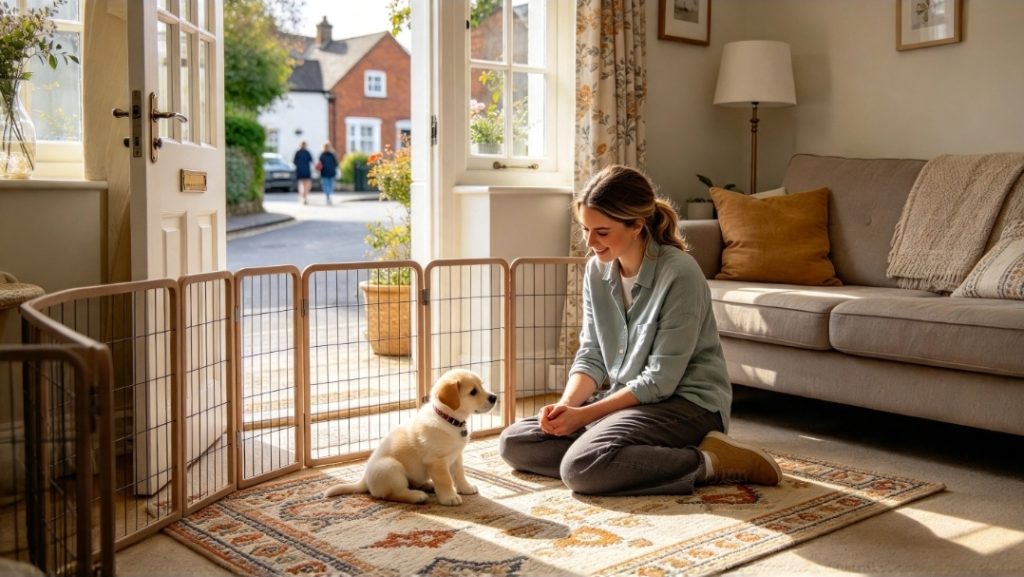
When Should I Start Socialising My Puppy?
When should I start socialising my puppy? You should start socialising your puppy as early as safely possible, rather than waiting until they are fully grown. Early socialisation helps a puppy learn how to cope with people, dogs, environments, sounds, handling and everyday experiences, but the experiences must be appropriate for the puppy’s age, vaccination status, confidence and ability to cope.
RECOMMENDED PRODUCTS

When is the best time to start puppy socialisation?
The best time to start is during your puppy’s early development, with safe socialisation beginning from the moment they arrive home.
You do not need to wait until your puppy can go everywhere before starting. Many socialisation experiences can take place safely at home, in your garden, during controlled handling exercises and through carefully managed exposure to everyday sights and sounds.
For outdoor environments and contact with unfamiliar dogs, follow your vet’s advice regarding your puppy’s vaccination programme and local disease risks.
What can I socialise my puppy to before vaccinations are complete?
There are many safe ways to introduce your puppy to the world without putting them unnecessarily at risk.
At home, you can gradually introduce:
- Different household sounds
- Different people
- Gentle handling
- Different surfaces
- Household objects
- Car travel
- Grooming experiences
- Calm visitors
- Appropriate, controlled sounds and sights from outside
The important point is that socialisation does not simply mean taking your puppy out to meet other dogs.
Your puppy can learn a great deal about the world through controlled experiences before they are ready for unrestricted public exposure.
RECOMMENDED PRODUCTS
When can my puppy meet other dogs?
Your puppy’s ability to meet other dogs depends on their vaccination status, health, the other dog’s health and the environment.
Speak to your vet about when your puppy can safely mix with other dogs and access public areas. Where appropriate, controlled contact with healthy, vaccinated and suitable dogs can provide valuable social experiences.
Choose dogs that are calm and socially appropriate rather than allowing uncontrolled interactions with unfamiliar dogs.
Your puppy does not need to play with every dog they meet. Learning to calmly observe another dog without interacting is an important part of social development.
Should I wait until my puppy has had all vaccinations?
You should not simply assume that all socialisation must stop until your puppy has completed their vaccinations.
There are many safe forms of socialisation that can begin earlier. However, the risks of infectious disease vary depending on your location and circumstances, so your vet should guide you on when your puppy can safely walk in public areas and interact with unfamiliar dogs.
The aim is to balance early learning with sensible health protection.
How should I start socialising my puppy?
Start with simple experiences that your puppy can manage comfortably.
Step 1: Introduce your puppy to people
Allow your puppy to experience different people without forcing interaction.
Some people can calmly sit nearby while your puppy observes them. Others can offer an appropriate reward if your puppy is comfortable.
Teach your puppy that people can be present without always requiring attention or physical contact.
Step 2: Introduce everyday sounds
Gradually expose your puppy to normal household and environmental noises.
Start at a manageable level and reward calm behaviour. If your puppy becomes frightened, reduce the intensity or increase distance.
Do not deliberately overwhelm your puppy with loud noises in an attempt to make them “get used to it”.
Step 3: Introduce handling
Briefly and gently handle your puppy’s paws, ears, mouth, body and collar area.
Reward calm behaviour and gradually increase the duration.
This helps prepare your puppy for grooming, veterinary examinations and normal care.
Step 4: Introduce new environments
As soon as it is safe to do so, gradually expose your puppy to different environments.
Begin with quieter situations and progress towards busier areas as your puppy becomes comfortable.
There is no benefit in immediately taking a young puppy into an extremely busy environment if they cannot cope with it.
Step 5: Introduce suitable dogs
When your vet confirms that it is safe, introduce your puppy to appropriate dogs in controlled situations.
Choose calm, healthy and suitably vaccinated dogs where possible.
Keep interactions manageable and allow your puppy space to disengage. A successful interaction does not have to involve prolonged play.
How do I know if I have started socialising my puppy too quickly?
Watch your puppy’s behaviour throughout the experience.
A puppy that can calmly investigate, take food, respond to you and recover quickly is generally coping better than one that is trying to escape, freezing, hiding or becoming excessively aroused.
If your puppy is struggling, make the situation easier.
Increase distance, reduce the duration, move somewhere quieter or stop the interaction altogether.
Progress should be based on your puppy’s ability to cope rather than their age alone.
Can I socialise my puppy too much?
Yes. More exposure is not automatically better.
A puppy can become overwhelmed if they are repeatedly exposed to too many people, dogs, noises or unfamiliar environments without enough time to process and recover.
Socialisation should include plenty of rest, repetition and calm observation.
Short, positive experiences are often more useful than long, intense sessions.
Should my puppy meet as many dogs as possible?
No.
The number of dogs your puppy meets is less important than the quality of those experiences.
A calm interaction with an appropriate dog can be far more valuable than repeated uncontrolled encounters with excitable or poorly behaved dogs.
Your puppy should also learn that seeing another dog does not automatically mean they get to approach it.
What role do rewards play in early socialisation?
Positive reinforcement helps your puppy build good associations with new experiences.
When your puppy calmly notices a person, sound, dog or environment, reward the behaviour you want to encourage.
Timing is important. Deliver the reward while your puppy is displaying the calm behaviour you want to reinforce.
As your puppy becomes more comfortable, gradually increase the difficulty rather than immediately moving into a much more challenging environment.
What equipment should I use when socialising my puppy?
For most early socialisation, you only need simple, suitable equipment.
A well-fitted harness or collar and appropriate lead can provide safe control when your puppy begins exploring suitable outdoor environments.
A long line may later be useful in a secure and appropriate area when your puppy is ready for more freedom. It should provide control without being used to drag your puppy towards something they are uncomfortable with.
Equipment should support safe learning rather than force exposure.
What if my puppy is frightened?
Do not force a frightened puppy to approach whatever is worrying them.
Create distance and allow your puppy to settle. Once they are comfortable again, you can work at an easier level.
For example, if your puppy is frightened by a busy street, move further away rather than carrying on closer. Reward calm observation and gradually build tolerance over time.
If your puppy repeatedly shows significant fear, seek guidance from a suitably qualified professional.
What happens if I start socialising my puppy late?
Starting later does not mean you cannot help your puppy.
Continue providing positive, controlled experiences and avoid trying to compensate by exposing the puppy to everything at once.
A puppy or young dog that has had limited socialisation may need a slower progression and more carefully managed experiences.
The same principle applies: start at a level the dog can manage and gradually build from there.
RECOMMENDED PRODUCTS
How long should I continue socialising my puppy?
Socialisation should continue as your puppy grows.
Early puppyhood provides important opportunities for learning, but a dog does not suddenly stop learning after this period.
Continue introducing appropriate experiences while developing obedience, calm behaviour, handling skills and confidence in everyday environments.
The long-term goal is not simply a puppy that has experienced many things. It is a dog that can respond appropriately to new and familiar situations.
Conclusion
When should I start socialising my puppy? Start as early as safely possible, using controlled and positive experiences that match your puppy’s age, health, vaccination status and confidence.
You can begin many experiences at home before public access is appropriate. Once your vet confirms that outdoor environments and dog-to-dog contact are safe, gradually expand your puppy’s experiences.
Focus on quality rather than quantity. Reward calm behaviour, allow your puppy time to process new experiences, increase difficulty gradually and never force a frightened puppy into a situation they cannot handle.




