
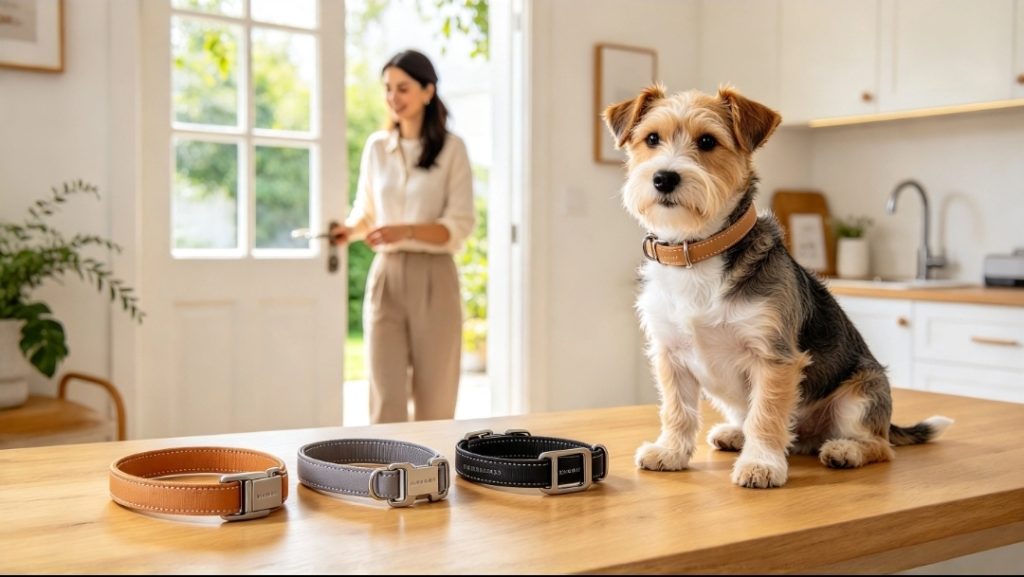
What is the best collar for dog training?
What is the best collar for dog training? For most basic dog training, a properly fitted flat collar is a simple and practical choice when a collar is appropriate for the individual dog and training situation. It should be comfortable, secure and used alongside positive reinforcement rather than as a tool for applying pain or punishment. A suitable harness may be a better option for some dogs or exercises.
The best collar is therefore not necessarily the most specialised collar. It is the one that fits correctly, keeps your dog safely connected when needed and allows you to train without causing discomfort.
RECOMMENDED PRODUCTS

What should I look for in a dog training collar?
A good training collar should be secure, comfortable and correctly fitted.
Consider:
- Your dog’s size and neck shape
- The strength of the collar and fastening
- Whether it stays securely in position
- Whether it causes rubbing or irritation
- Whether your dog can slip out of it
- What type of training you are doing
Check the collar regularly, particularly with puppies and dogs whose size or weight is changing.
Is a flat collar the best collar for dog training?
For many dogs, a flat collar is the simplest starting point.
It can be used for everyday walking and basic training when it is correctly fitted and suitable for the individual dog. A flat collar should allow normal movement and should not be used by repeatedly applying pressure to the dog’s neck.
The collar does not teach the behaviour. Your timing, communication and rewards teach the behaviour.
How should a dog training collar fit?
The collar should be secure without being unnecessarily tight.
It should not continually press into the dog’s neck or cause rubbing, irritation or discomfort. At the same time, it must be secure enough that your dog cannot easily back out of it.
Check the fit regularly rather than assuming that a collar that fitted previously will always fit correctly.
Is a collar or harness better for dog training?
Neither is automatically best for every dog.
A collar can be suitable for some dogs and training situations, while a harness may provide more appropriate control for others, particularly when managing pulling or when you need to reduce reliance on pressure around the neck.
The choice should be based on fit, comfort, safety and the behaviour being trained. Suitable collars and harnesses can both be used when correctly fitted and handled.
What is the best collar for puppy training?
A lightweight, properly fitted flat collar is usually a practical starting point for a puppy if a collar is appropriate.
Introduce it gradually and positively rather than simply putting it on and expecting the puppy to ignore it.
Reward calm behaviour while the puppy wears the collar, and regularly check that it has not become too tight as the puppy grows.
How do I teach my dog to wear a collar?
Introduce the collar in small stages.
1. Let your dog investigate the collar
Allow your dog to look at and smell the collar.
Reward calm interest rather than immediately fastening it around the neck.
2. Briefly put the collar on
Fasten the correctly adjusted collar and immediately reward your dog.
Keep the first sessions short.
3. Build up wearing time
Gradually increase the amount of time your dog wears the collar while monitoring its behaviour and comfort.
If your dog becomes distressed or repeatedly tries to remove it, make the exercise easier rather than forcing the process.
4. Connect the lead when appropriate
Once your dog is comfortable wearing the collar, introduce the lead calmly and reward your dog for remaining relaxed.
Progress gradually into simple lead training.
Can a collar stop my dog pulling?
No.
A collar does not teach loose lead walking by itself.
Teach your dog that staying near you and walking with a loose lead results in rewards. Start somewhere with few distractions and gradually increase the difficulty.
If the dog pulls, reduce the difficulty, regain its attention and reward the desired behaviour rather than relying on pressure from the collar. Reward-based training is recommended for teaching dogs appropriate behaviour.
RECOMMENDED PRODUCTS
Is a collar suitable for recall training?
A collar can be useful during early recall training when your dog is close to you and safely managed.
As you increase distance, a long training line attached to suitable equipment can provide a safer way to practise recall before allowing unrestricted off-lead freedom.
Do not use the collar to pull your dog back towards you. Teach the recall response by making returning to you rewarding.
What is the best collar for a dog that pulls?
There is no collar that should be relied upon to solve pulling.
A comfortable flat collar may be suitable for some dogs, while a properly fitted harness may be more appropriate when additional management is needed.
The training should focus on rewarding loose-lead walking and gradually increasing distractions. If your dog consistently pulls, make the training easier rather than simply increasing physical pressure.
What collar is best for a reactive dog?
A collar does not treat reactivity.
If your dog reacts strongly to people, dogs or other triggers, choose equipment that allows you to maintain safe control and create distance without relying on painful pressure.
A suitable harness may be preferable for some reactive dogs. If there is a genuine risk of biting, appropriate safety equipment and professional behavioural support may also be necessary.
The priority is preventing unsafe situations while teaching a calmer response.
Should I use a choke, slip or prong collar for training?
These should not be used as punishment-based training tools.
Prong collars are designed to apply painful pressure, and the RSPCA advises against their use. It also identifies choke/check chains and other punishment-based methods as inappropriate for reward-based training.
Training should instead focus on teaching the behaviour you want through appropriate management, positive reinforcement and accurate timing.
Should I use an electronic training collar?
An electronic shock collar should not be part of a positive-reinforcement training programme.
The RSPCA states that electronic collars can cause pain and fear and advocates reward-based training instead.
The legal position also differs across the UK, so owners should not assume that because a product is sold it is appropriate or lawful to use in their circumstances.
Can I use a collar and harness together?
Yes, in some situations using both can be practical.
For example, a collar can provide a secondary connection while a harness is used for the main lead attachment. This can be particularly useful where there is a concern about equipment failure or escape.
Both pieces of equipment must be correctly fitted and used safely.
What if my dog keeps slipping its collar?
Do not simply tighten the collar excessively.
Check the fit and consider whether a different type of suitable equipment would provide better security.
Some dogs may require a more secure management setup, particularly if they are frightened, highly reactive or prone to escaping.
If your dog is a significant flight risk, seek professional advice about appropriate equipment rather than relying on a standard collar alone.
Can the wrong collar make training harder?
Yes.
A poorly fitted, uncomfortable or unsuitable collar can distract your dog and make handling more difficult.
If your dog repeatedly scratches at the collar, tries to escape it, becomes uncomfortable when the lead is attached or shows other signs of distress, reassess the equipment and its fit.
Do not assume that stronger equipment is the answer.
How often should I check my dog’s collar?
Check the collar before training and regularly during normal use.
Look for:
- Frayed material
- Damaged buckles
- Worn stitching
- Loose fittings
- Signs of rubbing
- Changes in fit
Replace damaged equipment rather than continuing to use it.
Can a collar replace dog training?
No.
A collar provides a means of safely attaching a lead and managing your dog when appropriate. It does not teach recall, loose-lead walking, obedience or calm behaviour.
Training comes from clear communication, correct timing, positive reinforcement and gradual progression.
Equipment simply helps you carry out that training safely.
Conclusion
The best collar for dog training is usually a comfortable, correctly fitted flat collar when a collar is suitable for the individual dog and training situation.
Avoid choosing equipment because it promises a quick fix for pulling or difficult behaviour. A collar should support safe handling while the actual behaviour is taught through positive reinforcement and gradual progression.
If a collar is not appropriate for your dog’s behaviour or physical needs, a properly fitted harness may be a better option. The priority should always be comfort, safety and effective training rather than applying more pressure.
GPK9 — The Five Golden Rules
The GPK9 Five Golden Rules provide the foundation of the GPK9 Professional Training System. They give new dog owners, new dog handlers, experienced handlers and professional dog trainers a clear structure for developing the dog and the handler together.
The GPK9 Five Golden Rules cover five essential areas of development: Home & Social, Obedience, Prey Drive, Toilet and Social Walking. Each area has its own purpose, but they are designed to work together as one complete training system.
The GPK9 approach is based on CATEGORY → STATUS → DRIVE → CONTROL and the handler’s ability to OBSERVE → INTERPRET → DECIDE → COMMUNICATE → OBSERVE RESPONSE → REASSESS. This gives the handler a consistent process for understanding what the dog is doing, why the behaviour is occurring, what level of control is appropriate and how to communicate effectively.
The purpose of the GPK9 Five Golden Rules is not simply to teach a collection of individual exercises. They are designed to develop the dog’s behaviour, motivation, communication, control and reliability while teaching the handler how to make better decisions.
Golden Rule One — Home & Social
Golden Rule One — Home & Social establishes the foundation for everyday life with the dog. It focuses on communication, boundaries, calm behaviour, household routines and appropriate behaviour around people, animals and normal activity.
The purpose of Golden Rule One — Home & Social is to help the handler understand the dog’s behaviour and recognise changes in arousal before they become larger problems. The handler learns to observe, assess and communicate rather than simply reacting after unwanted behaviour has already occurred.
Golden Rule One — Home & Social provides the foundation from which the handler can develop a calmer, more predictable and better-communicating dog.
Golden Rule Two — Obedience
Golden Rule Two — Obedience develops the dog’s ability to understand and respond to the handler’s communication.
The focus of Golden Rule Two — Obedience is not simply teaching commands. It is about developing understanding, reliability, timing, reward, release and control so the dog learns what the handler is communicating.
Through Golden Rule Two — Obedience, the handler learns to progress training appropriately, gradually increasing the dog’s freedom and responsibility as understanding and reliability improve.
Golden Rule Three — Prey Drive
Golden Rule Three — Prey Drive focuses on understanding and developing the dog’s natural motivation to chase, pursue, engage and work with an appropriate toy or prey-based reward.
The purpose of Golden Rule Three — Prey Drive is not simply to increase drive. The handler must learn how to recognise the dog’s level of motivation, select an appropriate reward and use timing, communication and control to channel that motivation productively.
Golden Rule Three — Prey Drive teaches the handler that motivation can become a powerful training tool when it is developed and controlled correctly.
Golden Rule Four — Toilet
Golden Rule Four — Toilet establishes reliable toilet habits through consistency, observation, timing, supervision and appropriate reinforcement.
The handler learns through Golden Rule Four — Toilet to recognise when the dog is likely to need the toilet, provide the correct opportunity and reinforce the desired behaviour.
The objective of Golden Rule Four — Toilet is to establish a predictable routine that helps the dog understand where and when toileting is appropriate while reducing opportunities for mistakes.
Golden Rule Five — Social Walking
Golden Rule Five — Social Walking develops the dog’s ability to walk calmly and appropriately in the real world while remaining connected to the handler.
The focus of Golden Rule Five — Social Walking is the relationship between the handler, the dog, the environment, distractions, distance and available control.
Through Golden Rule Five — Social Walking, the handler learns to observe body language, identify potential triggers, assess distance and recognise changes in drive or arousal before behaviour escalates.
The objective of Golden Rule Five — Social Walking is not simply to make the dog walk beside the handler. It is to develop a dog that can experience the outside world while remaining connected to the handler and capable of responding to clear communication.
How the Five Golden Rules Work Together
The GPK9 Five Golden Rules are designed to work together rather than being treated as five completely separate subjects.
Golden Rule One — Home & Social establishes the foundations for everyday behaviour and communication.
Golden Rule Two — Obedience develops understanding, responsiveness and control.
Golden Rule Three — Prey Drive develops motivation and teaches the handler how to channel natural drive appropriately.
Golden Rule Four — Toilet establishes essential household routine and reliability.
Golden Rule Five — Social Walking takes the communication and control developed through the other areas into the outside environment.
Together, the GPK9 Five Golden Rules help the handler develop a complete understanding of the dog rather than treating individual behaviours as isolated problems.
The overall objective of the GPK9 Five Golden Rules is to train the human, train the dog and build the partnership through clear observation, communication, appropriate control and progressive development.




