
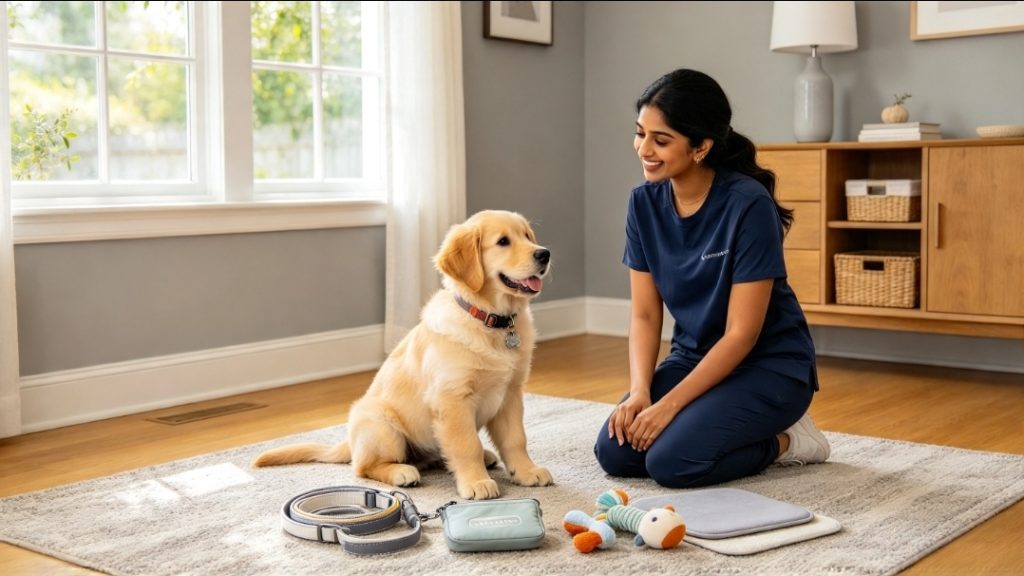
What equipment does a puppy need for training?
What equipment does a puppy need for training? A puppy does not need a large collection of equipment. For most basic training, you need suitable walking equipment, small food rewards, a safe resting area and a few appropriate toys. Additional equipment can be introduced as your puppy develops and specific training needs arise.
RECOMMENDED PRODUCTS

What basic equipment does a puppy need?
A practical puppy training setup can include:
- A suitable collar or harness
- A fixed lead
- Small training treats or suitable food
- A treat pouch or secure pocket
- Appropriate toys
- A comfortable resting area
- A training mat or similar designated area
- A crate or playpen if useful for management
You do not need to buy everything before starting training. Choose equipment according to what your puppy actually needs.
Does a puppy need a collar or harness?
A puppy needs a safe and appropriately fitted way of attaching a lead when lead training and walking.
A collar or harness should fit correctly without restricting movement or causing discomfort.
Check the fit regularly because puppies grow quickly and equipment that fitted correctly a few weeks ago may no longer be suitable.
What lead should I use for puppy training?
A standard fixed lead is usually a practical starting point.
It gives you a consistent connection with your puppy while you teach basic lead skills, attention and walking behaviour.
Keep the lead suitable for the puppy’s size and avoid using equipment that is unnecessarily heavy or restrictive.
A longer line can be introduced later when you are ready to work on recall and greater freedom in suitable environments.
Does a puppy need a long line?
Not for basic training.
A long line can become useful when teaching recall or allowing your puppy to explore while maintaining a safe connection.
It should be introduced when your puppy is ready for that stage of training and used in an appropriate environment.
What treats should I use for puppy training?
Use small, suitable rewards that your puppy finds motivating.
The pieces should be small enough to eat quickly so that training can continue without long interruptions.
You can often use part of your puppy’s normal food allowance for training. If your puppy needs a more valuable reward for a difficult exercise, use an appropriate alternative while keeping the puppy’s overall food intake in mind.
Does a puppy need a treat pouch?
No.
A treat pouch simply makes rewards easier to access.
You can use a secure pocket or another practical method of carrying food. The important thing is that you can deliver the reward quickly and accurately when your puppy performs the behaviour you want.
What toys does a puppy need for training?
A puppy can benefit from a small selection of suitable toys.
Depending on the puppy, this could include:
- An appropriate interactive toy
- A suitable tug toy
- A retrieve toy
- Safe chew toys
- Toys that encourage appropriate play
Choose toys that are appropriate for your puppy’s size, age and chewing behaviour.
Supervise play with toys that could be damaged or swallowed and replace damaged toys.
Can toys be used as training rewards?
Yes.
If your puppy is motivated by play, a suitable toy can be used to reward behaviours such as attention, recall or obedience.
Keep the game appropriate to the puppy’s level of excitement. If the puppy becomes too excited to respond or settle, reduce the intensity and help the puppy calm down before continuing.
Does a puppy need a training mat?
No, but a mat can be useful.
A training mat can provide a clear place where your puppy learns to settle, wait and remain calm.
Start with short periods and reward your puppy for choosing to remain on the mat. Gradually increase the duration and distractions as the puppy becomes more reliable.
Does a puppy need a crate?
No.
A crate is not essential for training, but it can be useful as a safe resting and management area when introduced positively.
A crate should never be used as punishment. Your puppy should be able to associate it with calm, safe and comfortable experiences.
RECOMMENDED PRODUCTS
Does a puppy need a playpen?
No, but a playpen can be useful for managing a puppy’s environment.
It can provide a controlled area for rest, play and exploration when you cannot provide direct supervision.
A playpen does not replace training, exercise, interaction or supervision.
Does a puppy need a place board?
No.
A place board is an optional training tool that can provide a clearly defined physical location for teaching position, duration and calm behaviour.
It can be introduced later if it is useful for the training you are doing.
Does a puppy need a clicker?
No.
A clicker can be used as a precise marker for desired behaviour, but it is not essential.
A consistent verbal marker can also be used. Whichever method you choose, timing and consistency are more important than the equipment.
What equipment does a puppy need for recall training?
When you begin progressing recall training, you may use:
- A suitable collar or harness
- A long line
- Small, motivating rewards
- A suitable toy
Start in an appropriate environment with low distractions and gradually increase the difficulty.
Do not give a puppy more freedom than its recall and environmental awareness can safely support.
What equipment does a puppy need for lead training?
For basic lead training, you generally need:
- A suitable collar or harness
- A fixed lead
- Suitable rewards
- A calm training environment
The equipment provides a safe connection. The training teaches the puppy how to walk with you.
Does puppy training equipment need to be expensive?
No.
Expensive equipment does not automatically make training more effective.
Prioritise equipment that is safe, correctly fitted, comfortable and suitable for the behaviour you are teaching.
As your puppy grows, equipment will need to be checked and replaced when it becomes too small, damaged or unsuitable.
What equipment should I avoid?
Avoid equipment that is unsuitable for your puppy’s size, uncomfortable, damaged or unnecessarily restrictive.
Do not buy equipment simply because it is marketed as a training solution. The equipment should have a clear purpose and support appropriate training.
If you are unsure whether a particular item is suitable for your puppy, seek advice from a qualified professional.
How often should I check my puppy’s equipment?
Check it regularly.
Puppies grow quickly, so collars, harnesses and other equipment can become too tight or unsuitable in a short period.
Inspect leads, clips, harnesses, collars and toys for damage and replace anything that is no longer safe.
What is the minimum equipment a puppy needs?
You can keep the initial setup simple.
For most basic puppy training, start with a suitable collar or harness, a fixed lead, appropriate food rewards, a few safe toys and a comfortable place to rest.
A mat, crate, playpen, long line or other equipment can be added when there is a genuine training or management reason for using it.
The equipment a puppy actually needs for training
A puppy does not need a large collection of specialist equipment.
Start with safe, correctly fitted and practical basics, then introduce additional equipment as your puppy develops.
The equipment supports the training, but it does not replace it. Your puppy learns through clear communication, good timing, positive reinforcement, consistency and gradual progression.
GPK9 — The Five Golden Rules
The GPK9 Five Golden Rules provide the foundation of the GPK9 Professional Training System. They give new dog owners, new dog handlers, experienced handlers and professional dog trainers a clear structure for developing the dog and the handler together.
The GPK9 Five Golden Rules cover five essential areas of development: Home & Social, Obedience, Prey Drive, Toilet and Social Walking. Each area has its own purpose, but they are designed to work together as one complete training system.
The GPK9 approach is based on CATEGORY → STATUS → DRIVE → CONTROL and the handler’s ability to OBSERVE → INTERPRET → DECIDE → COMMUNICATE → OBSERVE RESPONSE → REASSESS. This gives the handler a consistent process for understanding what the dog is doing, why the behaviour is occurring, what level of control is appropriate and how to communicate effectively.
The purpose of the GPK9 Five Golden Rules is not simply to teach a collection of individual exercises. They are designed to develop the dog’s behaviour, motivation, communication, control and reliability while teaching the handler how to make better decisions.
Golden Rule One — Home & Social
Golden Rule One — Home & Social establishes the foundation for everyday life with the dog. It focuses on communication, boundaries, calm behaviour, household routines and appropriate behaviour around people, animals and normal activity.
The purpose of Golden Rule One — Home & Social is to help the handler understand the dog’s behaviour and recognise changes in arousal before they become larger problems. The handler learns to observe, assess and communicate rather than simply reacting after unwanted behaviour has already occurred.
Golden Rule One — Home & Social provides the foundation from which the handler can develop a calmer, more predictable and better-communicating dog.
Golden Rule Two — Obedience
Golden Rule Two — Obedience develops the dog’s ability to understand and respond to the handler’s communication.
The focus of Golden Rule Two — Obedience is not simply teaching commands. It is about developing understanding, reliability, timing, reward, release and control so the dog learns what the handler is communicating.
Through Golden Rule Two — Obedience, the handler learns to progress training appropriately, gradually increasing the dog’s freedom and responsibility as understanding and reliability improve.
Golden Rule Three — Prey Drive
Golden Rule Three — Prey Drive focuses on understanding and developing the dog’s natural motivation to chase, pursue, engage and work with an appropriate toy or prey-based reward.
The purpose of Golden Rule Three — Prey Drive is not simply to increase drive. The handler must learn how to recognise the dog’s level of motivation, select an appropriate reward and use timing, communication and control to channel that motivation productively.
Golden Rule Three — Prey Drive teaches the handler that motivation can become a powerful training tool when it is developed and controlled correctly.
Golden Rule Four — Toilet
Golden Rule Four — Toilet establishes reliable toilet habits through consistency, observation, timing, supervision and appropriate reinforcement.
The handler learns through Golden Rule Four — Toilet to recognise when the dog is likely to need the toilet, provide the correct opportunity and reinforce the desired behaviour.
The objective of Golden Rule Four — Toilet is to establish a predictable routine that helps the dog understand where and when toileting is appropriate while reducing opportunities for mistakes.
Golden Rule Five — Social Walking
Golden Rule Five — Social Walking develops the dog’s ability to walk calmly and appropriately in the real world while remaining connected to the handler.
The focus of Golden Rule Five — Social Walking is the relationship between the handler, the dog, the environment, distractions, distance and available control.
Through Golden Rule Five — Social Walking, the handler learns to observe body language, identify potential triggers, assess distance and recognise changes in drive or arousal before behaviour escalates.
The objective of Golden Rule Five — Social Walking is not simply to make the dog walk beside the handler. It is to develop a dog that can experience the outside world while remaining connected to the handler and capable of responding to clear communication.
How the Five Golden Rules Work Together
The GPK9 Five Golden Rules are designed to work together rather than being treated as five completely separate subjects.
Golden Rule One — Home & Social establishes the foundations for everyday behaviour and communication.
Golden Rule Two — Obedience develops understanding, responsiveness and control.
Golden Rule Three — Prey Drive develops motivation and teaches the handler how to channel natural drive appropriately.
Golden Rule Four — Toilet establishes essential household routine and reliability.
Golden Rule Five — Social Walking takes the communication and control developed through the other areas into the outside environment.
Together, the GPK9 Five Golden Rules help the handler develop a complete understanding of the dog rather than treating individual behaviours as isolated problems.
The overall objective of the GPK9 Five Golden Rules is to train the human, train the dog and build the partnership through clear observation, communication, appropriate control and progressive development.




