Should My Dog Sleep on My Bed?
Should my dog sleep on my bed? There is no single answer that is right for every dog or every household. Some dogs can sleep comfortably on their owner’s bed without creating any problems, while other dogs are better suited to having their own sleeping area. The important question is not simply whether your dog is allowed on the bed. You should consider your dog’s behaviour, health, comfort, sleep quality, household rules and ability to settle appropriately.
Allowing your dog onto your bed is a choice. It should not become something that happens simply because your dog demands access to it.
The aim is to create a sleeping arrangement that allows both the dog and the owner to rest comfortably and safely.
RECOMMENDED PRODUCTS

Should my dog sleep on my bed?
A dog can sleep on your bed if the arrangement is appropriate for that individual dog and household.
Some owners enjoy having their dog close to them at night. Others prefer their dog to sleep in its own bed, crate or another designated sleeping area.
Neither decision automatically means that you are a better or worse dog owner.
What matters is whether the arrangement supports:
- appropriate rest;
- comfort;
- safety;
- household boundaries;
- reliable behaviour;
- good sleep;
- appropriate independence;
- the dog’s individual needs.
A dog should also have access to its own comfortable sleeping area, even if you choose to allow it onto your bed.
Dogs need opportunities to rest undisturbed, and their sleeping area should be comfortable, appropriately sized and positioned somewhere suitable for peaceful rest.
Your bed should not become your dog’s only sleeping place
One of the most important considerations is whether your dog can comfortably settle somewhere other than your bed.
If your dog can:
- settle on its own bed;
- relax on a placemat;
- rest in an appropriate safe space;
- sleep without constantly needing physical contact;
- remain comfortable when you are not beside it;
then allowing occasional access to your bed can simply become another choice within the household.
The problem can arise when the dog becomes unable to settle unless it has access to the owner.
A healthy sleeping routine should provide the dog with the ability to rest independently as well as spend time with you.
Give your dog its own sleeping area
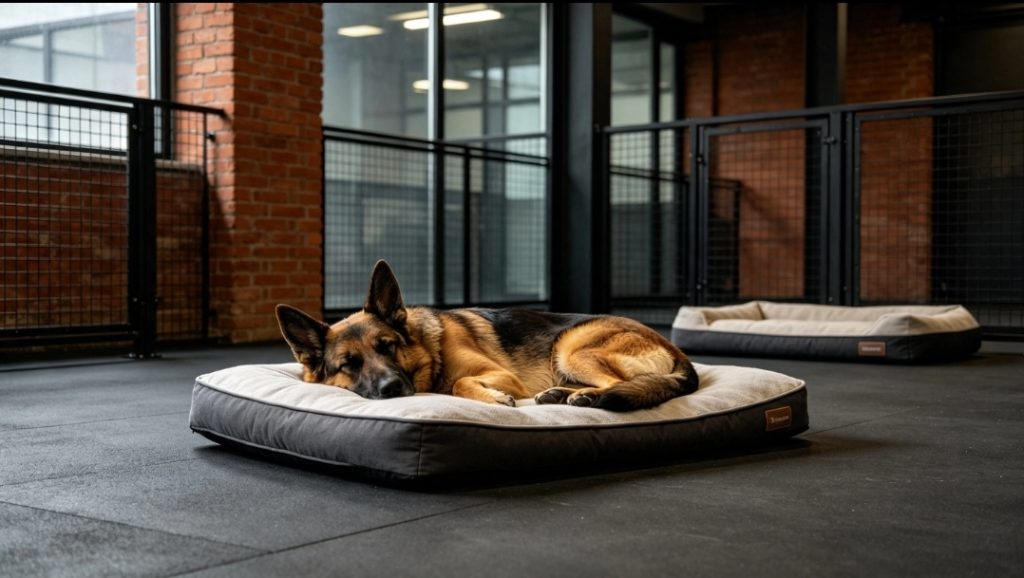
Even if your dog sleeps on your bed, provide another suitable place where it can rest.
This could be:
- a comfortable dog bed;
- a placemat;
- a suitable crate where appropriately trained;
- a quiet area of the home;
- another comfortable resting location.
The sleeping area should allow the dog to stretch out comfortably and change sleeping positions.
It should also be somewhere the dog can rest without being continually disturbed.
Professional welfare guidance consistently emphasises the importance of a comfortable, quiet and undisturbed place for a dog to sleep.
This is particularly important in busy households.
Children should understand that when the dog is sleeping or resting, it should be left alone.
Sleeping on the bed does not replace boundaries
Allowing your dog onto the bed does not mean that your dog should have unrestricted access to everything else.
Your dog can learn:
- when access to the bed is available;
- when it is not available;
- where it should sleep when the bed is unavailable;
- how to get on and off safely;
- how to settle without demanding attention;
- how to respond when asked to move.
The important factor is consistency.
If the rule is that your dog can sleep on the bed, everyone in the household should understand that rule.
If the rule is that your dog can only come onto the bed when invited, that should also be applied consistently.
Dogs can learn household routines when the information they receive is clear and predictable.
RECOMMENDED PRODUCTS
Should my puppy sleep on my bed?
A puppy can sleep on a bed with its owner, but the decision should be considered carefully.
Puppies are still developing their toilet training, sleeping routine, independence and understanding of household boundaries.
A puppy may also become accustomed very quickly to whatever sleeping arrangement is established.
If you allow a puppy onto your bed every night and later decide that you want it to sleep somewhere else, you may have to teach a new sleeping routine.
This does not mean that a puppy must never sleep on your bed.
It means that you should think about the long-term arrangement before establishing the habit.
For some puppies, beginning with their own bed close to their owner can provide reassurance while allowing them to develop an independent sleeping location.
What if my puppy cries at night?
A puppy may cry at night because it is adjusting to a completely new environment.
It may previously have slept beside its mother and littermates.
It may also need to go outside to toilet.
It may be uncertain about being alone.
The correct response is not simply to assume that crying means the puppy should immediately be given access to your bed.
First consider what the puppy actually needs.
Check:
- toilet requirements;
- comfort;
- temperature;
- sleeping environment;
- fear or uncertainty;
- previous routine;
- ability to settle.
Puppies often need time and gradual support while they learn to sleep independently.
Can sleeping on the bed create dependence?
Sleeping on the bed does not automatically create a behavioural problem.
However, you should consider whether your dog can also cope with sleeping away from you.
A dog should be capable of settling without constant access to its owner.
This is particularly important because there will be occasions when your dog cannot sleep on your bed.
You may stay somewhere else.
You may have visitors.
You may need to change sleeping arrangements.
Your dog may become older or develop a physical condition that makes getting onto the bed difficult.
Developing independence alongside companionship gives your dog greater flexibility.
Teach your dog to settle in its own space
A useful skill is teaching your dog that its own bed is a comfortable place to rest.
Begin in a quiet environment.
Allow the dog to investigate the bed naturally.
Reward calm behaviour.
When the dog chooses to lie down or settle appropriately, reinforce that behaviour.
Gradually increase the amount of time the dog remains settled.
You can then introduce the behaviour into different parts of the home.
The objective is not to force the dog into its bed.
The objective is to teach the dog that its own resting area is a safe and rewarding place to relax.
Positive reinforcement can be used to develop this behaviour gradually.
What if my dog refuses to sleep in its own bed?
Do not immediately assume that the dog is being stubborn.
Ask why.
The bed may be:
- uncomfortable;
- too small;
- too hot;
- too cold;
- positioned in a busy area;
- exposed to excessive noise;
- located somewhere the dog does not feel secure;
- associated with an unwanted experience.
Older dogs may also need different bedding because of physical discomfort or joint problems.
A dog that suddenly changes its sleeping behaviour should also be observed carefully.
A sudden inability to settle can sometimes indicate discomfort or another health issue, so veterinary advice may be appropriate if the change is persistent or concerning.
RECOMMENDED PRODUCTS
Should my dog sleep on my bed if it is older?
An older dog may still enjoy sleeping beside you.
However, physical comfort becomes increasingly important.
Jumping onto a high bed may be difficult for a dog with reduced mobility, arthritis or other physical limitations.
Consider whether your dog can safely get onto and off the bed.
You may also need to consider whether the mattress provides suitable support.
A comfortable bed at floor level may sometimes be a better option for an older dog.
The decision should therefore be based on the dog’s physical ability rather than simply what the dog wants to do.
What if my dog guards the bed?
This is where the situation changes.
A dog that simply enjoys sleeping on the bed is very different from a dog that becomes uncomfortable, tense, growls, snaps or attempts to prevent people from approaching the bed.
Bed access should not be allowed to become a situation in which the owner cannot safely manage the dog.
If your dog displays guarding behaviour around the bed, take the behaviour seriously.
Do not deliberately challenge or provoke the dog.
Create appropriate separation and seek professional behavioural assessment where necessary.
The priority is safety and understanding the behaviour, not proving who controls the bed.
What if my dog growls when I move it?
A growl is information.
Do not treat the growl as something that should simply be punished away.
Consider what happened immediately before it.
Was the dog:
- asleep?
- startled?
- uncomfortable?
- guarding the bed?
- guarding a person?
- physically painful?
- disturbed unexpectedly?
Dogs can react when suddenly woken or physically moved, particularly if they are startled or uncomfortable.
The safest approach is to avoid creating unnecessary confrontation and reassess the situation.
If the behaviour involves repeated growling, snapping or biting, appropriate professional support should be sought.
Do not disturb a sleeping dog
Dogs need sleep and rest.
A dog that is sleeping should not be repeatedly disturbed for:
- cuddles;
- play;
- photographs;
- children wanting to touch it;
- unnecessary movement;
- attention.
Dogs have different sleep patterns from humans and may move, twitch, change position or briefly wake during the night.
If your dog is sleeping peacefully, allow it to rest.
If sharing your bed means that either you or the dog is repeatedly disturbing the other, a separate sleeping arrangement may be more appropriate.
What if my dog keeps waking me up?
This is an important consideration.
If your dog repeatedly wakes you during the night, investigate why.
Possible reasons include:
- needing the toilet;
- discomfort;
- excessive excitement before bedtime;
- an inconsistent routine;
- anxiety;
- environmental disturbance;
- physical problems;
- wanting attention;
- needing access to water;
- an established habit.
Do not automatically reward every waking by providing prolonged attention.
Instead, determine what the dog actually needs and consider whether the current sleeping arrangement is helping or interfering with good rest.
RECOMMENDED PRODUCTS
Does sleeping on the bed affect behaviour?
Sleeping on the bed does not automatically determine whether a dog is well behaved.
Behaviour is influenced by many factors, including:
- learning;
- reinforcement;
- environment;
- motivation;
- routine;
- boundaries;
- management;
- physical and emotional wellbeing.
A dog can sleep on the bed and still have excellent household boundaries.
Equally, a dog that sleeps on its own bed can still display unwanted behaviour.
The sleeping location is only one part of the dog’s overall environment.
Sleeping on the bed and freedom
The question should not simply be:
“Can my dog get onto my bed?”
A better question is:
“Can my dog manage the freedom I am giving it?”
This follows an important GPK9 principle:
MORE FREEDOM REQUIRES MORE BEHAVIOURAL RESPONSIBILITY.
If your dog can access the bed appropriately, settle, respond when asked to move and continue behaving appropriately elsewhere, the freedom may be suitable.
If bed access is creating:
- guarding;
- excessive dependence;
- disrupted sleep;
- conflict;
- unwanted jumping;
- inability to settle elsewhere;
then the level of freedom may need to be reconsidered.
Reducing access is not a failure.
It is simply adjusting the environment to match the dog’s current level of behavioural responsibility.
Should my dog be allowed on the bed whenever it wants?
This depends on the household rule you choose.
There are several possible arrangements.
Free access
The dog can get onto the bed whenever appropriate.
This can work when the dog remains calm, safe and respectful of the household.
Invitation only
The dog waits for permission before getting onto the bed.
This can provide clearer control over when access is available.
No bed access
The dog has its own sleeping area and is not permitted onto the bed.
This can also be a perfectly appropriate household rule.
The important factor is not which option you choose.
It is whether the dog understands the rule and whether everyone applies it consistently.
Use a clear alternative
If you do not want your dog on your bed, simply repeatedly removing it may not teach the dog what you want instead.
Give the dog somewhere appropriate to go.
A comfortable bed or placemat can become a clear alternative.
Reward the dog for choosing that space.
Gradually develop the ability to settle there.
This creates a much clearer learning process:
Unwanted location → appropriate alternative → calm behaviour → reinforcement
The dog learns what behaviour is useful rather than simply experiencing repeated removal.
What if I change my mind?
You can change your household rules.
Perhaps you previously allowed your dog onto the bed but now need the dog to sleep elsewhere.
Introduce the new arrangement progressively.
Make the alternative sleeping location comfortable.
Reinforce calm behaviour there.
If necessary, begin with the dog’s own bed close to you and gradually increase the distance.
Do not expect a dog that has spent years sleeping on your bed to immediately understand a completely different routine without adjustment.
Behavioural change is a learning process.
Create a predictable bedtime routine
A consistent routine can make bedtime easier.
A suitable routine might include:
- normal evening activity;
- appropriate exercise and mental stimulation;
- a calm period before bedtime;
- a final toilet opportunity;
- access to water;
- preparation of the sleeping area;
- calm transition into the sleeping routine.
The exact routine should suit the individual dog.
The objective is to make bedtime predictable rather than exciting or chaotic.
Predictability can help dogs understand when activity is finishing and rest is beginning.
Your dog’s sleeping environment matters
Whether your dog sleeps on your bed or its own bed, the environment should support proper rest.
Consider:
- temperature;
- ventilation;
- noise;
- lighting;
- comfort;
- space;
- household activity;
- access to water;
- ability to move;
- freedom from hazards.
A sleeping area should allow the dog to lie comfortably and change position.
A dog should not be expected to sleep in an area where it is constantly disturbed.
What about children?
Children should understand that a sleeping dog needs space.
This is especially important if the dog sleeps on a bed or sofa.
Children should not climb onto a sleeping dog, hug it while it is asleep or deliberately wake it.
A dog that is suddenly startled can react differently from a dog that is awake and expecting interaction.
Teaching children to respect sleeping space is therefore part of responsible household management.
What about other dogs?
If more than one dog lives in the household, sleeping arrangements need additional consideration.
Each dog should have access to an appropriate resting area.
Competition over beds, furniture or access to people should not be allowed to develop into conflict.
If dogs are comfortable sharing space, that is one thing.
If one dog becomes uncomfortable when another approaches its sleeping area, the situation should be managed rather than ignored.
Watch the dogs’ communication and intervene before tension escalates.
Should I use a crate instead?
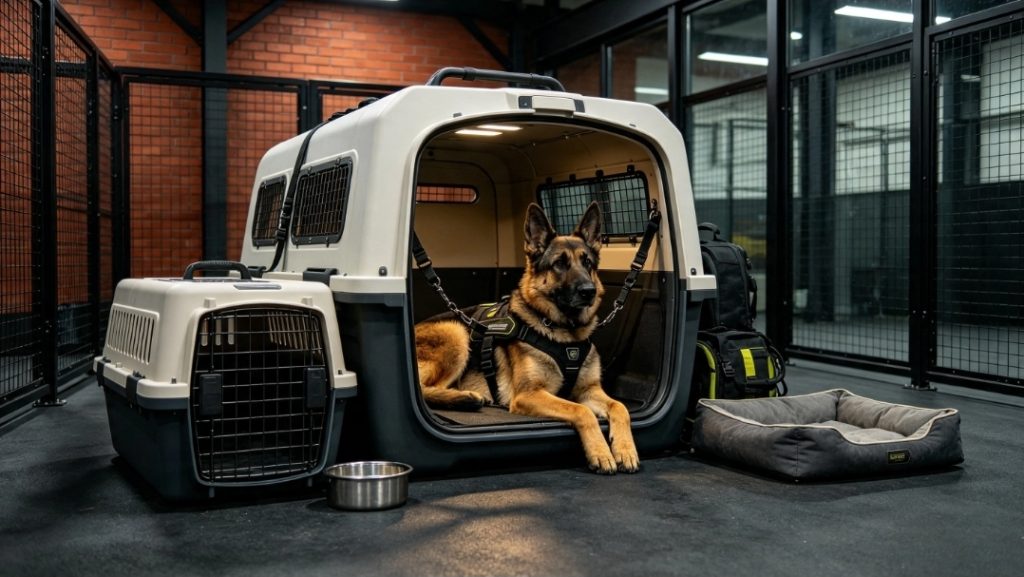
A crate can provide an appropriate sleeping or resting area when introduced and used correctly.
It should be a safe place rather than a punishment area.
Some dogs enjoy having an enclosed space where they can settle.
Other dogs may prefer an open bed where they have greater freedom of movement.
The important point is that the sleeping arrangement should suit the individual dog.
A crate should also be appropriately sized and used responsibly rather than as a way of avoiding the need to teach household behaviour.
RECOMMENDED PRODUCTS
Should I use a placemat instead?
A placemat can be particularly useful when teaching a dog where to settle within the household.
The dog learns that the mat represents a location for calm behaviour.
This can be useful during:
- evening relaxation;
- family activities;
- visitors;
- meal preparation;
- television time;
- household activity.
The objective is to teach the dog that it can be close to the family while remaining settled.
What if my dog becomes demanding at bedtime?
If your dog repeatedly paws at you, barks, jumps onto the bed or demands attention, observe what happens next.
If the behaviour consistently produces attention or access, the behaviour may become stronger.
Instead, teach an appropriate alternative.
For example:
Dog settles appropriately → calm behaviour is reinforced.
The dog learns that calm behaviour produces useful outcomes.
This is different from simply giving attention every time the dog demands it.
The GPK9 approach to sleeping arrangements
Sleeping arrangements can be viewed through the same simple process used throughout effective dog training.
OBSERVE
Look at what your dog is actually doing.
Is the dog:
- calm?
- comfortable?
- sleeping?
- demanding attention?
- guarding the bed?
- unable to settle?
- repeatedly waking you?
INTERPRET
Consider what the behaviour may be telling you.
Is the dog comfortable?
Is the environment appropriate?
Has the dog learned a habit?
Is there too much stimulation?
Could there be discomfort or another underlying problem?
DECIDE
Choose the most appropriate response.
The answer may be to:
- maintain the current arrangement;
- introduce an alternative sleeping area;
- reduce access;
- increase structure;
- improve comfort;
- establish a clearer routine;
- seek professional advice.
COMMUNICATE
Teach the dog what you want it to do.
If you want the dog to settle on its bed, reinforce that behaviour.
If bed access is invitation-only, teach the dog the appropriate routine.
If the dog is not permitted on the bed, provide a comfortable alternative.
OBSERVE RESPONSE
Watch what happens after the change.
Does the dog settle?
Does the dog become frustrated?
Does the dog understand the alternative?
Does the behaviour improve?
REASSESS
Use the dog’s response to determine what should happen next.
If the arrangement is working, continue.
If the dog is struggling, identify what needs to change.
When should my dog not sleep on my bed?
There are circumstances where sleeping on your bed may not be appropriate.
Consider another sleeping arrangement if:
- your dog guards the bed;
- your dog guards you while on the bed;
- your dog becomes aggressive when moved;
- your dog cannot settle anywhere else;
- your dog repeatedly disturbs your sleep;
- your dog cannot safely get onto or off the bed;
- your dog has physical problems that make jumping unsafe;
- the arrangement creates conflict within the household;
- the dog is developing excessive dependence on access to you.
Where behaviour involves aggression, guarding or biting, do not attempt to solve the problem through confrontation.
Prioritise safety and seek appropriate professional assessment.
When sleeping on the bed is working
If your dog:
- sleeps peacefully;
- remains comfortable;
- can settle elsewhere;
- responds appropriately when asked to move;
- does not guard the bed;
- does not disturb your sleep;
- maintains appropriate household behaviour;
then there may be no behavioural reason why sharing the bed cannot form part of your routine.
The important point is that access to the bed should remain compatible with the dog’s overall behaviour and welfare.
Recommended Products
A comfortable sleeping arrangement starts with appropriate equipment and management.
Consider suitable products for:
- a correctly sized dog bed;
- comfortable bedding;
- washable blankets;
- a placemat for settling;
- an appropriately introduced crate;
- suitable barriers where household management requires them.
The priority should always be comfort, safety, appropriate management and the dog’s ability to rest undisturbed.
GPK9 — The Five Golden Rules
The GPK9 Five Golden Rules provide the foundation of the GPK9 Professional Training System. They give new dog owners, new dog handlers, experienced handlers and professional dog trainers a clear structure for developing the dog and the handler together.
The GPK9 Five Golden Rules cover five essential areas of development: Home & Social, Obedience, Prey Drive, Toilet and Social Walking. Each area has its own purpose, but they are designed to work together as one complete training system.
The GPK9 approach is based on CATEGORY → STATUS → DRIVE → CONTROL and the handler’s ability to OBSERVE → INTERPRET → DECIDE → COMMUNICATE → OBSERVE RESPONSE → REASSESS. This gives the handler a consistent process for understanding what the dog is doing, why the behaviour is occurring, what level of control is appropriate and how to communicate effectively.
The purpose of the GPK9 Five Golden Rules is not simply to teach a collection of individual exercises. They are designed to develop the dog’s behaviour, motivation, communication, control and reliability while teaching the handler how to make better decisions.
Golden Rule One — Home & Social
Golden Rule One — Home & Social establishes the foundation for everyday life with the dog. It focuses on communication, boundaries, calm behaviour, household routines and appropriate behaviour around people, animals and normal activity.
The purpose of Golden Rule One — Home & Social is to help the handler understand the dog’s behaviour and recognise changes in arousal before they become larger problems. The handler learns to observe, assess and communicate rather than simply reacting after unwanted behaviour has already occurred.
Golden Rule One — Home & Social provides the foundation from which the handler can develop a calmer, more predictable and better-communicating dog.
Golden Rule Two — Obedience
Golden Rule Two — Obedience develops the dog’s ability to understand and respond to the handler’s communication.
The focus of Golden Rule Two — Obedience is not simply teaching commands. It is about developing understanding, reliability, timing, reward, release and control so the dog learns what the handler is communicating.
Through Golden Rule Two — Obedience, the handler learns to progress training appropriately, gradually increasing the dog’s freedom and responsibility as understanding and reliability improve.
Golden Rule Three — Prey Drive
Golden Rule Three — Prey Drive focuses on understanding and developing the dog’s natural motivation to chase, pursue, engage and work with an appropriate toy or prey-based reward.
The purpose of Golden Rule Three — Prey Drive is not simply to increase drive. The handler must learn how to recognise the dog’s level of motivation, select an appropriate reward and use timing, communication and control to channel that motivation productively.
Golden Rule Three — Prey Drive teaches the handler that motivation can become a powerful training tool when it is developed and controlled correctly.
Golden Rule Four — Toilet
Golden Rule Four — Toilet establishes reliable toilet habits through consistency, observation, timing, supervision and appropriate reinforcement.
The handler learns through Golden Rule Four — Toilet to recognise when the dog is likely to need the toilet, provide the correct opportunity and reinforce the desired behaviour.
The objective of Golden Rule Four — Toilet is to establish a predictable routine that helps the dog understand where and when toileting is appropriate while reducing opportunities for mistakes.
Golden Rule Five — Social Walking
Golden Rule Five — Social Walking develops the dog’s ability to walk calmly and appropriately in the real world while remaining connected to the handler.
The focus of Golden Rule Five — Social Walking is the relationship between the handler, the dog, the environment, distractions, distance and available control.
Through Golden Rule Five — Social Walking, the handler learns to observe body language, identify potential triggers, assess distance and recognise changes in drive or arousal before behaviour escalates.
The objective of Golden Rule Five — Social Walking is not simply to make the dog walk beside the handler. It is to develop a dog that can experience the outside world while remaining connected to the handler and capable of responding to clear communication.
How the Five Golden Rules Work Together
The GPK9 Five Golden Rules are designed to work together rather than being treated as five completely separate subjects.
Golden Rule One — Home & Social establishes the foundations for everyday behaviour and communication.
Golden Rule Two — Obedience develops understanding, responsiveness and control.
Golden Rule Three — Prey Drive develops motivation and teaches the handler how to channel natural drive appropriately.
Golden Rule Four — Toilet establishes essential household routine and reliability.
Golden Rule Five — Social Walking takes the communication and control developed through the other areas into the outside environment.
Together, the GPK9 Five Golden Rules help the handler develop a complete understanding of the dog rather than treating individual behaviours as isolated problems.
The overall objective of the GPK9 Five Golden Rules is to train the human, train the dog and build the partnership through clear observation, communication, appropriate control and progressive development.
A successful GPK9 handler learns to ask:
What is my dog doing?
Why is my dog doing it?
What is my dog communicating?
What level of control is appropriate?
How should I communicate with my dog?
What response did I get?
What should I do next?
This process forms the foundation of the GPK9 Professional Training System and allows the GPK9 Five Golden Rules to be applied consistently from the first stages of dog ownership through to advanced dog handling and professional training.