
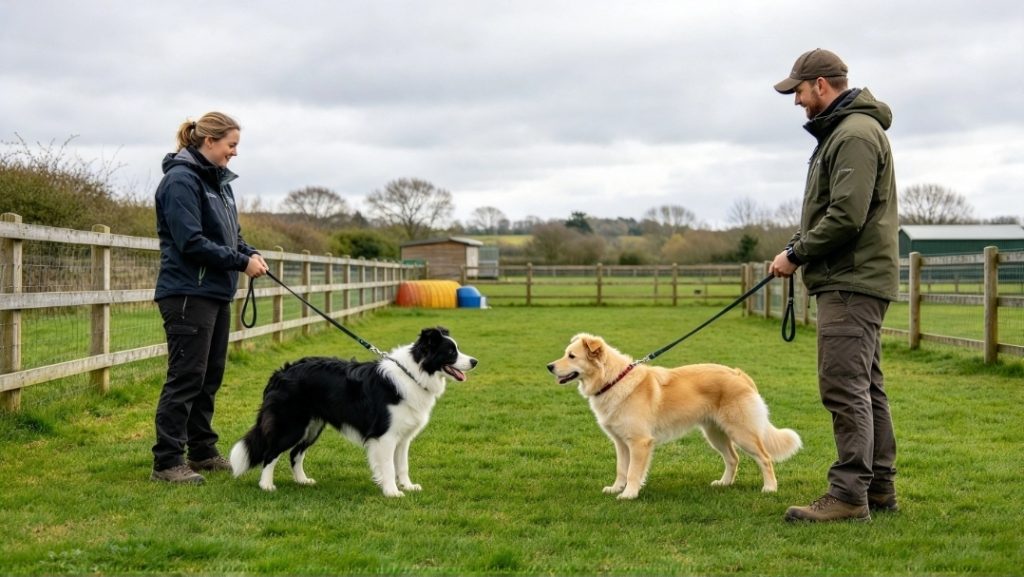
How Do I Socialise My Dog Safely?
To socialise your dog safely, introduce them gradually to different people, dogs, environments, sounds and everyday experiences while paying attention to how they respond. The aim is not to make your dog interact with everything, but to help them become more comfortable, confident and capable of behaving appropriately in different situations.
Good socialisation starts with manageable experiences, suitable distance, consistent communication and respect for your dog’s individual needs. Whether you have a young puppy or an adult dog, quality of experience matters more than the number of experiences.
What Does Socialising a Dog Actually Mean?
Socialisation is the process of helping your dog become familiar with the world around them. It includes learning how to experience different situations and respond appropriately without becoming unnecessarily frightened, excited or overwhelmed.
Socialisation can involve:
- Meeting suitable people in controlled circumstances.
- Seeing other dogs without needing to approach or play with them.
- Experiencing different environments, such as quiet streets, parks and unfamiliar buildings.
- Becoming familiar with everyday sounds, traffic, movement and different surfaces.
- Learning to tolerate appropriate handling and routine care.
- Remaining connected with you when distractions appear.
A well-socialised dog does not need to greet every person or interact with every dog. Being able to observe something unfamiliar, remain comfortable and continue with you is an important social skill.
Start With Your Dog’s Individual Needs
Every dog has a different temperament, history and level of experience. A confident dog may investigate a new environment readily, while a more cautious dog may need additional time and space.
Before introducing a new experience, consider what your dog can comfortably manage. Think about their age, previous experiences, current behaviour and the environment you intend to visit.
For puppies, introduce new experiences in a way that is appropriate for their development and vaccination status. Ask your veterinary professional which environments and interactions are suitable before exposing a puppy to places where disease risks may be higher.
For adult dogs, consider what they have already learned. A dog that has had limited social experience, or has developed fear around people or other dogs, may need a slower and more carefully managed approach.
Do not measure progress by how quickly your dog approaches something. Measure it by whether they can experience it and remain comfortable enough to learn.
How to Introduce Your Dog to New People
Your dog does not need to meet everyone they encounter. Learning to remain calm around unfamiliar people can be just as important as learning to interact appropriately.
Start in a setting where your dog has enough space to observe people without being approached directly. Allow them to watch from a comfortable distance and reward suitable behaviour, such as remaining relaxed or checking in with you.
When an interaction is appropriate, keep it calm and avoid allowing someone to crowd your dog, reach over them or insist on touching them.
Watch your dog’s response. If they move away, turn their head, become tense or try to avoid contact, give them space. Do not force them to accept attention simply because the person is friendly.
Children require particular care because their movements and behaviour can be unpredictable. Supervise interactions closely, teach children to behave calmly around dogs and make sure your dog can move away when they need to.
How to Socialise Your Dog Around Other Dogs
Seeing another dog should not automatically mean that your dog has to approach, greet or play with it.
Begin at a distance where your dog can notice the other dog without becoming overwhelmed. Observe whether they can remain reasonably relaxed, respond to you and continue moving when appropriate.
Choose interactions carefully. An unfamiliar dog that is overly excitable, intimidating or poorly controlled may not provide a suitable experience.
Avoid allowing greetings simply because two dogs are present. Consider their behaviour, the environment, available space and whether both dogs appear comfortable.
Useful social skills include:
- Seeing another dog without pulling towards it.
- Remaining responsive to you when a dog passes.
- Moving away calmly when an interaction is unsuitable.
- Being able to disengage from another dog.
- Recovering after an exciting or unfamiliar encounter.
Neutrality is a valuable social skill. Your dog can learn that other dogs are part of the environment without every sighting becoming an interaction.
If your dog barks, lunges, freezes or becomes difficult to redirect around other dogs, increase the distance and avoid forcing a closer encounter. Persistent or severe reactivity may require individual professional assessment.
Introduce New Environments Gradually
Different environments provide different challenges. A quiet residential street may be manageable, while a crowded town centre with traffic, people, bicycles and unfamiliar noises may be too demanding at first.
Start somewhere your dog can cope comfortably. Allow time to observe the surroundings, investigate suitable things and become familiar with the experience.
Gradually introduce other environments, such as:
- Quiet streets and walking routes.
- Parks and open spaces.
- Different safe walking surfaces.
- Places with moderate levels of people and movement.
- Everyday household sounds and activities.
- Suitable car journeys and unfamiliar buildings.
Avoid introducing too many new things at once. A new location combined with close contact from strangers, several unfamiliar dogs and loud noises may overwhelm a dog that could manage each experience separately.
Build difficulty gradually, and let your dog’s response guide your next decision.
Learn to Recognise Your Dog’s Body Language
Your dog communicates through posture, movement, facial expression and behaviour. Recognising these signals helps you decide whether an experience is suitable or whether you need to change the situation.
Signs that your dog may be uncomfortable include:
- Turning away or repeatedly avoiding an interaction.
- Moving away, hiding or attempting to escape.
- Freezing or becoming unusually still.
- Holding the body tensely or lowering the body.
- Tucking the tail or holding it differently from normal.
- Repeated lip licking or yawning in a stressful context.
- Panting when heat or exercise does not explain it.
- Becoming increasingly focused, agitated or difficult to redirect.
No single signal proves exactly how a dog feels. Consider the whole body, the situation and changes in behaviour rather than interpreting one sign in isolation.
Learning to recognise these signals is an important part of Read Your Dog — Understanding Your Dog’s Body Language. Better observation helps you make informed decisions before a situation becomes too difficult.
What Should You Do if Your Dog Becomes Overwhelmed?
If your dog shows clear signs of distress, do not keep moving closer in the hope that they will get used to it.
Instead:
- Observe what has changed and how your dog is responding.
- Create space by increasing distance or moving away from the trigger.
- Reduce the difficulty by choosing a quieter place or ending the interaction.
- Allow recovery without forcing further contact.
- Reassess before deciding whether to try again another time.
Do not punish your dog for showing fear or discomfort. Punishment can add further pressure to an already difficult situation and may make it harder to recognise when your dog needs help.
If your dog repeatedly struggles with ordinary situations, or their fear is severe or worsening, seek appropriate professional support. Where there is a risk of aggression or injury, prioritise safety and arrange an individual assessment.
How Socialisation Connects With the Home Environment
Socialisation is not limited to what happens outside. Your dog’s home environment, daily routines, boundaries and interactions with family members all influence how they experience everyday life.
Provide suitable opportunities for rest, predictable routines and calm interactions. Introduce visitors carefully and give your dog an appropriate place to retreat when they need space.
Avoid assuming that a dog should tolerate every interaction in the home simply because they know the people involved. Comfort and appropriate behaviour still matter in familiar surroundings.
This wider foundation connects with Golden Rule 1 — Home & Social: Creating a Better Home and Social Environment, which addresses the importance of the home environment, routines, boundaries and social experiences.
Socialisation and Walking Work Together
Walks provide opportunities to experience people, dogs, traffic, sounds and unfamiliar surroundings. They also require communication between you and your dog while you are both moving.
Choose walking routes that match your dog’s current ability. Maintain appropriate control, give other dogs and people enough space, and avoid allowing the lead to become a means of forcing an interaction.
Reward appropriate attention and calm responses. If the environment becomes too difficult, change direction, increase distance or choose a quieter route.
The aim is to help your dog learn how to experience the world while remaining responsive to you. This connects naturally with Golden Rule 5 — Social Walking: Developing Social Walking Skills, which focuses on communication, control and appropriate behaviour during walks.
Understanding Fear, Confidence and Anxiety
Some dogs need more support than others when experiencing unfamiliar situations. Fear may develop from limited exposure, previous negative experiences, individual temperament or other factors. It should not automatically be interpreted as stubbornness or disobedience.
If your dog is worried, reduce the pressure and work at a level they can manage. Repeatedly exposing them to something frightening without allowing recovery can make the experience harder rather than easier.
Build confidence through manageable experiences, suitable distance and careful observation. If your dog cannot remain comfortable, adjust the situation instead of insisting they continue.
For further guidance, Fear, Confidence and Anxiety — Understanding Fear and Anxiety explores how uncertainty can affect behaviour and why training should be adapted to the individual dog.
Common Socialisation Mistakes to Avoid
Forcing Interactions
Do not push your dog towards people, dogs or objects they are trying to avoid. Allow them space to observe and become comfortable.
Assuming More Exposure Is Always Better
Long, busy or unpredictable sessions can overwhelm a dog. Start with manageable experiences and increase difficulty gradually.
Allowing Every Dog to Say Hello
Not every dog is a suitable social partner. Calmly passing another dog can be a successful outcome.
Ignoring Body Language
Changes in posture, movement and attention can indicate that your dog needs more space. Respond before the situation escalates.
Progressing Too Quickly
A dog that manages one quiet environment may not yet be ready for a crowded one. Change one aspect of the challenge at a time where possible.
Confusing Socialisation With Obedience Alone
Commands can help you communicate, but they do not automatically make a frightened dog comfortable. Consider both your dog’s behaviour and how they are experiencing the situation.
A Simple Plan for Safer Socialisation
Use this practical sequence when introducing your dog to something unfamiliar:
- Choose one manageable experience. Avoid combining too many new challenges.
- Begin at a suitable distance. Give your dog room to observe without pressure.
- Watch their response. Look for signs that they can remain comfortable and responsive.
- Communicate clearly. Guide your dog calmly and reward appropriate behaviour where suitable.
- Adjust when necessary. Increase distance or end the experience if your dog struggles.
- Finish on a manageable experience. Allow your dog time to recover.
- Repeat and progress gradually. Increase difficulty only when your dog’s responses suggest they are ready.
Progress will not always be linear. Your dog may cope well in one situation and find another more challenging. Adapt your approach rather than expecting identical responses everywhere.
How Do I Know if My Dog Is Becoming Better Socialised?
Look for improvements in how your dog responds to everyday experiences. They may be able to observe unfamiliar people without becoming distressed, pass other dogs more calmly, explore new environments or recover more quickly after a surprising event.
Your dog does not need to become fearless or sociable with every person and dog. The goal is to develop appropriate responses, greater confidence where possible and the ability to navigate everyday situations safely.
Socialisation is an ongoing process. Continue observing your dog, choosing suitable experiences and adjusting your approach as their needs change.
Final Thoughts
Safe socialisation is about helping your dog become familiar with people, dogs, environments and everyday experiences at an appropriate pace. It does not mean forcing interactions or exposing your dog to as much as possible.
Start with manageable situations, learn to recognise body language, provide space when needed and build difficulty gradually. Connect your dog’s experiences at home with the skills they need outdoors, and seek professional help when fear or reactivity creates a significant challenge.
Observe your dog, consider what their behaviour is telling you, and adapt the experience accordingly. That is how you make better decisions and help your dog develop more appropriate social skills over time.
If you need additional support, contact our online coach.




