How Do I Know When to Stop a Social Interaction?
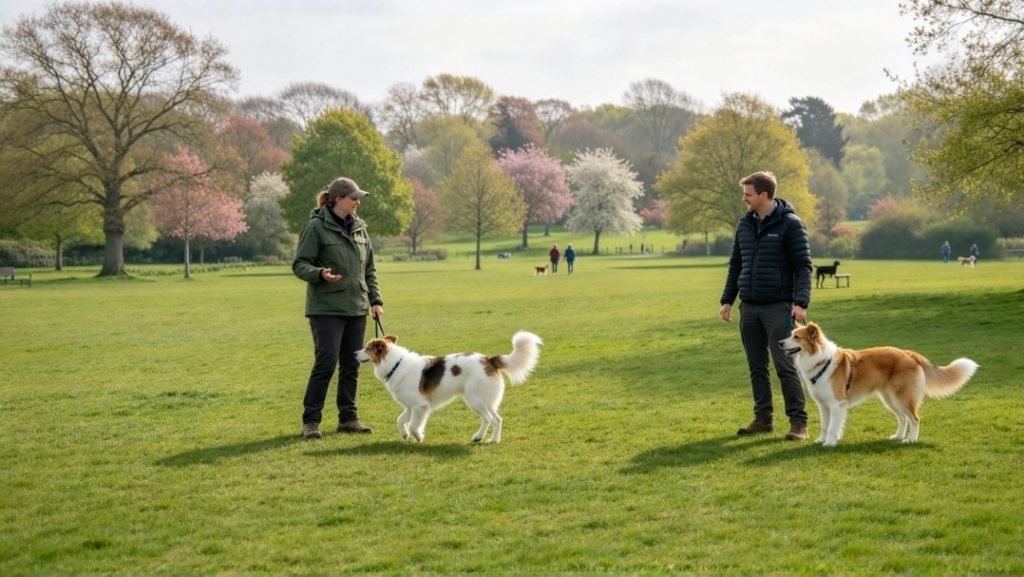
How do I know when to stop a social interaction? Stop the interaction when your dog or puppy starts showing signs of stress, fear, excessive arousal, frustration, discomfort or an inability to disengage. A good social interaction should remain manageable for both dogs, and you should intervene before behaviour escalates into barking, lunging, snapping or a fight.
RECOMMENDED PRODUCTS

What Does a Healthy Social Interaction Look Like?
A healthy interaction should allow the dogs to communicate, move naturally and take breaks.
Depending on the dogs and the situation, you may see:
- Relaxed body language
- Natural movement
- Brief investigation
- Appropriate play
- Pauses during play
- Dogs choosing to move away and return
- Both dogs responding to each other’s signals
- Both dogs being able to disengage
- A return to calm behaviour after the interaction
The interaction does not need to be continuous. Being able to pause and disengage is an important part of healthy social behaviour.
What Signs Mean I Should Stop the Interaction?
Watch for changes in body language and behaviour.
You should consider ending or interrupting the interaction if your dog:
- Becomes stiff or tense
- Tries repeatedly to move away
- Hides behind you
- Freezes
- Tucks its tail
- Shows repeated avoidance
- Becomes increasingly frantic
- Repeatedly ignores the other dog’s attempts to disengage
- Starts barking or growling
- Snaps
- Lunges
- Becomes unable to respond to you
- Cannot settle after the interaction
Do not wait for a serious reaction before intervening. Early intervention is easier and safer than trying to stop an interaction after it has escalated.
Should I Stop Dogs If They Are Playing Roughly?
Not necessarily.
Play can look energetic, noisy and physical without being inappropriate. The important thing is whether both dogs are comfortable and able to communicate.
Look for pauses, changes of roles and opportunities for each dog to move away.
If one dog continually chases, pins, corners or overwhelms the other dog and the other dog cannot escape or disengage, intervene.
What Does Good Play Look Like?
Good play usually involves some form of balance.
Dogs may take turns chasing, wrestling or initiating interaction. They may pause, move apart and then choose to interact again.
A brief interruption does not necessarily mean the dogs are having a bad experience. The ability to stop, reset and choose to continue is a positive sign.
What Does Uncomfortable Play Look Like?
Uncomfortable interaction may involve one dog repeatedly attempting to escape while the other continues pursuing it.
Other warning signs can include:
- Repeated hiding
- Freezing
- Tucked tail
- Persistent avoidance
- Stiff body language
- Ears held tightly back
- Repeated attempts to disengage
- Increasing vocalisation
- Snapping to create space
If these behaviours appear, create separation rather than allowing the interaction to continue.
Should I Stop an Interaction If My Dog Growls?
A growl should be taken seriously as communication.
Do not punish the growl. Instead, calmly create space and assess what caused the dog to feel the need to communicate that way.
A growl can indicate discomfort, fear, frustration, guarding or a desire for increased distance.
Stopping the situation and understanding the cause is more useful than punishing the warning signal.
RECOMMENDED PRODUCTS
What If My Dog Does Not Want to Interact?
Allow your dog to disengage.
A dog should not be forced to greet or play with another dog simply because the other dog wants to interact.
If your dog moves away, hides behind you, avoids the other dog or repeatedly tries to disengage, give it space.
Socialisation does not mean forcing dogs to interact. Learning that they can safely choose not to engage is also valuable.
How Do I Stop a Social Interaction Safely?
If the interaction needs to stop, remain calm and create space.
Call your dog away if it can respond reliably. You can also use the lead to guide your dog away where appropriate, without dragging it into a confrontation.
If two dogs are becoming tense, do not put your hands between them or attempt to grab collars during an active fight.
Instead, prioritise safety and create separation using an appropriate method for the circumstances. If there is a serious risk of injury, seek professional help with future interactions.
What Equipment Can Help?
For controlled social situations, a suitable harness or collar and lead can provide practical control.
A short line can help you manage distance when introducing a dog to another dog or when you need to interrupt an interaction safely.
A long line can be useful in an appropriate secure environment when your dog has enough training and reliability for greater freedom.
Equipment should allow you to manage the situation without creating unnecessary pressure.
A muzzle should not be used simply because two dogs are meeting. If there is a genuine bite risk, professional guidance is important and the muzzle should be introduced correctly before it is needed in a difficult situation.
What Should I Do After Stopping the Interaction?
Give the dog time to recover before deciding whether to continue.
Move away from the other dog and allow your dog to settle. Watch its behaviour rather than immediately trying to restart the interaction.
If your dog quickly returns to a relaxed state, you can reassess the situation.
If your dog remains tense, avoids the other dog or continues showing signs of stress, end the interaction.
There is no benefit in continuing simply because you planned for the dogs to play or socialise for a particular amount of time.
When Should I End a Puppy Interaction?
Puppies can become overwhelmed or overtired quickly.
If your puppy becomes excessively excited, starts repeatedly biting, stops responding, becomes frantic or struggles to settle, it may be time for a break.
Allow the puppy to move away and rest.
Short, successful interactions are generally more useful than allowing a puppy to continue until it becomes completely overwhelmed.
What Are the Most Common Mistakes?
A common mistake is waiting until the dogs are already fighting before intervening.
Other mistakes include:
- Ignoring early stress signals
- Assuming growling always means aggression
- Forcing a dog to continue interacting
- Allowing one dog to continually overwhelm another
- Punishing a dog for communicating discomfort
- Allowing play to continue after one dog repeatedly tries to disengage
- Assuming all dogs enjoy the same type of interaction
- Failing to provide breaks
The earlier you recognise a problem, the easier it is to change the situation.
When Should I Get Professional Help?
Professional help is recommended if your dog repeatedly becomes aggressive during social interactions, attempts to bite, causes injuries, cannot disengage or shows severe fear around other dogs.
A qualified professional can assess the interaction, identify the triggers and help you develop safer ways to manage future encounters.
If your dog’s behaviour changes suddenly or significantly, speak to your vet as well.
Conclusion
Knowing when to stop a social interaction means watching your dog’s body language, behaviour and ability to disengage.
Do not wait for a serious reaction. If your dog becomes tense, frightened, overwhelmed, excessively aroused or repeatedly tries to escape the interaction, create space and allow it to recover.
A successful social interaction does not have to end when something goes wrong. The goal is to recognise the signs early, intervene calmly and finish while your dog can still recover and remain safe.
GPK9 — The Five Golden Rules
The GPK9 Five Golden Rules provide the foundation of the GPK9 Professional Training System. They give new dog owners, new dog handlers, experienced handlers and professional dog trainers a clear structure for developing the dog and the handler together.
The GPK9 Five Golden Rules cover five essential areas of development: Home & Social, Obedience, Prey Drive, Toilet and Social Walking. Each area has its own purpose, but they are designed to work together as one complete training system.
The GPK9 approach is based on CATEGORY → STATUS → DRIVE → CONTROL and the handler’s ability to OBSERVE → INTERPRET → DECIDE → COMMUNICATE → OBSERVE RESPONSE → REASSESS. This gives the handler a consistent process for understanding what the dog is doing, why the behaviour is occurring, what level of control is appropriate and how to communicate effectively.
The purpose of the GPK9 Five Golden Rules is not simply to teach a collection of individual exercises. They are designed to develop the dog’s behaviour, motivation, communication, control and reliability while teaching the handler how to make better decisions.
Golden Rule One — Home & Social
Golden Rule One — Home & Social establishes the foundation for everyday life with the dog. It focuses on communication, boundaries, calm behaviour, household routines and appropriate behaviour around people, animals and normal activity.
The purpose of Golden Rule One — Home & Social is to help the handler understand the dog’s behaviour and recognise changes in arousal before they become larger problems. The handler learns to observe, assess and communicate rather than simply reacting after unwanted behaviour has already occurred.
Golden Rule One — Home & Social provides the foundation from which the handler can develop a calmer, more predictable and better-communicating dog.
Golden Rule Two — Obedience
Golden Rule Two — Obedience develops the dog’s ability to understand and respond to the handler’s communication.
The focus of Golden Rule Two — Obedience is not simply teaching commands. It is about developing understanding, reliability, timing, reward, release and control so the dog learns what the handler is communicating.
Through Golden Rule Two — Obedience, the handler learns to progress training appropriately, gradually increasing the dog’s freedom and responsibility as understanding and reliability improve.
Golden Rule Three — Prey Drive
Golden Rule Three — Prey Drive focuses on understanding and developing the dog’s natural motivation to chase, pursue, engage and work with an appropriate toy or prey-based reward.
The purpose of Golden Rule Three — Prey Drive is not simply to increase drive. The handler must learn how to recognise the dog’s level of motivation, select an appropriate reward and use timing, communication and control to channel that motivation productively.
Golden Rule Three — Prey Drive teaches the handler that motivation can become a powerful training tool when it is developed and controlled correctly.
Golden Rule Four — Toilet
Golden Rule Four — Toilet establishes reliable toilet habits through consistency, observation, timing, supervision and appropriate reinforcement.
The handler learns through Golden Rule Four — Toilet to recognise when the dog is likely to need the toilet, provide the correct opportunity and reinforce the desired behaviour.
The objective of Golden Rule Four — Toilet is to establish a predictable routine that helps the dog understand where and when toileting is appropriate while reducing opportunities for mistakes.
Golden Rule Five — Social Walking
Golden Rule Five — Social Walking develops the dog’s ability to walk calmly and appropriately in the real world while remaining connected to the handler.
The focus of Golden Rule Five — Social Walking is the relationship between the handler, the dog, the environment, distractions, distance and available control.
Through Golden Rule Five — Social Walking, the handler learns to observe body language, identify potential triggers, assess distance and recognise changes in drive or arousal before behaviour escalates.
The objective of Golden Rule Five — Social Walking is not simply to make the dog walk beside the handler. It is to develop a dog that can experience the outside world while remaining connected to the handler and capable of responding to clear communication.
How the Five Golden Rules Work Together
The GPK9 Five Golden Rules are designed to work together rather than being treated as five completely separate subjects.
Golden Rule One — Home & Social establishes the foundations for everyday behaviour and communication.
Golden Rule Two — Obedience develops understanding, responsiveness and control.
Golden Rule Three — Prey Drive develops motivation and teaches the handler how to channel natural drive appropriately.
Golden Rule Four — Toilet establishes essential household routine and reliability.
Golden Rule Five — Social Walking takes the communication and control developed through the other areas into the outside environment.
Together, the GPK9 Five Golden Rules help the handler develop a complete understanding of the dog rather than treating individual behaviours as isolated problems.
The overall objective of the GPK9 Five Golden Rules is to train the human, train the dog and build the partnership through clear observation, communication, appropriate control and progressive development.