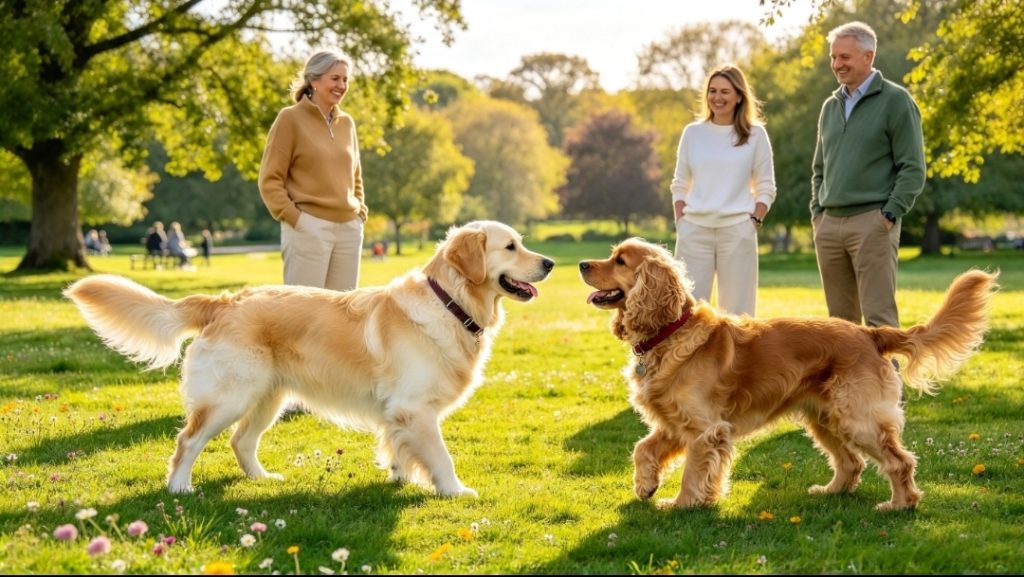
How Do I Know If My Dog Is Comfortable Around Other Dogs?
How do I know if my dog is comfortable around other dogs? Look at your dog’s whole body language and behaviour, not just whether it is quiet. A comfortable dog will usually have a relaxed body, move naturally, remain able to respond to you and recover easily when another dog is nearby. The most important thing is whether your dog can calmly observe or interact with another dog without showing signs of fear, stress, excessive excitement or conflict.
RECOMMENDED PRODUCTS

What Does a Comfortable Dog Look Like Around Other Dogs?
A comfortable dog can usually remain relaxed while another dog is present.
You may notice:
- A loose, relaxed body
- Natural movement
- Normal breathing
- Relaxed facial muscles
- Normal tail movement for that individual dog
- Willingness to explore or continue walking
- Ability to take food
- Ability to respond to its name
- Ability to look at another dog and then disengage
- A quick return to normal behaviour after the other dog has passed
No single body-language signal proves that a dog is comfortable. Look at the overall behaviour and context.
How Do I Know If My Dog Is Comfortable Walking Past Other Dogs?
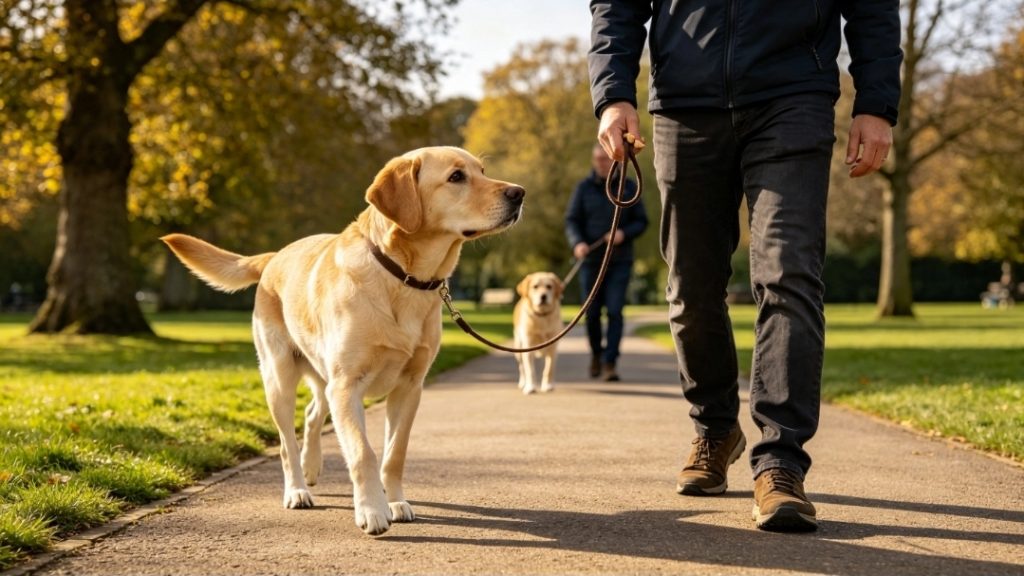
A useful sign is that your dog can notice another dog without becoming fixated on it.
Your dog may look at the other dog, then continue walking, look back at you, sniff the environment or return its attention to something else.
Your dog does not need to completely ignore every dog. Being able to notice another dog and remain calm is healthy social behaviour.
If your dog begins staring intensely, becomes tense, slows down, pulls towards or away from the other dog, or stops responding to you, the situation may be becoming too difficult.
What Signs Show That My Dog Is Uncomfortable Around Other Dogs?
Signs of discomfort can appear before barking or lunging.
Watch for:
- Stiffening of the body
- Intense staring
- Turning away
- Avoiding eye contact
- Freezing
- Lowering the body
- Tucking the tail
- Ears held unusually tightly back or forward
- Lip licking or yawning
- Moving away
- Pulling on the lead
- Whining
- Barking
- Growling
- Lunging
- Trying to escape
These signs should not automatically be interpreted as aggression. They indicate that you need to consider what your dog is experiencing and whether it needs more space.
Does Barking Mean My Dog Is Uncomfortable?
Not necessarily.
Dogs can bark because they are frightened, excited, frustrated, uncertain or trying to increase distance.
Look at what happens before and after the barking.
For example, a dog that pulls towards another dog while barking may be excited or frustrated about being unable to approach. A dog that backs away, becomes tense and then barks may be trying to create distance.
Barking needs to be interpreted in context rather than treated as proof that a dog is aggressive or uncomfortable.
How Can I Tell If My Dog Is Excited Rather Than Nervous?
Look at the dog’s body language, movement and ability to recover.
An excited dog may pull towards another dog, bounce, whine or struggle to remain focused because it wants access to the other dog.
A nervous dog may try to increase distance, become tense, freeze, hide behind you or show other avoidance behaviours.
Some dogs can display both excitement and uncertainty. The important question is whether the dog can remain under control and return to a calm state.
Is My Dog Comfortable If It Wants to Play With Other Dogs?
Wanting to play can be a positive sign, but it does not automatically mean the interaction is appropriate.
Watch how both dogs respond to each other.
Healthy interaction should allow dogs to move away, pause and communicate without one dog continually overwhelming the other.
If your dog becomes excessively aroused and cannot disengage, the interaction may need to be interrupted before the behaviour escalates.
A dog should be able to interact and then return to a calm state.
Is My Dog Comfortable If It Ignores Other Dogs?
Yes.
Ignoring another dog can be an excellent sign of social confidence.
Your dog does not need to greet every dog it sees. Being able to notice another dog and continue walking, sniffing or focusing on you demonstrates that the presence of another dog is not automatically controlling its behaviour.
Calm neutrality is often more useful than constant social interaction.
How Can I Test Whether My Dog Is Comfortable Around Other Dogs?
Do not deliberately place your dog in a stressful situation just to test it.
Instead, observe your dog during normal controlled encounters.
Start at a distance where your dog can see another dog while remaining relaxed. Watch whether your dog can:
- Notice the other dog.
- Remain physically relaxed.
- Respond to you.
- Take a reward if appropriate.
- Disengage from the other dog.
- Continue walking or exploring.
- Recover quickly once the dog has passed.
If your dog can do these things consistently, it is showing useful signs of comfort.
RECOMMENDED PRODUCTS
What Should I Do If My Dog Becomes Uncomfortable?
Increase the distance from the other dog and allow your dog to settle.
Do not force your dog to approach or remain close to another dog once it is showing clear signs of discomfort.
If your dog is repeatedly struggling, reduce the difficulty of the situation. You may be too close, in an environment that is too busy or progressing too quickly.
Reward calm behaviour when your dog is able to think and respond again.
What Equipment Should I Use Around Other Dogs?
Use equipment that allows you to safely manage distance and maintain control without unnecessary pressure.
A suitable harness or collar and lead can be used for everyday walks. A short line can provide closer control when another dog is nearby and you need to manage space.
A long line can be useful in a secure, suitable environment when your dog has enough control to work with greater freedom.
A muzzle is not normal equipment simply because another dog is present. If there is a genuine bite risk, professional guidance should be obtained and the muzzle introduced correctly.
Equipment should support safe training and management rather than replace training.
What If My Dog Is Comfortable With Some Dogs but Not Others?
This is common.
Your dog may be comfortable with familiar dogs but uncertain around unfamiliar dogs, or comfortable with calm dogs but uncomfortable around highly energetic dogs.
Consider the individual dog’s behaviour, size, movement, distance and environment.
Do not assume that because your dog is comfortable with one dog, it will automatically be comfortable with every dog.
How Do I Know When My Dog Is Ready for More Freedom?
Look for consistent calm behaviour rather than a single successful interaction.
Your dog should be able to remain responsive around other dogs, disengage when asked, recover quickly and cope with increasing levels of distraction.
Progress gradually. Greater freedom should come with greater behavioural responsibility.
If your dog’s behaviour deteriorates as you increase freedom, reduce the difficulty and rebuild the behaviour before progressing again.
When Should I Get Professional Help?
Seek professional help if your dog repeatedly lunges, snaps, attempts to bite, shows severe fear or cannot safely be managed around other dogs.
A qualified professional can help identify what your dog’s body language is communicating and develop a suitable training plan.
If your dog’s behaviour around other dogs changes suddenly, speak to your vet as well, particularly if there may be pain or another underlying health issue.
Conclusion
The best way to know whether your dog is comfortable around other dogs is to watch the whole dog rather than looking for one isolated signal.
A comfortable dog can usually remain relaxed, respond to you, disengage from another dog and return to normal behaviour. If your dog becomes tense, fixated, fearful or reactive, give it more space and reduce the difficulty.
Your dog does not need to greet every dog. Learning to calmly observe, pass and disengage from other dogs is an important part of good social behaviour.
GPK9 — The Five Golden Rules
The GPK9 Five Golden Rules provide the foundation of the GPK9 Professional Training System. They give new dog owners, new dog handlers, experienced handlers and professional dog trainers a clear structure for developing the dog and the handler together.
The GPK9 Five Golden Rules cover five essential areas of development: Home & Social, Obedience, Prey Drive, Toilet and Social Walking. Each area has its own purpose, but they are designed to work together as one complete training system.
The GPK9 approach is based on CATEGORY → STATUS → DRIVE → CONTROL and the handler’s ability to OBSERVE → INTERPRET → DECIDE → COMMUNICATE → OBSERVE RESPONSE → REASSESS. This gives the handler a consistent process for understanding what the dog is doing, why the behaviour is occurring, what level of control is appropriate and how to communicate effectively.
The purpose of the GPK9 Five Golden Rules is not simply to teach a collection of individual exercises. They are designed to develop the dog’s behaviour, motivation, communication, control and reliability while teaching the handler how to make better decisions.
Golden Rule One — Home & Social
Golden Rule One — Home & Social establishes the foundation for everyday life with the dog. It focuses on communication, boundaries, calm behaviour, household routines and appropriate behaviour around people, animals and normal activity.
The purpose of Golden Rule One — Home & Social is to help the handler understand the dog’s behaviour and recognise changes in arousal before they become larger problems. The handler learns to observe, assess and communicate rather than simply reacting after unwanted behaviour has already occurred.
Golden Rule One — Home & Social provides the foundation from which the handler can develop a calmer, more predictable and better-communicating dog.
Golden Rule Two — Obedience
Golden Rule Two — Obedience develops the dog’s ability to understand and respond to the handler’s communication.
The focus of Golden Rule Two — Obedience is not simply teaching commands. It is about developing understanding, reliability, timing, reward, release and control so the dog learns what the handler is communicating.
Through Golden Rule Two — Obedience, the handler learns to progress training appropriately, gradually increasing the dog’s freedom and responsibility as understanding and reliability improve.
Golden Rule Three — Prey Drive
Golden Rule Three — Prey Drive focuses on understanding and developing the dog’s natural motivation to chase, pursue, engage and work with an appropriate toy or prey-based reward.
The purpose of Golden Rule Three — Prey Drive is not simply to increase drive. The handler must learn how to recognise the dog’s level of motivation, select an appropriate reward and use timing, communication and control to channel that motivation productively.
Golden Rule Three — Prey Drive teaches the handler that motivation can become a powerful training tool when it is developed and controlled correctly.
Golden Rule Four — Toilet
Golden Rule Four — Toilet establishes reliable toilet habits through consistency, observation, timing, supervision and appropriate reinforcement.
The handler learns through Golden Rule Four — Toilet to recognise when the dog is likely to need the toilet, provide the correct opportunity and reinforce the desired behaviour.
The objective of Golden Rule Four — Toilet is to establish a predictable routine that helps the dog understand where and when toileting is appropriate while reducing opportunities for mistakes.
Golden Rule Five — Social Walking
Golden Rule Five — Social Walking develops the dog’s ability to walk calmly and appropriately in the real world while remaining connected to the handler.
The focus of Golden Rule Five — Social Walking is the relationship between the handler, the dog, the environment, distractions, distance and available control.
Through Golden Rule Five — Social Walking, the handler learns to observe body language, identify potential triggers, assess distance and recognise changes in drive or arousal before behaviour escalates.
The objective of Golden Rule Five — Social Walking is not simply to make the dog walk beside the handler. It is to develop a dog that can experience the outside world while remaining connected to the handler and capable of responding to clear communication.
How the Five Golden Rules Work Together
The GPK9 Five Golden Rules are designed to work together rather than being treated as five completely separate subjects.
Golden Rule One — Home & Social establishes the foundations for everyday behaviour and communication.
Golden Rule Two — Obedience develops understanding, responsiveness and control.
Golden Rule Three — Prey Drive develops motivation and teaches the handler how to channel natural drive appropriately.
Golden Rule Four — Toilet establishes essential household routine and reliability.
Golden Rule Five — Social Walking takes the communication and control developed through the other areas into the outside environment.
Together, the GPK9 Five Golden Rules help the handler develop a complete understanding of the dog rather than treating individual behaviours as isolated problems.
The overall objective of the GPK9 Five Golden Rules is to train the human, train the dog and build the partnership through clear observation, communication, appropriate control and progressive development.