
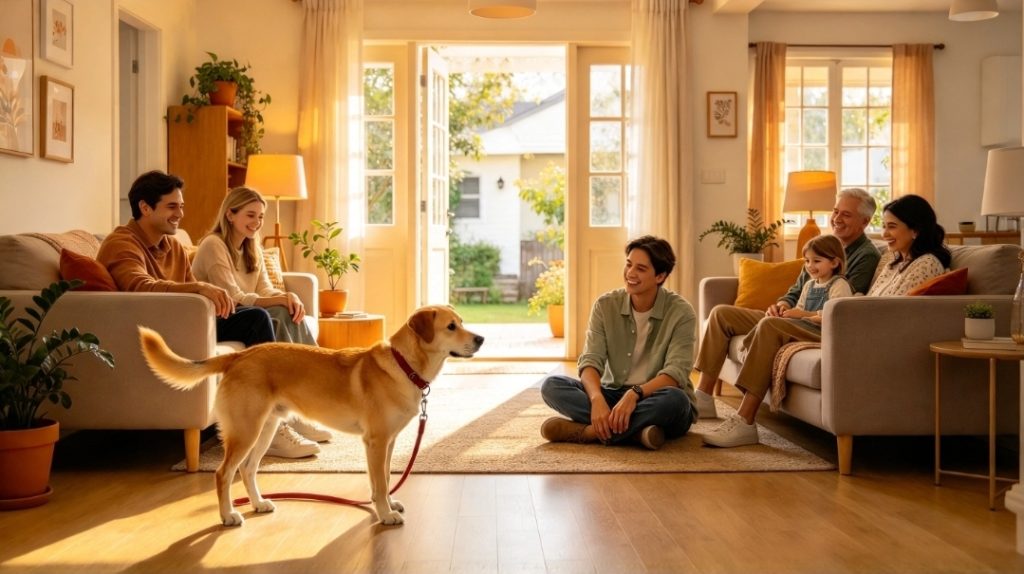
How do I introduce a rescue dog to my family?
How do I introduce a rescue dog to my family? Introduce your rescue dog gradually, keep interactions calm and predictable, and allow the dog to approach family members at its own pace. Do not expect a newly adopted rescue dog to immediately feel comfortable with everyone. The first priority is helping the dog feel safe while it learns who the people in its new home are.
RECOMMENDED PRODUCTS

How should I introduce a rescue dog to my family?
Start with a calm introduction rather than having everyone crowd around the dog.
Give the dog an opportunity to enter the home, explore and observe its surroundings.
Family members should remain calm and avoid immediately touching, hugging or calling the dog over repeatedly.
Allow the dog to approach when it feels comfortable.
Reward calm behaviour so the dog begins to associate family members with positive experiences.
Should everyone meet the rescue dog at the same time?
Not necessarily.
If several people are living in the home, introducing everyone gradually may be easier for a nervous dog.
Too many people approaching at once can create unnecessary pressure.
Give the dog time to become comfortable with one person before expecting it to interact with several people together.
The appropriate approach depends on the dog’s confidence and behaviour.
How should adults behave around a new rescue dog?
Adults should keep their movements and voices calm.
Avoid leaning over the dog, staring directly at it, reaching towards its head or immediately attempting to handle it.
Allow the dog to approach voluntarily.
If the dog approaches, keep the interaction gentle and brief initially. If it moves away, let it leave.
This teaches the dog that it can control the amount of interaction it receives.
How do I introduce children to a rescue dog?
Children need particularly careful supervision.
Explain that the dog needs space and should not be chased, hugged, climbed on or disturbed while eating or sleeping.
Initially, children can simply remain calm in the same room while the dog observes them.
As the dog becomes comfortable, controlled interaction can be introduced.
Do not leave young children and a newly adopted rescue dog unsupervised together, even if the dog appears friendly.
Should children feed the rescue dog?
Food can be useful for creating positive associations, but it should be done safely.
An adult should supervise any interaction involving food.
Children should not approach or interfere with the dog while it is eating.
If the dog shows guarding behaviour around food, do not allow children to participate in feeding exercises. Seek professional guidance instead.
Should I let my family stroke the rescue dog?
Only if the dog is comfortable with physical contact.
A dog approaching someone does not automatically mean it wants to be stroked.
Watch the dog’s body language and keep interactions gentle.
If the dog moves away, freezes, avoids contact or appears uncomfortable, stop the interaction and give it space.
Respecting the dog’s boundaries is an important part of building trust.
RECOMMENDED PRODUCTS
How do I introduce a rescue dog to a family member who lives elsewhere?
Introduce the person gradually.
Ask them to remain calm and initially ignore the dog.
Allow the dog to observe them from a comfortable distance and reward calm behaviour.
If the dog chooses to approach, the person can calmly acknowledge it without immediately reaching towards it.
Repeat the process during future visits rather than expecting the dog to become comfortable after one meeting.
How do I introduce a rescue dog to visitors?
Do not allow visitors to crowd the dog when they arrive.
Give the dog an appropriate place where it can retreat if it feels uncomfortable.
Ask visitors to remain calm and avoid immediately touching the dog.
Reward the dog for calm behaviour and allow it to approach when ready.
If the dog becomes frightened, increase distance rather than forcing interaction.
How do I introduce a rescue dog to another dog in the family?
Take introductions gradually.
Avoid simply putting the dogs together and expecting them to work everything out themselves.
Where appropriate, introduce them in a controlled environment with enough space for both dogs to remain comfortable.
Watch their body language and allow them opportunities to move away.
Keep early interactions short and calm.
If either dog shows significant fear, reactivity or aggression, separate them safely and seek professional guidance.
How do I introduce a rescue dog to other pets?
Introduce other animals gradually and prioritise safety.
Do not allow unrestricted access between a new rescue dog and another household animal until you understand how they respond to each other.
Use appropriate management to prevent chasing, cornering or unwanted interaction.
If the rescue dog has a strong prey drive or shows aggression towards another animal, professional guidance may be necessary before allowing closer contact.
What if my rescue dog hides from family members?
Do not pull the dog out of hiding.
Give it a safe place where it can retreat and rest.
Family members can spend quiet time nearby without demanding interaction.
Reward the dog when it voluntarily comes out or approaches.
As confidence develops, the dog may begin choosing to spend more time with the family.
What if my rescue dog growls at a family member?
Take the growl seriously as communication.
Do not punish the dog or force the interaction to continue.
Create distance and consider what happened immediately before the growl.
The dog may be frightened, uncomfortable, guarding something or reacting to a particular type of handling.
If the behaviour is repeated, escalating or accompanied by snapping or biting, seek professional behavioural help.
What if my rescue dog is frightened of one person?
Do not force the dog to interact with that person.
Allow the dog to observe them from a comfortable distance.
The person can calmly exist in the same environment without attempting to touch or approach the dog.
Positive reinforcement can be used when the dog remains calm in the person’s presence.
Over time, the dog can learn that the person’s presence predicts safe and positive experiences.
RECOMMENDED PRODUCTS
How do I introduce a rescue dog to a baby?
Use particularly careful management.
Never leave a baby and dog unsupervised together.
Give the dog a safe area where it can retreat from household activity and do not force the dog to approach the baby.
Gradually allow the dog to become accustomed to new sounds, smells and movements while maintaining appropriate distance.
If the dog shows fear, guarding, aggression or other concerning behaviour around the baby, seek professional help immediately.
How do I help my rescue dog become comfortable with the whole family?
Keep interactions predictable.
Each family member should use similar expectations and avoid overwhelming the dog.
Reward appropriate behaviour, allow the dog to rest undisturbed and give it opportunities to approach people voluntarily.
Family members can build relationships through simple activities such as calm training, appropriate play, feeding routines and relaxed time together.
The dog does not need constant attention to become part of the family.
Should I give my rescue dog lots of attention?
No.
Too much attention can overwhelm a dog that is still adjusting.
Give your dog opportunities to interact as well as opportunities to rest.
A rescue dog may need several quiet periods throughout the day while it adapts to its new environment.
Learning to relax around family members is just as important as actively interacting with them.
How do I teach my family the rules for handling the rescue dog?
Everyone should understand the same basic rules.
For example:
- Do not disturb the dog while it is eating.
- Do not disturb the dog while it is sleeping.
- Do not chase or corner the dog.
- Do not force physical contact.
- Do not take possessions away unnecessarily.
- Give the dog space when it asks for it.
- Reward appropriate behaviour.
- Ask an adult for help if the dog behaves unexpectedly.
Consistency helps the dog understand what to expect from everyone.
What equipment can help introduce a rescue dog to family members?
Equipment should provide safe management while the dog is learning.
A crate can provide a quiet recovery space when introduced positively.
A placemat or designated resting area can give the dog somewhere appropriate to settle while family activity continues.
A comfortable harness and lead can provide control during supervised introductions where appropriate.
A short line can provide additional management during training.
If there is a genuine risk of biting, a correctly fitted and positively introduced muzzle may be appropriate as part of a wider safety plan.
Equipment should never be used to force a dog into an interaction it cannot cope with.
How long does it take a rescue dog to accept a family?
There is no fixed timeframe.
Some rescue dogs become comfortable with their new family quickly, while others need weeks or months.
Previous experiences, temperament, age, health and the dog’s behaviour can all affect the process.
Focus on gradual progress rather than expecting immediate affection.
How do I know my rescue dog is becoming comfortable with my family?
Look for signs that the dog is becoming more relaxed.
These may include:
- Approaching family members voluntarily
- Resting comfortably in the same room
- Sleeping normally
- Eating comfortably around the household
- Responding to familiar people
- Engaging in training or play
- Choosing to remain near family members
- Recovering quickly after unexpected events
- Showing relaxed body language
Progress can be gradual and may look different for every dog.
When should I get professional help?
Seek professional help if the rescue dog shows serious fear, aggression, repeated lunging, snapping, attempts to bite or behaviour that cannot be safely managed.
Professional help is particularly important when behavioural concerns involve children, babies or other household animals.
If the dog’s behaviour changes suddenly or significantly, speak to your vet to rule out pain or illness.
Conclusion
Introducing a rescue dog to your family should be a gradual process based on safety, space, consistency and positive experiences.
Do not force interaction or expect immediate trust. Allow your rescue dog to approach family members at its own pace, reward calm behaviour and provide a safe place where it can retreat when it needs space.
With time and consistent handling, your rescue dog can learn that its new family is a safe and predictable part of its new life.
GPK9 — The Five Golden Rules
The GPK9 Five Golden Rules provide the foundation of the GPK9 Professional Training System. They give new dog owners, new dog handlers, experienced handlers and professional dog trainers a clear structure for developing the dog and the handler together.
The GPK9 Five Golden Rules cover five essential areas of development: Home & Social, Obedience, Prey Drive, Toilet and Social Walking. Each area has its own purpose, but they are designed to work together as one complete training system.
The GPK9 approach is based on CATEGORY → STATUS → DRIVE → CONTROL and the handler’s ability to OBSERVE → INTERPRET → DECIDE → COMMUNICATE → OBSERVE RESPONSE → REASSESS. This gives the handler a consistent process for understanding what the dog is doing, why the behaviour is occurring, what level of control is appropriate and how to communicate effectively.
The purpose of the GPK9 Five Golden Rules is not simply to teach a collection of individual exercises. They are designed to develop the dog’s behaviour, motivation, communication, control and reliability while teaching the handler how to make better decisions.
Golden Rule One — Home & Social
Golden Rule One — Home & Social establishes the foundation for everyday life with the dog. It focuses on communication, boundaries, calm behaviour, household routines and appropriate behaviour around people, animals and normal activity.
The purpose of Golden Rule One — Home & Social is to help the handler understand the dog’s behaviour and recognise changes in arousal before they become larger problems. The handler learns to observe, assess and communicate rather than simply reacting after unwanted behaviour has already occurred.
Golden Rule One — Home & Social provides the foundation from which the handler can develop a calmer, more predictable and better-communicating dog.
Golden Rule Two — Obedience
Golden Rule Two — Obedience develops the dog’s ability to understand and respond to the handler’s communication.
The focus of Golden Rule Two — Obedience is not simply teaching commands. It is about developing understanding, reliability, timing, reward, release and control so the dog learns what the handler is communicating.
Through Golden Rule Two — Obedience, the handler learns to progress training appropriately, gradually increasing the dog’s freedom and responsibility as understanding and reliability improve.
Golden Rule Three — Prey Drive
Golden Rule Three — Prey Drive focuses on understanding and developing the dog’s natural motivation to chase, pursue, engage and work with an appropriate toy or prey-based reward.
The purpose of Golden Rule Three — Prey Drive is not simply to increase drive. The handler must learn how to recognise the dog’s level of motivation, select an appropriate reward and use timing, communication and control to channel that motivation productively.
Golden Rule Three — Prey Drive teaches the handler that motivation can become a powerful training tool when it is developed and controlled correctly.
Golden Rule Four — Toilet
Golden Rule Four — Toilet establishes reliable toilet habits through consistency, observation, timing, supervision and appropriate reinforcement.
The handler learns through Golden Rule Four — Toilet to recognise when the dog is likely to need the toilet, provide the correct opportunity and reinforce the desired behaviour.
The objective of Golden Rule Four — Toilet is to establish a predictable routine that helps the dog understand where and when toileting is appropriate while reducing opportunities for mistakes.
Golden Rule Five — Social Walking
Golden Rule Five — Social Walking develops the dog’s ability to walk calmly and appropriately in the real world while remaining connected to the handler.
The focus of Golden Rule Five — Social Walking is the relationship between the handler, the dog, the environment, distractions, distance and available control.
Through Golden Rule Five — Social Walking, the handler learns to observe body language, identify potential triggers, assess distance and recognise changes in drive or arousal before behaviour escalates.
The objective of Golden Rule Five — Social Walking is not simply to make the dog walk beside the handler. It is to develop a dog that can experience the outside world while remaining connected to the handler and capable of responding to clear communication.
How the Five Golden Rules Work Together
The GPK9 Five Golden Rules are designed to work together rather than being treated as five completely separate subjects.
Golden Rule One — Home & Social establishes the foundations for everyday behaviour and communication.
Golden Rule Two — Obedience develops understanding, responsiveness and control.
Golden Rule Three — Prey Drive develops motivation and teaches the handler how to channel natural drive appropriately.
Golden Rule Four — Toilet establishes essential household routine and reliability.
Golden Rule Five — Social Walking takes the communication and control developed through the other areas into the outside environment.
Together, the GPK9 Five Golden Rules help the handler develop a complete understanding of the dog rather than treating individual behaviours as isolated problems.
The overall objective of the GPK9 Five Golden Rules is to train the human, train the dog and build the partnership through clear observation, communication, appropriate control and progressive development.




