Can Play Improve Dog Training?
Can play improve dog training? Yes, play can improve dog training when your dog genuinely enjoys it and the game is used as a meaningful reward for correct behaviour. Play can increase motivation, engagement and focus, but it needs to be controlled so that it supports learning rather than making your dog too excited to respond.
How Can Play Improve Dog Training?
Play can make training more rewarding for dogs that value interaction with toys or games.
A short game can reinforce behaviours such as:
- Attention
- Recall
- Waiting
- Obedience
- Engagement with the handler
- Appropriate responses around distractions
The important part is how play is used.
The dog should perform the desired behaviour first, then receive access to the game.
How Should I Use Play During Training?
Use play as a reward after the correct behaviour.
The basic sequence is:
Cue → behaviour → mark → play → release → reset.
For example, ask your dog to look at you. When your dog responds, mark the behaviour and immediately start a short game of tug.
Your dog learns that responding to you leads to something enjoyable.
Can Play Make a Dog More Motivated?
Yes.
A dog that strongly enjoys tug, fetch or another game may work enthusiastically for the opportunity to play.
This can be particularly useful when food is less valuable in a particular situation.
However, motivation is individual. Some dogs value food more than toys, while others prefer sniffing, exploring, praise or access to something they want.
The best reward is the one your dog finds valuable in that situation.
Can Play Improve Recall?
Yes.
If your dog enjoys playing, returning to you can lead to a short game.
Practise recall in an environment where your dog can succeed. When your dog returns, mark the response and immediately reward with play.
As reliability improves, gradually increase distance and distractions.
A long line can provide additional safety when practising recall outdoors before your dog is reliable off lead.
The aim is for coming back to you to remain worthwhile.
Can Play Improve Obedience?
Play can reinforce many obedience behaviours.
For example:
Sit → mark → tug → release.
Down → mark → fetch.
Look at me → mark → play.
The reward should follow the behaviour rather than being used to constantly lure the dog into position.
This helps your dog understand exactly which behaviour earned the game.
Can Play Improve Focus?
It can, particularly when the game itself is highly valuable to your dog.
Start in an environment with few distractions. Reward your dog for voluntarily looking at you or responding to your cue with a short game.
Gradually practise around more distractions.
If your dog can no longer focus, the environment may be too difficult. Increase distance from distractions or return to an easier exercise.
Can Play Help With Training Around Distractions?
Yes, but play should not be used to simply overpower a distraction.
If another dog, person, animal or environmental event is more rewarding or worrying than the toy, your dog may ignore the game.
Reduce the difficulty first.
Create enough distance from the distraction for your dog to respond, then reward appropriate behaviour.
As your dog’s ability improves, gradually make the situation more challenging.
Can Play Improve Loose Lead Walking?
Play can reinforce appropriate walking if your dog can remain controlled during the game.
For example, reward a period of loose lead walking with a brief game.
However, some dogs become more excited when playing and may immediately start pulling or jumping.
If that happens, reduce the intensity, shorten the game or use a calmer reward.
The reward should strengthen loose lead walking, not encourage the opposite behaviour.
Can Play Improve Engagement With the Handler?
Yes.
Interactive games can teach your dog that engaging with you leads to rewarding experiences.
Tug, fetch and other games require your dog to interact with you rather than simply receiving something from a distance.
Teach clear start and end points so that your dog learns to engage with you and then settle when the game finishes.
Can Too Much Play Make Training Worse?
Yes.
Play is not automatically helpful simply because the dog enjoys it.
A highly exciting game can increase arousal to the point where your dog struggles to listen, release the toy or return to calm behaviour.
If this happens, make the game shorter or calmer.
You can also use a different type of reward.
The goal is useful motivation, not maximum excitement.
How Do I Teach My Dog to Stop Playing?
Teach a consistent release cue and a clear end-of-play routine.
Stop moving the toy and wait for your dog to release it. Mark the release and, where appropriate, restart the game.
You can then finish the session and allow your dog to settle.
This teaches your dog that play has a beginning and an end.
Learning to disengage from play is just as important as learning to engage with it.
Can Play Replace Treats?
Sometimes.
If your dog values play highly, it can be used instead of food for some behaviours.
However, you do not need to eliminate treats.
Different rewards are useful for different situations. Food may be better when you need calm, precise behaviour, while play may be particularly effective when you want engagement or enthusiasm.
Use the reward that best supports the exercise.
What If My Dog Does Not Like Playing?
Do not force play.
Some dogs simply prefer other rewards.
You can try different appropriate toys and games, but if your dog remains uninterested, use another form of reinforcement.
Food, praise, attention, sniffing, exploring and access to preferred activities can all have training value.
A dog does not need to enjoy toys for training to be effective.
Common Mistakes When Using Play in Training
Avoid:
- Showing the toy before every command
- Using play before the desired behaviour occurs
- Making every game excessively exciting
- Playing for too long
- Failing to teach a release
- Using play when your dog is already too aroused
- Expecting play to overcome fear or extreme distraction
- Increasing difficulty too quickly
Play should make the correct behaviour more rewarding, not make the behaviour harder to perform.
How Do I Build Play Into a Training Session?
Keep the structure simple.
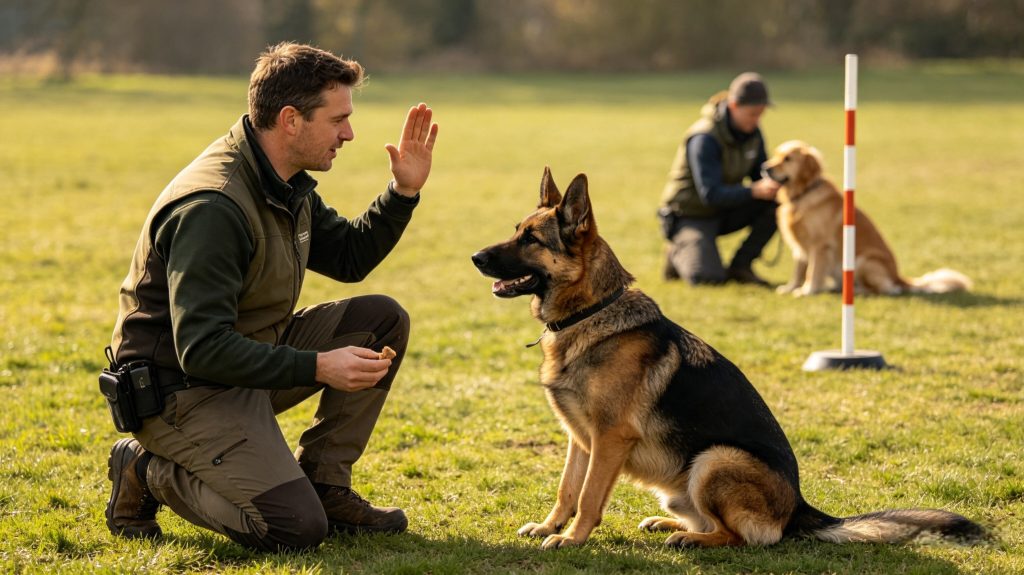
Ask for a behaviour, mark the correct response, reward with a short game, end the game and reset.
For example:
Attention → mark → play → release → reset.
Then ask for another behaviour.
As your dog becomes more reliable, gradually introduce greater duration, distance or distraction.
Keep sessions short enough that your dog remains engaged and capable of responding.
Conclusion
Play can improve dog training by increasing motivation, engagement and enjoyment when it is used appropriately.
The key is to make play a reward for correct behaviour rather than allowing it to become a distraction.
Choose games your dog genuinely enjoys, control the intensity, teach clear start and release cues, and increase difficulty gradually.
Used correctly, play can become more than entertainment. It can be a valuable training reward that helps your dog learn, respond and engage with you.