How Do I Understand My Dog’s Communication Signals?
To understand your dog’s communication signals, look at their whole body, behaviour, surroundings and changes in response, rather than relying on one movement or expression. A wagging tail does not always mean a dog is happy, and a growl does not automatically tell you why a dog is uncomfortable. The key is to observe what is happening, consider the possible meaning and respond according to the situation.
Dogs communicate continuously through body language, movement, facial expressions, vocalisations and their responses to people, animals and the environment. Learning to recognise these signals helps you understand when your dog is comfortable, excited, uncertain, frightened or struggling to cope.
RECOMMENDED PRODUCTS

How Do Dogs Communicate With People?
Dogs use several forms of communication at the same time. Their signals can be subtle, and the same behaviour may mean different things depending on the circumstances.
For example, a dog may approach you because they want attention, food, play or reassurance. Another dog may approach out of curiosity but move away when you reach towards them. The movement alone does not explain the dog’s intention; you need to consider what happens before, during and after the interaction.
Dogs communicate through:
- Body posture: Whether the body appears relaxed, tense, lowered, stiff or ready to move.
- Facial expressions: Changes around the eyes, ears, mouth and forehead.
- Movement: Approaching, retreating, turning away, pacing, freezing or repeatedly changing position.
- Tail position and movement: The height, stiffness, speed and pattern of movement.
- Vocalisations: Barking, growling, whining, whimpering and other sounds.
- Attention: Whether your dog looks towards you, watches something in the environment or repeatedly turns away.
- Responses to interaction: Whether your dog moves closer, remains comfortable, becomes tense or tries to create distance.
These signals should be considered together. No single movement provides a complete explanation of what a dog is feeling or trying to communicate.
What Does My Dog’s Body Language Mean?
Body language gives you useful information about your dog’s current response, but it needs to be interpreted in context.
A Relaxed Body
A dog that feels comfortable may show loose body movement, a relatively relaxed posture, natural breathing and an ability to move freely. The dog may explore, rest, approach voluntarily or respond to familiar communication.
However, relaxation should be judged against the individual dog and the situation. A dog that is normally active may become unusually still when uncomfortable, so a lack of movement does not automatically mean the dog is relaxed.
A Wagging Tail
Tail wagging is often misunderstood. It can occur during friendly interaction, excitement, uncertainty, frustration and other emotional states.
Look at the whole dog:
- Is the body loose or stiff?
- Is the tail held in a natural position or unusually high or low?
- Is the movement relaxed or rigid?
- Can the dog move away freely?
- What is happening around the dog?
- Does the dog’s behaviour change as the interaction continues?
A wagging tail should never be treated as automatic permission to approach, touch or handle a dog.
Turning Away or Moving Away
A dog that turns its head, shifts its body or moves away may be communicating that it wants space, is uncertain or no longer wishes to participate in an interaction.
Do not automatically interpret this as disobedience or rejection. Give the dog an opportunity to move away and observe whether it chooses to re-engage.
This is particularly important when children, visitors or unfamiliar dogs are involved. Dogs should not be forced to remain in an interaction simply because a person wants to make contact.
Becoming Stiff or Still
A sudden change from relaxed movement to a stiff posture or stillness deserves attention. The dog may be uncertain, uncomfortable, highly focused or responding to a potential threat.
Look for other changes, including a closed mouth, fixed attention, weight shifting backwards or forwards, and attempts to move away.
Do not approach closer to test what the dog will do. Reduce pressure, create space and assess the situation safely.
Lip Licking, Yawning or Looking Away
Lip licking, yawning and looking away can occur for several reasons, including ordinary behaviour, tiredness, anticipation or discomfort.
Their meaning depends on the surrounding circumstances. For example, repeated lip licking while a dog is being approached, restrained or handled may be more concerning when accompanied by stiffness, turning away or attempts to escape.
Rather than labelling one signal as proof of stress, look for a change from the dog’s usual behaviour and consider the full picture.
Why Must I Interpret My Dog’s Signals in Context?
Context is essential because the same behaviour can have different explanations in different situations.
A dog that barks at the front door may be responding to a sound, excitement, uncertainty, frustration or a perceived threat. A dog that pulls towards another dog may want to approach, feel frustrated by the lead or be reacting to discomfort.
The visible behaviour tells you what the dog is doing. It does not necessarily tell you why.
Before deciding how to respond, consider:
- What happened immediately beforehand? Was there a sudden noise, unfamiliar person, approaching dog or change in activity?
- Where is your dog? A familiar home, busy pavement and unfamiliar environment can produce different responses.
- What is your dog doing with its whole body? Look at posture, movement, facial expression and vocalisation together.
- Can your dog create distance? A lead, corner, closed doorway or close physical contact may restrict the dog’s options.
- Has the behaviour changed? Compare the current response with what is normal for that individual dog.
- What happens when the situation changes? Does your dog relax when given space, or does the difficulty continue?
This approach helps prevent assumptions. Instead of deciding that your dog is being stubborn, dominant, friendly or aggressive based on one action, gather more information before choosing what to do.
For a deeper understanding of how to interpret these observations, Read Your Dog — Reading Your Dog’s Body Language explores how posture, behaviour, emotional responses and environmental changes can help you make more informed decisions.
How Do I Know If My Dog Is Comfortable or Uncomfortable?
Look for patterns rather than relying on a single signal.
A comfortable dog may choose to remain in an interaction, move naturally, explore and disengage without difficulty. An uncomfortable dog may turn away, retreat, become stiff, repeatedly attempt to escape or show several changes in behaviour together.
These are observations, not a definitive diagnosis of emotion. Some dogs become quiet when worried, while others become vocal or physically active. Individual temperament, experience, health and the environment can all influence how a dog responds.
Watch What Happens During Physical Contact
Do not assume that a dog wants to be stroked simply because it approaches a person. Some dogs enjoy particular forms of contact but dislike others, or become uncomfortable when they cannot move away.
Where it is safe to do so, keep interactions gentle and brief, then pause. Allow the dog to choose whether to remain, move closer or leave. If the dog moves away, respect that choice rather than repeatedly reaching towards it.
Understanding the relationship between affection, emotion and everyday behaviour is also important. FUSS With Purpose — Understanding Everyday Interactions explores how physical contact, attention, motivation and daily interactions can influence a dog’s responses.
How Do Fear and Anxiety Affect Dog Communication?
Fear and anxiety can influence how a dog communicates and how well it copes with everyday situations.
A worried dog may attempt to avoid a trigger, seek distance, hide, freeze, bark, growl or try to escape. Another dog may initially appear quiet before showing more obvious signs of distress.
The response can also change as pressure increases. A dog that initially turns away may become increasingly tense if the person continues approaching or the dog cannot leave.
When you notice possible signs of fear or discomfort:
- Stop increasing the pressure.
- Create distance from the situation where possible.
- Allow the dog time and space to recover.
- Avoid forcing greetings, handling or exposure.
- Observe whether the dog becomes more comfortable when the situation changes.
Never punish a dog simply for communicating discomfort. Punishment may suppress visible warning signals without resolving the underlying problem.
If your dog regularly struggles with unfamiliar people, other dogs, noises or everyday environments, the Fear, Confidence and Anxiety course — Recognising Fear and Anxiety provides further guidance on recognising stress, understanding triggers and supporting a dog through difficult experiences.
If behaviour changes suddenly, physical discomfort may be a factor, so veterinary advice is appropriate. If your dog displays threatening behaviour, snaps, bites or presents a safety concern, seek qualified professional support rather than testing the dog’s reaction.
How Does My Dog Communicate During Walks?
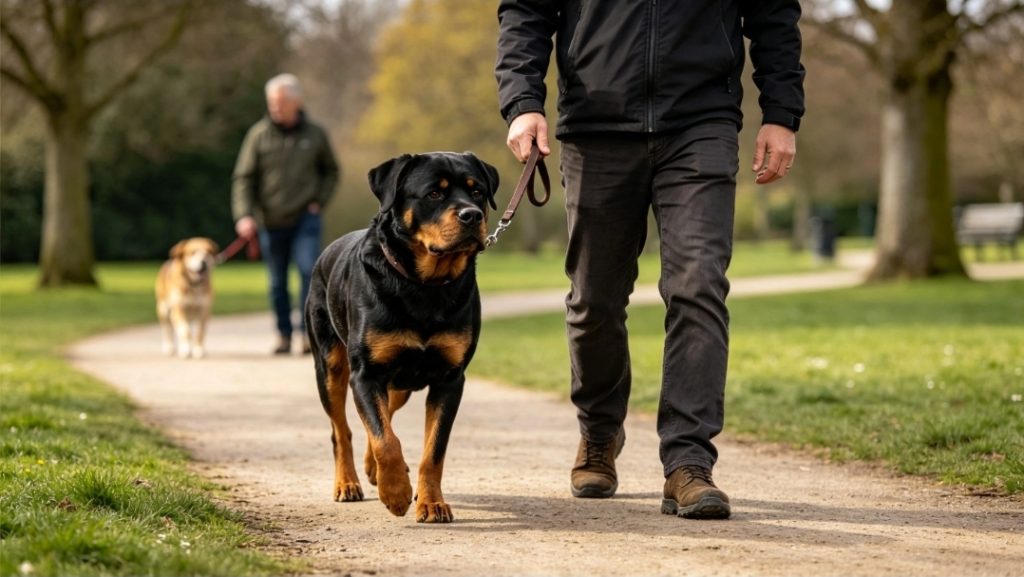
Communication does not stop when you leave the house. Walking introduces movement, changing distances, unfamiliar surroundings, distractions and interactions that can alter your dog’s behaviour.
Pay attention to how your dog responds when:
- Another dog appears in the distance.
- A person approaches or passes nearby.
- The walking environment becomes busier.
- The lead becomes tight.
- Your direction or pace changes.
- Your dog encounters an unfamiliar sound or object.
For example, a dog that looks repeatedly towards another dog may be interested, uncertain, excited or struggling to disengage. Pulling towards the dog does not, by itself, tell you which explanation is correct.
Observe the dog’s body, movement, attention and ability to respond to you. If tension or distress increases, create more distance where possible and avoid forcing a close encounter.
The K9 Communication in Motion course — Understanding Communication During Walks focuses on communication while moving through everyday environments, helping handlers consider attention, movement, changing situations and teamwork during walks and training.
How Can I Respond More Effectively to My Dog’s Signals?
Understanding a signal is only the first step. You also need to decide what action, if any, the situation requires.
A practical approach is to follow this sequence:
1. Observe
Look at your dog’s body language, behaviour, surroundings and response. Avoid immediately labelling the behaviour or assuming you already know the cause.
2. Interpret
Consider the possible explanations. Is your dog comfortable, excited, uncertain, distracted, frightened or physically uncomfortable? Remember that you are assessing possibilities, not reading the dog’s mind.
3. Decide
Determine what the situation requires. Your dog may need more distance, a quieter environment, a pause, a familiar cue or a change in activity.
4. Communicate
Use clear, appropriate guidance. This may mean changing your position, adjusting the lead, reducing the difficulty of an exercise or allowing your dog to disengage. Do not add unnecessary pressure when the dog is already struggling.
5. Observe the Response
Watch what happens after you change your approach. Does your dog become more relaxed, regain attention, move away or remain uncomfortable?
6. Reassess
Use the response to decide what to do next. If the dog is coping comfortably, you may be able to continue at an appropriate level. If discomfort increases, reduce the pressure further or end the interaction.
This process helps you make decisions based on the dog in front of you rather than following a fixed assumption about what a particular signal always means.
Common Mistakes When Reading Dog Communication
Even experienced owners can misinterpret canine behaviour when they focus on one signal or expect every dog to respond in the same way.
Avoid these common mistakes:
- Assuming a wagging tail means friendliness. Assess the tail alongside posture, movement and the surrounding situation.
- Treating a growl as meaningless noise or deliberate disobedience. Take it seriously as information that the dog may be uncomfortable or attempting to increase distance.
- Assuming a quiet dog is comfortable. Stillness can have different explanations, including fear or uncertainty.
- Ignoring attempts to move away. Allow the dog space rather than repeatedly initiating contact.
- Judging behaviour without considering the environment. Distractions, restraint, unfamiliar surroundings and previous experiences can all influence responses.
- Continuing when discomfort is increasing. Change the situation instead of waiting for a more obvious reaction.
- Expecting every dog to communicate identically. Learn the individual dog’s normal behaviour and recognise changes from that baseline.
The goal is not to assign a fixed meaning to every movement. It is to become more observant, recognise patterns and respond appropriately to the information available.
RECOMMENDED PRODUCTS
How Can I Become Better at Understanding My Dog?
Improving your understanding starts with everyday observation. You do not need to wait for a difficult behaviour to occur before paying attention to your dog’s communication.
During ordinary interactions, notice how your dog approaches you, responds to touch, engages with play, settles at home and reacts to changes in the environment. Compare those responses across different situations.
When something changes, ask yourself:
- What was happening immediately beforehand?
- What did my dog do differently?
- What other signals accompanied that behaviour?
- Did my actions or the environment influence the response?
- What happened when I gave my dog more space or changed my approach?
Over time, these observations can help you recognise patterns and make better-informed decisions. They can also help you identify when a behaviour is outside your experience and professional guidance is needed.
Understanding your dog is not about predicting every action perfectly. It is about recognising communication, responding thoughtfully and being prepared to reassess when the situation changes.
Conclusion: Listen to What Your Dog Is Communicating
Dogs communicate through their body language, behaviour, movement, vocalisations and responses to the world around them. To understand these signals, look at the whole dog, consider the context and notice changes from their usual behaviour.
A single signal rarely provides the complete answer. Observe first, interpret carefully, respond appropriately and reassess your dog’s reaction. This helps you recognise comfort and discomfort earlier, respect your dog’s boundaries and develop clearer communication in everyday life.
If your dog’s behaviour suggests significant fear, persistent anxiety or a risk to people or other animals, prioritise safety and seek appropriate professional support rather than trying to interpret or manage the situation alone.