What to Do When Your Dog Barks at Other Dogs on Walks
When your dog barks at other dogs on walks, observe its body language, assess the distance and create space before the situation becomes difficult to manage. Barking can be associated with excitement, frustration, fear or discomfort, so understanding the circumstances is essential before deciding how to respond.
The aim is to help your dog notice other dogs without automatically barking, lunging or pulling towards them. This takes consistent training, appropriate distance and an understanding of what your dog can comfortably manage.
RECOMMENDED PRODUCTS

Why Does Your Dog Bark at Other Dogs on Walks?
Barking is a behaviour, not a complete explanation of what your dog is experiencing. Different dogs can display similar reactions for different reasons, and some may experience several contributing factors at once.
Common reasons include:
- Excitement: Your dog becomes highly stimulated when another dog appears.
- Frustration: Your dog wants to approach another dog but cannot reach it because of the lead.
- Fear or discomfort: Your dog feels threatened, uncertain or uncomfortable with the other dog’s proximity.
- Anticipation: Your dog expects to play or greet another dog whenever one appears.
- Previous experiences: Earlier encounters influence how your dog responds to similar situations.
- Environmental pressure: Noise, crowds, narrow paths and limited space make the encounter harder to manage.
Do not assume that barking automatically means aggression or that your dog simply wants to play. The same outward behaviour can have different causes.
Look at your dog’s posture, movement, facial expression, tail position, lead tension and ability to disengage from the other dog. Also consider what the other dog is doing and whether your dog has enough room to move away.
If the behaviour appears suddenly or changes significantly, particularly alongside signs of pain or illness, consult your vet to investigate possible medical causes.
Common Problems When Your Dog Barks at Other Dogs
Pulling and Barking Together
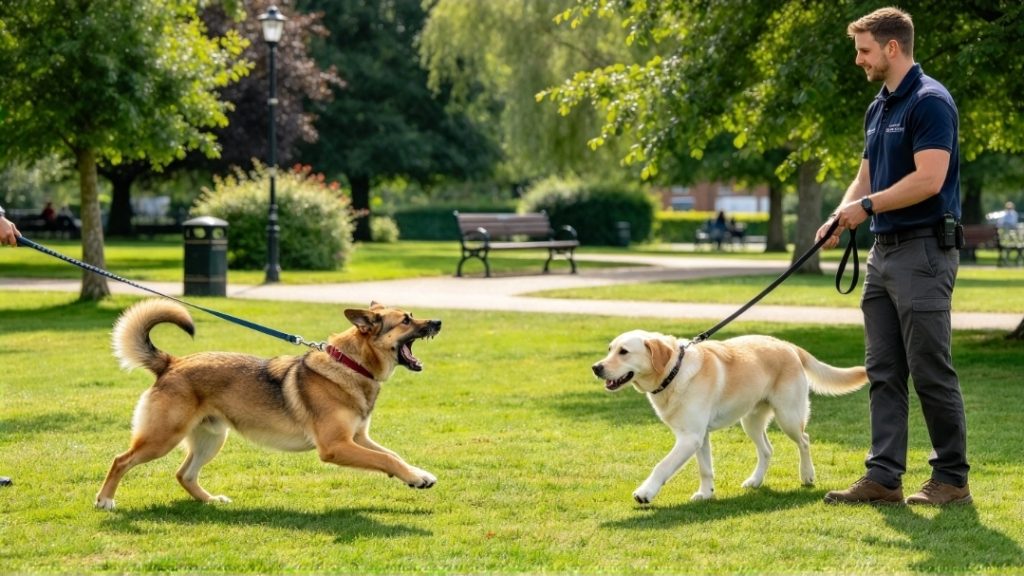
Some dogs pull towards another dog while barking, staring intensely or repeatedly changing direction. Others become stiff, freeze, retreat or attempt to escape.
These differences matter because similar outward behaviours can have different underlying causes.
Maintain a secure hold on the lead without jerking it. If possible, increase the distance between your dog and the other dog. Change direction or move to a suitable area where you can manage the encounter safely.
The priority is to prevent the situation from escalating, not to force your dog to walk past at close range.
Excitement Around Other Dogs
Your dog may notice another dog from a distance and immediately become more alert. As the distance decreases, excitement may increase until barking and pulling begin.
If encounters regularly result in play or greetings, your dog may start anticipating interaction whenever another dog appears.
Develop a consistent routine in which seeing another dog does not automatically lead to a greeting. When your dog notices another dog and remains comfortable, reward calm observation and appropriate engagement with you.
Frustration When Your Dog Cannot Approach
A dog that wants to reach another dog may pull, bark, whine or move from side to side when restrained.
Frustration is one possible explanation, but the behaviour alone cannot confirm it. A dog that feels threatened or uncomfortable may display similar actions.
Avoid allowing pulling and barking to become the expected route to a greeting. Create space, assess your dog’s response and continue only when the situation is manageable.
RECOMMENDED PRODUCTS
Fear or Discomfort Around Other Dogs
Some dogs bark when another dog approaches because they feel uncomfortable or threatened. You may notice tension, intense staring, a tucked tail, retreating or attempts to increase the distance.
Do not force your dog to remain close to another dog to prove it can cope. Allow space and avoid situations in which your dog feels trapped.
If your dog repeatedly reacts with fear, lunging or attempts to bite, seek qualified professional support rather than arranging close encounters yourself.
Barking in Busy Walking Environments
The other dog may not be the only factor affecting your dog’s behaviour. Pedestrians, children, cyclists, traffic, unfamiliar surroundings and limited space can all contribute to the difficulty of an encounter.
Consider the complete environment before deciding how to respond. Choosing a quieter route or walking at a less busy time may make it easier to manage the situation and practise appropriate behaviour.
Common Mistakes When Walking Past Other Dogs
Waiting Until the Barking Becomes Intense
When barking, pulling and lunging have already escalated, it may be more difficult to redirect your dog or move away calmly.
Observe your dog as soon as another dog appears. Changes in posture, staring, movement, lead tension and vocalisation can help you recognise when the situation is becoming more difficult.
Respond early by assessing the distance and creating space before the encounter becomes unmanageable.
Repeating Commands Without Assessing the Situation
Repeatedly calling your dog’s name or issuing several commands does not necessarily address the reason for the reaction.
If your dog is struggling with the distance or environment, additional verbal instructions may not help it cope.
Focus on clear communication, appropriate handling and environmental management. Practise familiar skills in quieter conditions before introducing more challenging distractions.
Allowing Every Encounter to Become a Greeting
Socialisation does not mean that your dog must greet every dog it sees.
Frequent greetings can create an expectation that approaching other dogs is part of every walk. Some dogs also need more space to feel comfortable.
Teach your dog that another dog can be present without physical interaction. Passing calmly, changing direction or moving away can all be appropriate outcomes.
Forcing Your Dog to Remain Close to Another Dog
Do not deliberately bring your dog closer to another dog when it is already showing signs of distress or escalating behaviour.
Repeated exposure to situations your dog cannot comfortably manage may increase stress rather than help it learn.
Progress should be guided by your dog’s response, with enough space to remain safe and capable of learning.
Punishing the Barking
Shouting, jerking the lead or punishing your dog can increase stress and may make the presence of other dogs feel even more unpleasant.
Barking can also be an important warning that your dog is uncomfortable. Suppressing the warning does not necessarily resolve the underlying emotion.
Instead, manage the distance, reduce the difficulty and reward appropriate responses when your dog is comfortable enough to learn.
What to Do When Your Dog Starts Barking
Use the following sequence to assess and manage the situation.
1. Observe Your Dog and the Environment
Look at your dog’s posture, movement, facial expression, attention and vocalisation. Consider the other dog’s behaviour, the available space and what else is happening nearby.
Ask yourself:
- Is your dog moving towards the other dog or trying to move away?
- Is its body relaxed or becoming tense?
- Is the other dog approaching directly?
- Is there enough room to change direction?
- Are additional distractions increasing the difficulty?
- Can your dog still respond to familiar communication?
These observations provide more useful information than focusing on the barking alone.
2. Assess Whether the Situation Is Manageable
Determine whether your dog can remain calm enough to continue walking and respond to you.
A dog that notices another dog and remains relaxed is in a different situation from one that is barking, lunging or struggling to be managed.
Do not judge progress solely by how close your dog can get to another dog. The priority is a safe, manageable encounter.
3. Create Space Where Necessary
If your dog becomes increasingly stimulated or uncomfortable, increase the distance where possible.
You can turn away, cross the road when safe or move behind a suitable barrier to help prevent a close encounter.
Avoid allowing unfamiliar dogs to approach each other when you are unsure whether the interaction is safe. If another dog is off the lead and approaching, prioritise distance and safety rather than attempting a training exercise.
4. Communicate Clearly
Use calm, consistent handling and avoid turning the encounter into a continuous sequence of commands.
When your dog is comfortable enough to engage with you, suitable food rewards, praise or another established positive reinforcer can support the behaviour you want to encourage.
Reward calm observation and appropriate engagement at a manageable distance. Do not require your dog to remain close to something it finds frightening or overwhelming.
5. Reassess Before Continuing
Once you have created space, observe whether your dog is becoming calmer and more manageable.
If your dog settles and the route is safe, you may be able to continue. If your dog remains distressed or difficult to control, move further away, choose another route or end the encounter.
Reassess the situation rather than continuing simply because you planned to complete the walk.
Understanding Distance During Social Walking
Distance is one of the most important factors when managing a dog that barks at other dogs.
Your dog may remain relaxed when another dog is across a field but begin barking when the distance decreases. There is no single distance that works for every dog, and the same dog may cope differently depending on the environment, previous experiences and its current state.
The aim is to identify a distance at which your dog can notice another dog while remaining comfortable enough to respond to you and learn.
Begin in environments that offer plenty of space. Reward suitable responses and make changes gradually, guided by your dog’s behaviour rather than a fixed timetable.
If your dog begins staring intensely, stiffening, pulling or barking, increase the distance instead of continuing to approach.
The objective is not to force your dog to tolerate a closer encounter. It is to develop a safer, calmer response over time.
How to Help Your Dog Become Calmer Around Other Dogs
Start in an Easier Environment
If your dog reacts to dogs on busy pavements, begin practising in a quieter area where you have more control over the distance.
Choose a location that allows your dog to notice another dog without being forced into a close encounter. Avoid starting somewhere crowded simply because you want to expose your dog to more distractions.
Reward Calm Observation
When your dog notices another dog and remains comfortable, use a suitable reward.
You can reward your dog for looking at the other dog calmly, turning its attention towards you or continuing to walk without pulling.
Initially, your dog may only manage a brief glance before becoming distracted. Reward appropriate responses and allow enough distance for your dog to remain comfortable.
If your dog cannot take food, respond to you or disengage from the other dog, the situation may be too difficult. Increase the distance instead of repeatedly presenting rewards.
Teach Your Dog to Change Direction
Practise turning with you in a quiet environment before using the skill around other dogs.
Walk forward, change direction and reward your dog for following. Repeat until the movement becomes familiar.
When another dog appears too close, a well-practised turn can help you move away without pulling your dog through the encounter.
Avoid Rushing Progress
Once your dog can remain calm at a particular distance, repeat the exercise in manageable sessions.
Change one aspect of the exercise at a time, such as the distance, movement of the other dog or level of environmental activity.
If barking returns or your dog becomes increasingly tense, make the exercise easier. Do not continue moving closer simply because the previous repetition went well.
Keep Walks Manageable
Your dog does not need to practise around other dogs throughout the entire walk.
Choose routes that allow you to create space and reduce unnecessary close encounters while you develop the necessary skills.
Calmer walking opportunities are useful for everyday exercise and exploration. Structured training can then take place in situations where you can better control the difficulty.
How to Recognise Progress
Progress is not measured solely by whether your dog stops barking immediately.
Look for improvements in the overall walking experience, including:
- Your dog notices another dog without immediately escalating.
- Your dog can maintain a more comfortable distance.
- You recognise changes in body language earlier.
- You can change direction or create space safely.
- Your dog can pass some dogs without greeting them.
- Your dog recovers more readily after a difficult encounter.
- You recognise environments that are currently too demanding.
Progress will vary between individual dogs. Avoid comparing your dog’s response with another dog’s behaviour or expecting every encounter to be successful.
Keep training appropriate to your dog’s ability and use manageable environments to build consistency. If the behaviour is worsening or remains difficult to manage, seek professional advice.
RECOMMENDED PRODUCTS
When to Seek Professional Dog Training Support
Seek professional support if your dog repeatedly barks and lunges at other dogs, appears frightened, attempts to bite, redirects its behaviour towards you or cannot be managed safely on walks.
A qualified professional can help assess possible causes and establish suitable changes to handling, distance, environment and training.
If your dog has a history of biting or presents an immediate risk to other dogs or people, prioritise safe separation and seek appropriate behaviour support. Do not deliberately expose your dog to close encounters to test whether it has improved.
If the behaviour has appeared suddenly or is accompanied by signs of pain or illness, consult your vet as well.
Final Thoughts: What to Do When Your Dog Barks at Other Dogs on Walks
When your dog barks at other dogs on walks, consider the complete situation rather than treating the barking as an isolated problem.
Observe your dog’s body language, assess the distance, consider the environment, communicate clearly and reassess before continuing. Excitement, frustration, fear and environmental pressure can produce similar outward behaviours, so your response should reflect the individual dog and circumstances.
Your dog does not need to greet every dog it sees. Learning to notice other dogs, remain comfortable at an appropriate distance and continue walking without an unwanted interaction is a valuable everyday skill.
With appropriate management, consistent positive training and professional support when needed, you can work towards calmer and more predictable walks without forcing your dog into situations it is not ready to manage.