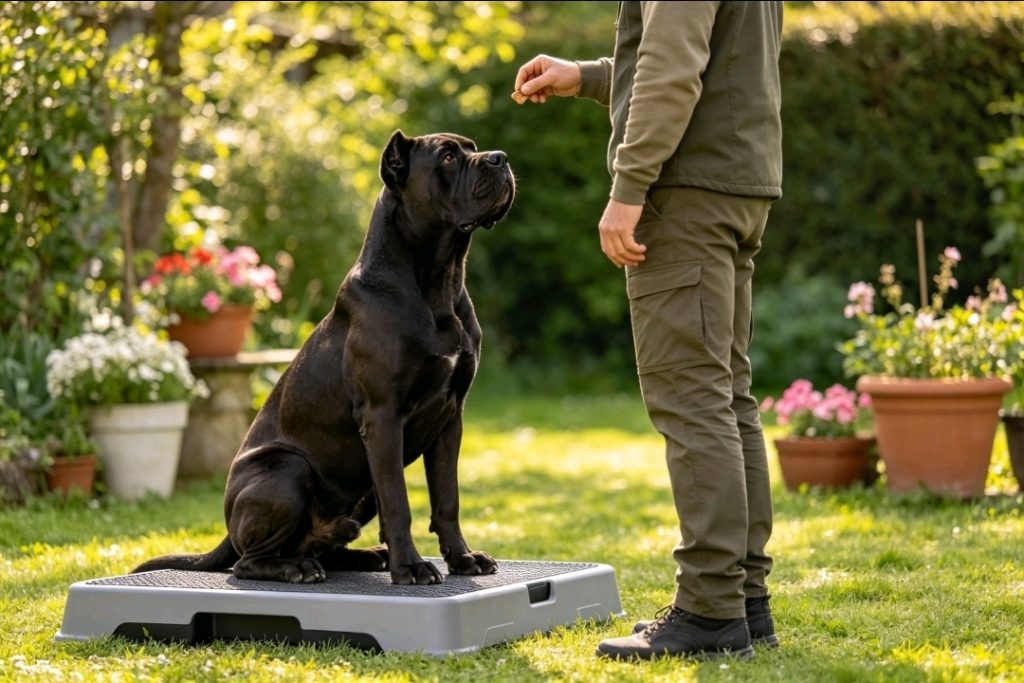
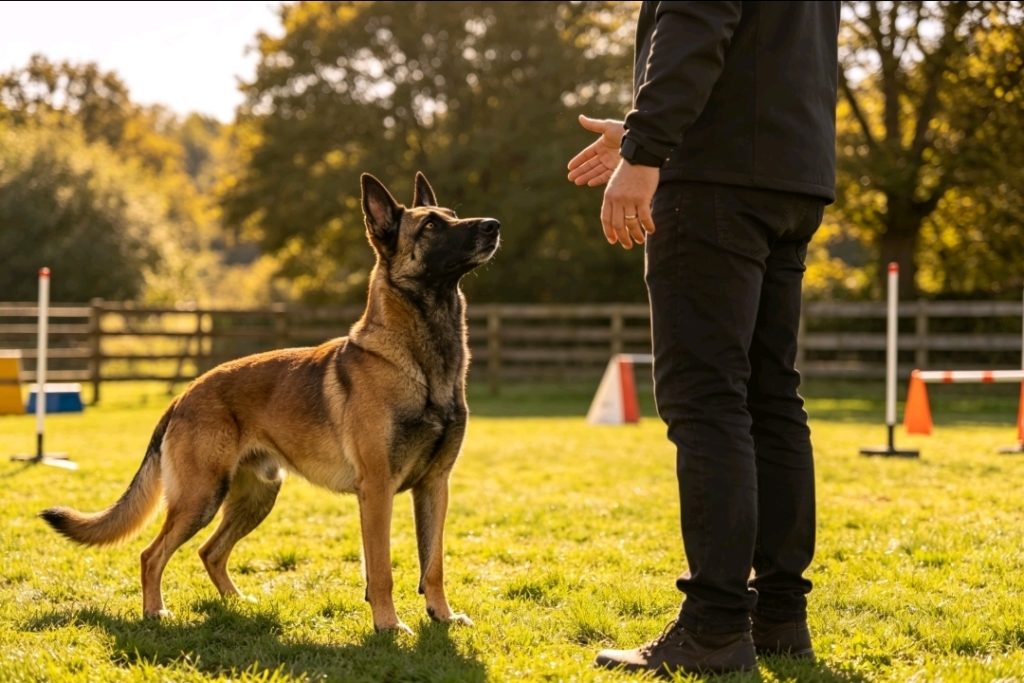
Why is my dog not progressing with training?
When a dog is not progressing with training, the answer is not always to train for longer or increase the difficulty. Progress depends on the dog’s current state, motivation, environment, level of control and ability to remain engaged with the training process. If progress has stopped, observe what is happening, assess the situation and identify what may be affecting the dog’s response before making another change.
RECOMMENDED PRODUCTS — Obedience Training
Start by observing what has changed
Before changing the training, look carefully at your dog’s response.
Ask yourself:
- Is your dog still engaging with you?
- Is your dog responding to food motivation?
- Is your dog becoming distracted?
- Is your dog remaining calm enough to learn?
- Has the training environment changed?
- Have distractions increased?
- Has the level of freedom increased?
- Is the current equipment appropriate?
- Has your dog stopped responding in the same way as before?
A lack of progress can have several possible causes. Careful observation helps you identify what is actually happening rather than simply assuming that your dog needs more training.
Assess your dog’s current training stage
Progression should be based on your dog’s response, not simply on how long you have been training.
If your dog was previously responding appropriately but is now struggling, assess the current stage before moving forward.
The difficulty may have increased too quickly. The environment may be making the training harder. Your dog may be distracted, or the current level of control may not be appropriate for the situation.
If the current stage is too difficult, returning to an easier stage can help rebuild the behaviour before progressing again.
Going backwards temporarily does not mean that your dog has failed. It means that the current training stage needs to be reassessed.
Consider food motivation
GPK9 obedience training considers the dog’s individual food drive.
Some dogs have:
- Low Food Drive
- High Food Drive
Food can be used as motivation during structured obedience training, but the dog’s individual response to food should be considered.
If your dog has stopped responding to food in the way it previously did, do not automatically assume that the dog is refusing to learn.
Observe the circumstances and assess whether the environment, distractions, training difficulty or the dog’s current state is affecting its food motivation.
Look at the training environment
A dog may respond well in one environment and struggle in another.
If you have increased the number of distractions, changed location or given the dog greater freedom, the training may suddenly become more difficult.
Consider whether the environment is helping your dog learn.
Where unnecessary distractions are interfering with training, remove or reduce them where appropriate.
Training should provide the dog with an environment in which it can remain engaged and respond appropriately before difficulty is increased again.
Check the level of control
The equipment and level of control should be appropriate to the dog’s current training situation.
For obedience training, GPK9 uses appropriate control including:
- Short Line
- Harness
- Long Line
- Free Roam
- Muzzle where appropriate to the training state
The aim is not to increase freedom simply because your dog has completed a particular amount of training.
Greater freedom should be accompanied by appropriate behavioural responsibility.
If increased freedom results in reduced engagement or control, reassess whether your dog is ready for that level of freedom.
Do not keep increasing the difficulty
One common reason for stalled progress is continuing to increase the difficulty when the dog is already struggling.
If your dog cannot respond appropriately at the current stage, making the exercise harder is unlikely to solve the problem.
Instead:
OBSERVE → ASSESS → ADJUST → REASSESS
Identify what is affecting your dog’s response.
Make an appropriate adjustment.
Then reassess.
This may mean reducing distractions, changing the environment, adjusting the level of control or returning to an easier stage.
Allow your dog to calm
A dog that cannot remain calm enough to learn may need the training situation changed before continuing.
Remove unnecessary distractions where appropriate and allow the dog to return to a suitable training state.
Once the dog is calm and able to engage again, reassess the situation.
If your dog can respond appropriately, training can continue.
If your dog cannot reduce or cannot calm, a reset may be required before returning to training.
Progress is not always linear
Training does not have to move forward continuously.
A dog may progress in one environment and struggle in another. It may respond well at one level of difficulty and need additional work before progressing further.
The important part is recognising the dog’s current response and making the appropriate decision from there.
Sometimes the correct next step is to continue.
Sometimes it is to simplify the training.
Sometimes it is to reduce distractions.
Sometimes it is to return to an earlier stage.
The aim is to create successful progression rather than simply moving through stages as quickly as possible.
Reassess after every adjustment
After making a change, observe your dog again.
Has engagement improved?
Is your dog responding appropriately?
Is the dog calmer?
Is the environment more suitable?
Can the dog continue learning?
Reassessment tells you whether the adjustment has helped.
If it has, you can continue from the appropriate stage. If it has not, reassess again and make another appropriate change rather than repeatedly increasing the difficulty.
When should I return to an earlier stage?
Returning to an earlier stage is appropriate when the dog is struggling with the current level of training.
An easier stage can provide an opportunity to rebuild engagement and successful responses before progressing again.
This is particularly relevant when:
- The environment has become more difficult.
- Distractions are interfering with training.
- Your dog has increased freedom but reduced control.
- Food motivation has changed.
- Your dog is no longer remaining engaged.
- Your dog cannot remain calm enough to continue.
- The current training stage is simply too difficult.
The aim is to find the appropriate training level for your dog at that moment.
When should professional support be considered?
If you cannot identify why your dog is not progressing, or the situation requires additional expertise, professional support can help assess the training situation and determine an appropriate next step.
Professional support should be considered where the dog’s behaviour, environment or training response cannot be safely or appropriately managed through your current training process.
RECOMMENDED COURSES
GOLDEN RULE 2 — OBEDIENCE
The GOLDEN RULE 2 — OBEDIENCE course is directly relevant when your dog is not progressing with training because it focuses on structured obedience, food motivation, control, engagement, progression and suitable training environments.
The GPK9 PROFESSIONAL TRAINING SYSTEM provides a structured process for understanding what is happening before deciding what to do next.
Within the GPK9 system, the traffic-light process provides a clear progression pathway:
GREEN → OBSERVE → CONTINUE → PROGRESS
If the dog is not in a suitable state, the process becomes:
AMBER → OBSERVE → ASSESS → REMOVE FROM DISTRACTION → CALM → REASSESS
If the dog returns to calm, training can continue. If the dog cannot reduce or cannot calm, the process moves to red and the dog returns to the crate for a reset before returning to the relevant Golden Rule.
This gives both first-time dog owners and professional dog trainers a structured way to identify when to continue, when to adjust the training and when a reset is required.
GPK9’S FIVE GOLDEN RULES
The GPK9 Five Golden Rules are broken down into bite-sized, easy-to-understand sections so that the wider GPK9 PROFESSIONAL TRAINING SYSTEM can be learned progressively. The Five Golden Rules are separate parts of one connected system, and no single Golden Rule course teaches the complete system. An individual course can provide useful information for a specific training requirement, such as understanding why a dog is not progressing, but understanding the complete system requires all five Golden Rules. The system is designed to be practical and understandable for both first-time dog owners and professional dog trainers. Learning all five provides a broader understanding of how different areas connect and how observation, assessment, adjustment, resetting and progression can be applied across different situations. One Golden Rule may be particularly relevant to a specific problem, but it is only one part of the complete GPK9 PROFESSIONAL TRAINING SYSTEM.