How to Use a Dog Crate, Training Mat and Playpen Together
Using a dog crate, training mat and playpen together can become confusing when each area is used without a clear purpose or when the puppy is expected to understand the difference automatically. A young puppy may become unsettled when moved repeatedly between spaces, leave the training mat whenever household activity starts, become overexcited inside the playpen or resist entering the crate when the areas have not been introduced consistently. Handlers can also become frustrated when they provide more freedom than the puppy can manage or use one area as a response to every unwanted behaviour. Without clear structure, the three areas can become confusing rather than providing a gradual progression through different levels of freedom and management.
RECOMMENDED PRODUCTS
Secure puppy crate — Crates & Pens
A suitable puppy crate can provide a secure defined area that forms part of a structured home routine and early puppy management.
Common Problems
One common problem is treating the crate, training mat and playpen as if they have identical purposes. Although all three can provide boundaries, they represent different types and levels of access within the home.
A puppy may be expected to settle on a training mat when it has not developed sufficient understanding, or given playpen freedom when it is still struggling to manage a smaller environment. This can create repeated unwanted behaviour and make progression difficult to assess.
Another problem occurs when the handler moves the puppy between all three areas without a consistent routine. The puppy may not understand why one area requires calm behaviour while another allows greater movement.
Common Issues
A dog crate can become associated with restriction when it is used primarily after unwanted behaviour. The puppy may begin to resist entering the crate or become unsettled when the handler approaches it.
The training mat can create issues when the puppy is expected to remain there despite increasing distractions, movement or household activity. Repeatedly leaving the mat can become a source of frustration for the handler.
The playpen can create separate problems when it provides too much stimulation. If the puppy is continually playing, seeking attention or reacting to people around the pen, the puppy may struggle to understand that monitored freedom still requires appropriate behaviour.
Common Mistakes
A common mistake is introducing all three areas without considering progression. The puppy may be given access to the playpen before it has developed an appropriate understanding of the earlier stages of home structure.
Another mistake is changing the purpose of each area from one situation to another. If the mat becomes a place for play, the playpen becomes a place for unrestricted activity and the crate becomes a place associated only with unwanted behaviour, the distinctions between the three areas can become less clear.
A further mistake is allowing different household members to use the areas according to different expectations.
Frustration
Confusion between the three areas can create frustration for both puppy and handler. The puppy may repeatedly leave the mat, attempt to exit the playpen or become unsettled when entering the crate.
The handler may feel that the puppy understands one area but suddenly becomes difficult when moved into another. This can lead to repeated interruptions and unnecessary changes to the puppy’s level of freedom.
Timing
Timing becomes important when moving a puppy between the crate, training mat and playpen. If the puppy is already highly excited, moving directly into another area may not result in the calm behaviour the handler expects.
Progression can also become poorly timed when greater freedom is introduced simply because the puppy has behaved appropriately for a short period. A temporary improvement does not necessarily demonstrate that the puppy is ready for the next stage.
Misunderstanding and Miscommunication
A puppy does not automatically understand what each area represents. The handler may understand that the crate provides security, the training mat provides a defined location for calm behaviour and the playpen provides monitored freedom, but these distinctions have to become meaningful through consistent experiences.
Miscommunication can also occur when household members use different expectations. One person may encourage the puppy to play on the mat while another expects the puppy to remain calm there. These differences can make progression less clear.
RECOMMENDED PRODUCTS
Training mat — Dog Beds & Rest
A dedicated training mat provides a clearly defined location that can support calm home behaviour as the puppy progresses towards greater freedom.
GPK9’S FIVE GOLDEN RULES
The GPK9 Five Golden Rules provide one connected system for understanding how the dog crate, training mat and playpen can work together within the home.
These areas are not treated as three unrelated pieces of equipment. They form part of a wider progression involving home structure, communication, obedience, play, toilet routines and the puppy’s ability to remain manageable around different environments.
The system can be applied from the early puppy stage through to more advanced dog training, giving the handler a framework for recognising behaviour, monitoring progression and maintaining consistent expectations.
Golden Rule One — Home and Social
How to Use a Dog Crate, Training Mat and Playpen Together connects directly to Golden Rule One.
GPK9 Golden Rule One establishes the progression:
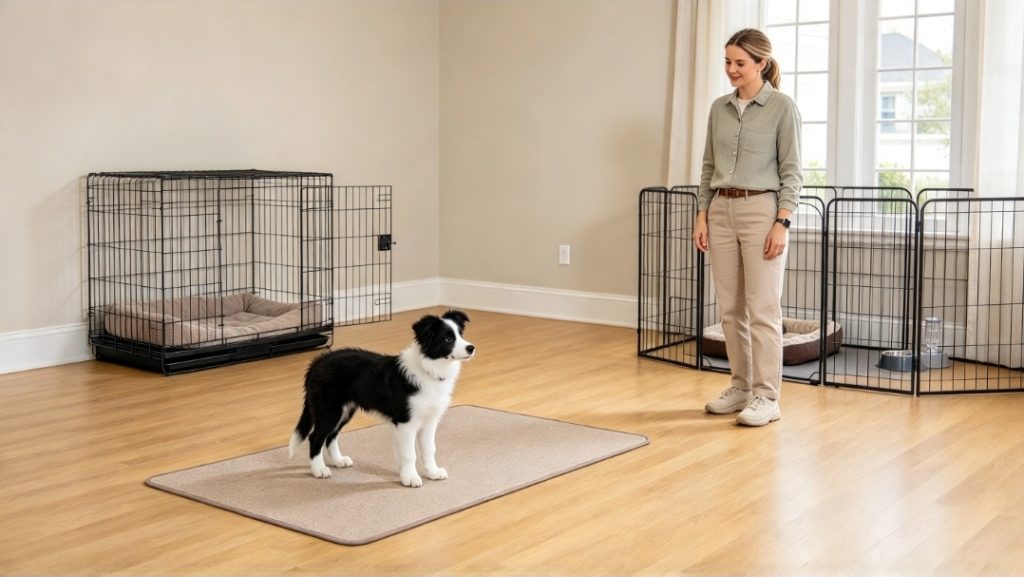
Crate → Placemat → Playpen
The crate provides safety, reset and toilet support.
The placemat provides calm home freedom.
The playpen provides monitored freedom.
This progression gives each area a clear position within the wider home structure. The puppy is not simply moved between three different pieces of equipment; the handler is monitoring the puppy’s behaviour as freedom develops.
The traffic-light system supports this progression. Green indicates appropriate progress and continued monitoring. Amber indicates that behaviour requires observation and review. Red indicates that the current situation should stop or return to a more controlled stage.
Golden Rule Two — Obedience
Obedience connects to How to Use a Dog Crate, Training Mat and Playpen Together because the puppy needs clear communication as it moves through different levels of freedom.
GPK9 Golden Rule Two uses food and luring alongside praise, shaping and movement within structured exercises. Consistency in the training area and timing helps the handler communicate more clearly with the puppy.
This supports the wider progression because the puppy’s behaviour in each area can provide information about its current level of understanding.
Golden Rule Three — Prey Drive and Play
Play can affect how a puppy responds to the playpen and the wider home environment. Movement, toys and interaction can increase excitement and make it more difficult for the puppy to remain manageable.
GPK9 Golden Rule Three separates structured play from obedience training and focuses on observing engagement and arousal.
This is relevant when using a dog crate, training mat and playpen together because each area should remain connected to its appropriate purpose rather than becoming a constant source of stimulation.
Golden Rule Four — Toilet
Toilet training is particularly connected to the early stages of home structure.
GPK9 Golden Rule Four establishes consistency around the same place, the same time and a toilet command. The crate can provide toilet support while the puppy is developing its routine, while increasing freedom requires continued observation of the puppy’s behaviour and toilet needs.
This allows toilet training to remain part of the wider home system rather than becoming a separate issue.
Golden Rule Five — Social Walking and Ignore the World
Although How to Use a Dog Crate, Training Mat and Playpen Together focuses on the home, Golden Rule Five connects with the puppy’s wider ability to remain calm and manageable around environmental activity.
The puppy’s development should not be limited to one room or one piece of equipment. As the puppy progresses outside the home, it encounters movement, sounds, people, animals and other environmental pressures.
GPK9 Golden Rule Five focuses on a calm, relaxed and manageable walk without relying on continuous commands. This complements the structured progression established within the home.
Final Connection
How to Use a Dog Crate, Training Mat and Playpen Together is about understanding how three different areas can form part of one structured progression.
The crate, placemat and playpen each provide a different level of management and freedom. The crate provides safety, reset and toilet support; the placemat provides calm home freedom; and the playpen provides monitored freedom.
The GPK9 Five Golden Rules bring this structure together with obedience, play, toilet routines and social walking. Rather than treating each area as an isolated solution, the system allows the handler to observe the puppy’s behaviour and consider whether progression is appropriate.
The key is not simply having a crate, training mat and playpen. It is understanding when, why and how each area fits into the puppy’s development, while maintaining consistent communication, timing, boundaries and progression.