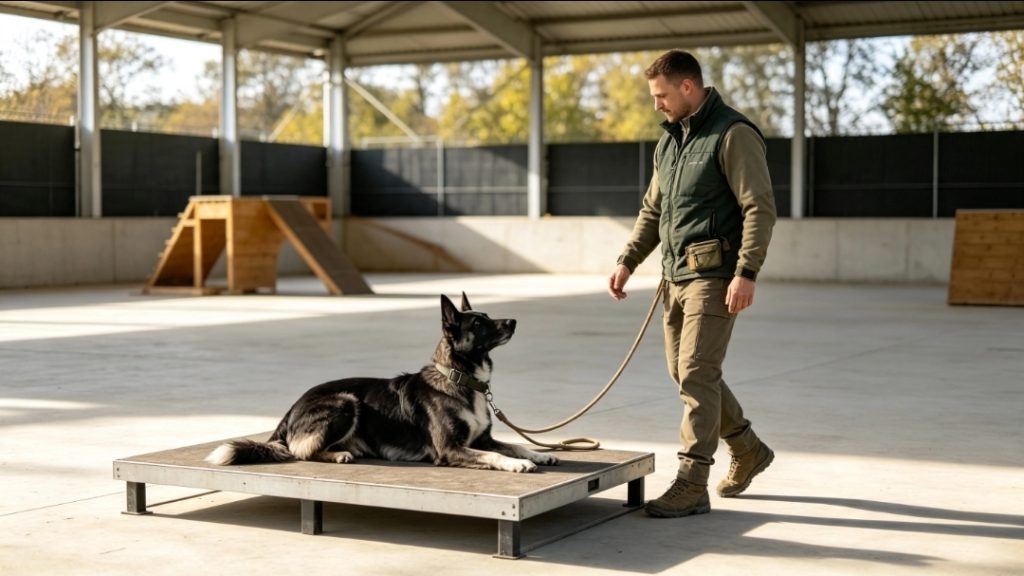
How to Use a Dog Training Mat to Create Structure at Home
How to Use a Dog Training Mat to Create Structure at Home is an important part of creating clear structure for your dog. A training mat can provide a consistent place for your dog to settle, observe and understand what is expected within the home environment. However, simply purchasing a mat and placing it on the floor does not automatically create structure. The way the mat is introduced, used and incorporated into your dog’s daily routine can make a significant difference.
RECOMMENDED PRODUCTS
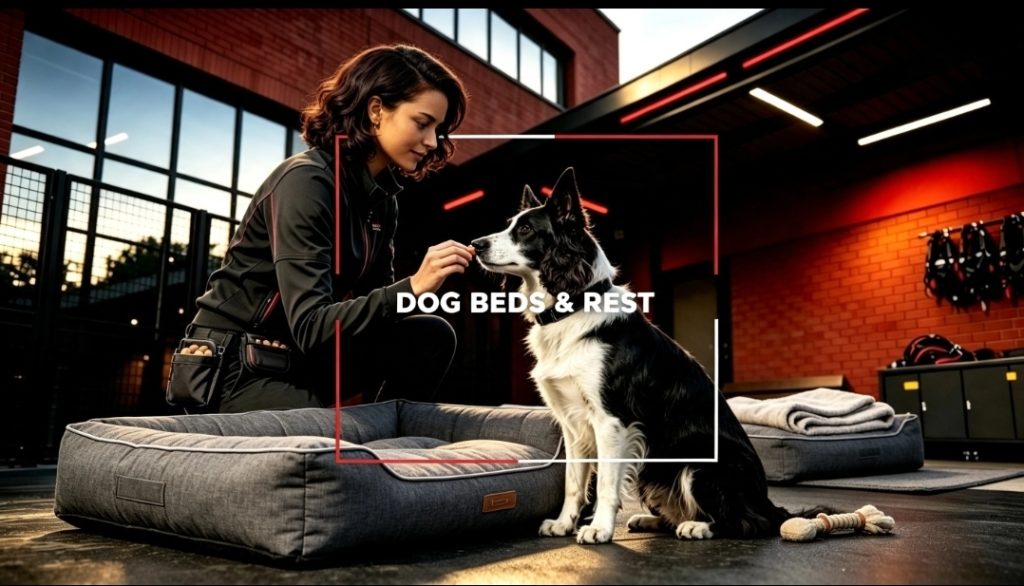
Dog Training Mat
A durable, non-slip dog training mat can provide a consistent place for your dog to settle and learn within the home.
Treat Pouch
A suitable treat pouch allows rewards to be delivered clearly and consistently during structured training.
Why Use a Dog Training Mat?
One of the common mistakes owners make is treating a training mat as nothing more than a bed. While a comfortable bed has an important purpose, a training mat can have a different role within a structured training system.
The purpose is not simply to tell a dog where to lie down. The mat can become part of a predictable routine that helps the dog understand where calm behaviour, observation and controlled freedom take place.
Without clear structure, owners can unintentionally give a dog too much freedom too quickly. This can result in jumping, pacing, unwanted interaction, following people around the house, stealing objects, excessive excitement or difficulty settling.
A mat can therefore become one part of a wider approach to creating boundaries and predictable behaviour inside the home.
Common Mistakes When Using a Training Mat
A frequent mistake is introducing the mat without establishing what it is intended to achieve.
Another is expecting the dog to remain on the mat for long periods before the dog understands the behaviour being taught.
Some owners repeatedly place their dog onto the mat but do not consider what happens before, during or after the exercise. Others allow the dog to leave repeatedly without addressing why the dog is struggling to remain settled.
Another common problem is using the mat only when the dog is already excited. This can make the exercise unnecessarily difficult.
Structure should be introduced progressively. The environment, timing, reward and level of freedom can all influence whether the dog is able to remain calm and focused.
This is where having a consistent training system becomes important.
GPK9’s Approach to Home Structure
GPK9 uses a structured system that considers the dog’s environment, behaviour and level of freedom rather than treating individual training exercises as isolated activities.
Within the GPK9 system, the training mat can form part of a wider home structure alongside other controlled areas and routines.
The objective is not to provide every answer in a single exercise. Instead, the system gives the handler a framework for understanding when different forms of structure may be appropriate and how the dog’s behaviour can be monitored as training progresses.
This helps avoid one of the biggest mistakes in dog training: giving a dog more freedom than its current level of understanding can support.
GOLDEN RULE ONE — HOME AND SOCIAL

GOLDEN RULE ONE — HOME AND SOCIAL
Home structure is an important foundation for developing predictable behaviour.
A dog needs to understand how to move between different levels of freedom within the home. A crate, training mat and playpen can each have different purposes within a structured environment.
The mistake is assuming that one piece of equipment should be used for everything.
The GPK9 system considers the dog’s current behaviour and level of understanding when determining how structure is applied. The training mat can provide an opportunity for calm behaviour and controlled freedom, while other areas can provide different levels of management when required.
The important principle is consistency. The handler needs to understand why an area is being used rather than simply placing the dog there without a clear purpose.
GOLDEN RULE TWO — OBEDIENCE

Obedience training provides the communication needed for the dog and handler to work together effectively.
A training mat can support obedience development because it provides a consistent environment in which the handler can observe the dog’s behaviour and reinforce appropriate responses.
One common mistake is trying to teach too many behaviours at once. Another is changing the environment, timing and expectations constantly.
GPK9’s approach places importance on consistency and clear communication. The handler should understand what they are asking, why they are asking it and how the dog’s response should be recognised.
The mat therefore becomes part of a wider training environment rather than being treated as a standalone exercise.

Training Treats
Small, suitable training rewards can help maintain clear communication during structured exercises.
Long Line
A suitable long line can provide additional control and management when progressing training beyond the immediate home environment.
GOLDEN RULE THREE — PREY DRIVE / PLAY

GOLDEN RULE THREE — PREY DRIVE / PLAY
Play and prey-drive activities require a different approach from calm home structure.
A common mistake is allowing high-energy play to take over areas where the dog is expected to settle. When excitement and calm behaviour become mixed together without clear boundaries, the dog can struggle to understand the difference between training states.
GPK9’s system separates different activities so the handler can observe the dog’s behaviour and manage arousal appropriately.
The training mat is therefore not simply somewhere to continue playing. It can help provide a clear contrast between controlled calm behaviour and activities designed to increase engagement and motivation.
Understanding these differences allows the handler to create clearer expectations without relying on constant correction.
GOLDEN RULE FOUR — TOILET

Toilet training is another area where structure and routine can make a significant difference.
Owners sometimes provide too much freedom too quickly and then become confused when accidents occur. Others change locations, timings or routines frequently, making it more difficult for the dog to develop a predictable pattern.
A structured home environment can help the handler monitor what the dog is doing and recognise when greater freedom is appropriate.
The wider GPK9 system considers routine, location and observation as important parts of helping the dog develop reliable habits.
The training mat itself is not a replacement for appropriate toilet training. Instead, it can form part of a controlled home environment where the handler can better monitor behaviour.
GOLDEN RULE FIVE — SOCIAL WALKING / IGNORE THE WORLD

GOLDEN RULE FIVE — SOCIAL WALKING / IGNORE THE WORLD
Calm behaviour should not be limited to the home.
A dog that learns to settle inside the house may still struggle when exposed to distractions outside. Dogs encounter people, animals, sounds, movement and unfamiliar environments during everyday life.
The objective of social walking is not simply to make the dog walk from one location to another. It is about developing a calm and manageable state while experiencing the surrounding environment.
The same principle of observation and appropriate progression applies.
The handler should recognise when the dog is coping comfortably and when the environment has become too demanding. This provides an important connection between the structured home environment and the dog’s behaviour in the wider world.
Why Owners Often Struggle With Structure
Many owners are not deliberately doing anything wrong. They simply have never been shown how the different parts of a structured training system fit together.
They may purchase a crate, mat, playpen, harness or treats without understanding how each item should fit into the dog’s overall development.
This can lead to inconsistent expectations.
For example, an owner may allow unrestricted access to the house during one part of the day and then suddenly expect the dog to remain settled when visitors arrive. Another owner may repeatedly use a crate without understanding how controlled freedom should eventually develop.
The equipment is not the system.
The system is the understanding behind how, why and when each part is used.
Building Structure Without Creating Confusion
Good structure should make life clearer for both the dog and the handler.
The aim is not to restrict a dog unnecessarily. It is to provide an environment where expectations are understandable and freedom can develop alongside the dog’s ability to manage it.
This is one of the principles behind the GPK9 approach.
Rather than treating every training problem as a completely separate issue, the system looks at the dog’s overall development and the relationship between environment, communication, behaviour and progression.
That gives the handler a framework to work from without attempting to solve every problem through a single exercise.
When a Dog Is Struggling With the Mat
If a dog repeatedly leaves the mat, becomes highly excited, cannot settle or shows signs of frustration, simply increasing pressure is not necessarily the answer.
The handler should consider what is happening around the dog.
Is the environment too distracting?
Has the dog been given too much freedom?
Has the exercise progressed too quickly?
Is the dog tired, overstimulated or unable to understand the expectation?
These questions can help identify whether the problem is with the exercise itself or with the level of structure surrounding it.
The GPK9 system encourages handlers to observe the dog rather than automatically repeating the same action.
A Training Mat Is Part of a Bigger System
A training mat can be an extremely useful tool, but its value comes from how it is incorporated into a structured training programme.
It should not be viewed as a quick fix for unwanted behaviour.
The mat can become part of a predictable home routine, helping the dog understand when calm behaviour is expected and giving the handler a consistent point from which to develop training.
GPK9 teaches a system designed to help handlers understand the relationship between structure, communication, behaviour and progression.
The objective is to train the human, train the dog and build the partnership.
RECOMMENDED PRODUCTS
Dog Training Mat
Choose a suitable non-slip mat that provides a consistent training and settling area.
Interactive Dog Toy
A suitable interactive toy can support controlled engagement when used appropriately within a structured training routine.
Training Treats
Small training rewards can help the handler maintain clear communication during exercises.
GPK9 Professional Online Dog Training Course — Five Golden Rules
The GPK9 Professional Online Dog Training Course introduces the structured principles behind the Five Golden Rules and helps handlers understand how to develop clearer routines, communication and progression with their dog.
The course is designed as an educational training system rather than a replacement for professional assessment where more complex behavioural problems are present.
For owners who want to understand not just what to do, but how the different parts of a structured training approach fit together, the Five Golden Rules provide the foundation for progressing through the wider GPK9 training pathway.