
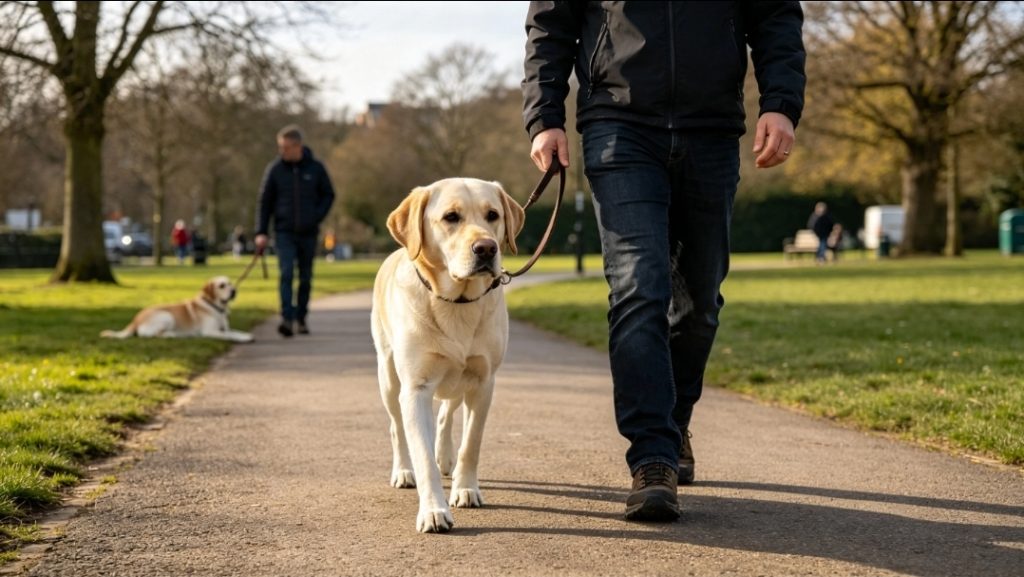
Walking your dog should be enjoyable.
But for owners of a reactive dog, even a normal walk can become stressful.
You see another dog approaching.
Your dog notices them.
Their body becomes tense.
They stare.
The lead becomes tight.
Then suddenly your dog starts barking, lunging, pulling or spinning at the end of the lead.
You may find yourself asking:
“How do I stop my dog being reactive on the lead?”
The first step is understanding what lead reactivity actually is.
A reactive dog isn’t necessarily an aggressive dog.
Lead reactivity can have several causes, including fear, frustration, excitement, anxiety or a lack of appropriate training.
The key is to understand your individual dog’s behaviour and then build a structured training approach.
What Is Lead Reactivity?
Lead reactivity describes an exaggerated response to something a dog encounters while being walked on a lead.
The trigger could be:
- Another dog
- A person
- A cyclist
- A vehicle
- A child
- Another animal
- A particular environment
- A specific sound
The reaction might involve:
- Barking
- Growling
- Lunging
- Pulling
- Jumping
- Whining
- Staring
- Spinning
- Trying to escape
The important point is that the reaction itself doesn’t necessarily tell you why it’s happening.
Two dogs can bark and lunge at another dog while having completely different motivations.
Why Is My Dog Reactive on the Lead?
There isn’t one universal reason.
Your dog might be frightened by other dogs.
They might desperately want to greet them.
They may feel trapped because the lead prevents them from moving away.
They may have had a previous negative experience.
They may have learned that barking makes the other dog disappear.
Or they may simply have never been taught how to behave appropriately around distractions.
Understanding the cause is an important part of learning how to stop a dog being reactive on the lead.
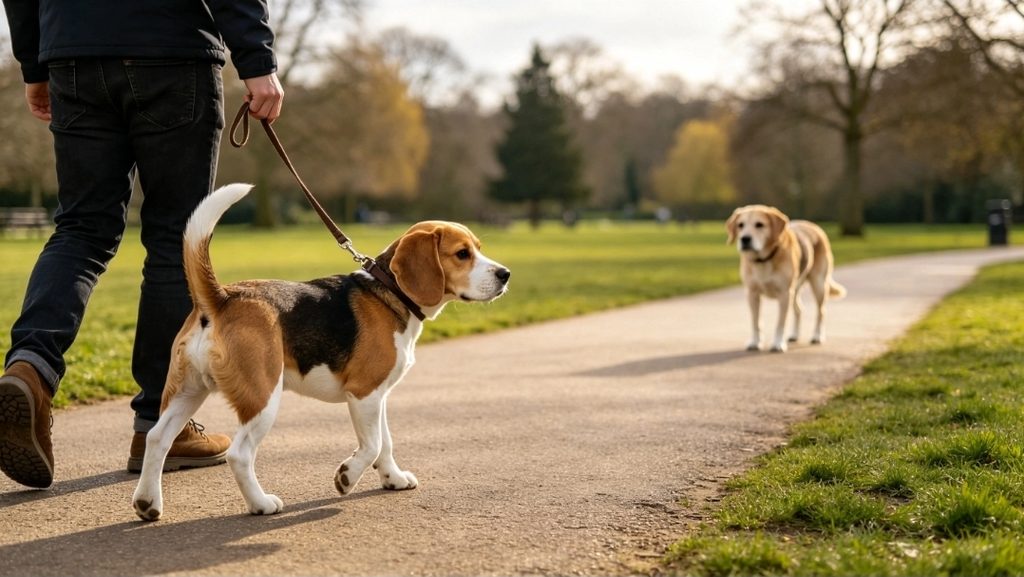
Lead Reactivity Doesn’t Always Mean Aggression
This is an important distinction.
A dog barking and lunging towards another dog may look aggressive.
But the behaviour could be caused by frustration.
Imagine your dog sees another dog.
They desperately want to investigate.
The lead prevents them from reaching the other dog.
Their frustration increases.
They begin pulling and barking.
The behaviour can look aggressive even though the motivation may be completely different.
This is why simply punishing the reaction doesn’t necessarily solve the underlying problem.
Fear Can Cause Lead Reactivity
Fear is another common reason for reactive behaviour.
A frightened dog may attempt to create distance from something they perceive as threatening.
When they’re on a lead, they can’t simply walk away.
Their options become limited.
They may therefore bark, growl or lunge in an attempt to make the trigger move away.
If the other dog continues walking past, your dog may learn that reacting made the scary situation disappear.
This can reinforce the behaviour.
Frustration Can Cause Lead Reactivity
Some dogs become frustrated when they can’t reach another dog.
You may see:
- Pulling
- Barking
- Whining
- Jumping
- Spinning
- Scratching at the lead
The dog may be desperate to interact.
That doesn’t mean you should allow them to greet every dog.
Instead, your dog needs to learn that seeing another dog doesn’t automatically mean they get access to it.
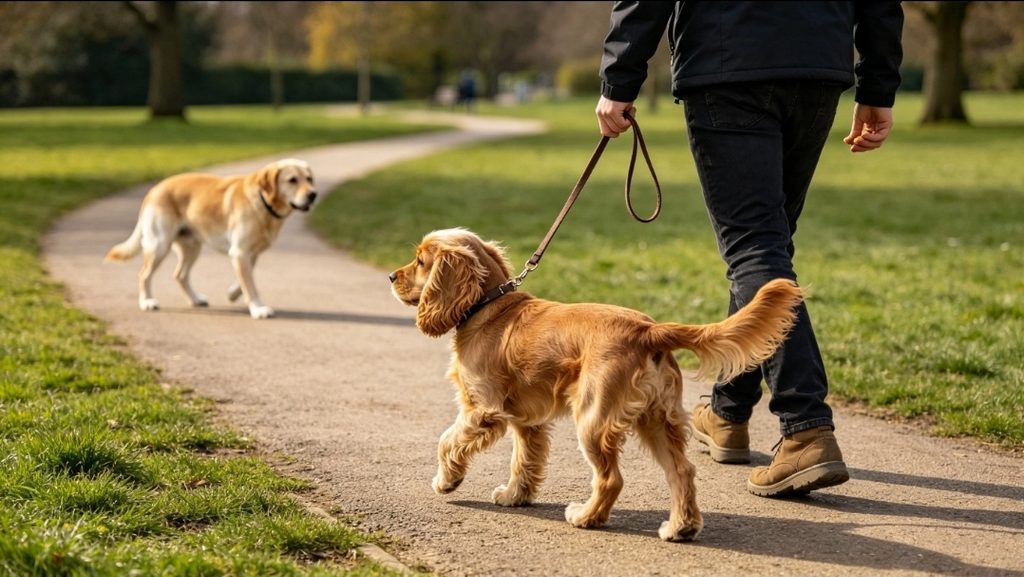
Don’t Wait Until Your Dog Explodes
One of the biggest mistakes owners make is waiting until their dog is already barking and lunging before attempting to intervene.
By that point, your dog may be extremely aroused.
Learning becomes much harder.
Instead, pay attention to the early signs.
Your dog sees another dog.
They become more alert.
Their ears change position.
Their body becomes tense.
They stare.
Their attention becomes fixed.
This is your opportunity.
Create distance.
Get their attention.
Reward calm behaviour.
Don’t wait until the barking starts.
Distance Is One of Your Most Important Tools
If your dog reacts at ten metres, don’t start your training at ten metres.
Start further away.
Perhaps your dog can calmly notice another dog at thirty metres.
That’s your starting point.
Your goal isn’t to immediately walk directly past the trigger.
Your goal is to teach your dog:
“I can see another dog and remain calm.”
As your dog becomes more reliable, you can gradually reduce the distance.
This is one of the most important principles when learning how to stop a dog being reactive on the lead.
Teach Your Dog to Focus on You
Your dog needs an alternative behaviour.
If another dog appears and the only thing your dog knows how to do is react, you’re going to struggle.
Teach your dog to:
- Look at you
- Respond to their name
- Follow you
- Walk beside you
- Sit
- Change direction
- Move away from distractions
Practise these behaviours away from triggers first.
Then gradually introduce them around mild distractions.
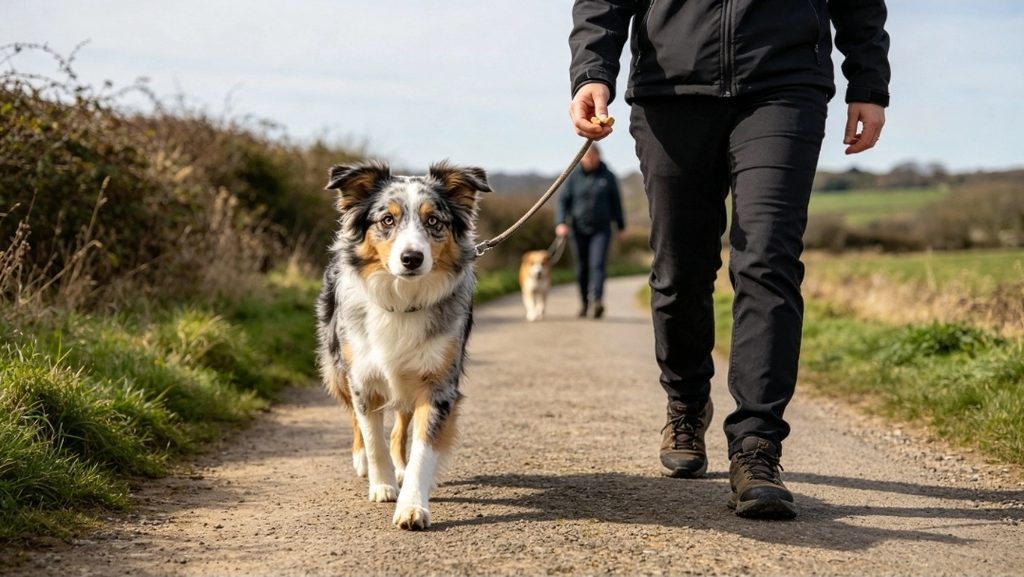
Use a Calm Voice
When your dog begins reacting, it’s easy to become frustrated.
You may raise your voice.
You may pull on the lead.
You may repeatedly tell your dog:
“Stop!”
But increased tension can make the situation worse.
Try to remain calm.
Give your dog clear information.
Use behaviours they already understand.
Create distance when necessary.
Your emotional state can also influence the situation.
Calm, controlled handling is important.
Don’t Punish Your Dog for Being Afraid
If fear is contributing to the reactivity, punishment may increase the dog’s anxiety.
Your dog needs to learn that the presence of another dog doesn’t automatically mean something bad will happen.
Creating space can help.
Allow your dog to observe from a distance where they’re capable of remaining calm.
Reward appropriate behaviour.
Gradually build their confidence.
Don’t Force Dog-to-Dog Greetings
A reactive dog doesn’t need to greet every dog.
In fact, repeatedly forcing close interactions can make the problem worse.
Your dog needs to learn that they can walk past another dog without interacting.
This is an extremely useful life skill.
Your dog doesn’t need to play with every dog they see.
They need to be able to remain controlled around them.
Teach an Emergency Change of Direction
A useful skill for reactive dogs is learning to turn away with you.
Imagine you’re walking down a narrow path.
Another dog appears unexpectedly.
You don’t have enough space to maintain your normal distance.
A trained change-of-direction behaviour can allow you to calmly move away.
Practise this when there is no trigger.
Turn.
Encourage your dog to follow.
Reward them.
Repeat until the movement becomes familiar.
Then you have another tool available when you need it.
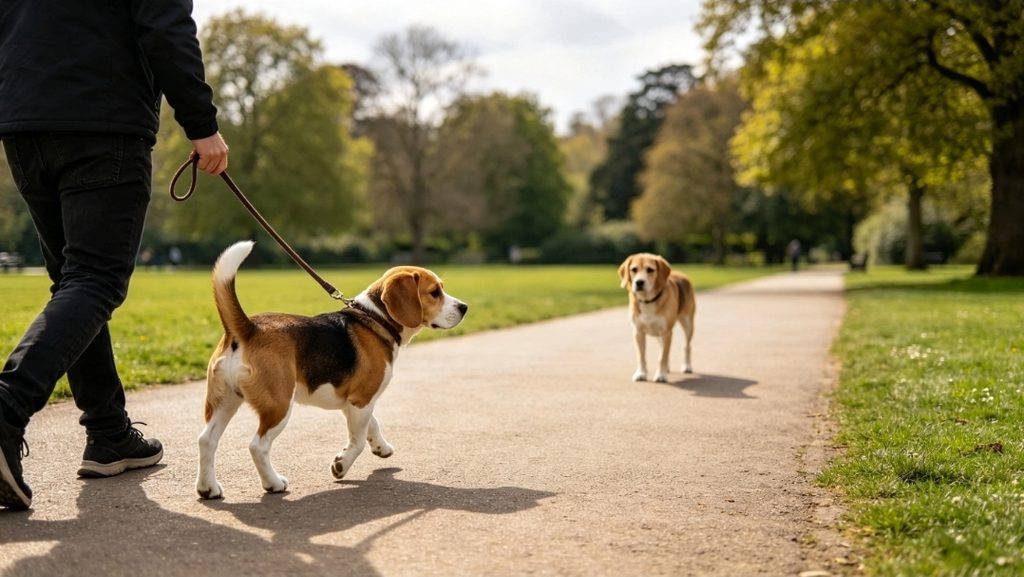
Reward the Behaviour You Want
Don’t only concentrate on correcting unwanted behaviour.
Look for opportunities to reward good behaviour.
Your dog sees another dog.
They remain calm.
Reward.
They look at you.
Reward.
They walk past without lunging.
Reward.
They follow you away from the trigger.
Reward.
Your dog needs to understand what behaviour produces the outcome you want.
Gradually Reduce the Distance
Once your dog can remain calm at a particular distance, you can gradually make the exercise more difficult.
For example:
30 metres: Calm.
25 metres: Calm.
20 metres: Calm.
15 metres: Calm.
You don’t need to reduce the distance during every session.
If your dog starts reacting, you’ve probably increased the difficulty too quickly.
Go back to a distance where your dog can succeed.
Work Below Your Dog’s Threshold
Your dog’s threshold is essentially the point at which they can no longer remain calm and respond appropriately.
If your dog can calmly observe another dog at twenty metres but reacts at ten metres, ten metres may currently be too difficult.
Training should take place where your dog can still think and learn.
Don’t deliberately push them beyond that point simply to see what happens.
IMAGE 5 — Progressing Towards Calm Behaviour
DALL·E image description: Create a premium, photorealistic professional dog-training photograph showing a young Whippet calmly walking beside its handler on a UK park path while another dog passes at a controlled distance. The Whippet should maintain relaxed body language and briefly look towards the other dog before returning its attention to the handler. The handler should calmly reward the dog. The other dog should be safely handled and positioned at an appropriate distance. The scene should communicate successful progress, reduced reactivity, calm observation, controlled exposure and reliable handler engagement. Premium professional canine behaviour photography, natural British daylight, realistic detailed fur, cinematic depth of field, horizontal 16:9 composition, no text, logos or watermark.
Practise in Different Locations
Your dog may learn to remain calm in one environment but struggle somewhere else.
This is normal.
Training needs to generalise.
Practise in:
- Quiet streets
- Parks
- Countryside
- Different walking routes
- Areas with mild distractions
Build the difficulty gradually.
Don’t expect your dog to perform perfectly everywhere simply because they succeeded once.
Don’t Allow Repeated Rehearsal of the Reaction
Every time your dog repeatedly performs the same reactive behaviour, they get another opportunity to practise it.
This doesn’t mean you can prevent every reaction.
Unexpected situations happen.
But good management can reduce unnecessary opportunities for your dog to rehearse the behaviour.
Choose quieter walking routes when appropriate.
Walk at quieter times.
Create distance.
Cross the road.
Turn around.
Use your training.
Management isn’t failure.
It’s part of the training process.
What Equipment Should You Use?
Equipment should allow you to safely and responsibly manage your dog.
Your dog should have appropriate identification and secure walking equipment.
The exact equipment required can vary depending on the individual dog.
The most important thing is that equipment doesn’t replace training.
A lead can provide control.
It doesn’t teach your dog how to behave around another dog.
Training does that.
What If Your Dog Is Already Lunging and Barking?
Don’t panic.
If your dog reacts, focus on creating distance.
Don’t deliberately move closer.
Don’t allow an uncontrolled interaction.
Once your dog is calm, think about what happened.
How close were you?
What was the trigger?
What happened immediately beforehand?
Could you have spotted the trigger earlier?
Could you have changed direction?
Could you have created more distance?
Use each experience to improve your future training.
How Long Does It Take to Stop Lead Reactivity?
There isn’t one fixed timeframe.
Some dogs improve relatively quickly.
Others require considerably more work.
The timeframe can depend on:
- The dog’s age
- The dog’s temperament
- How long the behaviour has existed
- The intensity of the reaction
- The trigger
- The owner’s consistency
- The training environment
- How frequently the behaviour is rehearsed
Don’t judge progress purely by whether your dog never reacts again.
Look for improvements.
Your dog reacts less intensely.
They recover faster.
They can remain calm closer to another dog.
They respond to you more quickly.
They can walk past a trigger without escalating.
These are meaningful signs of progress.
What If Your Dog’s Reactivity Is Getting Worse?
If the behaviour is becoming more intense, don’t simply keep exposing your dog to the same situation.
Reassess your approach.
Increase distance.
Reduce distractions.
Work on engagement.
Consider professional support if necessary.
And if the behaviour is sudden or significantly different from your dog’s normal behaviour, veterinary advice may be appropriate to rule out an underlying physical issue.
GPK9 and Lead Reactivity Training
Learning how to stop a dog being reactive on the lead requires more than simply telling your dog not to bark.
You need to establish communication.
Build engagement.
Develop obedience.
Teach alternative behaviours.
Manage distractions.
And gradually increase difficulty.
This is where structured training can be valuable.
GPK9 90 Day Transformation
The GPK9 90 Day Transformation is the most relevant GPK9 course for this topic because lead reactivity requires consistency and progressive training rather than a single quick exercise.
A structured 90-day training period gives owners the opportunity to establish better training habits, improve communication and work consistently towards more reliable behaviour.
The aim isn’t to promise that every reactive dog will be completely transformed in exactly 90 days.
Every dog is different.
Instead, the programme provides a structured period in which you can commit to your dog’s training and development.
A Simple Plan for stopping Lead Reactivity
Step 1 — Identify the Trigger
Find out what causes your dog to react.
Step 2 — Identify the Distance
Work out how close your dog can get before they struggle.
Step 3 — Create Space
Start training at a distance where your dog can remain calm.
Step 4 — Build Engagement
Teach your dog to focus on you.
Step 5 — Reward Calm Behaviour
Reinforce the response you want.
Step 6 — Introduce Controlled Distractions
Gradually work around other dogs and triggers.
Step 7 — Reduce Distance Slowly
Only make the exercise harder when your dog is ready.
Step 8 — Practise Everywhere
Help your dog generalise the behaviour across different environments.
Step 9 — Prevent Unnecessary Reactions
Use management to avoid repeatedly rehearsing the unwanted behaviour.
Step 10 — Stay Consistent
Behaviour change takes repetition.
Final Thoughts: How to Stop a Dog Being Reactive on the Lead
Learning how to stop a dog being reactive on the lead isn’t about forcing your dog to walk directly past every trigger.
It’s about understanding why your dog reacts and teaching them a better response.
Create distance.
Build engagement.
Teach alternative behaviours.
Reward calmness.
Introduce distractions gradually.
Avoid unnecessary confrontations.
Don’t rush the process.
And remember that a reactive dog isn’t necessarily a bad dog.
The behaviour is information.
Your job is to understand that information and use appropriate training and management to help your dog respond differently.
With consistency and patience, you can work towards a dog that sees another dog, remains calm, listens to its handler and continues walking.
The goal isn’t simply to stop the barking or pulling.
The goal is to teach your dog what to do instead.


