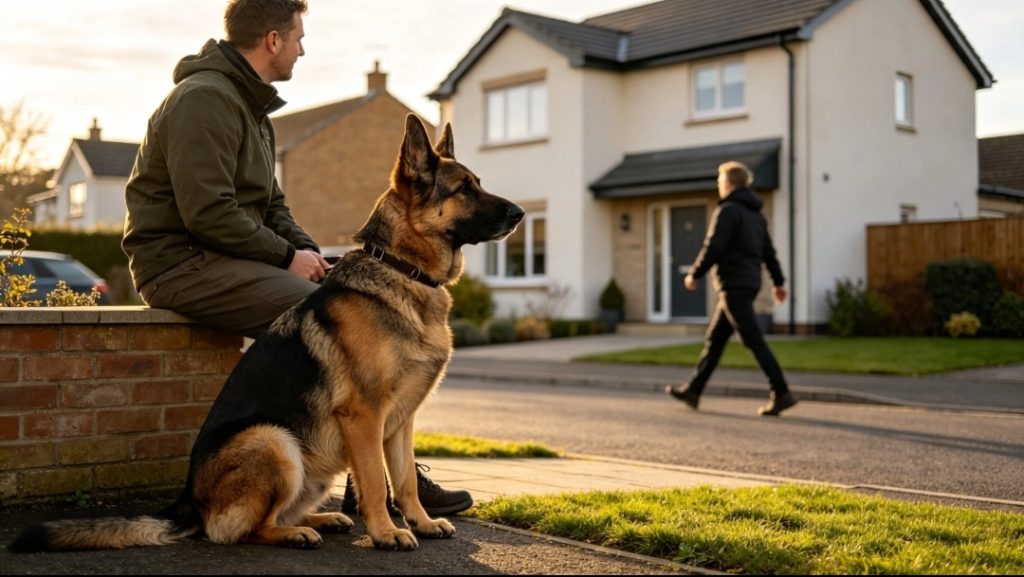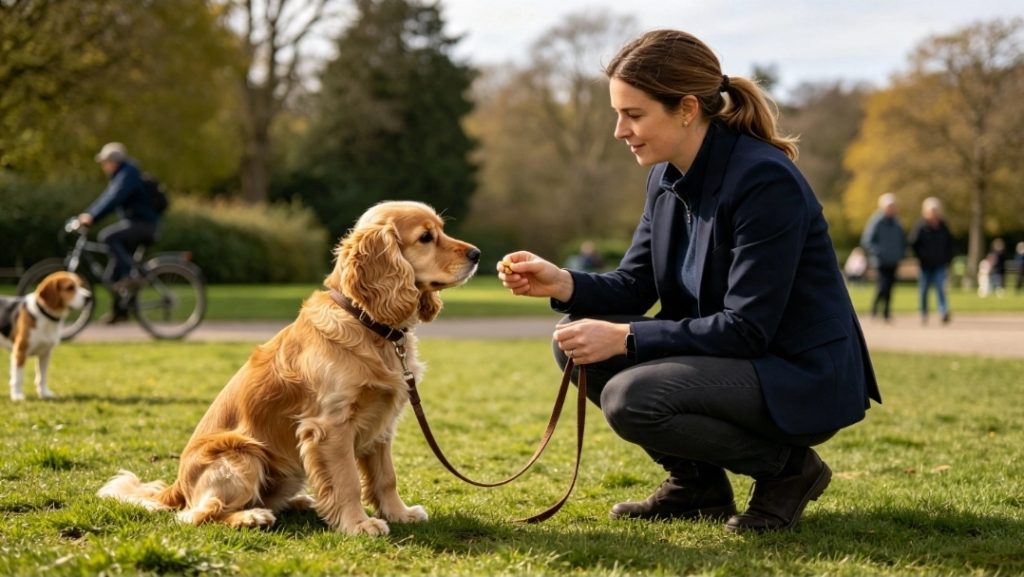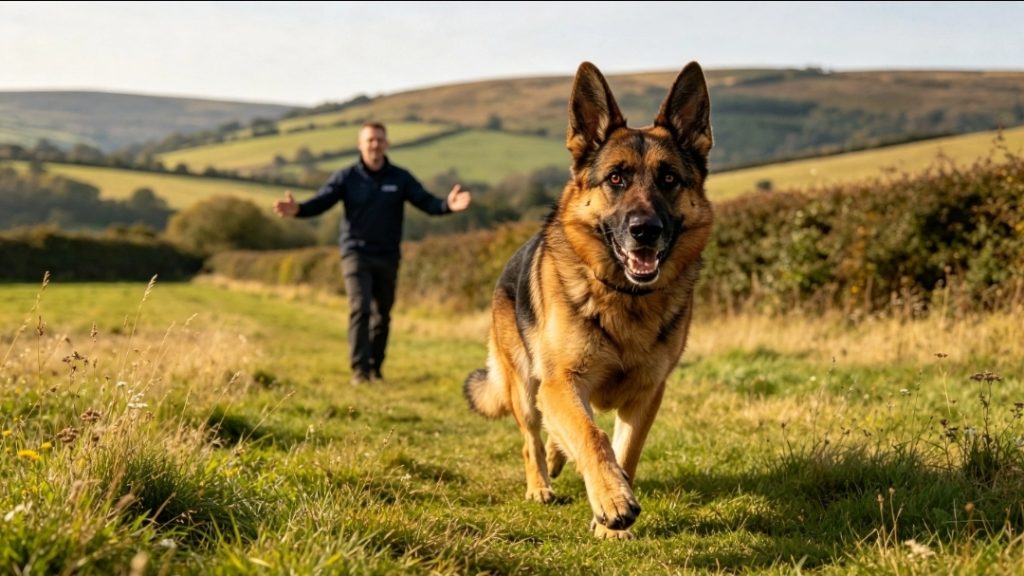
Teaching your dog to come when called is one of the most important skills you can develop.
A reliable recall can give your dog greater freedom while also helping you keep them safe. Whether you’re calling your dog away from another dog, bringing them back from exploring the park, stopping them running towards a road or simply asking them to return to you, a dependable recall can make everyday life much easier.
But there is a big difference between a dog that knows the word “come” and a dog that will reliably return when called.
Many owners experience the same problem.
Their dog comes when called in the kitchen.
They come when called in the garden.
But take them to the park, introduce another dog, a new smell or an interesting distraction, and suddenly the recall disappears.
So, how do you train your dog to come when called?
The answer is not simply repeating the command louder.
A reliable recall is built through relationship, motivation, repetition, appropriate rewards and gradually increasing distractions.
In this GPK9 guide, we’ll explain how to train your dog to come when called and how to build a recall that becomes increasingly reliable in real-world situations.
Why Is Recall So Important?
Recall is more than a convenient obedience command.
It can be a genuine safety skill.
Imagine your dog gets through an open gate.
They spot something across the road.
Another dog begins running.
A cyclist approaches.
Your dog becomes distracted by wildlife.
In situations like these, being able to call your dog back can be extremely important.
A reliable recall also gives your dog greater freedom.
The objective isn’t to keep your dog permanently attached to you.
The objective is to develop a dog that can explore appropriately and still understands that returning to their handler is worthwhile.
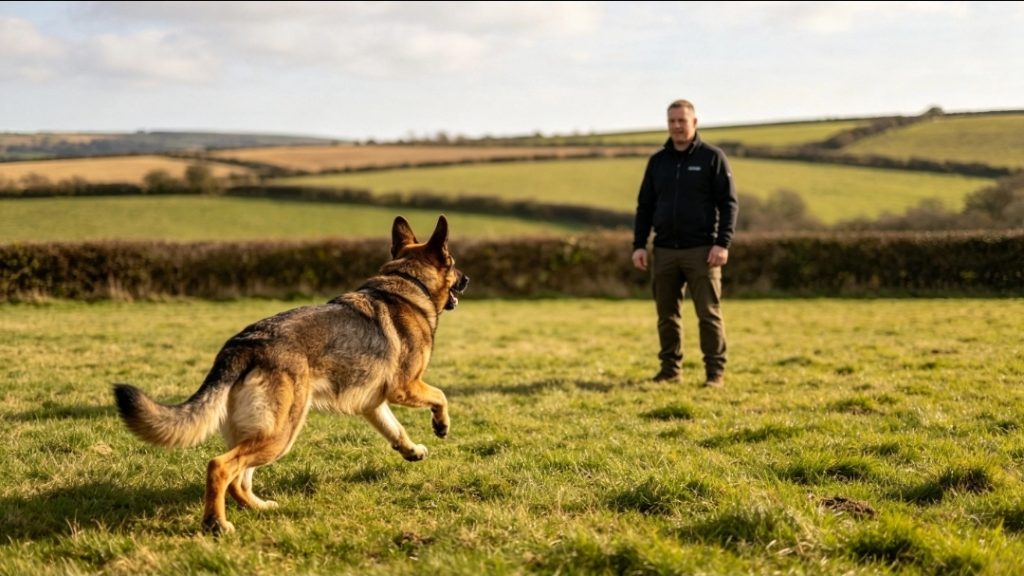
Why Doesn’t My Dog Come When Called?
Before learning how to train your dog to come when called, it is important to understand why your dog might ignore you.
Your dog may not return because:
- They don’t fully understand the recall command.
- They have not been trained around distractions.
- Returning to you ends their freedom.
- The reward isn’t valuable enough.
- They are more interested in something else.
- They have learned that ignoring the command has no consequences.
- The recall has been repeated too many times without reinforcement.
- The environment is currently too difficult for their level of training.
One of the biggest mistakes owners make is expecting too much too soon.
A dog that recalls perfectly in the living room has not necessarily learned to recall reliably at a busy park.
You have to build the behaviour gradually.
Choose Your Recall Word
Choose a clear recall command and use it consistently.
This could be:
“Come!”
“Here!”
Or another word you choose.
The exact word is less important than consistency.
If one member of the household says “come”, another says “here”, and someone else repeatedly shouts the dog’s name, your dog can receive mixed signals.
Pick one primary recall cue and make sure everyone understands how to use it.
Your dog’s name can also be taught as an attention cue, helping your dog learn to look towards you before you give another instruction.
Start Recall Training Somewhere Easy
If you’re wondering how to train your dog to come when called, don’t begin in the most distracting environment you can find.
Start somewhere your dog can succeed.
Your home is often an excellent starting point.
Stand a short distance away.
Use your recall word.
When your dog comes towards you, reward them.
Make returning to you a positive experience.
Repeat the exercise regularly.
You aren’t trying to test your dog.
You’re teaching them.
Every successful repetition helps establish the association:
Recall command → return to handler → good things happen.
Make Coming Back to You Worthwhile
Your dog has choices.
When you’re outside, your dog may have access to smells, wildlife, other dogs, people, grass, trees and countless other distractions.
Why should they choose you?
Because you’ve made returning to you worthwhile.
The reward doesn’t always have to be food.
Depending on your dog, you might use:
- Food rewards
- A favourite toy
- Tug play
- A ball
- Praise
- Access to something the dog enjoys
- Continued freedom
Different dogs value different rewards.
The important thing is to understand what motivates your individual dog.
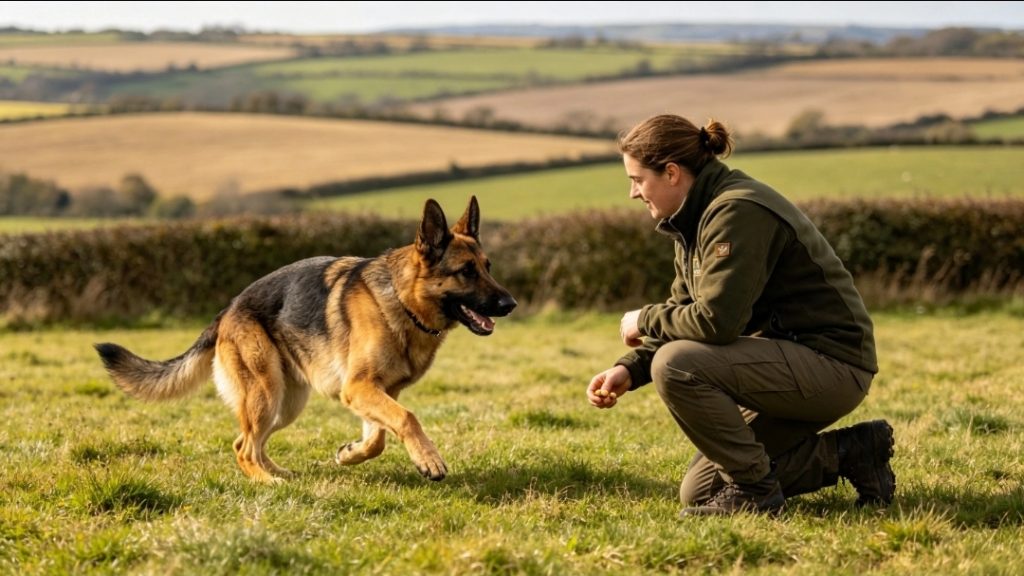
Never Make Recall Mean “The Fun Is Over”
This is one of the most common recall mistakes.
Imagine your dog is having the best time at the park.
You call:
“Come!”
Your dog runs back.
You put the lead on.
You walk home.
If this happens every single time, your dog can start learning:
Coming back = freedom ends.
That can make your recall weaker.
Instead, practise calling your dog back and then allowing them to return to what they were doing.
For example:
Call → reward → praise → release back to explore.
This teaches your dog that returning to you doesn’t always mean the fun is finished.
It can actually become part of the fun.
Don’t Repeatedly Shout the Recall Command
Another common mistake is repeating the command over and over.
“Come!”
Nothing.
“Come!”
Nothing.
“COME!”
Still nothing.
Eventually, the dog comes back.
The problem is that the dog may learn that the first command isn’t important.
Instead, make the recall meaningful.
Use your recall cue when you have a reasonable chance of success.
If your dog is currently too distracted to respond, don’t keep repeating the command while they ignore you.
Change the situation.
Move closer.
Reduce the distraction.
Use a better reward.
Make the exercise easier.
Then build up again.
Build Recall Around Distractions Gradually
This is where many owners go wrong.
They teach recall inside the house and then expect the dog to perform perfectly in a busy park.
Your dog needs to learn that the recall applies in different environments.
Progress gradually.
Stage 1: Home
Practise in different rooms.
Stage 2: Garden
Introduce more environmental distractions.
Stage 3: Quiet Outdoor Area
Use a safe enclosed space or appropriate long line.
Stage 4: More Distractions
Gradually introduce smells, people and environmental activity.
Stage 5: Other Dogs
Only increase the difficulty when your dog is ready.
Stage 6: Real-World Training
Continue practising in increasingly realistic situations while maintaining appropriate safety.
The principle is simple:
Increase difficulty gradually rather than expecting perfection immediately.
Use a Long Line for Safer Recall Training
A long training line can be extremely useful when developing recall outdoors.
It allows your dog to experience greater freedom while giving you additional control if they decide to ignore the recall.
A long line should be used appropriately and safely.
Never allow it to become tangled around people, dogs or obstacles, and make sure you understand how to handle it correctly.
The long line is not there to drag your dog back.
It gives you a safety net while your dog learns.
The ultimate objective is for the dog to return because they understand the recall, not because they are being physically pulled towards you.
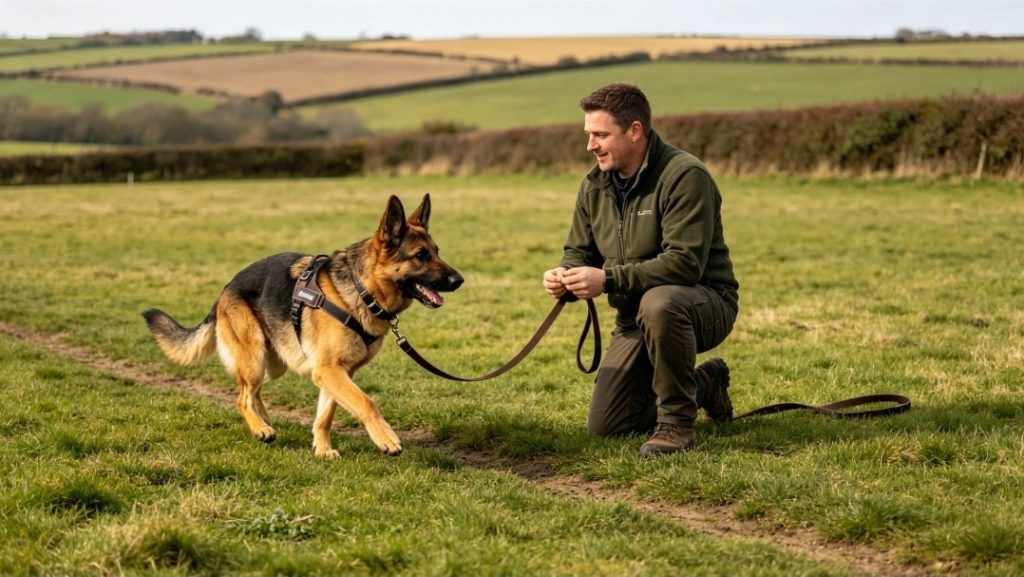
Teach Your Dog That Returning to You Is Safe
Your dog should never learn that coming back to you results in something unpleasant every time.
Imagine your dog finally returns after ignoring you.
You immediately shout at them:
“Where have you been?”
The dog may begin associating the recall with your anger.
Instead, reward the return.
Even if your dog took longer than you wanted.
You can improve the training later.
The moment your dog chooses to return should be valuable.
This is particularly important when teaching a young or inexperienced dog.
Practise the Recall Away From the Park
Don’t wait until you’re at the park to train recall.
Practise throughout everyday life.
Call your dog from one room to another.
Call them from the garden.
Call them away from a toy.
Call them during a quiet walk.
Reward them.
Then release them again.
The more often your dog experiences successful recalls, the more familiar the behaviour becomes.
Training doesn’t need to be a formal one-hour session.
Short, frequent practice can be extremely useful.
Teach an Emergency Recall
A normal recall and an emergency recall can be treated as two different skills.
Your everyday recall might be:
“Come!”
An emergency recall should be a special cue that you don’t constantly use.
Choose a distinctive word or sound.
Then build an extremely strong association with it using an exceptionally valuable reward.
Practise initially in easy environments.
You want your dog to learn:
Emergency cue = immediately turn and return to my handler.
Do not waste the emergency cue by repeatedly using it when you don’t need it.
It should be reserved for situations where you need an exceptionally strong response.
Recall Training With Other Dogs
Other dogs can be one of the biggest distractions for a dog.
If your dog loves playing, you may find that calling them away from another dog is much harder than calling them away from a toy in the house.
Don’t immediately expect a perfect recall.
Start at a distance where your dog can still focus on you.
Reward the dog for checking in with you.
Gradually increase the challenge.
You can eventually practise calling your dog away from controlled distractions.
The aim is not to prevent your dog enjoying interaction with other dogs.
The aim is to teach your dog that they can disengage and return to their handler when asked.
Recall Around Wildlife and Other Distractions
Wildlife can be particularly challenging.
A rabbit, bird or deer can trigger a powerful chase response in some dogs.
This is why recall should be developed before allowing a dog complete freedom in environments where wildlife is present.
If your dog’s recall is not reliable, use appropriate management such as a secure enclosed area or long line while continuing training.
Never assume that because your dog comes when called at home, they will automatically return when they see something they desperately want to chase.
Don’t Use Recall Only When You Want to Leave
Your recall should be practised throughout the walk.
Don’t make every recall mean:
“Put your lead on. We’re going home.”
Instead:
Call your dog.
Reward them.
Give them praise.
Then release them back to exploring.
Call them again later.
Reward them.
Continue the walk.
This makes recall a normal part of the dog’s experience rather than a warning that freedom is about to disappear.
What If My Dog Ignores Me?
Don’t panic.
Don’t chase your dog.
Don’t repeatedly scream their name.
Instead, assess the situation.
Ask yourself:
Is the environment too difficult?
Is my dog too distracted?
Is my reward valuable enough?
Have I progressed too quickly?
Does my dog actually understand the recall?
If your dog repeatedly fails, make the exercise easier.
Move further away from distractions.
Use a long line where appropriate.
Increase the value of the reward.
Return to an environment where your dog can succeed.
Training improves through successful repetitions.
Build Focus Before Expecting Reliable Recall
Recall is closely connected to your dog’s ability to focus on you.
A dog that naturally checks in with its handler is often easier to recall than a dog that completely disconnects from the handler whenever something interesting appears.
Build engagement through everyday training.
Reward your dog for:
- Looking at you
- Responding to their name
- Following you
- Choosing to stay close
- Returning voluntarily
- Playing with you
- Responding to basic commands
These small behaviours contribute to a stronger overall relationship.
The Importance of Consistency
Everyone in the household should understand the recall system.
Use the same recall word.
Use similar expectations.
Reward successful recalls.
Don’t call the dog repeatedly when you know they are unlikely to respond.
And don’t allow one family member to treat recall as a completely different command from another.
Consistency helps your dog understand what is expected.
How GPK9 Builds Recall Foundations
At GPK9, we don’t view recall as an isolated command.
A reliable recall is connected to engagement, focus, obedience, motivation and the relationship between the dog and handler.
Your dog needs to understand that listening to you is worthwhile even when the environment becomes interesting.
That foundation starts with basic training and develops as the dog matures.
GPK9 Fundamentals 1
For puppies and young dogs beginning their training journey, GPK9 Fundamentals 1 – 6 Weeks to 6 Months is the most relevant GPK9 course to begin building these foundations.
You can explore “GPK9 Fundamentals 1 – 6 Weeks to 6 Months” and begin building the foundations that can support future obedience and recall work.
For an older dog, GPK9 also provides Fundamentals 2 – 6 Months to 18 Months and Fundamentals 3 – 18 Months to Adult Dog, allowing training to progress as the dog develops.
A Simple Recall Training Routine
If you’re wondering how to train your dog to come when called, consistency is more important than doing one long training session.
Try building recall into everyday life.
Step 1: Choose Your Cue
Pick one clear recall word.
Step 2: Start Somewhere Easy
Begin indoors or in another low-distraction environment.
Step 3: Call Your Dog
Use your recall cue once.
Step 4: Reward Immediately
Make returning to you worthwhile.
Step 5: Repeat
Build successful repetitions.
Step 6: Add Distance
Gradually increase how far away your dog can be.
Step 7: Add Distractions
Introduce distractions slowly.
Step 8: Practise Outdoors
Use a safe enclosed environment or long line where appropriate.
Step 9: Practise Around Real-Life Distractions
Gradually introduce people, dogs and environmental distractions.
Step 10: Maintain the Behaviour
Continue practising even after your dog appears reliable.
Common Recall Training Mistakes
Calling Your Dog Only When It’s Time to Go Home
This can make your recall cue predict the end of freedom.
Repeating the Command
Repeatedly shouting can teach your dog that the first command isn’t important.
Punishing Your Dog When They Return
Your dog should learn that returning to you is always a safe and worthwhile choice.
Progressing Too Quickly
A quiet garden and a busy dog park are completely different training environments.
Using Low-Value Rewards
If the environment is highly distracting, your reward needs to compete with that environment.
Expecting a Puppy to Have an Adult Dog’s Reliability
Recall develops with training, maturity and experience.
Stopping Training Once Your Dog Is Reliable
Recall needs maintenance.
When Should You Get Professional Help?
If your dog repeatedly runs away, ignores recall around major distractions or has a strong chase response towards wildlife, professional training can be extremely useful.
Professional guidance can help identify where your recall training is breaking down and create a structured progression appropriate for your dog.
If your dog displays aggression, extreme fear or other significant behavioural problems alongside poor recall, seek appropriately qualified professional advice.
Final Thoughts: How to Train Your Dog to Come When Called
Learning how to train your dog to come when called is not about finding one magic word.
It is about building a behaviour your dog understands and wants to perform.
Start in an easy environment.
Choose a clear recall cue.
Reward your dog generously for returning.
Build distance gradually.
Introduce distractions slowly.
Use a long line where appropriate.
Practise around real-world situations.
And, most importantly, make returning to you worthwhile.
A reliable recall isn’t created in one afternoon at the park.
It is built through hundreds of successful experiences.
Your dog should learn:
When my handler calls, coming back is always a good decision.
That is the foundation of reliable recall.
And when your dog understands that returning to you doesn’t mean the fun is automatically over, you can begin to build something even more valuable: a dog that chooses to stay connected with you while still enjoying the world around them.
For puppies and young dogs beginning their obedience journey, explore “GPK9 Fundamentals 1 – 6 Weeks to 6 Months” and start building the foundations for reliable communication, obedience and future recall training.