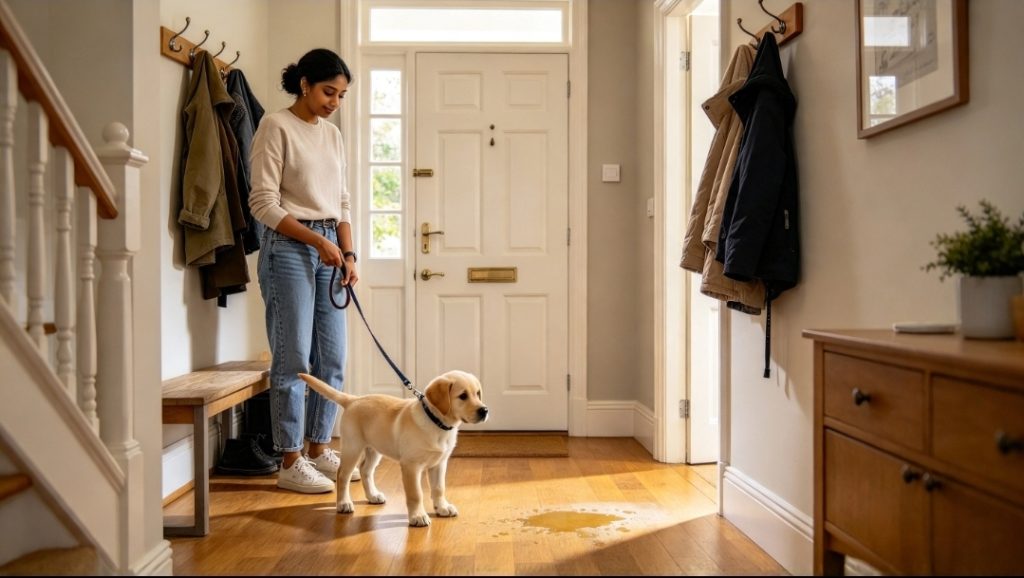
Why does my puppy keep peeing in the house?
If your puppy keeps peeing in the house, the answer is usually not simply that the puppy is being difficult or refusing to learn. Repeated accidents are information. They can show that the puppy’s current toilet routine, supervision, environment, management or level of freedom needs to be reassessed.
The GPK9 approach is to look at what happens before, during and after the accident rather than concentrating only on the puddle left behind.
The key question is:
What is causing the puppy to keep having opportunities to pee indoors?
RECOMMENDED PRODUCTS

Has my puppy actually learned where to toilet?
A common reason for repeated accidents is that the puppy has not yet fully learned where toileting is expected.
Knowing that a puppy should go outside is different from the puppy consistently understanding:
WHEN → WHERE → WHAT TO DO
Toilet training is learned through repetition and consistency.
The puppy needs regular opportunities to toilet in the correct location, followed by appropriate positive reinforcement.
If the puppy has only occasionally succeeded outside, it may simply need more consistent teaching and management.
Is my puppy being given too much freedom?
One of the first things to assess is how much freedom the puppy has inside the home.
A puppy that can freely move between rooms may have many opportunities to find a quiet location and pee before the handler notices.
This is where the GPK9 HOME & SOCIAL structure becomes particularly relevant:
CRATE → PLACEMAT → PLAYPEN
The crate provides a conditioned safe space for rest, routine and resetting.
The placemat provides stationing, duration and settling.
The playpen provides controlled freedom within a boundary.
These are not necessarily permanent stages or a strict one-way progression.
The puppy’s current behaviour should determine the appropriate level of management.
More freedom requires more behavioural responsibility
A puppy that repeatedly pees indoors may simply have been given more freedom than it can currently manage.
The GPK9 principle is:
MORE FREEDOM REQUIRES MORE BEHAVIOURAL RESPONSIBILITY.
If the puppy is successful with controlled freedom, it can gradually progress.
If accidents increase when freedom increases, reassess.
The answer may be to temporarily return to a more controlled environment while the toilet routine becomes reliable again.
Are you missing the signs that your puppy needs to go?
Puppies can display subtle changes before toileting.
Your puppy might:
- Sniff the floor.
- Become restless.
- Walk away from an activity.
- Circle.
- Search for a suitable location.
- Stop playing.
- Move towards an area where it has previously toileted.
- Suddenly become more interested in the floor.
- Change its behaviour without an obvious reason.
These signs are individual to each puppy.
The more closely you observe your puppy, the easier it becomes to recognise its personal pattern.
This is why GPK9 begins with:
OBSERVE → INTERPRET → DECIDE → ACT → REASSESS
RECOMMENDED PRODUCTS
Are toilet opportunities frequent enough?
A puppy may repeatedly pee indoors because the opportunities to toilet outside are not frequent enough for its current stage of development and routine.
Consider when the puppy is being taken outside.
Useful opportunities include:
- After waking.
- After sleeping during the day.
- After eating.
- After drinking.
- After active play.
- After excitement.
- Before settling down.
- When the puppy begins showing signs that it needs to go.
A fixed routine provides structure, but observation must remain part of the process.
If the puppy clearly needs to toilet, waiting for a scheduled time may create an unnecessary accident.
Is the puppy becoming distracted outside?
Repeated indoor accidents do not always mean the puppy is refusing to toilet outside.
The puppy may simply be distracted.
Outdoor environments can contain:
- New smells.
- Sounds.
- Movement.
- People.
- Other animals.
- Interesting objects.
- Opportunities to explore.
A puppy can become so interested in its surroundings that the original purpose of going outside is forgotten.
If this happens, reduce unnecessary distractions and give the puppy an appropriate opportunity to toilet calmly.
Are you rewarding the correct behaviour?
Positive reinforcement helps the puppy understand which behaviour produces the desired outcome.
When the puppy toilets in the correct location, provide appropriate positive reinforcement.
Food can be used as part of this process when suitable.
The important point is consistency.
The puppy should repeatedly experience:
CORRECT LOCATION → CORRECT BEHAVIOUR → POSITIVE OUTCOME
This helps build a clearer association between toileting and the designated area.
Are accidents being handled correctly?
If an accident has already happened, punishment after the event does not teach the puppy where it should have gone.
Instead, use the accident as information.
Ask:
- When did the puppy last toilet?
- What had the puppy been doing?
- Had it just woken up?
- Had it eaten or drunk?
- Had it been playing?
- How much freedom did it have?
- Was anyone supervising?
- Were there signs that were missed?
- Was the puppy distracted outside?
This turns the accident into an opportunity to improve the next part of the routine.
Is the toilet routine consistent?
Puppies learn through repetition.
If the toilet location, routine and response change constantly, the puppy may have less opportunity to establish a predictable pattern.
A consistent approach should include:
CONSISTENT ROUTINE
CONSISTENT TOILET LOCATION
CONSISTENT OBSERVATION
CONSISTENT POSITIVE REINFORCEMENT
CONSISTENT MANAGEMENT
The objective is not to make every day identical.
It is to make the expectations clear enough that the puppy can learn them.
Is excitement causing accidents?
Excitement can change a puppy’s behaviour.
Active play, visitors, interaction and changes in the environment can all make it more difficult to maintain the normal toilet routine.
This is another reason to observe what happened immediately before an accident.
If the puppy regularly pees after energetic play, for example, that part of the routine becomes an important point for a toilet opportunity.
The answer is not necessarily to stop the activity.
It may simply mean recognising that the activity creates another reason to observe and manage the puppy appropriately.
Is the puppy being supervised closely enough?
Supervision is one of the simplest ways to reduce opportunities for indoor accidents.
When the puppy is loose in the house, the handler should be able to observe its behaviour.
If the puppy repeatedly disappears into another room before peeing, unrestricted access may be providing too much freedom.
Controlled management can make it easier to recognise behaviour and act before an accident occurs.
RECOMMENDED PRODUCTS
What does GPK9 say to do when the puppy is struggling?
The GPK9 status response system provides a structured way to respond.
GREEN — OBSERVE → CONTINUE → PROGRESS
The puppy is calm and the current routine is working.
Observe the puppy, continue the appropriate activity and progress when appropriate.
AMBER — OBSERVE → ASSESS → REMOVE FROM DISTRACTION → CALM → REASSESS
The puppy is struggling.
Observe what has changed, assess the situation, reduce the distraction and allow the puppy to calm before reassessing.
If the puppy returns to an appropriate state:
GREEN → CALM → CONTINUE → PROGRESS
RED — STOP → OBSERVE → ASSESS → REMOVE FROM DISTRACTION → CALM → REASSESS
If the situation has become unproductive, stop and reset.
If the puppy cannot reduce or calm appropriately, return to an appropriate level of control and management.
The purpose is not punishment.
The purpose is to restore the conditions required for successful learning.
How do I know what needs to change?
Repeated accidents should lead to a reassessment of the whole situation.
Use the GPK9 decision process:
OBSERVE
What is the puppy doing?
INTERPRET
What does the behaviour suggest about the current situation, routine and management?
DECIDE
Does the puppy need to go outside, have less freedom, have fewer distractions or return to a more controlled environment?
ACT
Make the appropriate change.
REASSESS
Did the change improve the puppy’s behaviour?
This prevents you from repeatedly doing the same thing and expecting a different result.
What if the puppy improves and then starts having accidents again?
Toilet training does not always progress in a perfectly straight line.
A puppy may appear to be progressing and then have a period where accidents increase.
Rather than assuming that all previous learning has disappeared, reassess what has changed.
Has the puppy:
- Been given more freedom?
- Experienced a change in routine?
- Had more visitors?
- Been more active?
- Been sleeping differently?
- Been distracted?
- Been supervised less closely?
The appropriate response is to identify the change and adjust management where necessary.
Progress should be based on the puppy’s behaviour, not simply on the number of days since the last accident.
When should I seek additional support?
If repeated indoor urination continues despite a consistent routine, appropriate management and careful observation, it may be appropriate to seek professional advice.
The GPK9 system is designed to help identify when training needs to be reassessed and when additional support may be appropriate.
The focus remains on understanding the individual puppy and the circumstances rather than simply applying more pressure.