
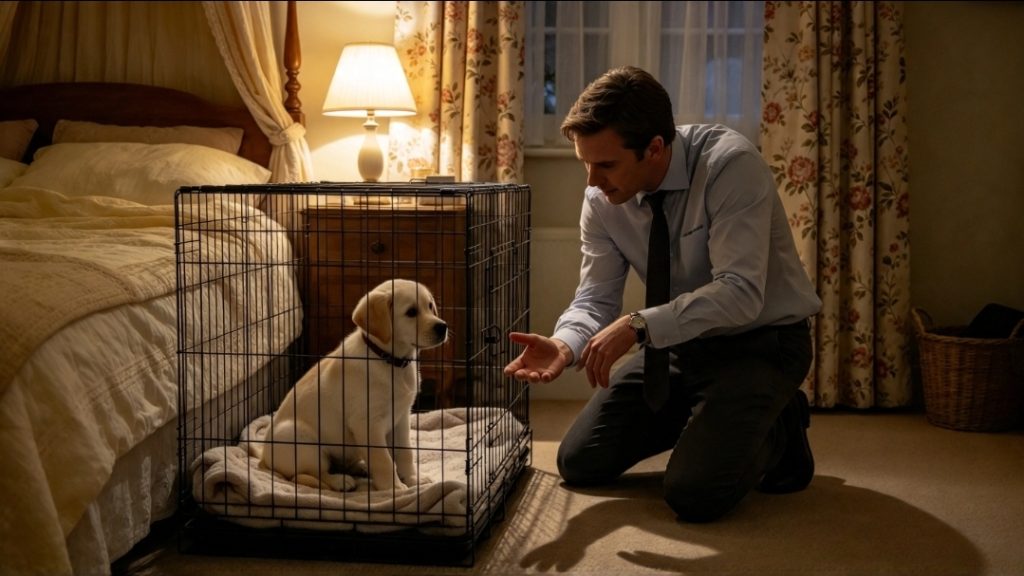
Why does my puppy cry in the crate?
A puppy may cry in the crate for several different reasons, so the first step is to observe the puppy rather than automatically assuming that the crate itself is the problem. The puppy may need the toilet, may not yet understand how to settle, may be responding to a change in environment or routine, or may be struggling with the current level of crate training. GPK9 approaches the situation by observing the puppy, interpreting what is happening, deciding on an appropriate response, acting calmly and then reassessing.
RECOMMENDED PRODUCTS

Crying is therefore information.
The important question is not simply “How do I stop my puppy crying in the crate?”
The important question is:
“Why is my puppy crying, and what is the puppy showing me?”
What can cause a puppy to cry in a crate?
There is no single explanation that applies to every puppy.
Possible reasons include:
- The puppy needs to go to the toilet.
- The puppy has not yet developed reliable settling behaviour.
- The puppy is unfamiliar with the crate.
- The puppy has been asked to remain in the crate for longer than its current training level supports.
- The puppy is overstimulated.
- The environment contains distractions.
- The puppy’s normal routine has changed.
- The puppy has not yet developed a positive association with the crate.
- The puppy is struggling to reduce its arousal.
- The puppy is uncomfortable or there is another issue requiring attention.
These possibilities cannot be determined simply by hearing the puppy cry.
The puppy’s behaviour needs to be observed in context.
Start with the GPK9 decision process
The GPK9 decision process is:
OBSERVE → INTERPRET → DECIDE → ACT → REASSESS
This provides the structure for understanding why the puppy is crying.
OBSERVE
Look at the puppy rather than focusing only on the vocalisation.
Observe:
- Body posture.
- Facial expression.
- Ears.
- Tail.
- Movement.
- Orientation.
- Attention.
- Engagement.
- Arousal.
- Ability to settle.
- Responsiveness.
- Recovery.
- Environmental awareness.
- Changes in behaviour.
- Previously learned criteria.
Ask yourself what has changed.
Did the puppy settle before?
Did the crying begin after the crate door was closed?
Did it happen after waking?
Did it happen after a change in the environment?
Has the puppy recently eaten, played, trained or toileted?
These observations provide useful information.
INTERPRET
Now consider what the behaviour may mean within the current situation.
GPK9 considers:
CATEGORY → STATUS → DRIVE → CONTROL
For a puppy crying in a crate, the relevant category is primarily HOME & SOCIAL, while TOILET may also be directly relevant.
The puppy’s status, drive, environment and current level of control should then be considered.
DECIDE
Once the situation has been interpreted, decide what response is appropriate.
The response may be to:
- Continue.
- Assess.
- Provide an appropriate toilet opportunity.
- Reduce distraction.
- Allow the puppy to calm.
- Adjust the training criteria.
- Reset the training.
- Return to an earlier stage of crate training.
ACT
Apply the appropriate action calmly.
Do not make the response unnecessarily exciting.
REASSESS
Observe the puppy again after the action.
Has the puppy:
- Returned to calm?
- Settled?
- Re-engaged?
- Responded appropriately?
- Demonstrated that the current level is manageable?
If the puppy can continue appropriately, training can progress gradually.
If not, reduce the situation and return to an appropriate level.
Could my puppy be crying because it needs the toilet?
Yes, toilet needs should always be considered when a puppy is crying in a crate.
Young puppies are still developing their toilet routine, and waking or becoming unsettled may indicate that the puppy needs to go outside or to its designated toilet location.
GPK9 TOILET training focuses on:
SAME PLACE → SAME TIME → TOILET COMMAND
A consistent routine helps the puppy understand where and when toileting is expected.
If the puppy wakes and needs the toilet, address that need rather than assuming the crying is simply a crate-training problem.
Keep the toilet routine calm and predictable.
Could my puppy simply be struggling to settle?
Yes.
Settling is a learned behaviour, and a puppy may need time and positive experiences to develop the ability to remain calm in the crate.
The GPK9 HOME & SOCIAL structure places importance on:
- Routine.
- Calmness.
- Boundaries.
- Settling.
- Controlled freedom.
- Environmental management.
The crate provides a controlled environment in which the puppy can learn to settle.
Food can also be used as positive reinforcement when developing a positive association with the crate.
The aim is not to force the puppy to remain quiet.
The aim is to help the puppy understand that calm behaviour is appropriate.
Could the puppy be overstimulated?
A puppy that has recently experienced a lot of activity may struggle to settle.
Consider what happened before the puppy entered the crate.
For example:
- Was the puppy playing?
- Was there training?
- Were there visitors?
- Was there a lot of environmental activity?
- Was the puppy exposed to new experiences?
- Was the puppy already highly aroused?
The puppy’s current status matters.
If the puppy is struggling to reduce its arousal, simply expecting it to settle immediately may not address the underlying situation.
Observe, reduce unnecessary stimulation, allow the puppy to calm and reassess.
What if my puppy cries as soon as the crate door closes?
If crying starts immediately when the door closes, consider the puppy’s previous crate experience.
The puppy may not yet have developed sufficient positive association with the closed crate.
Return to an easier stage.
Positive reinforcement and food can be used to develop the puppy’s understanding that the crate is a safe and rewarding place.
The progression might involve:
ENTER → REWARD → SETTLE → SHORT DURATION → REASSESS
As the puppy becomes comfortable, duration can gradually increase.
If the puppy struggles, reduce the expectation rather than continually increasing it.
What if my puppy was calm and then started crying?
A change in behaviour is important information.
If the puppy was previously calm and then begins crying, observe what changed.
Possible changes could include:
- The puppy woke.
- The puppy needs the toilet.
- The environment changed.
- A distraction appeared.
- The duration increased.
- The puppy became more aroused.
- The routine changed.
- The puppy has reached the limit of its current training level.
The GPK9 decision process is designed for exactly this situation:
OBSERVE → INTERPRET → DECIDE → ACT → REASSESS
Do not simply repeat the same response without considering what has changed.
Use the GPK9 STATUS RESPONSE SYSTEM
The GPK9 STATUS RESPONSE SYSTEM provides a structured way to decide what happens next.
GREEN — OBSERVE → CONTINUE → PROGRESS
If the puppy is calm and able to settle:
OBSERVE → CONTINUE → PROGRESS
Continue the appropriate activity and progress when the puppy’s behaviour supports progression.
AMBER — OBSERVE → ASSESS → REMOVE FROM DISTRACTION → CALM → REASSESS
If the puppy is struggling:
OBSERVE → ASSESS → REMOVE FROM DISTRACTION → CALM → REASSESS
Reduce unnecessary distractions and allow the puppy to calm.
If the puppy returns to a calm state:
GREEN → CALM → CONTINUE → PROGRESS
If the puppy cannot reduce or calm:
RED → CANNOT REDUCE → CANNOT CALM → RETURN TO CRATE
RED — STOP WHAT YOU ARE DOING → OBSERVE → ASSESS → REMOVE FROM DISTRACTION → CALM → REASSESS
If the situation requires an immediate stop:
STOP WHAT YOU ARE DOING → OBSERVE → ASSESS → REMOVE FROM DISTRACTION → CALM → REASSESS
If the puppy returns to calm:
GREEN → CALM → CONTINUE → PROGRESS
If the puppy cannot reduce or calm:
RED → CANNOT REDUCE → CANNOT CALM → RETURN TO CRATE
Then:
RESET → RELEVANT GOLDEN RULE → GREEN → OBSERVE → CONTINUE
The purpose is to return the puppy to an appropriate state rather than continuing to increase the difficulty.
The crate is part of HOME & SOCIAL
The GPK9 HOME & SOCIAL pathway is:
CRATE → PLACEMAT → PLAYPEN
This is not necessarily a straight line.
A puppy can move forward when its behaviour supports greater freedom and return to an earlier stage when more structure is required.
CRATE
The crate is a conditioned safe space for:
- Rest.
- Routine.
- Calmness.
- Resetting.
- Controlled management.
PLACEMAT
The placemat develops:
- Stationing.
- Duration.
- Settling.
- Calm behaviour outside the crate.
PLAYPEN
The playpen introduces controlled freedom within a boundary.
This supports the GPK9 principle:
MORE FREEDOM REQUIRES MORE BEHAVIOURAL RESPONSIBILITY.
If the puppy is not ready for greater freedom, returning to the crate or another appropriate level of control is not a failure.
It is part of the progression.
RECOMMENDED PRODUCTS
What should I avoid doing when my puppy cries?
Do not immediately assume the puppy is being difficult
Crying is behaviour that needs to be interpreted.
Do not automatically increase the crate duration
If the puppy is struggling, increasing the duration may increase the difficulty.
Do not use the crate as punishment
The crate should remain a positive, conditioned safe space.
Do not ignore potential toilet needs
A puppy may be crying because it needs to toilet.
Do not create unnecessary excitement
If you need to interact with the puppy, keep the response appropriate to the situation.
Do not forget to reassess
After making a change, observe the puppy again.
The response should be based on what happens next.
How can I help my puppy settle in the crate?
Start with the behaviour the puppy can successfully perform.
Use positive reinforcement and food to build a positive association with the crate.
Keep the environment appropriate and avoid unnecessary distractions.
Develop duration gradually.
Observe the puppy throughout the process.
If the puppy remains calm:
GREEN → OBSERVE → CONTINUE → PROGRESS
If the puppy begins struggling:
AMBER → OBSERVE → ASSESS → REMOVE FROM DISTRACTION → CALM → REASSESS
The aim is to develop reliable calm behaviour rather than simply suppressing vocalisation.
When should I seek professional support?
If your puppy consistently cries in the crate, cannot settle despite appropriate gradual training, shows significant changes in behaviour or you are unsure what the behaviour means, professional assessment can help.
The important point is to distinguish between a puppy that is still learning to settle and a situation where the behaviour requires further assessment.
GPK9 focuses on observing the individual puppy and considering its status, drive, environment, control, engagement, calmness and recovery before deciding what to do next.



