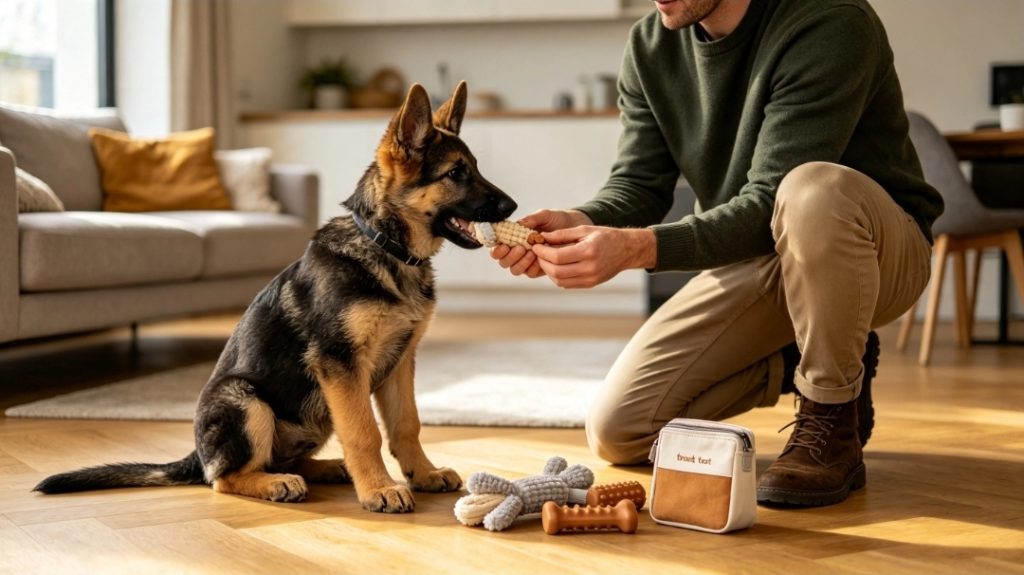
What is the fastest way to toilet train a puppy?
The fastest way to toilet train a puppy is not to rush the puppy. It is to make the correct behaviour easy to repeat. A consistent toilet location, predictable routine, close observation, appropriate management and timely positive reinforcement can reduce unnecessary mistakes and help a puppy understand what is expected. The key is to create as many successful repetitions as possible while giving the puppy only as much freedom as its current behaviour supports.
RECOMMENDED PRODUCTS

What is the fastest way to toilet train a puppy?
The fastest practical approach is to create a clear and repeatable system from the moment your puppy comes home.
The basic structure is:
ROUTINE → LOCATION → TOILET COMMAND → SUCCESS → REINFORCEMENT → REPEAT
Rather than waiting for the puppy to have accidents and reacting afterwards, organise the environment so that the puppy has frequent opportunities to toilet in the correct place.
Speed comes from consistency.
It does not come from rushing the puppy, increasing pressure or expecting a very young puppy to develop physical control before it is ready.
The more clearly the puppy experiences the correct sequence, the more opportunities it has to learn.
Can a puppy really be toilet trained quickly?
Puppies can make rapid progress when their environment, routine and supervision are consistent.
However, there is no guaranteed number of days in which every puppy will become completely reliable.
Individual puppies develop at different rates.
Age, physical development, previous experience, environment, routine and the puppy’s ability to control its bladder and bowels can all affect progress.
The objective should therefore be:
Fastest appropriate progress — not fastest possible pressure.
A puppy that appears to progress quickly but is given too much freedom may begin having accidents again.
Reliable progress is more useful than temporary progress.
What makes toilet training faster?
Several factors can make the learning process more efficient.
A consistent toilet location
Use the same appropriate location as much as possible.
A consistent routine
Take the puppy to the toilet at predictable times and around predictable activities.
Close observation
Learn the puppy’s individual signals.
Appropriate management
Prevent unnecessary opportunities for accidents.
A consistent toilet command
Use the same command each time.
Positive reinforcement
Reinforce successful toileting appropriately and promptly.
Gradual freedom
Increase freedom as reliability develops.
These elements work together.
The GPK9 Professional Training System does not treat them as unrelated techniques.
Start with the toilet location
Choose the appropriate toilet location before beginning the routine.
If you have a secure garden, this may be a specific area of grass.
Take the puppy directly to that location rather than allowing it to wander around the garden.
This helps establish a clear association between the location and toileting.
For puppies without immediate garden access, an appropriate designated toilet area can be used.
The principle remains:
Same place → Same routine → Same command → Repeated success
The clearer the pattern, the easier it is for the puppy to understand.
Establish a predictable routine
A predictable routine is one of the most effective ways of increasing successful toilet opportunities.
Take the puppy to its toilet location after:
- Waking.
- Eating.
- Drinking.
- Playing.
- Training.
- Excitement.
- Resting.
- Before bedtime.
The exact frequency should be adapted to the individual puppy.
A very young puppy may require frequent opportunities because physical control is still developing.
The routine should therefore combine predictable events with observation.
Do not rely solely on a clock.
Watch your puppy closely
Observation is one of the fastest ways to improve toilet training because it allows you to respond before an accident occurs.
Look for changes such as:
- Sniffing.
- Circling.
- Restlessness.
- Searching for a location.
- Moving away from play.
- Suddenly stopping an activity.
- Whining.
- Squatting.
- Returning to an area where the puppy has previously toileted.
Every puppy is an individual.
Learn what your puppy does immediately before it needs to go.
The GPK9 decision process is:
OBSERVE → INTERPRET → DECIDE → ACT → REASSESS
Observe the puppy.
Interpret the behaviour within the current situation.
Decide whether the puppy needs to toilet.
Act promptly.
Then reassess the result.
The earlier you recognise the relevant behaviour, the more opportunity you have to create a successful repetition.
Use a toilet command consistently
Choose one simple toilet command.
Take the puppy to the appropriate location and calmly use the command.
Do not continually change the wording.
The purpose is to establish an association between the verbal cue, the location and the behaviour.
Over repeated successful sessions, the puppy can learn what the command means.
The command is part of the routine, not a replacement for the routine.
Reinforce the correct behaviour
When the puppy toilets in the correct location, reinforce the behaviour appropriately.
Food can be used as positive reinforcement where appropriate.
The timing should connect the positive outcome with the successful behaviour.
The puppy should experience a clear pattern:
Correct location → Toilet → Positive outcome
Repeated successful experiences help establish the behaviour.
How much supervision does a puppy need?
If speed and reliability are the objective, supervision is important.
A puppy that is allowed to disappear into another room can toilet before you have an opportunity to respond.
Supervision allows you to:
- Recognise toilet signals.
- Interrupt inappropriate behaviour where appropriate.
- Take the puppy to the correct location.
- Reinforce success.
- Learn the puppy’s individual routine.
Supervision does not mean constantly interacting with the puppy.
It means being able to manage the puppy’s environment appropriately.
Why too much freedom can slow toilet training
Giving a puppy unrestricted access to the home before it is reliable can actually make toilet training more difficult.
The puppy has more opportunities to make mistakes.
It may also develop preferences for inappropriate locations.
This is why the GPK9 HOME & SOCIAL structure uses controlled freedom.
The core pathway is:
CRATE → PLACEMAT → PLAYPEN
The pathway is not necessarily linear.
A puppy can progress towards greater freedom, but it can also return to an earlier stage when additional management is required.
The principle is:
MORE FREEDOM REQUIRES MORE BEHAVIOURAL RESPONSIBILITY.
If the puppy is not yet reliable, reduce the opportunities for mistakes.
As reliability develops, increase freedom gradually.
How can a crate help speed up toilet training?
A crate can support a structured routine when it has been properly introduced as a safe space for rest.
The crate can provide an appropriate controlled environment during periods when the puppy is resting or cannot be directly supervised.
A simple sequence can be:
REST → WAKE → TOILET LOCATION → TOILET → POSITIVE REINFORCEMENT
This creates predictable transitions.
The crate should never be used as punishment for an accident.
It is part of environmental management and routine, not the toilet-training solution by itself.
How can a playpen help?
A playpen provides controlled freedom within a boundary.
It can give a puppy more space while still allowing the environment to remain manageable.
This can be useful during periods when the puppy cannot have unrestricted access to the home.
As toilet reliability develops, the puppy can gradually move towards greater freedom.
If accidents increase, reduce the level of freedom and rebuild successful behaviour.
What if my puppy does not toilet when I take it outside?
Do not assume that taking the puppy outside automatically means it will toilet.
The puppy may be distracted, excited or simply not ready.
Consider:
STATUS → DRIVE → CONTROL
Is the puppy calm enough to focus?
Is the environment distracting?
Is the puppy highly motivated by something else?
Does the puppy need a quieter, more controlled environment?
The appropriate response may be to reduce distractions and give the puppy another opportunity rather than allowing the toilet trip to become an extended period of uncontrolled activity.
What should I do after a successful toilet?
Once the puppy has toileted correctly, calmly acknowledge the behaviour and provide appropriate positive reinforcement.
The puppy can then continue with the next part of its routine.
This is important because the puppy begins to understand that toileting is one part of the normal daily routine.
The process should not become unnecessarily complicated.
Consistency is more important than creating a large event every time the puppy toilets.
What if my puppy has an accident?
An accident should lead to assessment rather than simply frustration.
Ask:
What happened before the accident?
Consider:
- Was the puppy overdue for a toilet opportunity?
- Had it recently woken?
- Had it eaten or drunk?
- Had it been playing?
- Was it excited?
- Was it unsupervised?
- Had it been given too much freedom?
- Did it show a signal that was missed?
- Had the normal routine changed?
The GPK9 process is:
OBSERVE → INTERPRET → DECIDE → ACT → REASSESS
The accident provides information.
Use that information to improve the next opportunity.
Should I punish accidents to make toilet training faster?
Punishment does not provide the puppy with the clear toilet-training structure it needs.
The objective is to teach the puppy:
Where to go → When to go → What behaviour is expected
Focus on:
- Routine.
- Observation.
- Management.
- Appropriate location.
- Consistent command.
- Positive reinforcement.
- Supervision.
- Repetition.
If you catch the puppy beginning to toilet in an inappropriate location, calmly redirect it to the appropriate location where possible.
The aim is to create a successful repetition.
How does the GPK9 status system help?
The GPK9 status response system helps determine whether the puppy is in a suitable state to continue.
GREEN — OBSERVE → CONTINUE → PROGRESS
The puppy is in a suitable state.
Observe the puppy, continue the appropriate routine and progress when appropriate.
AMBER — OBSERVE → ASSESS → REMOVE FROM DISTRACTION → CALM → REASSESS
The puppy may be struggling because of distraction, excitement or another environmental factor.
Observe.
Assess.
Remove the distraction where appropriate.
Allow the puppy to calm.
Reassess.
If the puppy returns to a suitable state:
GREEN → CALM → CONTINUE → PROGRESS
RED — STOP → OBSERVE → ASSESS → REMOVE FROM DISTRACTION → CALM → REASSESS
If the situation requires an immediate stop, stop what you are doing.
Observe and assess.
Remove the puppy from the distraction where appropriate.
Allow the puppy to calm.
Reassess.
If the puppy cannot reduce or calm appropriately, return to an appropriate level of control and reset.
The purpose is not to rush the puppy through the process.
The purpose is to identify the appropriate state and respond accordingly.
How does drive affect toilet training?
The GPK9 Professional Training System begins with:
CATEGORY → STATUS → DRIVE → CONTROL
For toilet training, the relevant drive can include food motivation and environmental motivation.
A puppy with a high level of food motivation may respond readily to appropriate food reinforcement.
A puppy with lower food motivation may require greater emphasis on routine, timing and environmental management rather than simply increasing food.
The puppy’s current state also matters.
If the environment is highly stimulating, the puppy may be more interested in its surroundings than the toilet task.
This is why drive should be considered alongside status and control rather than treated as a separate training method.
What control should I use during toilet training?
Control should reflect the puppy’s current behaviour.
A puppy that is calm and reliable can gradually receive greater freedom.
A puppy that is distracted or repeatedly having accidents may need greater management.
The objective is not maximum control.
It is appropriate control.
The GPK9 approach is:
STATUS → DRIVE → CONTROL
Then:
OBSERVE → INTERPRET → DECIDE → ACT → REASSESS
This creates a structured way of deciding how much freedom and management the puppy currently requires.
How quickly should I increase freedom?
Do not increase freedom simply because a certain number of days has passed.
Increase freedom when the puppy’s behaviour demonstrates that it is ready.
Look for:
- Fewer accidents.
- Consistent use of the correct location.
- Predictable toilet behaviour.
- Recognition of the routine.
- Appropriate response to the toilet command.
- Increasing ability to remain clean between toilet opportunities.
- Appropriate behaviour when given additional freedom.
If reliability decreases, reduce freedom again.
This may appear slower in the short term, but it prevents the puppy from repeatedly practising unwanted behaviour.
What are the biggest mistakes that slow toilet training?
Inconsistent routines
If every day follows a completely different pattern, the puppy receives less predictable information.
Too much freedom
Unrestricted access creates more opportunities for accidents.
Poor supervision
If toilet signals are missed, the opportunity to create a successful repetition is lost.
Changing the toilet location
Inconsistent locations can make the expected behaviour less clear.
Changing the command
Use one consistent toilet command.
Ignoring successful behaviour
Successful toileting should be appropriately reinforced.
Expecting too much too soon
A puppy’s physical development places limits on how quickly reliability can develop.
Focusing on punishment
The focus should be teaching the correct behaviour, not simply reacting to mistakes.
A fast and structured puppy toilet-training routine
A practical routine can be organised into nine steps.
Step 1 — Prepare the environment
Choose the appropriate toilet location before starting.
Step 2 — Establish the command
Choose one consistent toilet command.
Step 3 — Control the puppy’s freedom
Give the puppy only the amount of freedom its current behaviour supports.
Step 4 — Create frequent opportunities
Take the puppy to the toilet around waking, eating, drinking, playing, training and other predictable events.
Step 5 — Observe
Learn the puppy’s individual signs.
Step 6 — Act quickly
Take the puppy to the correct location when the signs appear.
Step 7 — Reinforce success
Provide appropriate positive reinforcement when the puppy toilets correctly.
Step 8 — Reassess accidents
Use accidents as information about the current routine, supervision and level of freedom.
Step 9 — Progress gradually
Increase freedom as reliability develops.
If reliability decreases, return to a more controlled stage.
RECOMMENDED PRODUCTS
What is the fastest way to stop toilet accidents?
The most effective way to reduce accidents is to reduce the opportunities for them while increasing opportunities for successful toileting.
That means:
More observation.
More appropriate opportunities.
Better management.
Clearer routine.
Consistent location.
Consistent command.
Appropriate reinforcement.
Do not simply give the puppy more freedom and hope that accidents stop.
Control the environment while the behaviour is being learned.
How long does it take to toilet train a puppy?
There is no single timeframe that applies to every puppy.
Some puppies may develop reliable habits relatively quickly, while others require considerably longer.
A puppy’s age, development, previous experience, environment, routine and individual behaviour all affect progress.
The important measure is not simply the number of days.
Look for increasing reliability.
If accidents are becoming less frequent and the puppy is consistently using the correct location, the training is progressing.
If accidents increase, reassess the current level of freedom, supervision and routine.
When should I seek professional or veterinary advice?
If toilet problems persist despite consistent training, additional support may be appropriate.
Seek professional advice if you are struggling to identify the cause of repeated behavioural problems.
If your puppy shows sudden changes in toileting behaviour, appears uncomfortable or distressed, or there are unusual changes in urination or bowel movements, veterinary advice may be appropriate.
Toilet training should not be used to explain away a potential physical health problem.
The key to faster toilet-training progress
The fastest appropriate route is not to rush the puppy.
It is to reduce unnecessary mistakes and increase successful repetitions.
Use:
CONSISTENT ROUTINE → OBSERVATION → APPROPRIATE CONTROL → CORRECT LOCATION → POSITIVE REINFORCEMENT → REASSESSMENT → PROGRESSION
When the puppy is successful, continue and progress appropriately.
When the puppy struggles, assess what has changed.
If necessary, reduce distractions, increase management and return to a level where successful behaviour can be repeated.
The objective is reliable behaviour that continues as the puppy receives more freedom.