What is the best way to train a dog?
The best way to train a dog is to use a clear, consistent and progressive approach that takes the individual dog, its motivation and its environment into account. Effective training is not simply about repeating commands until a dog responds. It involves teaching the behaviour clearly, rewarding the behaviour you want, observing how the dog responds and adjusting the level of difficulty when necessary.
GPK9 uses positive reinforcement, food, patience and appropriate motivation as important parts of the training process. The aim is to help the dog understand what is expected while gradually developing reliable behaviour across different environments and situations.
RECOMMENDED PRODUCTS
Start with the right environment
Training should begin in an environment where your dog has a realistic opportunity to succeed.
A quiet area of the home can provide a useful starting point because there are fewer distractions. This allows the dog to concentrate on the handler and understand the behaviour being taught.
Once the behaviour becomes more reliable, the environment can gradually become more challenging.
Moving too quickly from a quiet room to a busy environment can make a behaviour appear unreliable when the dog may simply not yet understand how to perform it around increased distractions.
Start with an achievable level of difficulty and build from there.
Understand what motivates your dog
Dogs do not all respond to motivation in exactly the same way.
Some dogs have a high food drive and respond readily to food rewards. Others have a lower food drive and may require more careful consideration of the food, environment, timing and training exercise.
Prey drive can also influence how a dog responds to movement and play.
Understanding whether your dog has low or high food drive or low or high prey drive can help you choose appropriate motivation and manage the training environment.
The objective is to work with the individual dog rather than assume that one approach will produce exactly the same response from every dog.
Use positive reinforcement and food
Food can be an effective way to communicate to your dog that it has performed the behaviour you want.
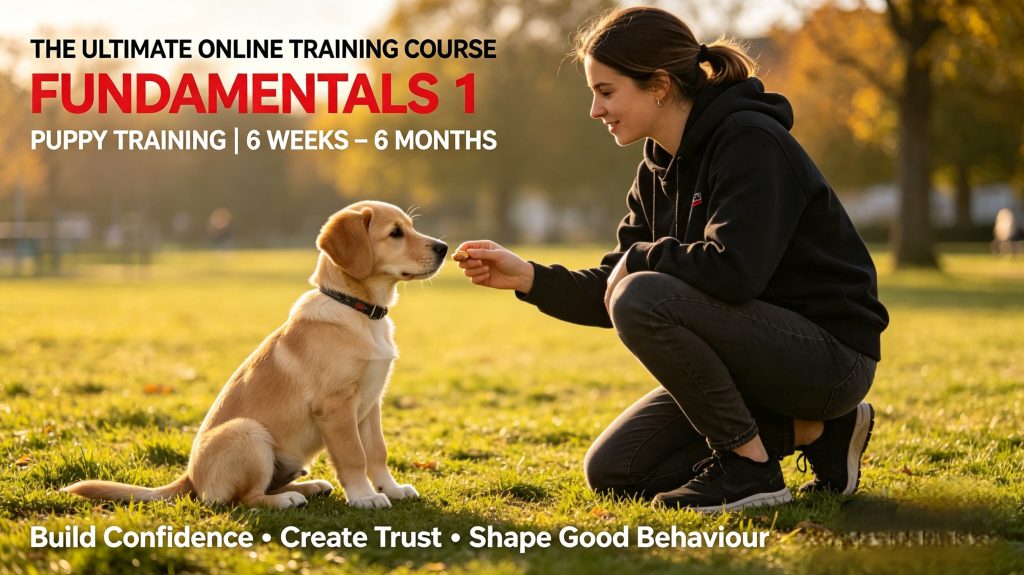
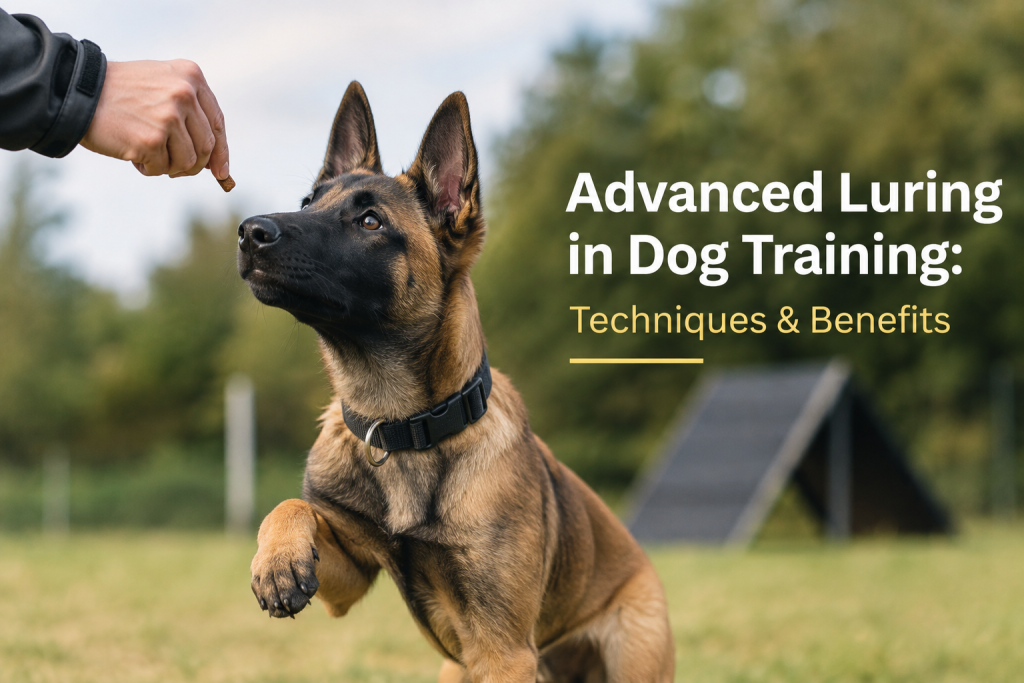
When teaching a new behaviour, food can initially be used as a lure to guide the dog into the required position or movement. Once the desired behaviour occurs, the food provides an immediate reward.
A simple training process can therefore be:
Guide → Behaviour → Reward → Repeat
The timing of the reward is important because the dog needs to associate the reward with the behaviour being developed.
As understanding improves, the physical lure can gradually become less important while appropriate reinforcement continues.
The aim is to develop the behaviour rather than simply make the dog follow food.
Keep training clear and consistent
Dogs learn through repetition and consistency.
Use clear training criteria and avoid constantly changing what you expect from your dog.
If you are teaching a particular behaviour, give your dog the opportunity to understand it before adding additional difficulty.
Short, focused sessions can help maintain engagement and allow you to concentrate on one training objective at a time.
Consistency should also extend beyond formal training sessions. The behaviours you teach should gradually become part of everyday life.
Build behaviour progressively
Good training is progressive.
Once your dog understands a behaviour in one environment, you can gradually introduce changes such as:
- A different location
- Greater duration
- Greater distance
- Additional distractions
- Increased freedom
- Reduced management
- More challenging environments
Avoid changing everything at once.
If the difficulty increases too quickly, return to a stage your dog understands and rebuild.
Progression should be based on the dog’s response rather than an arbitrary timetable.
RECOMMENDED PRODUCTS
Use appropriate control and management
Training and management work together.
Different equipment can provide different levels of control during the learning process.
A short line can provide close control when required. A harness may be appropriate for particular training and walking situations. A long line can provide greater movement while maintaining a level of control. Free roam can be introduced when the dog and environment are suitable.
For home training, a crate can provide a structured area for rest, routine and resetting. A placemat can help develop stationing, settling and controlled freedom. A playpen can provide a defined boundary where the dog can experience increased freedom while remaining appropriately managed.
More freedom should come with an appropriate level of behavioural responsibility.
Observe your dog rather than simply repeating commands
One of the most important parts of effective training is observation.
Pay attention to your dog’s:
- Body posture
- Facial expression
- Ears and tail
- Movement
- Orientation
- Attention
- Engagement
- Arousal
- Ability to settle
- Responsiveness
- Recovery
- Environmental awareness
- Social behaviour
These observations help determine whether the current training level is appropriate.
If your dog suddenly stops responding, becomes distracted or becomes too excited, repeatedly giving the same command may not solve the problem.
Instead, assess what has changed.
The environment may be too difficult. The distraction may be too strong. The reward may not be sufficiently motivating. The dog may need a break or the exercise may need to be made easier.
RECOMMENDED PRODUCTS
Remove unnecessary distractions
When a dog is struggling, reducing the difficulty is often more useful than increasing pressure.
Move away from unnecessary distractions where possible and allow the dog to regain its ability to concentrate.
Once the dog is calm and engaged again, reassess the exercise and decide whether to continue at the same level or return to an easier stage.
This creates a more structured learning process and helps prevent training from becoming unnecessarily difficult.
Know when to progress
A dog should not progress simply because it has performed a behaviour once.
Look for consistency.
When your dog can repeatedly perform the behaviour appropriately in the current environment, you can consider increasing the difficulty.
Progress might involve introducing a new location, increasing distraction, increasing freedom or reducing management.
If the dog struggles, return to the previous stage.
Going back to an easier stage is not a failure. It allows you to rebuild the behaviour before attempting progression again.
Know when to reset
There will be times when continuing the exercise is not productive.
If your dog cannot reduce its arousal, cannot settle or cannot engage appropriately, continuing to repeat the exercise may make the situation more difficult.
A reset provides an opportunity to remove the dog from unnecessary distractions, allow it to calm and then reassess the situation.
Depending on the circumstances, a crate, placemat or playpen may provide an appropriate management option within the home.
Once the dog is ready, return to the relevant training exercise at a manageable level.
Make training part of everyday life
The best training approach should eventually work beyond a formal training session.
Everyday activities can provide opportunities to reinforce appropriate behaviour.
Waiting at a door, settling on a placemat, walking calmly, responding to its name, coming when called, remaining within an appropriate boundary and engaging with its handler can all become part of the dog’s wider training.
The aim is to develop behaviour that can be used naturally rather than behaviour that only exists during a training session.
Avoid trying to make training harder too quickly
A common mistake is assuming that more difficulty automatically means better training.
It does not.
Training should challenge the dog enough to encourage learning without creating unnecessary difficulty.
If your dog is struggling, reduce the challenge.
If your dog is consistently successful, make a small progression.
This creates a steady learning process where the dog can understand each stage before moving forward.
When should professional support be considered?
General training can be suitable for many everyday behaviours, but some situations require professional assessment.
If a dog presents a significant safety concern, displays serious aggression, attempts to bite or has complex behavioural problems that cannot be safely managed, professional support should be considered.
Professional assessment can help identify the individual dog’s needs, environmental factors and appropriate management requirements.
Online information can support learning, but it should not replace professional assessment where there is a significant safety concern.