How do I train my dog?
Training your dog starts with creating the right environment, understanding what motivates your dog and teaching behaviours progressively. Whether you have a puppy, an adult dog or an older dog, effective training is not simply about teaching commands. It is about helping your dog understand what you want, rewarding the behaviour you want to develop and gradually increasing the level of difficulty as your dog becomes more reliable.
The first step is to establish a calm and suitable training environment. Choose an area where your dog can concentrate without unnecessary distractions. Short, consistent training sessions can be easier for a dog to understand than long sessions that allow concentration to deteriorate. Training should be based around positive reinforcement, food, patience and appropriate motivation.
RECOMMENDED PRODUCTS
Start by understanding your dog
Every dog is different. Some dogs are highly motivated by food, while others may have a lower food drive. Some dogs may have a strong interest in movement and toys because of a higher prey drive, while others may show less interest.
Understanding your dog’s motivation helps you choose an appropriate way to train.
Food can be particularly useful for teaching new behaviours because it allows you to guide the dog and reward the behaviour you want. If your dog has a lower food drive, consider the environment, timing and level of distraction before assuming that the dog does not want to learn.
The same principle applies to prey drive. A dog that becomes highly interested in movement or toys may require a different training environment from a dog that remains relatively calm around movement.
The aim is not to force every dog through exactly the same training process. The aim is to understand the individual dog and adjust the training appropriately.
Create a suitable training environment
When you first begin training, make the environment as easy for your dog as possible.
A quiet area of the home can provide a useful starting point because there are fewer distractions. Training in the same general area and around similar times can also help establish consistency.
As your dog becomes more reliable, the training environment can gradually become more challenging.
This is important because a dog that understands a behaviour in a quiet room may not immediately understand that the same behaviour is expected in a garden, on a walk or in a busy environment.
Training therefore needs to progress gradually.
Start where your dog can succeed, build reliability and then introduce additional difficulty.
Teach through food and positive reinforcement
Food can be used to help your dog understand what behaviour you are looking for.
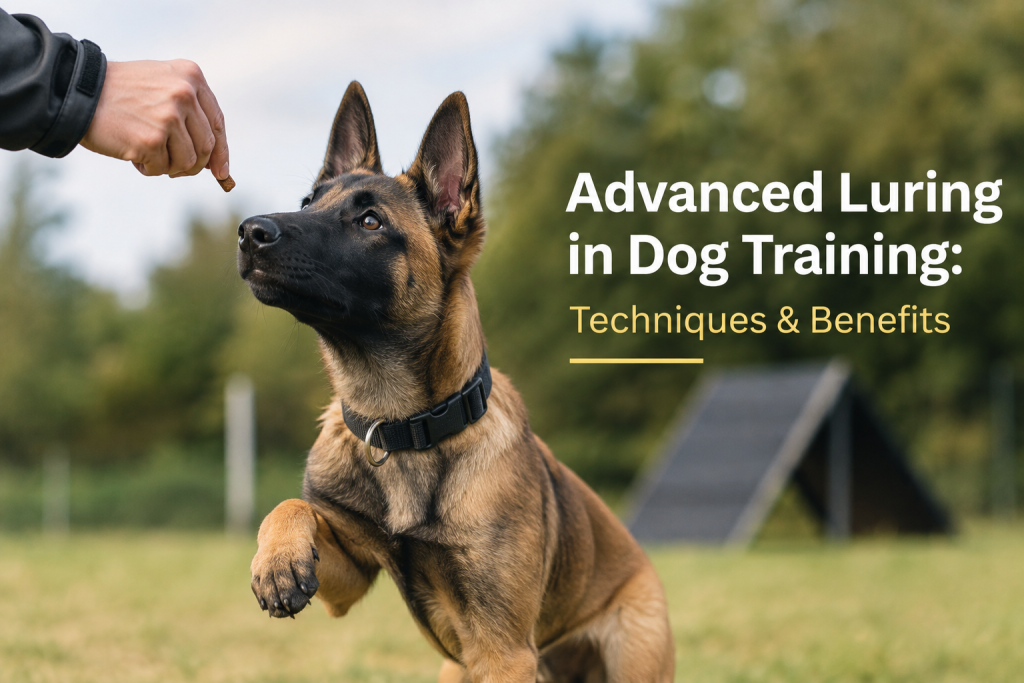
For example, when teaching a basic behaviour, food can be used as a lure to guide the dog into the desired position. Once the dog performs the behaviour, the food provides an immediate reward.
This creates a simple learning process:
Guide → Behaviour → Reward → Repeat
The timing of the reward matters. Your dog needs to be able to understand which behaviour resulted in the reward.
As your dog becomes more familiar with the behaviour, you can gradually reduce its dependence on the physical lure while continuing to reinforce the behaviour appropriately.
The objective is not simply to hold food in front of the dog’s face indefinitely. The food initially helps communicate what you want, while repetition and appropriate progression help the dog learn the behaviour.
Teach one behaviour at a time
When starting training, avoid trying to teach too many things simultaneously.
Choose a behaviour, create a suitable environment and give your dog an opportunity to understand what you are asking.
For example, you might begin by developing attention and engagement before progressing into more structured obedience.
Once your dog understands a behaviour, practise it repeatedly in short sessions. When the behaviour becomes more reliable, you can gradually introduce changes in location, duration or distraction.
This allows your dog to build understanding rather than simply memorising a behaviour in one specific situation.
Build focus and engagement
A dog needs to be able to engage with its handler before more difficult training can be successful.
Begin in an environment where your dog can concentrate. Use food motivation and calm interaction to encourage engagement.
Observe how your dog responds.
If your dog is attentive and engaged, you can continue developing the exercise.
If the environment is creating too much distraction, reduce the difficulty rather than repeatedly asking the dog to perform a behaviour that it cannot currently manage.
This is particularly important when moving from home training into outdoor environments.
Use appropriate control and management
Training and management work together.
A dog should not be given more freedom simply because it has learned one behaviour. Increased freedom should be accompanied by an appropriate level of behavioural responsibility.
Different equipment can help manage different stages of training.
A short line can provide closer control when necessary. A harness can provide suitable management for particular training situations. A long line can allow greater movement while maintaining a level of control. Free roam can be introduced when the dog’s behaviour and environment make that appropriate.
The correct equipment depends on the individual dog, the environment and the behaviour being trained.
For home training, a crate can provide a structured place for rest, routine and resetting when appropriate. A placemat can help develop stationing, settling and controlled freedom within the home. A playpen can provide a defined area where a dog can have increased freedom while remaining within an appropriate boundary.
These are not replacements for training. They are management tools that can support the training process.
Keep training sessions manageable
Training does not need to be complicated.
Short, consistent sessions allow you to focus on one specific training objective without creating unnecessary frustration.
Your dog should have opportunities to succeed.
If you continue increasing the difficulty while your dog is struggling, you may make the exercise unnecessarily difficult. Instead, reduce the difficulty, return to a stage your dog understands and rebuild from there.
Training is a process of progression rather than constantly making things harder.
Introduce distractions gradually
Once your dog understands a behaviour in a controlled environment, you can begin introducing distractions.
Do not move immediately from a quiet room to the most difficult environment available.
Instead, make small changes.
For example, you could move from one room to another, then to the garden, then to a quieter outdoor area before eventually working around greater environmental distractions.
The exact progression depends on your dog.
A dog that struggles around movement, other dogs, people or unfamiliar environments may require a slower progression.
Observation is therefore an important part of training.
Observe your dog’s response
Good training requires you to watch the dog rather than simply repeat commands.
Pay attention to your dog’s:
- Body posture
- Facial expression
- Ears and tail
- Movement
- Orientation
- Attention
- Engagement
- Arousal
- Ability to settle
- Responsiveness
- Recovery
- Environmental awareness
- Social behaviour
These observations help you decide whether to continue, adjust the exercise or reduce the level of difficulty.
If your dog becomes distracted, overly excited or unable to engage, continuing to repeat the same instruction may not solve the problem.
Instead, consider what has changed.
Has the environment become too difficult?
Has the level of distraction increased?
Is the dog becoming tired?
Is the reward sufficiently motivating?
Does the dog understand the behaviour?
Does the dog need a calmer environment?
These questions help you identify the appropriate next step.
Allow your dog to calm before continuing
Training should not become a battle between the dog and the handler.
If your dog becomes too excited or cannot concentrate, reduce the difficulty and remove unnecessary distractions where possible.
Allow your dog to return to a calmer state before continuing.
A crate, placemat or playpen may be appropriate depending on the situation and the dog’s stage of training.
Once your dog is able to engage appropriately again, return to the relevant exercise at a manageable level.
This teaches the dog that training is structured and that progression happens when the dog is able to cope with the level of difficulty.
RECOMMENDED PRODUCTS
Progress gradually
One of the most important parts of training is knowing when to progress.
Do not progress simply because your dog has performed a behaviour once.
Look for consistency.
Your dog should be able to perform the behaviour repeatedly in the current environment before you make the exercise more difficult.
Progress can involve:
- Increasing duration
- Increasing distance
- Changing location
- Adding controlled distractions
- Increasing freedom
- Reducing management
- Introducing a more difficult environment
Only change one part of the exercise when possible so that you can understand what your dog is capable of managing.
If your dog struggles after progression, go back to the previous stage and rebuild.
Going backwards temporarily is not failure. It is part of developing reliable behaviour.
Make training part of everyday life
Dog training does not have to happen only during formal training sessions.
Everyday situations provide opportunities to develop appropriate behaviour.
Waiting at a door, settling on a placemat, walking calmly, responding to a name, coming when called, remaining within an appropriate boundary and engaging with the handler can all become part of a dog’s wider training.
Consistency matters.
If the behaviour is expected during training but not expected in everyday life, your dog may receive mixed information.
The objective is to build behaviour that can eventually be used naturally within the dog’s everyday environment.
What if my dog is not progressing?
If your dog is not progressing, do not automatically assume that the dog is stubborn or unwilling to learn.
Look at the training process.
Consider whether the environment is too difficult, whether the behaviour has been clearly established, whether the reward is motivating, whether there are too many distractions or whether the dog needs a break.
You may need to return to an easier stage.
Observation should lead to assessment, assessment should determine the appropriate action, and the result should then be reassessed.
This creates a continuous training process rather than simply repeating the same exercise regardless of the dog’s response.
When should I get professional support?
Some training problems require more than general training advice.
If your dog displays serious aggression, attempts to bite, presents a significant safety concern or has behavioural problems that you cannot safely manage, professional assessment should be considered.
A professional can assess the individual dog, environment and behaviour and help determine an appropriate training and management approach.
Online education can provide useful information, but it should not replace professional assessment where a dog’s behaviour creates a significant safety concern.