Is crate training cruel?
Why do people think crate training might be cruel?
Concerns about crate training often come from seeing a dog confined for excessive periods, showing signs of distress or being placed in a crate as punishment.
Those concerns are important because inappropriate use can create problems.
A crate should not be used to:
- Punish a dog.
- Ignore a dog’s needs.
- Avoid providing appropriate exercise.
- Replace training.
- Keep a dog confined unnecessarily.
- Force a distressed dog to remain confined.
- Prevent normal opportunities for appropriate interaction and activity.
A crate is a management tool.
It does not replace responsible ownership or training.
What should a crate provide?
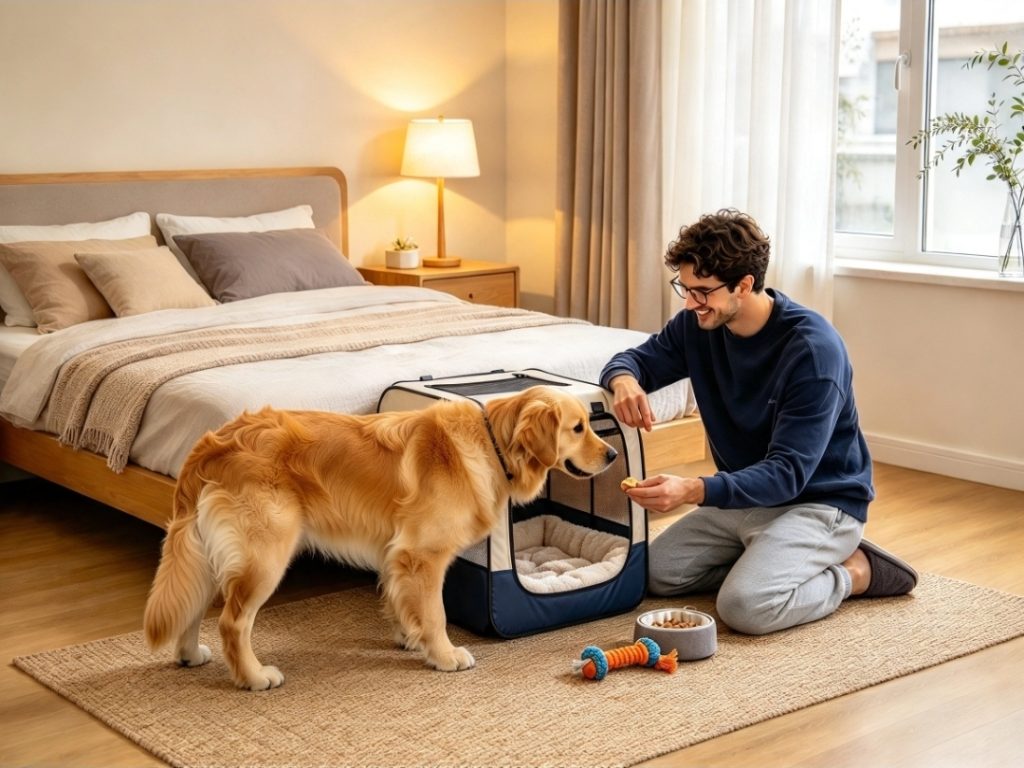
Within the GPK9 system, the crate is a conditioned safe space for rest, routine and resetting.
That means the dog should be able to develop a positive relationship with the space.
The crate can become associated with:
- Rest.
- Calmness.
- Routine.
- Sleep.
- Quiet periods.
- Appropriate management.
- Resetting after an unsuitable level of stimulation.
The objective is not simply to get the dog to tolerate being inside.
The objective is to establish the crate as an appropriate part of the dog’s environment.
Is putting a dog in a crate as punishment appropriate?
No.
Using the crate as punishment can undermine the purpose of the space.
If the dog learns:
“Crate = punishment”
the crate may become associated with negative experiences rather than rest and security.
Instead, the crate should form part of a predictable routine.
If a dog needs to be removed from a situation because it cannot reduce or calm, the GPK9 approach is to manage the situation appropriately and use the crate as a reset space, rather than presenting it as a punishment.
The distinction is important.
Resetting is not punishment.
A reset is about reducing the situation and allowing the dog to return to an appropriate state.
How does GPK9 determine whether crate use is appropriate?
The GPK9 decision process is:
OBSERVE → INTERPRET → DECIDE → ACT → REASSESS
This prevents the crate from being used automatically without considering the dog’s current state.
Observe
Look at the dog’s:
- Body posture.
- Facial expression.
- Ears.
- Tail.
- Movement.
- Attention.
- Engagement.
- Arousal.
- Ability to settle.
- Responsiveness.
- Recovery.
- Environmental awareness.
- Changes in behaviour.
The dog’s behaviour provides information about whether the current situation is appropriate.
Interpret
Consider the dog’s current:
- Status.
- Drive.
- Control.
- Environment.
- Distractions.
- Engagement.
- Calmness.
- Responsiveness.
- Recovery.
For example, a dog that calmly enters its crate, settles and rests is demonstrating very different behaviour from a dog that is becoming increasingly distressed.
The response should therefore be based on the actual situation.
Decide
Determine whether the appropriate response is to:
- Continue.
- Progress.
- Reduce stimulation.
- Remove a distraction.
- Calm.
- Reassess.
- Stop the activity.
- Reset.
- Change the level of control.
Act and reassess
After taking action, observe the dog again.
Ask whether the dog:
- Has returned to calm.
- Can settle.
- Can engage appropriately.
- Can respond appropriately.
- Can continue.
This keeps crate use connected to the dog’s actual behaviour.
The GPK9 status system and the crate
The GPK9 status system provides a structured way to respond when a dog becomes overwhelmed or struggles to manage its environment.
GREEN
OBSERVE → CONTINUE → PROGRESS
The dog is in a suitable state.
Continue the appropriate activity and progress when appropriate.
AMBER
OBSERVE → ASSESS → REMOVE FROM DISTRACTION → CALM → REASSESS
The dog is beginning to struggle.
Reduce the distraction, allow the dog to calm and reassess.
If the dog returns to an appropriate state:
GREEN → CALM → CONTINUE → PROGRESS
If the dog cannot reduce or calm:
RED → CANNOT REDUCE → CANNOT CALM → RETURN TO CRATE
RED
STOP WHAT YOU ARE DOING → OBSERVE → ASSESS → REMOVE FROM DISTRACTION → CALM → REASSESS
If the dog cannot reduce or calm, return to the crate where appropriate.
Then:
RESET → HOME & SOCIAL → GREEN → OBSERVE → CONTINUE
The crate is therefore part of a structured reset process rather than a punishment mechanism.
What does a dog look like when it is comfortable in its crate?
Individual dogs will behave differently, but useful observations may include:
- Relaxed body posture.
- Ability to settle.
- Calm breathing.
- Resting or sleeping.
- Appropriate responsiveness.
- Normal interaction when released.
- Ability to return to normal activity after leaving the crate.
The important point is to observe the whole dog rather than focusing on one isolated behaviour.
What if my dog does not settle in the crate?
If a dog is struggling to settle, do not simply assume that more confinement will solve the problem.
Observe what is happening.
Consider:
- Has the dog been introduced to the crate appropriately?
- Is the environment too stimulating?
- Is the dog appropriately tired and ready for rest?
- Is the crate positioned appropriately?
- Has the dog developed a positive association with the space?
- Is the dog being expected to remain there for an inappropriate period?
- Is there an underlying issue requiring professional assessment?
The answer may involve changing the environment, training process, routine or level of control.
The crate should not replace freedom
A crate is one part of HOME & SOCIAL, not the entire system.
The GPK9 pathway is:
CRATE → PLACEMAT → PLAYPEN
The pathway is not necessarily linear.
A dog can return to an earlier stage when required.
The crate provides a controlled space for rest and resetting.
The placemat introduces stationing, duration and settling.
The playpen provides controlled freedom within a boundary.
As the dog’s behaviour develops, the level of freedom can increase appropriately.
The principle is:
MORE FREEDOM REQUIRES MORE BEHAVIOURAL RESPONSIBILITY.
Can a dog have too much crate time?
Yes. A crate should not become a substitute for providing the dog with appropriate opportunities for movement, interaction, training, toilet routines and normal life.
The appropriate amount of crate use depends on the individual dog and the circumstances.
The important consideration is whether the crate is being used as one part of appropriate management or as a way of avoiding the dog’s needs.
If the dog is spending excessive periods confined, the wider routine should be reviewed.
Is it cruel to crate a puppy?
A puppy can be introduced to a crate appropriately as part of its home routine.
However, puppies have different developmental needs from adult dogs and require appropriate opportunities for:
- Toilet routines.
- Sleep.
- Feeding.
- Play.
- Training.
- Exploration.
- Social interaction.
- Movement.
- Calmness.
The crate should support these needs rather than replace them.
For a puppy, the progression toward greater freedom should be based on demonstrated behaviour.
If the puppy can settle and behave appropriately outside the crate, controlled freedom can gradually increase.
If the puppy struggles, the environment can be reduced and reassessed.
What if my dog chooses to enter the crate?
A dog voluntarily choosing to enter its crate can be useful information about its relationship with the space.
If the crate has been established as a comfortable area for rest, the dog may use it when it wants to settle.
This is consistent with the GPK9 understanding of the crate as a conditioned safe space.
The crate can therefore remain available even when the dog has progressed to greater freedom.
When should crate use be reduced?
Crate use can be reduced as the dog’s ability to manage greater freedom develops.
Look for evidence that the dog can:
- Settle outside the crate.
- Remain calm around normal household activity.
- Behave appropriately.
- Respond to redirection.
- Recover from distractions.
- Manage increased environmental freedom.
- Maintain appropriate routines.
Progress should be gradual.
If increased freedom results in inappropriate behaviour, reduce the level of freedom and reassess.
Returning to the crate does not necessarily mean the dog has failed.
It means the current level of freedom may require further development.
What if the dog becomes distressed?
This is an important situation requiring careful observation.
If a dog is showing significant distress in a crate, the response should not simply be to insist that it remains confined regardless of its behaviour.
Observe the situation and consider the dog’s welfare, environment, previous experiences and the way crate training has been introduced.
Where there are significant or persistent behavioural concerns, an appropriately qualified professional should assess the individual dog and circumstances.
The GPK9 system is a training framework and does not replace individual professional assessment where that is required.
Crate training is about management, not confinement for its own sake
A useful distinction is:
Crate as management
versus
Crate as unnecessary confinement.
Appropriate management considers what the dog can currently handle and provides an environment that supports calmness, routine and safety.
Unnecessary confinement uses the crate simply because it is convenient, without considering the dog’s needs or behaviour.
The equipment may look identical.
The way it is being used is fundamentally different.
RECOMMENDED COURSES
The GPK9 PROFESSIONAL TRAINING SYSTEM contains five connected training areas. For this subject, GOLDEN RULE 1 — HOME AND SOCIAL is the directly relevant course because it covers the crate, settling, boundaries, controlled freedom, calmness, resetting and progression.
1. GOLDEN RULE 1 — HOME AND SOCIAL
This is the primary course for understanding appropriate crate use.
It covers:
- Crate.
- Placemat.
- Playpen.
- Boundaries.
- Controlled freedom.
- Settling.
- Calmness.
- Routine.
- Resetting.
- Progression.
The remaining four courses form the wider GPK9 framework:
2. GOLDEN RULE 2 — OBEDIENCE
Covers structured obedience, food motivation, engagement, control, suitable equipment, suitable environments and progression.
3. GOLDEN RULE 3 — PLAY DRIVE AND PLAY
Covers prey drive, play, toy motivation, controlled play, handler control, calming, resetting and progression.
4. GOLDEN RULE 4 — TOILET
Covers toilet routine, toilet location, toilet command, management, control, routine and progression.
5. GOLDEN RULE 5 — SOCIAL WALKING
Covers calm social walking, IGNORE THE WORLD, environmental awareness, control, distractions, calmness and structured walking.
For the question “Is crate training cruel?”, GOLDEN RULE 1 — HOME AND SOCIAL has the strongest direct connection because it addresses the purpose of the crate and how it fits within the dog’s wider progression toward controlled freedom.
A simple way to assess your crate use
Ask yourself:
Is the crate providing an appropriate safe space?
Is my dog able to settle appropriately?
Am I using the crate for rest, routine and management rather than punishment?
Does my dog receive appropriate opportunities for movement, training and interaction?
Am I increasing freedom as the dog demonstrates greater behavioural responsibility?
Do I reduce the situation and reassess when the dog struggles?
These questions help move the discussion away from whether crates are automatically good or bad.
The more useful question is whether the crate is being used appropriately for the individual dog and situation.
The crate should be part of a wider training system
A crate alone does not teach a dog how to behave throughout the home.
The dog also needs opportunities to develop:
- Calmness.
- Settling.
- Engagement.
- Obedience.
- Appropriate play.
- Toilet routines.
- Social walking.
- Environmental awareness.
- Controlled freedom.
The crate provides one part of the management structure.
As the dog develops, the balance between management and freedom can change.
Final thoughts
Crate training is not automatically cruel simply because it involves a dog spending time inside a crate. What matters is how the crate is introduced, why it is being used, how long it is used appropriately for the individual circumstances, what the dog is communicating through its behaviour and whether the dog’s wider needs are being met. Within the GPK9 PROFESSIONAL TRAINING SYSTEM, the crate is a conditioned safe space for rest, routine and resetting. It should not be used as punishment or as a replacement for appropriate training, exercise, interaction and care. The dog’s behaviour should always be observed, interpreted and reassessed so that the level of control and freedom remains appropriate.
GPK9’S FIVE GOLDEN RULES
GPK9’S FIVE GOLDEN RULES. The GPK9 PROFESSIONAL TRAINING SYSTEM is divided into five accessible areas, with each area dealing with a particular part of dog training while remaining connected to the wider framework. An individual course can provide specific help for a particular training requirement, but no single course represents the entire system. The five areas work together as one connected framework, and the bite-sized structure allows information to be learned progressively by first-time dog owners and professional trainers. The question of whether crate training is cruel relates particularly strongly to HOME & SOCIAL because it involves the crate, boundaries, controlled freedom, settling, calmness, management, resetting and progression, but that area remains part of the wider system. Understanding all five provides the complete GPK9 framework and helps the reader understand how the dog’s situation is considered, how status, drive and control are assessed, how the appropriate response is identified, how management and calmness are handled, how resetting works and how progression takes place. In relation to crate training, this wider understanding helps distinguish appropriate management and a conditioned safe space from using a crate as punishment or unnecessary confinement, while showing how the crate fits into the dog’s broader training and development.