One of the first questions many dog owners ask when they begin training is:
How long does it take to train a dog?
The honest answer is that there isn’t one exact timeframe.
Some behaviours can begin developing within a few training sessions.
Others can take weeks or months to become reliable.
More advanced behaviours may require ongoing training throughout your dog’s life.
Dog training isn’t a race.
The speed of progress depends on the individual dog, the behaviour being taught, the owner’s consistency, the training environment and how gradually the difficulty is increased.
The most important thing isn’t simply how quickly your dog learns a command.
It’s whether your dog can perform that behaviour reliably when it matters.
How Long Does It Take to Train a Dog?
A dog can sometimes learn the basics of a new behaviour relatively quickly.
But learning a behaviour and becoming reliable are two completely different things.
Your dog might learn to sit in your kitchen within a few sessions.
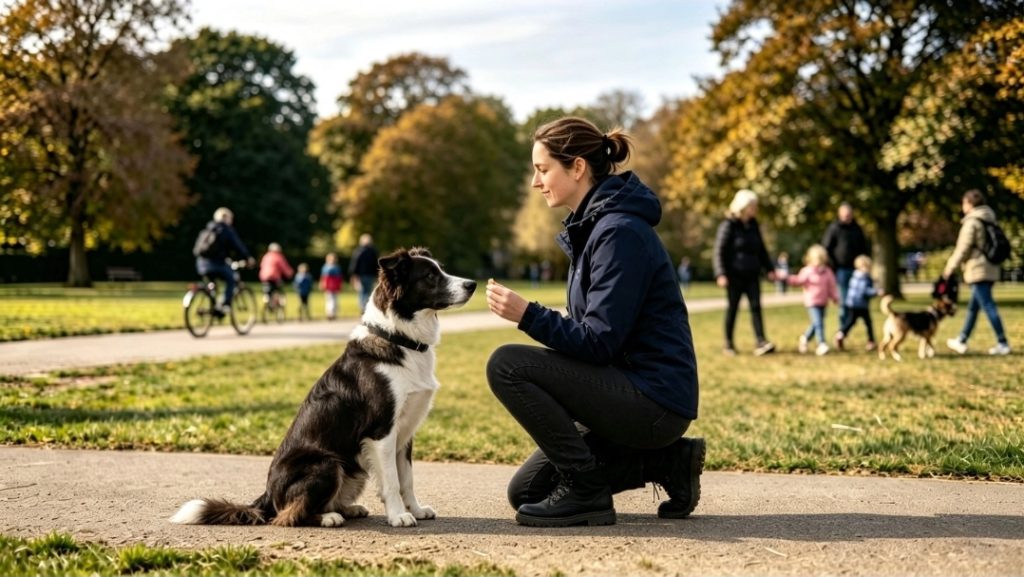
That doesn’t automatically mean they will sit in a busy park while another dog walks past.
Training has stages.
Your dog needs to understand the behaviour first.
Then they need to practise it.
Then you introduce distractions.
Then you increase distance and duration.
Eventually, you work towards reliability in everyday situations.
That’s why how long it takes to train a dog depends on what you expect your dog to achieve.
Training a Dog Doesn’t Happen Overnight
One of the biggest mistakes owners make is expecting immediate results.
A command may be understood quickly, but reliability takes considerably longer.
Think about learning a new skill yourself.
Understanding something doesn’t necessarily mean you can perform it perfectly under pressure.
Dogs are the same.
A dog may understand what you want but still struggle when the environment becomes more difficult.
This is why successful training involves repetition and progression.
How Long Does It Take to Teach Basic Commands?
Basic commands can include:
- Sit
- Down
- Stay
- Wait
- Come
- Leave
- Place
- Name recognition
- Focus
- Walking beside the handler
Some dogs learn these behaviours quickly.
However, the real challenge is transferring them into different environments.
Your dog may sit perfectly at home.
Then you go outside and everything changes.
Suddenly there are smells, sounds, people, dogs, birds and movement.
The behaviour hasn’t necessarily disappeared.
The environment has simply become more difficult.
How Long Does It Take to Train a Puppy?
Puppies can begin learning from a very young age.
Early training can include:
- Name recognition
- Engagement
- Basic obedience
- Recall
- Lead skills
- Handling
- Settling
- Appropriate social behaviour
Puppies generally require short, focused training sessions and plenty of rest.
The objective isn’t to spend hours drilling commands.
It’s to establish clear communication and good habits from the beginning.
For puppies, progress should be measured by development rather than expecting adult-level reliability immediately.
How Long Does It Take to Train an Older Dog?
Older dogs can absolutely learn new behaviours.
An adult dog may have established habits, but that doesn’t mean those habits cannot be changed.
In some cases, an older dog may actually be easier to train because they can concentrate for longer and have greater maturity.
However, if a dog has spent years rehearsing an unwanted behaviour, changing that behaviour may take time.
The longer a behaviour has been practised, the more consistent your training may need to be.
How Long Does Recall Training Take?
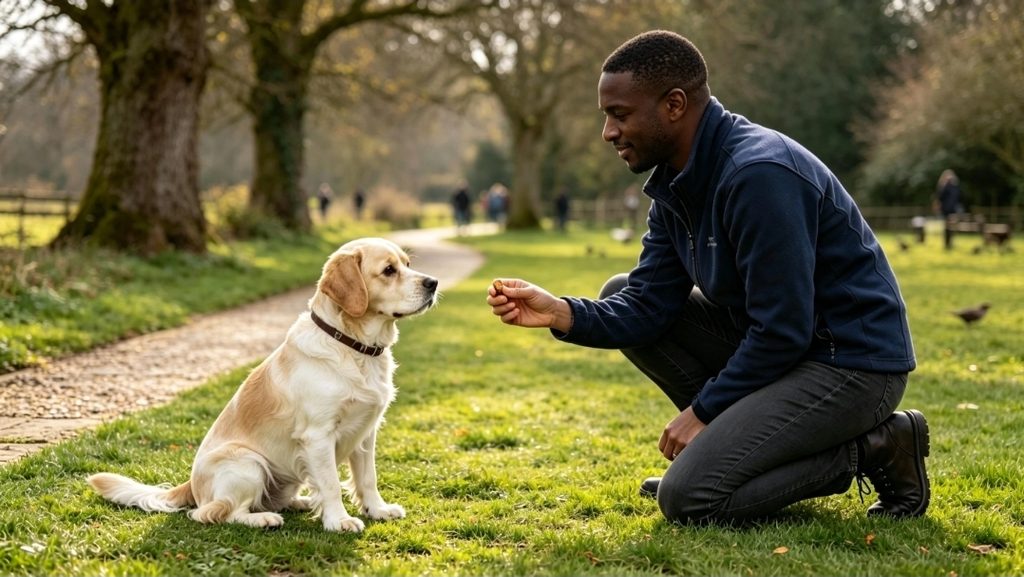
Recall is one of the most important behaviours you can teach your dog.
But reliable recall isn’t created simply by teaching the word “come.”
You need to gradually develop the behaviour.
Start somewhere with minimal distractions.
Reward your dog for returning.
Then gradually introduce:
- Greater distance
- Outdoor environments
- Mild distractions
- People
- Other dogs
- Different locations
- Increasingly difficult distractions
A dog that comes back reliably in your garden may struggle when another dog is running nearby.
That’s why recall needs to be trained progressively.
How Long Does It Take to Stop a Dog Pulling on the Lead?
Loose-lead walking can take time.
The outside world is extremely rewarding to a dog.
There are smells everywhere.
Other dogs are interesting.
People are interesting.
Movement creates stimulation.
Your dog needs to learn that walking with you is worthwhile.
Begin in an easier environment.
Reward appropriate lead behaviour.
Gradually introduce distractions.
Increase the difficulty as your dog’s skills improve.
Some dogs progress quickly.
Others need considerably more repetition.
How Long Does It Take to Toilet Train a Dog?
Toilet training can vary significantly between individual puppies.
Age, routine, supervision and consistency all matter.
A young puppy needs frequent opportunities to go outside.
Taking your puppy out after sleeping, eating, drinking and playing can help establish a routine.
Reward appropriate toileting.
Accidents will happen.
The important thing is to establish a predictable routine and provide appropriate supervision.
How Long Does It Take to Stop a Dog Barking?
Barking isn’t one single behaviour with one single cause.
A dog may bark because of:
- Excitement
- Fear
- Frustration
- Attention seeking
- Territorial behaviour
- Boredom
- Environmental triggers
- Other dogs
- People
Before trying to stop excessive barking, you need to understand why your dog is barking.
Teaching an alternative behaviour and changing how your dog responds to a trigger can take time.
The more established the behaviour is, the more consistent your approach needs to be.
Why Does My Dog Learn Some Things Faster Than Others?
Not every behaviour has the same level of difficulty.
Your dog might learn sit very quickly.
Recall is more complicated.
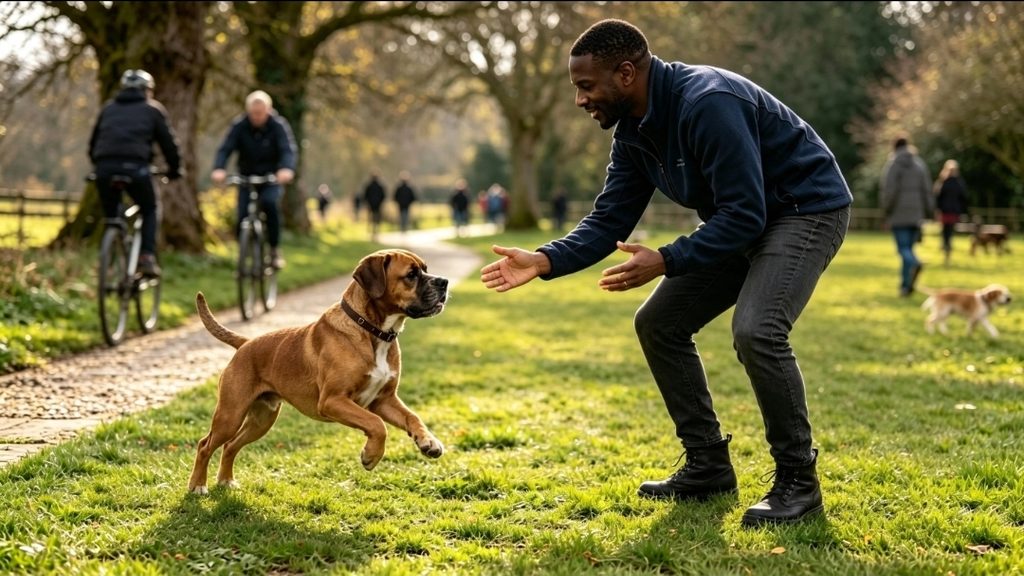
Your dog has to hear the cue, stop what they’re doing, turn towards you, move towards you and continue despite whatever else is happening around them.
That’s a much more demanding behaviour.
Don’t judge your dog’s overall training progress based on how quickly they learn one particular command.
Your Dog’s Environment Changes Everything
A behaviour learned inside your home doesn’t automatically become reliable everywhere.
Your kitchen is familiar.
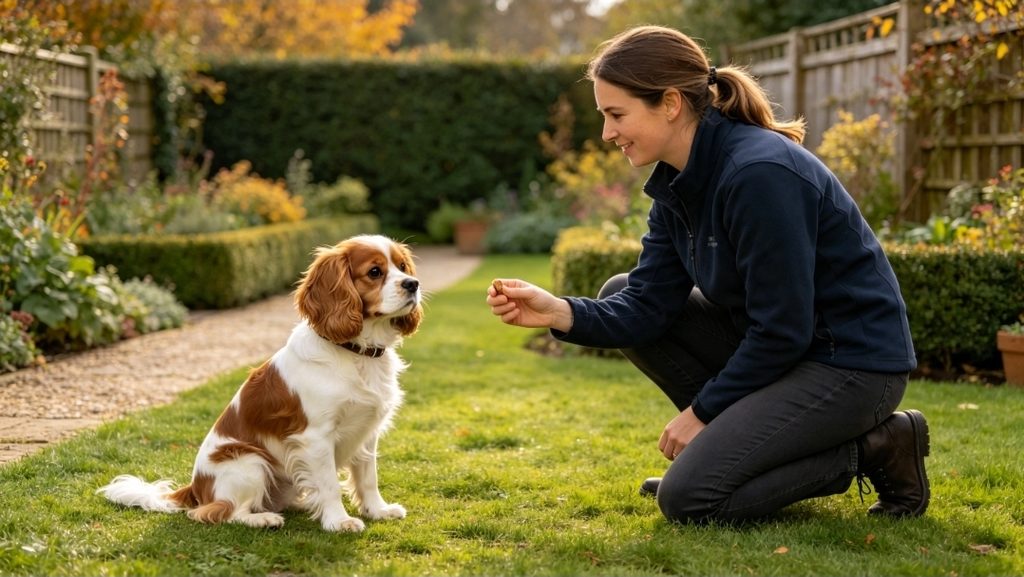
Your garden might be slightly more difficult.
A quiet street may be harder.
A busy park can be considerably more challenging.
A crowded environment can present an entirely different level of difficulty.
This is why training needs progression.
Don’t jump from the easiest environment to the hardest.
Build the behaviour gradually.
Consistency Is One of the Biggest Factors
If you want to know how long it takes to train a dog, you also need to consider how consistently the dog is being trained.
Training once a week and expecting major changes may not produce the same progress as regular, focused training.
Consistency helps your dog understand:
What behaviour is expected.
When it is expected.
What happens when they get it right.
Regular training doesn’t have to mean long sessions.
Short, focused sessions can be extremely useful.
Short Training Sessions Can Be Effective
You don’t necessarily need to train for an hour at a time.
Several short sessions throughout the day can provide valuable repetition.
For example:
Morning: Engagement and name recognition.
Afternoon: Recall.
Evening: Obedience and settling.
Training can also become part of everyday life.
Ask for a sit before opening a door.
Reward your dog for checking in with you.
Practise calm behaviour around visitors.
Reward appropriate lead behaviour.
Training doesn’t have to happen only when you formally announce that it’s “training time.”
Don’t Increase the Difficulty Too Quickly
One of the biggest reasons dogs appear to suddenly stop listening is that the owner has increased the difficulty too quickly.
Your dog performs a behaviour successfully five times at home.
You take them to a busy park.
They fail.
The owner thinks:
“But they know it.”
They might know it in the original environment.
They haven’t necessarily learned to perform it under the new conditions.
Increase difficulty gradually.
How Long Does It Take to Build Reliable Obedience?
There’s a major difference between:
“My dog knows the command.”
and
“My dog reliably performs the command.”
Reliability takes longer.
Your dog needs to perform the behaviour:
- At home
- In the garden
- On walks
- Around people
- Around dogs
- Around distractions
- At different distances
- For different durations
- In different environments
That’s when training starts becoming genuinely useful in everyday life.
What If Your Dog Isn’t Making Progress?
If your dog isn’t improving, don’t simply repeat the same training method harder.
Stop and reassess.
Ask yourself:
Does my dog understand the behaviour?
Am I asking for too much?
Is the environment too difficult?
Is my dog motivated?
Am I consistent?
Am I rewarding the correct behaviour?
Have I progressed too quickly?
Sometimes the best thing you can do is go back a step.
Make the exercise easier.
Rebuild the behaviour.
Then gradually increase the difficulty again.
How Long Does Dog Training Really Take?
For basic obedience, you may see noticeable progress relatively quickly.
But noticeable progress isn’t the same as finished training.
A dog can make significant improvements in a matter of weeks while still requiring months of development to become highly reliable.
This is particularly true when training needs to work around distractions and in real-world environments.
That’s why a structured training period can be useful.
Instead of constantly asking yourself whether your dog is improving, you can work through a planned progression.
The 90-Day Approach to Dog Training
A consistent period of structured training can give both the handler and dog time to develop.
Rather than expecting a dramatic transformation after one weekend, think about what can be achieved through repeated work over a longer period.
Over 90 days, you can establish routines, reinforce behaviours, identify weaknesses and progressively increase the difficulty of your training.
The objective isn’t to suggest that every dog will be completely trained in exactly 90 days.
Every dog is different.
The objective is to create a structured period of consistent work.
What Makes Dog Training Take Longer?
Several factors can affect progress.
The Dog’s Age
Puppies are still developing and may require shorter sessions and more repetition.
Previous Training
A dog with no training history may need to learn basic communication first.
Established Habits
Long-standing unwanted behaviours can take longer to change.
Motivation
Dogs differ in what motivates them.
Environment
The more distracting the environment, the more difficult training can become.
Handler Consistency
Clear and consistent training helps your dog understand what is expected.
Behaviour Difficulty
A simple sit is considerably easier to establish than reliable recall around major distractions.
Dog Training Is an Ongoing Process
One of the biggest misconceptions about how long it takes to train a dog is that there is a point where training is completely finished.
There doesn’t have to be.
Dogs continue learning throughout their lives.
You may teach basic obedience when your dog is young.
Later, you may develop more advanced obedience.
You may introduce new environments.
You may work on distractions.
You may strengthen existing behaviours.
Training can evolve as your dog develops.
How GPK9 Can Help
If you’re looking for a structured way to improve your dog’s training rather than simply working through random exercises, GPK9 provides online training programmes designed to develop obedience and handler skills progressively.
For this particular topic, the 90 Day Transformation is the most relevant GPK9 option because it directly fits the idea of committing to a structured period of consistent training and development. GPK9 currently lists it as a £49 training product alongside its other online programmes.
GPK9 90 Day Transformation
The 90 Day Transformation gives owners a defined period to commit to their dog’s training rather than expecting results overnight.
The focus should be on consistency, repetition and progression.
Use the 90 days to establish better training habits, strengthen communication with your dog and work towards more reliable behaviour.
A Simple Dog Training Progression
Stage 1 — Understanding
Teach your dog what behaviour you want.
Stage 2 — Repetition
Practise the behaviour regularly.
Stage 3 — Consistency
Make your expectations clear.
Stage 4 — Distractions
Introduce increasingly difficult environments.
Stage 5 — Distance
Gradually increase how far your dog can perform the behaviour from you.
Stage 6 — Duration
Increase how long your dog can maintain the behaviour.
Stage 7 — Reliability
Practise until the behaviour becomes dependable.
Stage 8 — Maintenance
Continue reinforcing the behaviour throughout your dog’s life.
So, How Long Does It Take to Train a Dog?
There isn’t a magic number.
Some basic behaviours can begin developing within days.
Reliable obedience can take weeks or months.
Complex behaviours and established behavioural problems can take considerably longer.
And training should continue throughout your dog’s life.
The important thing is to measure progress, not simply count days.
Your dog doesn’t need to be perfect after one week.
They need to be better than they were before.
Final Thoughts: How Long Does It Take to Train a Dog?
So, how long does it take to train a dog?
The answer depends on the dog, the behaviour, the environment and the consistency of the training.
Don’t focus entirely on how quickly you can finish.
Focus on building reliable behaviour.
Teach clearly.
Practise regularly.
Reward appropriate behaviour.
Increase difficulty gradually.
Train in different environments.
Build engagement.
Don’t rush.
Most importantly, understand that dog training isn’t something you simply complete and forget about.
Dog training is a process, not a deadline.
A structured period of consistent training can make a significant difference, but the goal isn’t simply to reach the end of a training programme.
The goal is to develop a dog that understands what you’re asking, can respond around distractions and has a strong, reliable relationship with its handler.
**Start with the foundations. Build gradually. Stay consistent. Give your dog time to learn.**