
How do I toilet train a dog in a flat?
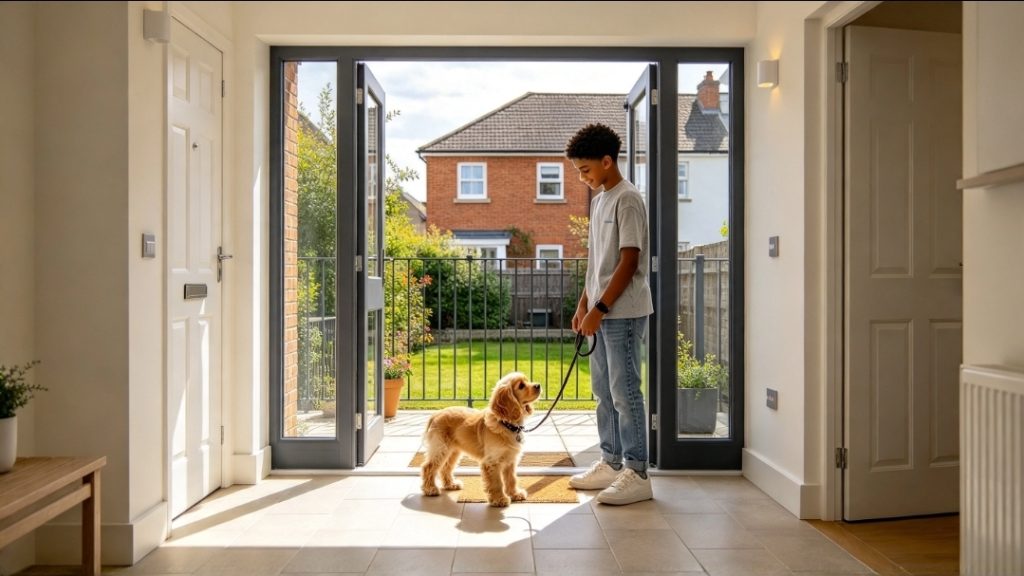
A professional, realistic dog-training scene inside a modern British flat, showing a young medium-sized puppy with a short, smooth coat being calmly guided towards the exit by its handler. The puppy is wearing a suitable harness attached to a short lead. The flat should have a practical hallway leading towards the front door, with a clean, uncluttered living area visible behind it. Include subtle indications of structured home management such as a crate, placemat and playpen positioned appropriately within the living area, without making them the main focus. Outside the front door, show a quiet residential pathway leading towards a small suitable grass area used consistently as the dog’s toilet location. The handler should appear calm and observant, allowing the puppy to focus rather than creating excitement. The puppy should show attentive but relaxed body language. The image should communicate the practical challenge of getting a dog from a flat to an appropriate outdoor toilet location while maintaining a consistent routine. Include realistic residential surroundings, safe boundaries and a clean designated grass area. No logos, text, watermarks or branding.
RECOMMENDPRODUCTS

How do I toilet train a dog in a flat?
Toilet training a dog in a flat requires a clear routine because the dog may need to travel from the living area, through a hallway, out of the building and to an appropriate toilet location before it can toilet. The key is to plan the routine before the dog needs to go, observe the dog’s behaviour, use the same suitable toilet location and introduce a consistent toilet command.
Why can toilet training in a flat be different?
Toilet training in a flat can involve more steps than toilet training in a house with direct access to a private garden.
A dog living in a flat may need to:
- Leave its crate or living area.
- Move through the flat.
- Reach the front door.
- Travel through a communal hallway.
- Use stairs or a lift where applicable.
- Leave the building.
- Walk to an appropriate toilet location.
- Remain focused long enough to toilet.
This means the handler needs to consider the entire journey rather than focusing only on what happens once the dog reaches the grass.
The GPK9 approach is to consider the dog’s current situation and manage it accordingly.
What should the toilet routine look like?
A consistent routine can make toilet training easier for both the dog and the handler.
A basic sequence can be:
OBSERVE → DECIDE → LEAD OUT → TOILET LOCATION → COMMAND → TOILET → REINFORCE → RETURN
The exact timing will depend on the individual dog.
Young puppies may need more frequent opportunities, particularly after:
- Sleeping
- Eating
- Drinking
- Playing
- Training
- Excitement
- Periods of activity
The handler should also learn the dog’s individual signs that it needs to toilet.
Choose a suitable toilet location
A dog living in a flat may not have immediate access to a private garden.
Identify a suitable outdoor toilet location that can be reached consistently and safely.
Ideally, the location should be:
- Accessible
- Safe
- Suitable for the dog
- Relatively quiet
- Consistent
- Easy to reach as part of the daily routine
The purpose is to create a clear association between the journey, the location and the toilet behaviour.
If the location changes constantly, the dog may have more difficulty understanding what is expected.
How do I teach a toilet command in a flat?
Choose one simple toilet command and use it consistently.
For example:
- “Toilet”
- “Go toilet”
- “Busy”
The particular word is less important than consistency.
The command should not be repeatedly given while travelling through the building or while the dog is distracted.
Instead:
- Leave the flat calmly.
- Travel to the established toilet location.
- Allow the dog to investigate the area.
- Observe the dog’s behaviour.
- Use the toilet command appropriately.
- Allow the dog time to toilet.
- Reinforce successful toileting.
- Return to the normal routine.
Over repeated experiences, the dog can begin to associate the command with the behaviour.
Why is timing important?
Timing is particularly important when living in a flat because reaching the toilet location may take longer.
If the handler waits until the dog is already desperate to toilet, there may not be enough time to travel through the flat and building.
The aim is therefore to anticipate the dog’s needs.
Observation becomes important.
Look for changes such as:
- Sniffing
- Circling
- Restlessness
- Searching for an appropriate area
- Moving away from an activity
- Suddenly focusing on the floor
- Changes in normal behaviour
The more familiar the handler becomes with the dog’s individual signals, the easier it becomes to start the toilet routine at an appropriate time.
What if I have to use stairs or a lift?
The route out of the flat should form part of the management plan.
If stairs are involved, the handler should consider whether the dog can safely manage them.
If a lift is used, the dog may encounter:
- People
- Other dogs
- Doors opening
- Strange sounds
- Movement
- Small enclosed spaces
These distractions can interfere with the toilet routine.
The objective is not to turn the journey into a social or obedience training session every time.
Where possible, keep the journey calm and purposeful.
RECOMMENDED PRODUCTS
What if the dog gets distracted in the building?
Observe the dog’s behaviour.
A communal building can provide many distractions.
The dog may want to:
- Investigate smells
- Greet people
- Watch other dogs
- Play
- Explore
- Respond to noises
If the dog becomes distracted, avoid unnecessarily increasing excitement.
The relevant GPK9 process is:
OBSERVE → INTERPRET → DECIDE → ACT → REASSESS
Consider what is causing the distraction and whether the dog can continue appropriately.
If the dog is calm and responsive, continue.
If the dog is struggling, reduce the distraction and allow the dog to calm before continuing.
How does the GPK9 status system apply?
Toilet training in a flat falls within the TOILET category.
The dog’s current status helps determine what to do next.
GREEN
OBSERVE → CONTINUE → PROGRESS
If the dog is calm, responsive and following the toilet routine appropriately, continue.
The dog can gradually progress as its behaviour becomes reliable.
AMBER
OBSERVE → ASSESS → REMOVE FROM DISTRACTION → CALM → REASSESS
If the dog is becoming distracted or struggling:
- Observe.
- Assess what is happening.
- Remove the dog from the distraction where appropriate.
- Allow the dog to calm.
- Reassess.
If the dog returns to a suitable calm state:
GREEN → CALM → CONTINUE → PROGRESS
RED
If the situation requires an immediate stop:
STOP WHAT YOU ARE DOING → OBSERVE → ASSESS → REMOVE FROM DISTRACTION → CALM → REASSESS
If the dog cannot reduce or calm:
RED → CANNOT REDUCE → CANNOT CALM → RETURN TO CRATE
The routine can then be reset:
RESET → TOILET → GREEN → OBSERVE → CONTINUE
The status system should be applied to the dog’s actual behaviour rather than simply labelling the dog.
How can a crate help when toilet training in a flat?
A crate can provide a controlled area for rest and routine when used appropriately.
Within the GPK9 HOME & SOCIAL structure:
CRATE → PLACEMAT → PLAYPEN
The crate is a conditioned safe space for rest, routine and resetting.
The purpose is not to use the crate as punishment.
It can help the handler manage the dog’s routine between appropriate toilet opportunities while preventing unnecessary unrestricted access to the flat.
The dog should still be given appropriate opportunities to toilet.
How does the placemat fit into toilet training?
The placemat can provide a station for settling and controlled duration within the home.
If the dog is calm and appropriately settled, the handler can maintain the routine.
If the dog begins showing signs that it needs to toilet, the handler should observe the change and respond rather than expecting the dog to remain on the placemat.
The placemat is therefore part of the wider home-management structure rather than a replacement for taking the dog outside.
What about a playpen?
A playpen can provide controlled freedom within a boundary.
This can be particularly useful when a dog is not yet ready for unrestricted access to the entire flat.
The principle is:
MORE FREEDOM REQUIRES MORE BEHAVIOURAL RESPONSIBILITY.
If the dog repeatedly has accidents when given more freedom, reduce the level of freedom and rebuild the routine.
Progress should be based on demonstrated behaviour.
Should I use puppy pads in a flat?
The answer depends on the toilet-training objective.
If the long-term objective is for the dog to toilet outdoors, repeatedly encouraging indoor toileting can potentially create an additional association that later needs to be changed.
Where practical and appropriate, a consistent outdoor toilet location can provide a clearer long-term routine.
However, individual circumstances matter. Very young puppies, dogs with specific needs and situations where immediate outdoor access is temporarily impossible may require different management.
The important point is to understand what behaviour the handler is trying to establish before choosing the management strategy.
What if my dog has an accident inside the flat?
An accident should prompt the handler to review what happened.
Ask:
- When did the dog last toilet?
- Did the dog show any signs that were missed?
- Was the dog given too much freedom?
- Was the dog taken outside soon enough?
- Was the route to the toilet location too long?
- Was the dog distracted?
- Was the routine changed?
- Was the dog appropriately managed between toilet opportunities?
This follows the GPK9 decision process:
OBSERVE → INTERPRET → DECIDE → ACT → REASSESS
The purpose is to identify what can be changed rather than simply reacting to the accident.
RECOMMENDED PRODUCTS
What if my dog does not toilet when we reach the grass?
Do not assume that repeating the toilet command will make the dog toilet.
Observe the situation.
The dog may be:
- Distracted
- Too excited
- Unfamiliar with the location
- Not ready to toilet
- Focused on another environmental stimulus
- Struggling to settle
Give the dog an appropriate opportunity and keep the environment as calm as practical.
If the dog becomes distracted, reduce the distraction where possible and reassess.
If the dog successfully calms and engages with the toilet routine, continue.
How do I reinforce successful toileting?
Once the dog toilets successfully, reinforce the behaviour appropriately.
This can include calm verbal praise and, where suitable for the individual dog, food reinforcement.
The important principle is timing.
The dog should be able to connect the successful behaviour with the positive outcome that follows.
Avoid creating excessive excitement immediately after toileting if this causes the dog to become distracted from the routine.
How do I gradually increase freedom in the flat?
Toilet training should not finish simply because the dog has had several successful days.
Freedom can be increased progressively according to the dog’s reliability.
A simple progression may involve:
CONTROLLED AREA → GREATER CONTROLLED FREEDOM → INCREASED HOME ACCESS
Monitor the dog’s behaviour at each stage.
If the dog remains reliable, progress appropriately.
If accidents increase, reduce the level of freedom and return to the previous successful stage.
This is consistent with the GPK9 principle:
MORE FREEDOM REQUIRES MORE BEHAVIOURAL RESPONSIBILITY.
What role does drive play in toilet training?
The GPK9 TOILET category recognises:
- Low Prey Drive
- High Prey Drive
- Low Food Drive
- High Food Drive
Drive can influence how the dog responds to the environment.
For example, a dog with high prey drive may become distracted by birds or movement outside the flat.
A dog with high food drive may become focused on food rather than the toilet routine.
The handler should therefore consider the dog’s individual motivation when deciding how much control and management is appropriate.
How should equipment be used?
The GPK9 TOILET structure identifies different levels of control.
GREEN
- Short Line
- Harness
- Long Line
- Free Roam
AMBER
- Short Line
- Muzzle
RED
- Short Line
- Muzzle
Equipment should be selected according to the individual situation and the level of control required.
For a normal toilet journey, a suitable harness and lead can provide practical control while travelling from the flat to the toilet location.
Equipment does not replace observation, management or training.
What should I do if the dog becomes overwhelmed?
If the dog becomes unable to continue appropriately, reduce the situation.
The GPK9 status response is:
OBSERVE → ASSESS → REMOVE FROM DISTRACTION → CALM → REASSESS
If the dog returns to a calm state, continue appropriately.
If the dog cannot reduce or calm:
RED → CANNOT REDUCE → CANNOT CALM → RETURN TO CRATE
Then:
RESET → TOILET → GREEN → OBSERVE → CONTINUE
The objective is to return the dog to an appropriate state before progressing.
A practical flat toilet-training routine
A simple routine can look like this:
Step 1 — Establish the toilet location
Choose an appropriate outdoor location that can be used consistently.
Step 2 — Learn the dog’s routine
Observe when the dog is most likely to need to toilet.
Step 3 — Prepare before the dog needs to go
Have the appropriate lead and harness ready so the journey can begin without unnecessary delay.
Step 4 — Leave the flat calmly
Move through the flat and communal areas without creating unnecessary excitement.
Step 5 — Reach the toilet location
Give the dog an opportunity to investigate and settle.
Step 6 — Use the toilet command
Use the chosen command calmly and consistently at the appropriate point.
Step 7 — Allow the dog to toilet
Give the dog sufficient opportunity without unnecessary distraction.
Step 8 — Reinforce success
Recognise and reinforce successful toileting appropriately.
Step 9 — Return home
Return to the normal routine.
Step 10 — Progress gradually
Increase freedom only when the dog’s behaviour demonstrates that it can manage the additional responsibility.
Common mistakes when toilet training a dog in a flat
Waiting until the dog is desperate
The longer journey from a flat can make last-minute trips more difficult.
Changing the toilet location constantly
Consistency can help the dog develop a clear association.
Repeating the toilet command
The command should have meaning and should not become background noise.
Turning every toilet trip into a walk
A toilet trip and a longer social walk do not have to be the same activity.
Allowing too much freedom too soon
Freedom should reflect the dog’s current reliability.
Ignoring distractions
People, dogs, lifts, noises and smells can all affect the dog’s ability to focus.
Reacting only after accidents
Review the routine and management that came before the accident.
Expecting every dog to progress at the same rate
Individual dogs learn differently and may require different levels of management and progression.
RECOMMENDED PRODUCTS
When should I seek additional help?
Most toilet-training problems can be approached by reviewing the routine, management, environment and the dog’s behaviour.
However, additional professional or veterinary assessment may be appropriate when:
- Toileting behaviour suddenly changes.
- A previously reliable dog begins having repeated accidents.
- The dog appears unwell.
- The dog repeatedly struggles to toilet.
- There are unexplained changes in urination or defecation.
- The dog becomes highly distressed.
- The handler cannot identify what is causing the problem.
- Training and appropriate management are not resolving the issue.
The GPK9 system provides a framework for observing and responding to behaviour, but it does not replace appropriate professional or veterinary assessment where required.



