How do I teach my dog to stay off the sofa?
How do I teach my dog to stay off the sofa is not simply about telling the dog what not to do. The aim is to create a clear household boundary while teaching the dog what it should do instead. If your dog repeatedly jumps onto the sofa, gets removed and then immediately jumps back up, the problem may be that the dog has not been given a clear alternative or enough guidance about the level of freedom it can currently manage.
Teaching a dog to stay off the sofa is not simply about telling the dog what not to do. The aim is to create a clear household boundary while teaching the dog what it should do instead. If your dog repeatedly jumps onto the sofa, gets removed and then immediately jumps back up, the problem may be that the dog has not been given a clear alternative or enough guidance about the level of freedom it can currently manage.
RECOMMENDED PRODUCTS

Why does my dog keep getting on the sofa?
A sofa can be highly rewarding from a dog’s perspective. It may be comfortable, elevated, warm, close to people and associated with attention or relaxation.
If the dog has previously been allowed onto the sofa, it may also have learned that climbing onto it is part of normal household life.
This means that suddenly introducing a new rule can require some consistency.
The important question is not simply:
“How do I stop my dog getting on the sofa?”
Instead, consider:
“What behaviour do I want my dog to perform when the sofa is available?”
A useful solution is to teach the dog that the floor, a placemat or another designated resting area is where it should settle.
Start with a clear household boundary
Everyone in the household should understand the same rule.
If the dog is allowed on the sofa sometimes but not at other times, the dog has to work out when the behaviour is permitted.
For some households, allowing the dog on the sofa occasionally may be appropriate. For others, the sofa may always be out of bounds.
If your objective is specifically to teach your dog to stay off the sofa, consistency is important.
The dog should not receive mixed messages from different people.
Give your dog somewhere else to settle
Simply preventing access to the sofa does not automatically teach the dog where it should go.
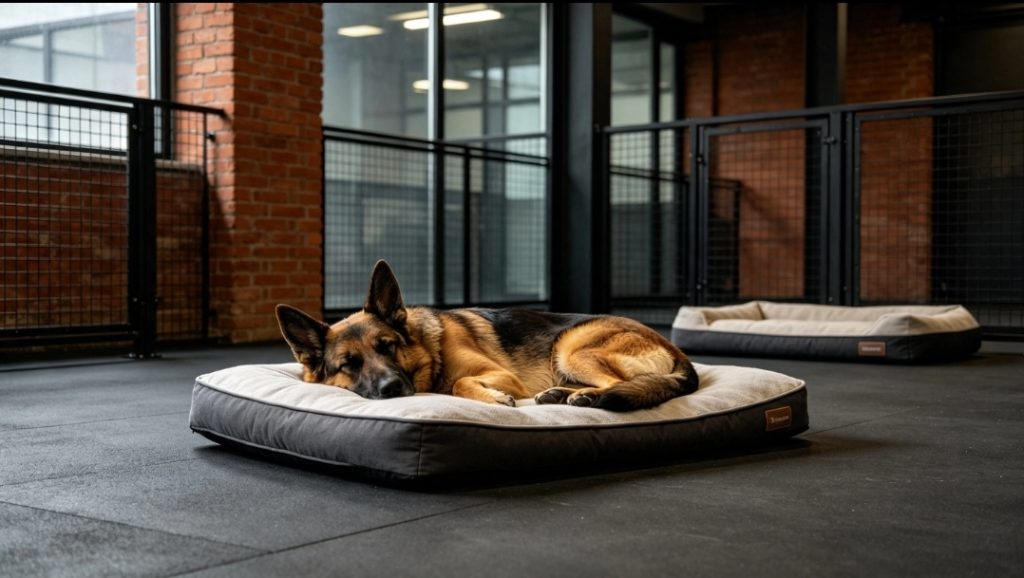
An appropriate resting area can give the dog a clear alternative.
A placemat is particularly useful because it creates a defined location for settling. The dog can learn that when it is not using the sofa, there is another comfortable and predictable place where it can relax.
This is more useful than repeatedly moving the dog away from the sofa without teaching an alternative behaviour.
Why an alternative matters
Imagine that your dog gets onto the sofa because it wants to relax beside you.
If you remove the dog from the sofa but provide no alternative, the dog may simply try again.
Instead, the process can become:
SOFA → GUIDE AWAY → PLACEMAT → SETTLE → REWARD
The exact response depends on the individual dog, but the principle remains the same: establish the boundary while showing the dog what behaviour is appropriate.
Teach the dog to choose the placemat
Begin in a calm environment where there are few distractions.
Place the placemat in an appropriate position within the room.
Encourage the dog towards it using food motivation where appropriate. When the dog is on the placemat and remains calm, reinforce that behaviour.
The objective is not to constantly lure the dog onto the mat forever.
The objective is to build an understanding that the placemat is an appropriate place to settle.
Short, successful repetitions can help establish the behaviour.
As the dog becomes more reliable, gradually increase the duration and reduce unnecessary assistance.
What should I do when my dog jumps onto the sofa?
The response should depend on the dog’s current state.
The GPK9 Professional Training System uses:
OBSERVE → INTERPRET → DECIDE → ACT → REASSESS
Before immediately reacting, observe what is happening.
Is the dog calm?
Is the dog highly excited?
Is the dog responding to you?
Is the behaviour becoming repetitive?
Is the environment creating too much distraction?
Is the dog able to settle when redirected?
These observations help determine the appropriate response.
If the dog is calm and responsive
A calm dog that simply attempts to climb onto the sofa may only require clear, consistent guidance.
Redirect the dog towards the appropriate resting area and reinforce the desired behaviour when the dog settles.
The aim is to make the correct choice clear.
If the dog is becoming overexcited
If the dog repeatedly jumps onto the sofa, ignores redirection or becomes increasingly excited, continuing to repeat the same instruction may not solve the problem.
The dog may need less freedom and a calmer environment.
Remove unnecessary distractions and allow the dog to settle before trying again.
The principle is:
OBSERVE → ASSESS → REMOVE FROM DISTRACTION → CALM → REASSESS
If the dog becomes calm and responsive again, you can continue.
If the dog cannot reduce its arousal or settle appropriately, the situation may need to be reduced further.
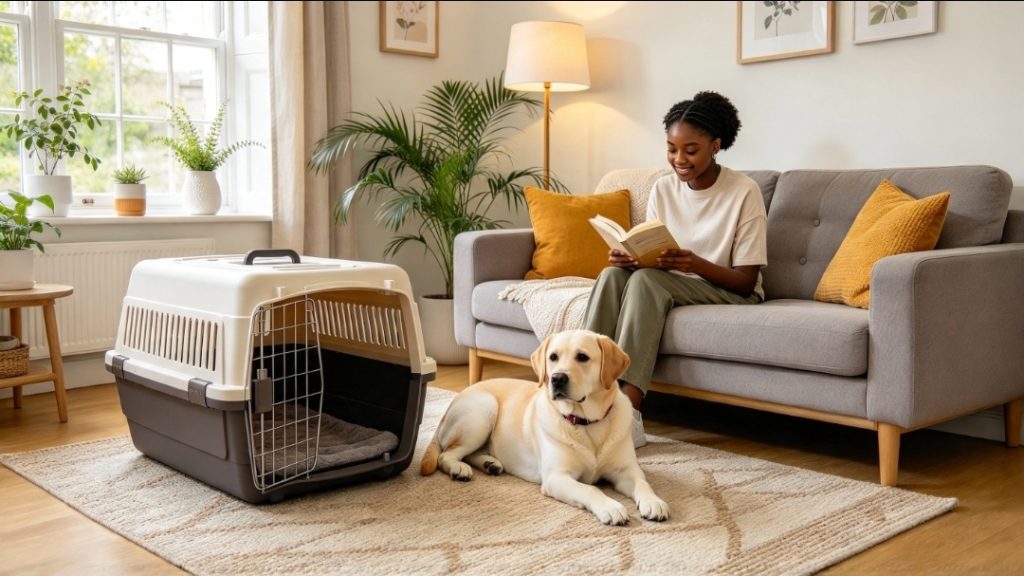
Does my dog need a crate?
A crate should not be viewed simply as somewhere to put a dog because it has broken a household rule.
Within the GPK9 Professional Training System, the crate is a conditioned safe space for rest, routine and resetting.
If your dog cannot settle despite appropriate management, returning to an established crate routine can provide a controlled opportunity to calm down.
The aim is not punishment.
The aim is to reduce the situation and give the dog an opportunity to reset.
Once the dog is calm, you can reassess what level of freedom is appropriate.
How much freedom should my dog have?
A useful GPK9 principle for home training is:
MORE FREEDOM REQUIRES MORE BEHAVIOURAL RESPONSIBILITY.
A dog that reliably stays away from the sofa while calmly settling on its placemat may be able to manage more freedom than a dog that repeatedly jumps onto furniture.
Freedom should therefore reflect the dog’s current behaviour.
The basic Home & Social progression can be understood as:
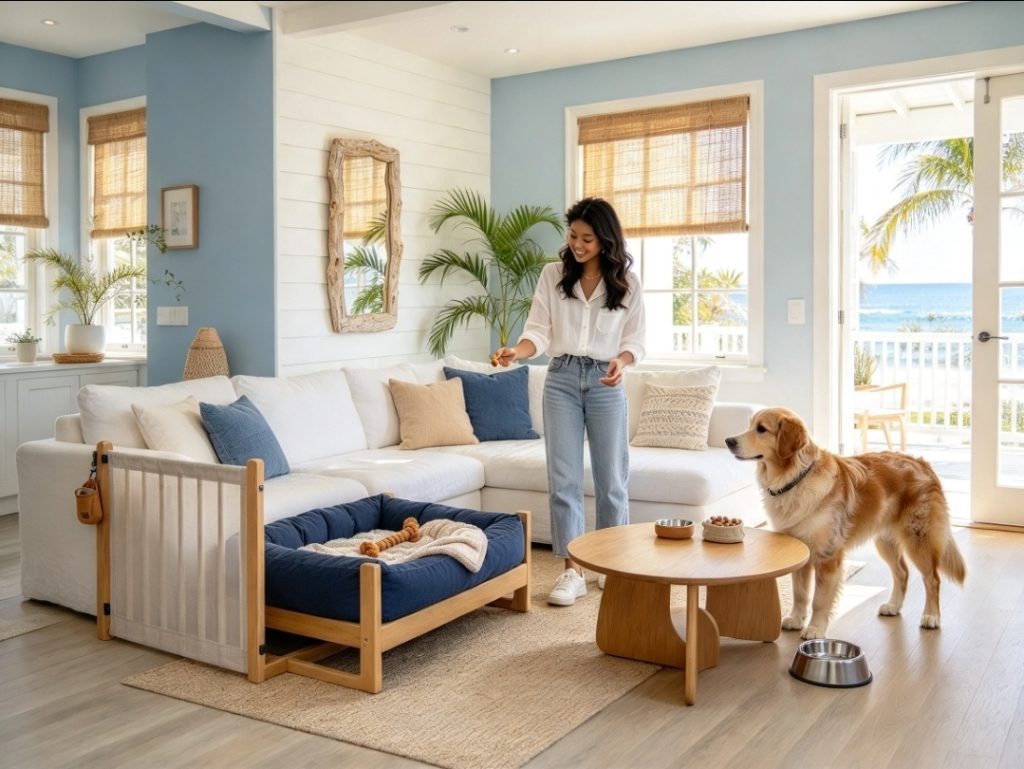
CRATE → PLACEMAT → PLAYPEN
This is not necessarily a straight line.
If the dog struggles with a higher level of freedom, you can temporarily return to an earlier stage, establish calm behaviour and then progress again.
Use management while the behaviour is being learned
Training does not have to rely entirely on the dog making the correct decision every time.
Management can reduce opportunities for the unwanted behaviour while the desired behaviour is being established.
For example, you may use an appropriate boundary, supervised access to the room, a playpen where suitable, or the dog’s established resting area.
The objective is to make successful behaviour easier.
Management should support training rather than replace it.
What if my dog keeps returning to the sofa?
Repetition is useful information.
If your dog gets off the sofa and immediately climbs back on several times, consider whether the current level of freedom is too high.
Rather than becoming frustrated and repeatedly removing the dog, reassess the situation.
Ask:
- Is the dog calm?
- Is the dog responding?
- Is the placemat clearly established?
- Is the dog receiving appropriate reinforcement for settling?
- Is there too much freedom?
- Is there too much environmental stimulation?
- Does the dog need a reset?
If the dog is struggling, reduce the situation.
The GPK9 approach is not about simply repeating the same action regardless of the dog’s response. The dog’s behaviour provides information about whether the current stage is appropriate.
How do I reinforce staying off the sofa?
Reinforce the behaviour you want to see.
If your dog chooses the floor, settles on its placemat or remains calmly away from the sofa, that behaviour can be reinforced.
Food can be useful where the dog has suitable food motivation.
Keep reinforcement appropriate to the dog’s current training stage.
Over time, the dog should increasingly understand the household expectation rather than relying on continuous food for every successful moment.
The long-term objective is calm, reliable behaviour within the home.
RECOMMENDED PRODUCTS
What if my dog gets onto the sofa when I am not watching?
This is where management becomes particularly important.
If your dog is repeatedly practising a behaviour when nobody is supervising, the behaviour can become well established.
Consider whether the dog currently has too much unsupervised freedom.
A dog that cannot yet reliably stay off furniture may need a more controlled environment when it cannot be supervised.
As the behaviour becomes more reliable, freedom can gradually increase.
The decision should be based on observed behaviour rather than simply the dog’s age.
A simple sofa-training routine
A practical routine can be kept straightforward.
Step 1 — Prepare the environment
Place the dog’s designated resting area somewhere appropriate in the room.
Make sure the environment is calm enough for the dog to learn.
Step 2 — Establish the alternative
Encourage the dog towards the placemat and reinforce appropriate settling.
Step 3 — Observe
Watch the dog’s body language, attention, arousal and responsiveness.
Step 4 — Redirect calmly
If the dog approaches or climbs onto the sofa, calmly guide the dog towards the appropriate alternative.
Step 5 — Reinforce the correct behaviour
When the dog settles appropriately away from the sofa, reinforce that behaviour.
Step 6 — Reassess
Determine whether the dog can remain calm and continue appropriately.
Step 7 — Adjust freedom
If the dog is successful, gradually progress.
If the dog repeatedly struggles, reduce freedom and return to a level the dog can manage.
What should I do if my dog becomes frustrated?
Frustration can make learning more difficult.
If your dog becomes increasingly excited, repeatedly attempts to access the sofa or stops responding appropriately, continuing to push the exercise may not be productive.
Use the status response appropriate to the situation.
AMBER:
OBSERVE → ASSESS → REMOVE FROM DISTRACTION → CALM → REASSESS
If the dog returns to a calm state:
GREEN → CALM → CONTINUE → PROGRESS
If the dog cannot reduce or calm:
RED → CANNOT REDUCE → CANNOT CALM → RETURN TO CRATE
After the dog has reset:
RESET → HOME & SOCIAL → GREEN → OBSERVE → CONTINUE
This keeps the focus on the dog’s current state rather than simply trying to force a particular outcome.
Common mistakes when teaching a dog to stay off the sofa
Allowing the rule to change
If the dog is sometimes invited onto the sofa and sometimes removed, the household expectation becomes less clear.
Removing the dog without teaching an alternative
The dog needs to understand where it should settle instead.
Giving too much freedom too quickly
A dog may perform correctly while supervised but struggle when given unrestricted access.
Repeating the same instruction when the dog is overexcited
If the dog cannot respond appropriately, reduce the situation and allow the dog to calm.
Using the sofa as the only focus
The real objective is not simply preventing sofa access.
It is teaching appropriate behaviour within the home.
How do I know whether my dog is ready for more freedom?
Look at the behaviour rather than simply assuming that more time means more freedom.
A dog may be ready to progress when it can:
- Remain calm around the sofa.
- Choose its appropriate resting area.
- Respond appropriately when redirected.
- Settle without constant intervention.
- Recover quickly from normal household distractions.
- Maintain the behaviour consistently.
- Remain appropriate when household activity increases.
If these behaviours are not reliable, continue working at the current level rather than rushing to the next stage.
The key principle behind staying off the sofa
Teaching your dog to stay off the sofa is ultimately about creating a clear household expectation and giving the dog an appropriate behaviour to perform instead.
Observe what the dog is doing.
Interpret its current state.
Decide what level of control is appropriate.
Act calmly and consistently.
Then reassess.
If the dog can remain calm and respond appropriately, continue and gradually progress.
If the dog struggles, reduce the situation, allow the dog to calm and reset before trying again.
This creates a clearer learning process than repeatedly removing a dog from the sofa without considering why it keeps returning.