How do I teach my dog to settle in a crate?
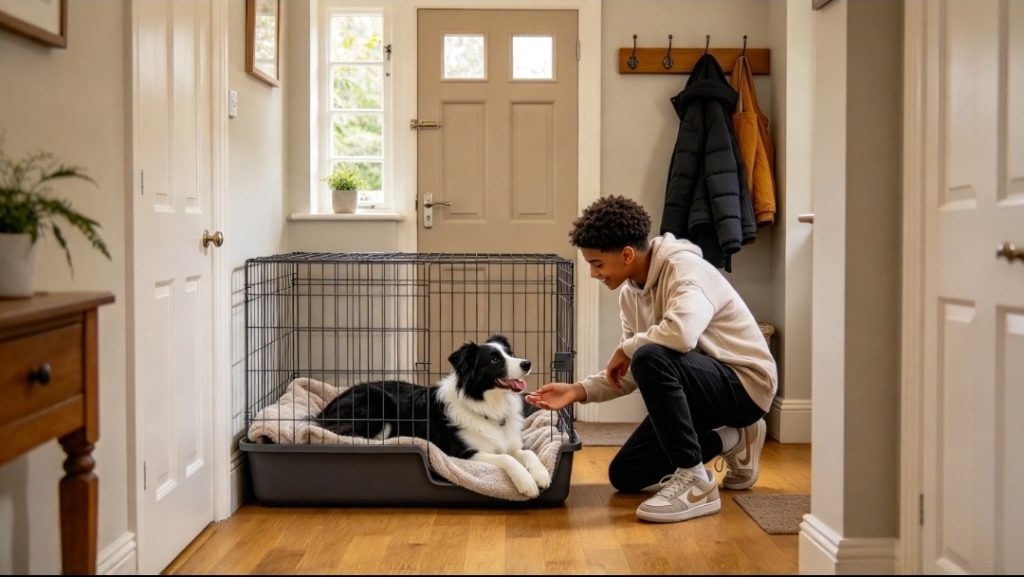
Teaching your dog to settle in a crate is about developing calmness, duration and predictability, not simply making your dog stay inside a confined space. The GPK9 Professional Training System places the crate within HOME & SOCIAL, where the focus is on routine, controlled freedom, settling, calmness and resetting. Use positive reinforcement, food and patience, while following OBSERVE → INTERPRET → DECIDE → ACT → REASSESS so that training progresses according to what your dog is actually showing you.
RECOMMENDED PRODUCTS

What does it mean to settle in a crate?
Settling means your dog can reduce its activity, remain appropriately calm and rest within the crate.
A settled dog may:
- Lie down comfortably
- Remain relaxed
- Reduce unnecessary movement
- Stop constantly monitoring the environment
- Respond appropriately when required
- Recover from minor distractions
- Remain calm for an appropriate period
The objective is not simply:
DOG INSIDE CRATE
The objective is:
DOG INSIDE CRATE → CALM → SETTLE → REST
This distinction is important because a dog can physically remain inside a crate while still being highly aroused or unable to settle.
The GPK9 HOME & SOCIAL pathway
Crate settling sits within the GPK9 HOME & SOCIAL structure:
CRATE → PLACEMAT → PLAYPEN
These are connected areas rather than rigid stages.
CRATE
The crate provides a controlled space for:
- Rest
- Routine
- Calmness
- Management
- Resetting
- Supporting toilet routines
PLACEMAT
The placemat develops:
- Stationing
- Duration
- Settling
- Calmness
- Controlled freedom outside the crate
PLAYPEN
The playpen introduces greater freedom within a controlled boundary.
The GPK9 principle is:
MORE FREEDOM REQUIRES MORE BEHAVIOURAL RESPONSIBILITY.
If your dog cannot manage increased freedom calmly, reduce the level of freedom and return to an earlier stage.
Start with a calm crate environment
Before teaching duration, consider the environment.
A crate placed directly in the middle of constant activity may make settling unnecessarily difficult.
Consider:
- Household movement
- Noise
- Other animals
- Visitors
- Toys
- Food preparation
- Television
- Outdoor distractions
- The dog’s current arousal
The aim is not to isolate the dog from normal life.
The aim is to provide an appropriate environment in which the dog can learn to settle while gradually developing the ability to cope with normal household activity.
Build a positive association first
If your dog is not comfortable around the crate, start with positive experiences.
Allow the dog to investigate the crate.
Use food to reinforce appropriate behaviour such as:
- Approaching
- Looking towards the crate
- Entering
- Remaining inside briefly
- Settling
- Responding to the handler
A useful progression is:
APPROACH → ENTER → REINFORCE → SETTLE → REASSESS
Do not rush from voluntary entry directly into prolonged confinement.
The dog first needs to understand that calm behaviour around and inside the crate is worthwhile.
Use food without creating dependence on the lure
Food is a useful part of positive reinforcement.
However, there is a difference between using food to teach a behaviour and continually luring the dog into the crate.
The objective is for the dog to learn the behaviour.
A simple progression is:
MOTIVATE → ENTER → REINFORCE → SETTLE → REDUCE PROMPTING → REASSESS
As the dog understands the behaviour, allow the learned response to become more independent.
Patience is important.
If your dog needs more repetitions at one stage, stay at that stage.
Teach duration gradually
Once your dog can enter the crate and settle briefly, develop duration progressively.
Do not immediately expect a long period of calmness.
Instead:
SHORT DURATION → REASSESS → LONGER DURATION → REASSESS → PROGRESS
The correct duration is determined by the dog’s behaviour.
If the dog remains calm and consistent, progress appropriately.
If the dog becomes restless, vocal or increasingly aroused, reassess before increasing duration.
Reinforce calm behaviour
When your dog settles appropriately, that calm behaviour is important.
Look for:
- Relaxed body posture
- Reduced movement
- Calm breathing
- Ability to remain in position
- Appropriate attention
- Recovery from minor distractions
Reinforce the behaviour you want to develop.
The aim is to teach the dog that calmness is part of the crate routine.
Do not make the crate constantly exciting
Food, toys and interaction can all be useful, but the crate should ultimately support calmness.
If every crate experience involves excitement, high-value activity or constant interaction, the dog may learn that the crate predicts activity rather than rest.
The balance is:
POSITIVE ASSOCIATION → CALMNESS → SETTLING → REST
The crate does not need to become the most exciting place in the house.
It needs to become a predictable place where appropriate behaviour is possible.
What if my dog gets up immediately?
If your dog settles and then gets up, observe what happened.
Ask:
- Was there a distraction?
- Did someone move?
- Did another dog enter the room?
- Has the dog reached its current duration limit?
- Does the dog need the toilet?
- Has arousal increased?
- Is the environment too stimulating?
Do not automatically interpret getting up as failure.
It is information.
The GPK9 decision process is:
OBSERVE → INTERPRET → DECIDE → ACT → REASSESS
Use the information to determine the next step.
RECOMMENDED PRODUCTS
What if my dog will not settle at all?
If your dog cannot settle, do not simply increase crate duration.
First identify why.
Your dog may be:
- Too highly aroused
- Distracted
- Unsure about the crate
- Uncomfortable with the current duration
- Needing the toilet
- Struggling with the environment
- Missing the settling skill itself
Reduce the difficulty and rebuild the behaviour.
If necessary, return to an earlier part of the HOME & SOCIAL pathway.
Use the placemat to develop settling
Settling should not exist only inside the crate.
The placemat gives your dog an opportunity to learn:
STATIONING → DURATION → SETTLING → CALMNESS
This can help develop calm behaviour outside the crate as well.
The wider GPK9 structure therefore becomes:
CRATE → PLACEMAT → PLAYPEN
The dog learns controlled behaviour in different levels of freedom.
RECOMMENDED PRODUCTS
Build calmness after activity
A common mistake is expecting an excited dog to immediately become calm simply because it has entered the crate.
If your dog has just finished exciting play or experienced a stimulating environment, observe its current arousal.
The transition should become:
ACTIVITY → CALM → CRATE → SETTLE → REST
Rather than:
HIGH AROUSAL → CRATE → EXPECTED IMMEDIATE SETTLING
This is where calmness and patience become important.
GPK9 GREEN, AMBER AND RED responses
GREEN — OBSERVE → CONTINUE → PROGRESS
If your dog is calm, responsive and able to settle:
OBSERVE → CONTINUE → PROGRESS
Continue the appropriate training and gradually increase difficulty when the dog is ready.
AMBER — OBSERVE → ASSESS → REMOVE FROM DISTRACTION → CALM → REASSESS
If your dog begins struggling:
OBSERVE → ASSESS → REMOVE FROM DISTRACTION → CALM → REASSESS
If the dog becomes calm:
GREEN → CALM → CONTINUE → PROGRESS
If the dog cannot reduce or calm:
RED → CANNOT REDUCE → CANNOT CALM → RETURN TO CRATE
RED — STOP WHAT YOU ARE DOING
If the dog becomes significantly unsettled:
STOP WHAT YOU ARE DOING → OBSERVE → ASSESS → REMOVE FROM DISTRACTION → CALM → REASSESS
If the dog becomes calm, return to GREEN.
If the dog cannot reduce or calm:
RETURN TO CRATE → RESET → HOME & SOCIAL → GREEN → OBSERVE → CONTINUE
The reset is not punishment. It is a return to an appropriate level of control and learning.
What if my dog cries while settling?
Crying is information.
Before deciding what to do, consider:
- Toilet requirements
- Current arousal
- Environmental distractions
- Duration
- Previous crate experience
- Ability to settle
- Changes in routine
Do not automatically open the crate every time your dog vocalises.
Equally, do not automatically ignore every vocalisation.
Observe the whole situation and determine what the dog is communicating.
If the dog is struggling, reduce the difficulty and reassess.
What if my dog falls asleep?
Sleep is not the only goal, but it can be a natural result of successful settling.
The important behaviour is the transition:
ACTIVITY → CALM → SETTLE → REST
A dog does not have to sleep every time it enters the crate.
Being able to remain calmly settled is already an important skill.
How do I progress crate settling?
Progress should follow the dog’s behaviour.
You can gradually develop:
VOLUNTARY ENTRY → SHORT SETTLE → LONGER SETTLE → MINOR DISTRACTIONS → GREATER DURATION → APPROPRIATE FREEDOM
Do not increase every variable at the same time.
If duration increases, keep the environment relatively simple.
If distractions increase, you may need to reduce duration.
If freedom increases, behavioural responsibility must also increase.
This reflects the GPK9 principle:
MORE FREEDOM REQUIRES MORE BEHAVIOURAL RESPONSIBILITY.
RECOMMENDED PRODUCTS
Common mistakes when teaching crate settling
Expecting immediate calmness
Settling is a learned behaviour that may require progressive development.
Increasing duration too quickly
A dog that settles briefly is not automatically ready for prolonged confinement.
Using the crate only for separation
The crate should become part of normal daily life.
Putting an over-aroused dog straight into the crate
Allow appropriate calmness before expecting prolonged settling.
Ignoring the environment
Distractions can make settling much harder.
Using constant food lures
Food should support learning rather than become the only reason the dog enters or remains in the crate.
Giving too much freedom too soon
Controlled freedom should increase alongside behavioural responsibility.
How do I know my dog has learned to settle?
Look for consistency rather than one successful session.
Your dog may be developing reliable crate settling when it can:
- Enter calmly
- Remain relaxed
- Settle without constant prompting
- Maintain appropriate duration
- Recover from minor distractions
- Respond when required
- Return to calmness after activity
- Repeat the behaviour consistently
When these behaviours are becoming reliable, progression can continue.
If the dog begins struggling, reduce the difficulty and rebuild.
When should I get professional help?
If your dog consistently cannot settle, shows significant distress around the crate, becomes increasingly difficult to manage or experiences a substantial change in behaviour, individual professional assessment may be appropriate.