How Do I Teach My Dog Self-Control?
How do I teach my dog self-control? The best approach is to teach your dog that calm, controlled behaviour is what earns access to the things it wants. Start with simple exercises such as waiting for food, toys, doors and greetings, reward your dog for remaining calm, and gradually increase the difficulty as your dog becomes more reliable.
What is self-control in dogs?
Self-control means your dog can experience something exciting or rewarding without immediately rushing towards it or reacting impulsively.
A dog with developing self-control can pause, wait, respond to a cue and make an appropriate choice even when something it wants is available.
Self-control is not about preventing your dog from showing excitement. It is about teaching your dog how to manage its behaviour when excitement, frustration or anticipation increases.
How do I teach my dog self-control?
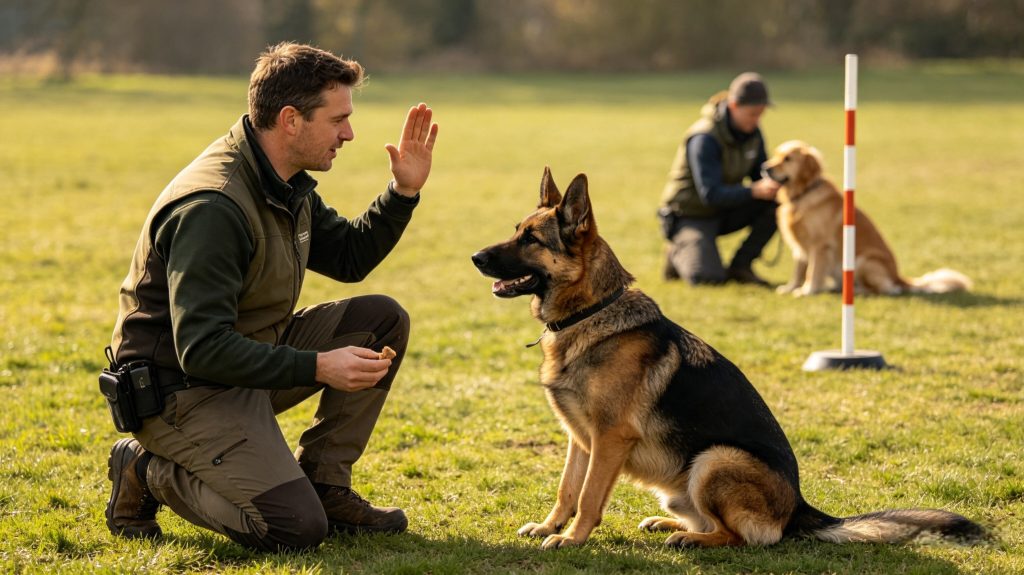
Self-control should be taught through short, achievable exercises that give your dog a clear reason to remain calm.
A simple training pattern is:
Wait → remain calm → reward → release.
The reward teaches your dog that controlling its behaviour produces a positive outcome.
1. Start with something your dog wants
Choose a low-level distraction or reward that your dog is interested in, such as food, a toy or access to the garden.
Do not start with something that makes your dog extremely excited.
The aim is to give your dog an opportunity to succeed.
2. Ask for a simple behaviour
Ask for a behaviour your dog already understands, such as sitting, standing calmly or looking at you.
Keep the exercise simple and avoid adding unnecessary commands.
3. Introduce a short wait
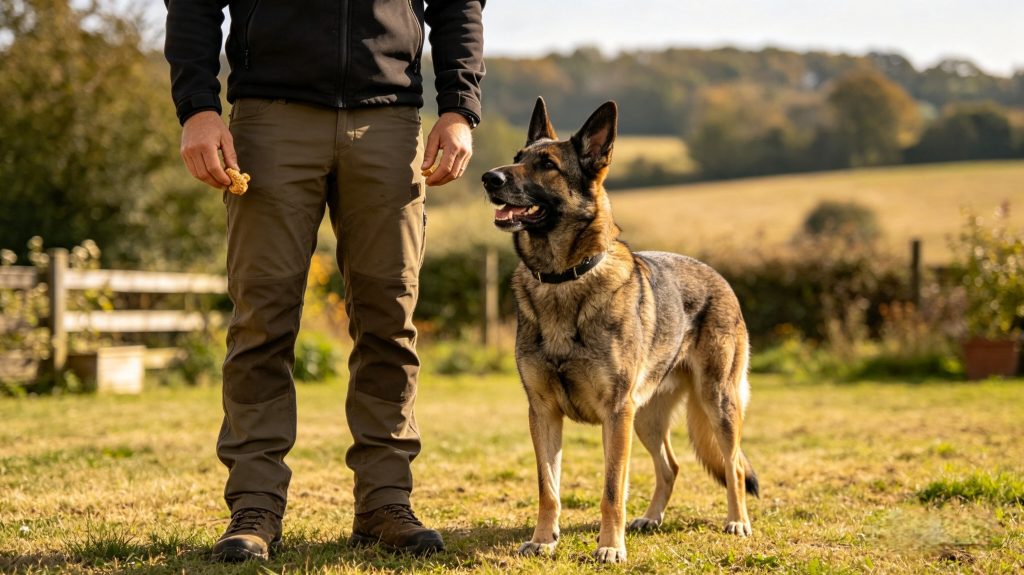
Present the reward but do not immediately give it to your dog.
Wait for a brief moment of calm behaviour.
Initially, this may only be one or two seconds.
4. Reward the calm response
If your dog remains controlled, reward it.
The timing matters. Reward the calm behaviour while it is happening, rather than waiting until your dog becomes excited again.
5. Release your dog
Use a consistent release cue to tell your dog when it can access the reward.
This creates a clear pattern:
Control → reward → release.
Your dog learns that waiting does not mean it will never get what it wants.
6. Gradually increase the difficulty
Once your dog can remain calm for a short period, gradually increase the duration, distance or distraction.
Do not increase everything at once.
For example:
One second → three seconds → five seconds → longer duration.
Then introduce slightly more difficult distractions.
If your dog breaks the behaviour repeatedly, make the exercise easier.
How do I teach my dog to wait for food?
Food is an easy way to practise self-control because it is naturally rewarding.
Ask your dog for a simple behaviour and present the food without immediately allowing access.
Reward calm waiting and then release your dog to eat.
As your dog improves, gradually increase the time it can wait.
Avoid deliberately teasing your dog with food or making the exercise unnecessarily difficult. The purpose is to teach control, not frustration.
How do I teach self-control with toys?
Toys can be used in the same way.
Ask your dog for a calm behaviour before starting the game. When your dog remains controlled, reward it by releasing the toy and beginning play.
During play, occasionally pause and allow your dog to settle before restarting.
This teaches your dog that calm behaviour gives access to exciting activities.
If your dog becomes frantic, grabbing, jumping or unable to respond, the game has become too stimulating. Pause and allow your dog to recover before continuing.
How do I teach my dog to control itself at the door?
Doors provide a useful real-life self-control exercise.
Ask your dog to wait while you open the door. Start with only a small amount of movement.
If your dog remains calm, reward it and gradually open the door further.
If your dog rushes forward, close the door or reduce the difficulty and try again.
Once your dog can wait reliably, use a release cue to allow it through.
The same principle can be applied to gates, car doors and other situations where your dog wants immediate access.
How do I teach self-control around people?
Start with calm greetings rather than allowing your dog to practise jumping, rushing or excessive excitement.
Ask for a simple behaviour before your dog receives attention.
Reward four paws on the floor, calm standing or sitting, depending on what your dog can reliably perform.
If your dog becomes too excited, create some distance and allow it to settle before attempting the greeting again.
A placemat can also be useful for teaching calm behaviour during household activity or while visitors are present.
How do I teach self-control around other dogs?
Do not begin by putting your dog close to another dog and expecting it to remain calm.
Start at a distance where your dog can notice the other dog while still responding to you.
Reward calm observation, checking in with you and appropriate disengagement.
Gradually reduce the distance only when your dog remains responsive.
If your dog begins pulling, barking, lunging or becomes unable to respond, increase the distance again.
If the behaviour involves aggression or cannot be safely managed, seek professional assessment rather than attempting increasingly difficult exposure yourself.
What equipment can help with self-control training?
Equipment can help you manage the environment while your dog learns.
A short line and suitable harness can provide controlled movement during training. A long line can provide greater freedom in appropriate secure areas once your dog has developed sufficient control.
A placemat can provide a clear location for practising calm behaviour at home.
A crate can provide a secure recovery or rest area when your dog has become too stimulated to continue learning. It should never be used as punishment.
Equipment supports training but does not create self-control by itself. Your dog still needs to learn the behaviour.
What if my dog becomes frustrated when I make it wait?
If your dog becomes increasingly frustrated, the exercise may be too difficult.
Reduce the waiting time and make the reward easier to access.
For example, instead of asking your dog to wait for ten seconds, reward after one or two seconds and then release.
Build duration gradually as your dog succeeds.
Self-control develops through repeated successful experiences. Making the exercise excessively difficult can teach frustration rather than control.
How do I increase my dog’s self-control?
Once your dog understands the basic exercise, gradually introduce different challenges.
You can increase:
- Duration — ask your dog to remain calm for longer.
- Distance — move further away while your dog waits.
- Distraction — introduce more movement, noise or activity.
- Difficulty — practise around increasingly valuable rewards.
- Environment — move from quiet areas to more challenging locations.
Change one variable at a time where possible.
If your dog struggles, reduce the difficulty and rebuild from there.
How long does it take to teach a dog self-control?
There is no fixed timeframe.
Some dogs develop good control quickly in quiet environments but need much more practice around exciting distractions.
Short, regular training sessions are generally more useful than long sessions that leave your dog frustrated or overstimulated.
Self-control should also be practised during everyday activities rather than treated as a single training exercise.
Should I punish my dog for being impulsive?
Punishment does not teach your dog what behaviour you want instead.
If your dog rushes towards food, jumps at visitors or grabs a toy, focus on teaching the alternative behaviour and controlling access to the reward until your dog can respond appropriately.
Self-control is learned through practice, clear communication, appropriate rewards and gradual progression.
Conclusion
Teaching your dog self-control means showing it that calm behaviour earns access to the things it wants.
Start with simple waits, reward controlled behaviour, use a clear release cue and gradually introduce longer durations and stronger distractions. If your dog becomes frustrated or overwhelmed, make the exercise easier rather than forcing it to continue.
With consistent practice, self-control becomes part of your dog’s everyday behaviour rather than something it only performs during formal training.