How Do I Teach My Dog Impulse Control?
How do I teach my dog impulse control? The best way is to teach your dog to pause before acting, wait for access to something it wants, and choose an appropriate behaviour instead of immediately reacting. Start with simple situations involving food, toys, doors and attention, reward calm decisions, and gradually practise around stronger distractions.
What is impulse control in dogs?
Impulse control is your dog’s ability to pause between wanting something and acting on that desire.
For example, instead of immediately rushing towards food, jumping at a person or grabbing a toy, your dog learns to wait, respond to you and then gain access to what it wants.
Impulse control is therefore not about stopping your dog from being excited. It is about teaching your dog that being able to control its behaviour is what allows it to access rewarding things.
How do I teach my dog impulse control?
The basic training pattern is:
Pause → choose the correct behaviour → reward → release.
Begin with situations your dog can handle easily. Reward even a very short pause at first, then gradually increase the difficulty.
1. Choose something your dog wants
Use a reward that your dog genuinely values, such as food, a toy, play or access to something interesting.
Start with something that creates mild excitement rather than using the most stimulating reward immediately.
2. Wait for a pause
Allow your dog to notice the reward without immediately giving it access.
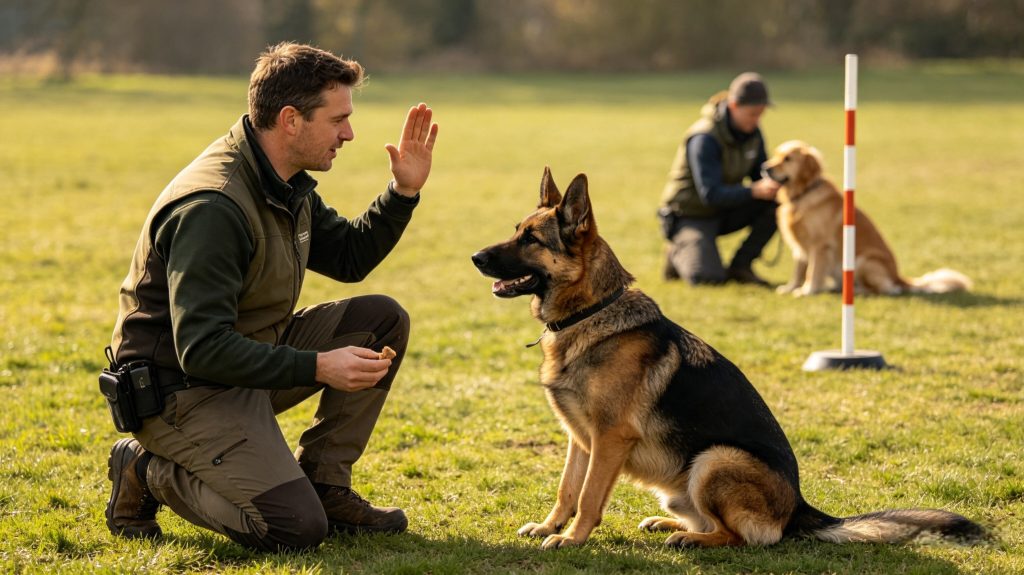
The moment your dog pauses, becomes calmer or looks towards you, mark the behaviour and reward it.
The pause may initially be very brief.
3. Reward the decision
Timing is important.
Reward the behaviour you want your dog to repeat. If your dog waits calmly for a moment, that moment should lead to something positive.
Your dog begins to learn:
Calm behaviour gets me what I want.
4. Use a release cue
Once your dog can wait, use a consistent release cue to allow access to the reward.
This prevents waiting from becoming an unclear exercise where your dog does not know when it is allowed to move.
The sequence becomes:
Wait → remain controlled → reward → release.
5. Gradually increase difficulty
Once your dog can succeed easily, increase the challenge gradually.
You can increase the:
- Duration of the wait
- Distance from the reward
- Level of distraction
- Value of the reward
- Difficulty of the environment
Change one factor at a time where possible.
If your dog repeatedly fails, make the exercise easier.
How do I teach impulse control with food?
Food is one of the simplest ways to practise impulse control.
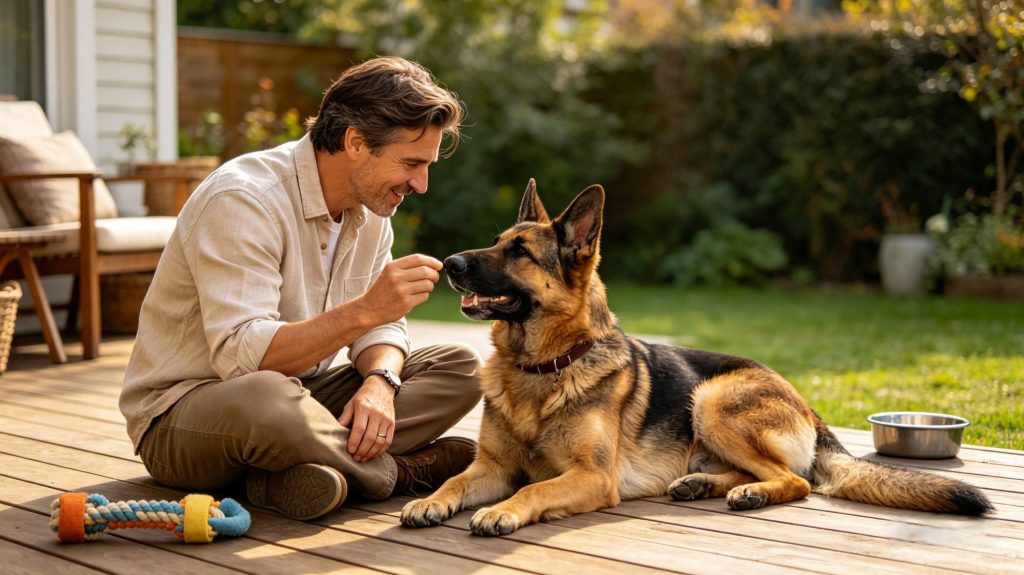
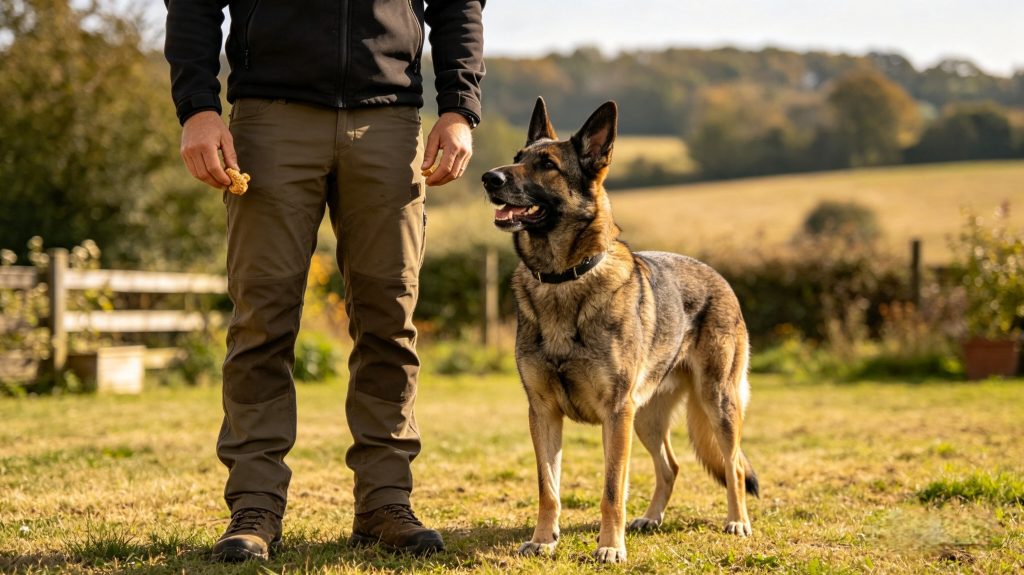
Hold a small amount of food and wait for your dog to remain controlled rather than grabbing, jumping or rushing.
Reward calm behaviour and then release your dog to take the food.
You can gradually progress from food in your hand to food placed on a surface, provided your dog can remain controlled.
Do not deliberately tease or frustrate your dog. The purpose is to teach controlled access, not to make the dog struggle for its reward.
How do I teach impulse control with toys?
Toys can be used in exactly the same way.
Ask for a simple behaviour before starting the game. When your dog remains controlled, release it to the toy and begin playing.
During play, pause occasionally. If your dog can disengage and respond appropriately, reward that control by restarting the game.
This teaches your dog that exciting activities do not have to become uncontrolled.
If your dog becomes frantic, grabbing, jumping or ignoring you, reduce the intensity of the game and allow your dog to settle before continuing.
How do I teach my dog impulse control at the door?
Doors provide a useful everyday exercise.
Ask your dog to wait while you move towards the door. Initially, only open the door slightly.
If your dog remains controlled, reward it.
Gradually increase how far the door opens. If your dog moves towards the door, reduce the difficulty and try again.
Once your dog can wait reliably, use a release cue to allow it through.
The same exercise can be used with gates, car doors and access to the garden.
How do I teach impulse control around people?
Start with calm behaviour before allowing your dog to greet someone.
If your dog normally jumps, rushes forward or becomes highly excited, create enough distance for it to respond to you.
Reward calm standing, sitting or another appropriate behaviour.
Only allow the greeting when your dog is sufficiently controlled to interact appropriately.
If excitement increases again, create distance and reset rather than allowing the dog to continue practising uncontrolled behaviour.
How do I teach impulse control around other dogs?
Do not expect a dog to develop impulse control by immediately placing it close to another dog.
Start at a distance where your dog can see the other dog while still responding to you.
Reward calm observation, checking in with you and disengaging from the other dog.
Gradually reduce the distance only when your dog remains responsive.
If your dog starts pulling, barking, lunging or becomes unable to respond, increase the distance again.
If there is aggression or a significant safety concern, seek professional assessment rather than attempting to manage increasingly difficult encounters alone.
What equipment can help with impulse control?
Equipment can help you manage the situation while your dog learns.
A short line and suitable harness can provide controlled movement during training. A long line can provide additional freedom in a secure, appropriate environment once your dog has developed sufficient control.
A placemat can provide a consistent location for practising calm behaviour at home.
A crate can provide a secure recovery or rest area if your dog becomes too stimulated to continue learning. It should be used as a safe space, not as punishment.
Equipment should support training rather than replace it. Your dog still needs to learn how to make controlled choices.
What if my dog cannot control itself?
If your dog repeatedly rushes towards the reward, becomes frustrated, jumps, barks or ignores you, the exercise is probably too difficult.
Reduce the challenge.
For example, shorten the waiting period, increase your distance from the distraction, use a less exciting reward or move somewhere quieter.
Successful repetition is more valuable than repeatedly allowing your dog to fail.
How do I teach impulse control around distractions?
Once your dog understands the basic exercise, gradually introduce distractions.
Start with mild distractions and reward your dog for noticing them without immediately reacting.
You can then increase the difficulty by adding movement, sounds, people, dogs or other exciting situations.
The progression should be based on your dog’s ability to remain responsive.
If your dog becomes too excited to think or respond, move away from the distraction and allow it to settle before trying again.
Should I punish impulsive behaviour?
Punishment does not teach your dog what to do instead.
If your dog jumps, rushes towards something or grabs an object, focus on preventing the unwanted behaviour from being rehearsed and teach an appropriate alternative.
Reward the behaviour you want to see repeated.
Impulse control develops through clear communication, appropriate rewards, good timing and gradual progression, rather than simply correcting mistakes.
How long does it take to teach impulse control?
There is no fixed timeframe.
A dog may learn to wait for food quickly but still struggle to control itself around other dogs, visitors or exciting outdoor distractions.
Practise regularly in short sessions and use everyday opportunities to reinforce controlled behaviour.
Progress gradually from easy situations to more challenging ones rather than expecting the same level of control everywhere immediately.
What is the difference between impulse control and obedience?
Obedience involves teaching specific behaviours in response to cues.
Impulse control is the ability to pause and make an appropriate choice when something is motivating or exciting.
The two work together.
For example, a dog may know the command to sit but still need to develop the impulse control to remain calm when a visitor arrives.
Teaching both gives your dog a clearer way to respond when excitement or temptation increases.
Conclusion
Teaching impulse control means teaching your dog that pausing and making an appropriate choice leads to access to rewarding things.
Start with easy situations, reward brief moments of control, use a clear release cue and gradually increase duration and distractions. If your dog becomes frustrated or overwhelmed, reduce the difficulty and allow it to succeed again.
With consistent practice, impulse control can become part of your dog’s everyday behaviour rather than something it only performs during formal training.