How do I stop my puppy pooping in the house?
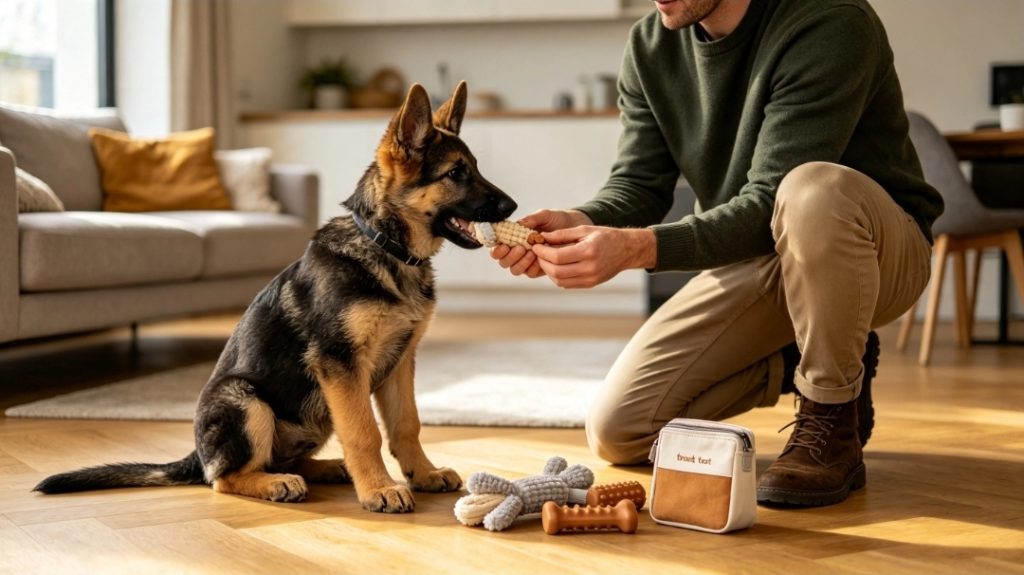
A professional realistic photograph of a young Labrador Retriever puppy, approximately 10–12 weeks old, standing calmly inside a clean modern family home near an open doorway leading to a secure garden. The puppy has a short yellow coat, relaxed and attentive body language and is wearing a comfortable harness attached to a short training lead. A calm adult handler is observing the puppy closely and preparing to take it outside. The home should include a clearly managed puppy area with a crate, placemat and playpen, clean flooring and minimal distractions. Through the doorway, show a secure garden containing a clearly designated toilet area. Include a training pouch and lead as subtle practical equipment. The image should communicate supervision, routine, controlled freedom, positive reinforcement and calm puppy toilet training. No logos, branding or watermarks.
RECOMMENDED PRODUCTS

How do I stop my puppy pooping in the house?
The most effective way to stop a puppy pooping in the house is to create a consistent toilet routine, provide regular opportunities to use the correct toilet area and carefully manage the puppy’s freedom while it learns.
The goal is not simply to react when an accident happens. The GPK9 approach is to understand what happened beforehand, identify when the puppy is most likely to need to toilet and create the conditions that make the correct behaviour easier.
The process is:
OBSERVE → INTERPRET → DECIDE → ACT → REASSESS
Why does my puppy poop in the house?
A puppy may poop indoors because it has not yet learned where toileting is expected.
Other factors can include:
- The puppy was not taken outside at the right time.
- The puppy had recently eaten.
- The puppy had just woken up.
- The puppy had been playing or became excited.
- Early signs were missed.
- The puppy had too much freedom.
- The puppy was unsupervised.
- The puppy became distracted outside.
- The toilet routine was inconsistent.
Repeated accidents should therefore be treated as information.
Instead of asking only, “How do I stop my puppy pooping in the house?”, ask:
What happened before the accident?
Build a predictable toilet routine
A puppy should be given regular opportunities to poop in the correct location.
Useful times to take the puppy outside include:
- After waking.
- After sleeping during the day.
- After eating.
- After active play.
- After periods of excitement.
- Before settling down.
- When the puppy begins showing signs that it needs to toilet.
The routine should be consistent but flexible enough to respond to the puppy’s behaviour.
A timetable can provide structure, but observation tells you when the puppy may need an additional opportunity.
Pay particular attention after meals
Food can be an important part of understanding a puppy’s toilet routine.
Rather than simply relying on a fixed schedule, observe what happens after your puppy eats.
If your puppy regularly needs to poop after eating, that becomes an important part of your individual toilet routine.
The goal is to recognise the puppy’s pattern and provide an opportunity to toilet in the correct location.
Learn your puppy’s pre-toilet behaviour
Puppies can show changes in behaviour before they poop.
Look for signs such as:
- Sniffing the floor.
- Circling.
- Restlessness.
- Searching for a location.
- Moving away from an activity.
- Suddenly stopping play.
- Returning to an area previously used for toileting.
- Becoming more focused on the floor.
Not every puppy will display the same signs.
Learning your own puppy’s behaviour allows you to act earlier.
This is why observation is central to the GPK9 system.
Take your puppy to the same toilet area
Consistency can help the puppy understand where toileting is expected.
Where practical, take the puppy to the same designated toilet area and allow it time to investigate and toilet without unnecessary distractions.
The desired association is:
TOILET → CORRECT LOCATION → POSITIVE OUTCOME
When the puppy poops in the correct location, provide appropriate positive reinforcement.
Food, praise and calm interaction can all be used to reinforce the behaviour.
What if my puppy does not poop outside?
Going outside does not guarantee that the puppy will immediately toilet.
The puppy may become distracted by smells, sounds, movement or other environmental activity.
If the puppy does not poop, avoid turning the toilet trip into unrestricted play.
Keep the opportunity calm and purposeful.
If the puppy remains distracted, reassess the environment and the level of control.
The aim is to give the puppy a suitable opportunity to toilet before progressing to another activity.
RECOMMENDED PRODUCTS
What if my puppy comes back inside and poops?
This can happen when the puppy has not yet learned the complete routine.
If the puppy comes inside without toileting, do not automatically assume that the puppy no longer needs to go.
Continue to observe closely and maintain appropriate management.
The puppy may need another opportunity outside shortly afterwards.
This is where supervision becomes important.
Manage your puppy’s freedom
If your puppy repeatedly poops indoors, consider whether it has too much freedom.
A puppy that can move freely around the entire home can easily find a quiet area in which to toilet before anyone notices.
The GPK9 HOME & SOCIAL structure provides different levels of controlled freedom:
CRATE → PLACEMAT → PLAYPEN
The crate provides a conditioned safe space for rest, routine and resetting.
The placemat provides stationing, duration and settling.
The playpen provides controlled freedom within a boundary.
The puppy can move between these levels according to its current behaviour and ability to manage responsibility.
More freedom requires more behavioural responsibility
The GPK9 principle is:
MORE FREEDOM REQUIRES MORE BEHAVIOURAL RESPONSIBILITY.
If your puppy is reliable with a controlled amount of freedom, you can gradually progress.
If accidents increase after giving the puppy more freedom, reassess.
Returning temporarily to a more controlled environment is not failure.
It is part of managing the puppy at the level it can currently handle.
What should I do if I catch my puppy pooping indoors?
If you see the puppy beginning to poop indoors, calmly interrupt the situation and take it to the appropriate toilet area.
The objective is to provide an opportunity for the puppy to finish in the correct place.
Avoid harsh punishment.
The puppy needs to learn where the correct behaviour should happen, rather than developing fear around toileting.
When the puppy finishes in the correct location, reinforce the behaviour appropriately.
What if I discover the accident afterwards?
If the accident has already happened, avoid punishing the puppy afterwards.
The puppy cannot be expected to understand why it is being punished for something that happened earlier.
Instead, clean the area appropriately and reassess the circumstances.
Ask:
- When did the puppy last poop?
- When did it last eat?
- Had it just woken up?
- Had it been playing?
- How long had it been indoors?
- How much freedom did it have?
- Was anyone supervising?
- Were signs missed?
- Was the puppy distracted outside?
This information can help you change the routine for the next opportunity.
Use positive reinforcement
Positive reinforcement helps the puppy understand what behaviour you want repeated.
When your puppy poops in the correct location, provide a suitable reward promptly.
Food can be used as part of the process when appropriate.
The puppy should repeatedly experience:
CORRECT LOCATION → CORRECT BEHAVIOUR → POSITIVE REINFORCEMENT
Over time, this can help establish a clearer association between the toilet area and the desired behaviour.
Why are accidents still happening?
If your puppy continues to poop indoors, look at the whole training process rather than focusing on the accident alone.
Routine
Are toilet opportunities being provided at appropriate times?
Observation
Are you recognising the puppy’s individual signs?
Supervision
Can you see what the puppy is doing when it has freedom?
Management
Does the puppy currently have more freedom than it can manage?
Environment
Is the puppy distracted when outside?
Reinforcement
Is correct toileting being positively reinforced?
Progression
Has freedom been increased too quickly?
These questions help identify where the current process needs to change.
What if accidents happen after play?
Play can create an important transition point in a puppy’s routine.
A puppy may become highly engaged in play and then need to toilet afterwards.
Rather than treating this as unexpected, build it into your observation.
After active play, give the puppy an appropriate toilet opportunity.
This allows the puppy’s natural daily activities to become predictable parts of the toilet routine.
What if my puppy is improving but still has occasional accidents?
Progress does not have to be perfectly linear.
A puppy can become increasingly reliable while still having occasional accidents.
Look at the overall pattern.
If accidents are becoming less frequent and the puppy is increasingly successful in the correct location, continue the appropriate routine and progress gradually.
If accidents suddenly increase, reassess what has changed.
It may be that the puppy has been given too much freedom or that the routine has changed.
RECOMMENDED PRODUCTS
Use the GPK9 status response system
The GPK9 status response system provides a structured way to respond when the puppy is struggling.
GREEN — OBSERVE → CONTINUE → PROGRESS
The puppy is calm and the current toilet routine is working.
Observe, continue the appropriate activity and progress when appropriate.
AMBER — OBSERVE → ASSESS → REMOVE FROM DISTRACTION → CALM → REASSESS
The puppy is becoming distracted or struggling with the situation.
Observe what has changed, assess the environment, reduce the distraction and allow the puppy to calm before reassessing.
If the puppy returns to an appropriate state:
GREEN → CALM → CONTINUE → PROGRESS
RED — STOP → OBSERVE → ASSESS → REMOVE FROM DISTRACTION → CALM → REASSESS
If the situation is no longer productive, stop and reset.
If the puppy cannot reduce or calm appropriately, return to an appropriate level of control and management.
The objective is to restore the conditions needed for successful learning.
What is the GPK9 reset for toilet training?
When the puppy is struggling, the GPK9 reset is:
RESET → TOILET → GREEN → OBSERVE → CONTINUE
This means returning to the relevant Golden Rule, restoring an appropriate state and then continuing when the puppy is ready.
For a puppy repeatedly pooping indoors, the reset may involve returning to a more structured toilet routine, increasing supervision and temporarily reducing freedom.
When can I give my puppy more freedom?
Freedom should increase gradually as the puppy demonstrates greater behavioural responsibility.
Look for a consistent pattern of:
- Toileting in the correct location.
- Fewer indoor accidents.
- Better recognition of the routine.
- More predictable behaviour.
- Appropriate behaviour between toilet opportunities.
- Improved ability to settle.
- Increasing reliability with greater freedom.
If the puppy manages increased freedom successfully, continue to progress.
If accidents increase, reassess and return to an appropriate level of management.