
How Do I Leash Train a Puppy?
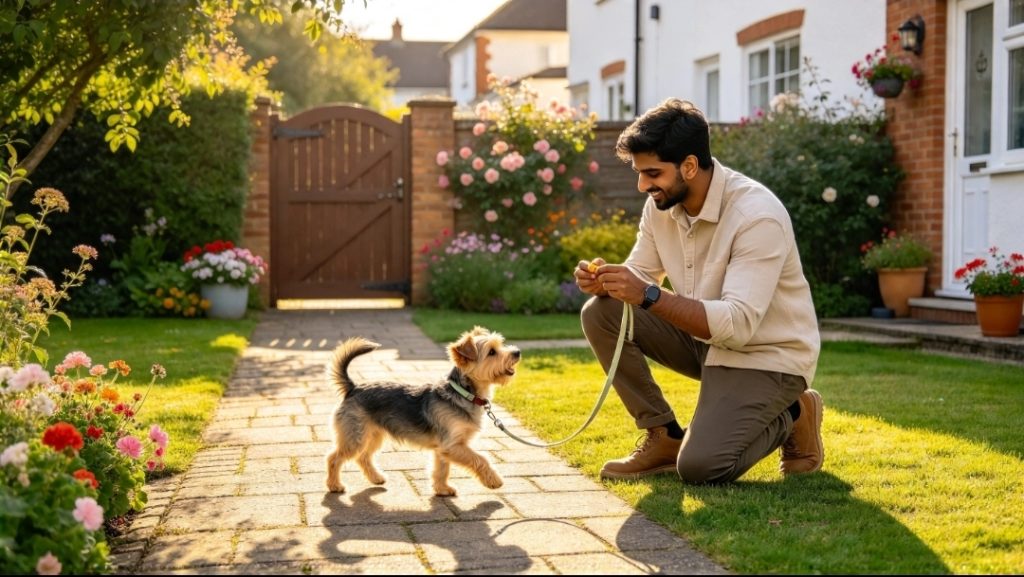
How do I leash train a puppy? Start by teaching your puppy that wearing a lead is normal and that following you is rewarding. Begin in a quiet, familiar environment, keep sessions short, reward calm behaviour and gradually introduce movement, different locations and distractions. Puppy leash training should build confidence and good habits rather than expecting perfect walking immediately.
RECOMMENDED PRODUCTS

When should I start leash training my puppy?
You can begin introducing your puppy to a collar or harness and lead at home before expecting them to go on longer walks.
Start with short, positive sessions where your puppy can become comfortable with the equipment without pressure. Once your puppy is comfortable wearing it, begin teaching simple movement and attention exercises.
Actual outdoor walking should follow your puppy’s vaccination and veterinary guidance.
How do I get my puppy used to the lead?
Start somewhere quiet, such as inside your home.
Allow your puppy to investigate the lead before attaching it. When your puppy remains calm around it, reward the behaviour.
Attach the lead and allow your puppy to move naturally for short periods while you supervise. Avoid immediately pulling or directing your puppy around.
The aim is to teach:
Lead attached → remain calm → move naturally → reward
Repeat this over short sessions until the equipment becomes familiar.
How do I teach my puppy to follow me?
Once your puppy is comfortable with the lead, take a few steps away and encourage your puppy to follow.
When your puppy comes with you, reward immediately.
You can change direction gently and reward your puppy for staying connected to your movement.
At this stage, you are not trying to teach a formal heel. You are teaching your puppy that following the handler is worthwhile.
How do I teach my puppy to walk without pulling?
Begin in an environment with very few distractions.
Walk a short distance with your puppy. When the lead remains loose and your puppy stays connected to you, reward the behaviour.
If your puppy moves ahead and the lead becomes tight, stop or change direction appropriately rather than continuing to walk while being pulled.
Once your puppy reconnects with you and the lead becomes loose again, continue.
This teaches your puppy that loose-lead movement allows the walk to continue.
Should I use treats when leash training a puppy?
Yes. Food can be very useful for introducing leash walking because it provides clear positive reinforcement.
Reward your puppy immediately after the behaviour you want, such as:
- Following you
- Walking with a loose lead
- Looking towards you
- Changing direction with you
- Remaining calm around a mild distraction
As your puppy becomes more reliable, you can gradually vary how often rewards are given.
The reward should reinforce the behaviour rather than being used constantly as a lure.
What lead and harness should I use for a puppy?
Use equipment that is appropriate for your puppy’s size and suitable for comfortable, controlled handling.
A well-fitted harness can be useful for puppies, particularly when you want to reduce pressure around the neck. A suitable standard lead can then provide a clear connection between you and your puppy.
Check the fit regularly because puppies grow quickly.
A short lead is generally easier for early controlled training than immediately introducing a long line.
Can I use a long line when leash training a puppy?
A long line can be useful later when your puppy has developed basic lead skills and you are working in a suitable safe environment.
It provides greater freedom while maintaining a connection with the handler.
However, it should not replace basic lead training. Your puppy should first learn how to respond to you and move appropriately on a standard lead.
More freedom requires more behavioural responsibility.
RECOMMENDED PRODUCTS
How long should puppy leash training sessions be?
Keep early sessions short.
Young puppies have limited attention spans, so several brief training sessions are often more productive than one long session.
You can practise for a few minutes, take a break and return to the exercise later.
Stop while your puppy is still engaged and responding well.
How do I teach my puppy to walk outside?
Once your puppy is ready to walk outside, start somewhere relatively quiet.
Do not begin with a busy high-stimulation environment if your puppy has never experienced leash walking outdoors.
Allow your puppy to investigate the surroundings while maintaining appropriate control.
Reward calm movement and attention towards you.
Gradually introduce:
Quiet area → quiet walk → mild distractions → busier environments
This gives your puppy an opportunity to learn how to walk while also processing the new environment.
What should I do if my puppy pulls on the lead?
First, consider why your puppy is pulling.
Your puppy may be excited by a smell, person, dog, movement or something else in the environment.
Rather than repeatedly pulling your puppy back, reduce the difficulty where possible.
Stop or change direction when appropriate, wait for your puppy to reconnect with you, then reward the correct response and continue.
If the environment is too distracting, move further away or return to a quieter location.
What if my puppy refuses to walk?
Do not immediately drag your puppy forward.
A puppy may stop because the surroundings are unfamiliar, something has frightened them, they are tired or they are unsure about what is expected.
Give your puppy time to assess the environment and encourage movement calmly.
If your puppy remains uncomfortable, make the situation easier rather than forcing the puppy through it.
If stopping appears to be caused by pain, illness or physical discomfort, seek veterinary advice.
How do I teach my puppy to ignore distractions?
Do not expect a young puppy to ignore everything immediately.
Instead, introduce distractions gradually.
For example, allow your puppy to notice a person at a comfortable distance. If your puppy remains calm and can respond to you, reward that behaviour.
Over time, you can practise around progressively more challenging distractions.
If your puppy becomes excessively excited or loses the ability to respond, increase distance and reduce the difficulty.
Should a puppy walk beside me all the time?
No.
A puppy does not need to remain in a strict heel position throughout an ordinary walk.
The important early skills are being able to move safely with you, maintain appropriate lead control, respond to changes in direction and reconnect with you when needed.
Formal heelwork can be taught separately if you require it.
How do I progress puppy leash training?
Progress gradually rather than simply walking for longer.
You can increase one difficulty at a time:
Increase the distance
Gradually walk further while maintaining appropriate lead behaviour.
Change the environment
Move from familiar areas to different safe locations.
Introduce distractions
Practise around people, sounds, movement and other appropriate distractions.
Increase freedom
Introduce a longer line or greater freedom only when your puppy has developed the necessary control.
The aim is to make each stage achievable before moving to the next.
What are the most common puppy leash-training mistakes?
Expecting perfect walking immediately
Puppies are learning both the equipment and the behaviour.
Starting somewhere too distracting
A busy environment can make the first training experience unnecessarily difficult.
Pulling the puppy constantly
Repeatedly pulling a puppy forward does not teach the puppy how to make appropriate walking choices.
Training for too long
Long sessions can cause tiredness, frustration and loss of concentration.
Allowing pulling to become rewarding
If pulling consistently gives the puppy access to exciting people, dogs, smells or objects, the behaviour can become stronger.
Changing the rules
Your puppy needs consistent expectations so that the correct behaviour is clear.
RECOMMENDED PRODUCTS
How do I know if my puppy is ready to progress?
Your puppy should be able to remain reasonably calm, respond to you and walk with a loose lead in the current environment before you make the exercise substantially harder.
You do not need perfection.
Look for consistent improvement and successful repetitions.
If your puppy struggles after increasing the difficulty, simply return to an easier stage and build up again.
How long does it take to leash train a puppy?
There is no fixed timeframe.
A puppy may become comfortable wearing a lead quickly, but reliable loose-lead walking can take weeks or months of consistent practice.
The important thing is to develop the behaviour gradually rather than rushing the process.
Puppies are still learning how to control their impulses, respond to their handler and cope with new environments.
Conclusion
How do I leash train a puppy? Start small, keep training positive and build the behaviour gradually. Introduce the lead in a quiet environment, reward your puppy for following you and walking with a loose lead, then slowly increase distance, environments and distractions.
Do not expect a puppy to walk perfectly from the beginning. Teach the behaviour first, reinforce it consistently and increase difficulty only when your puppy is ready. This creates the foundation for safe, confident and reliable lead walking as your puppy develops.




