How do I get my dog to like its crate?
Getting your dog to like its crate is not about forcing the dog to remain inside until it stops reacting. The aim is to build a positive association with the crate so that it becomes a predictable part of the dog’s routine for rest, calmness, management and resetting. The GPK9 approach is to observe → interpret → decide → act → reassess, using positive reinforcement, food, patience and appropriate progression.
RECOMMENDED PRODUCTS

What does it mean for a dog to like its crate?
A dog does not need to become excited every time it sees the crate.
A more useful goal is for the dog to view the crate as a normal, safe and predictable place to settle.
Look for behaviour such as:
- Entering the crate willingly
- Remaining calm inside
- Settling without constant prompting
- Resting
- Responding appropriately to the handler
- Recovering from distractions
- Returning to calmness after activity
The objective is calm acceptance and positive association, rather than creating excitement around the crate.
Within the GPK9 Professional Training System, the crate forms part of HOME & SOCIAL.
The crate is part of a wider home-training system
GPK9 uses the pathway:
CRATE → PLACEMAT → PLAYPEN
This is not a rigid one-way progression.
A dog may move between these stages depending on its behaviour, environment and current level of responsibility.
Crate
The crate provides a controlled environment for:
- Rest
- Routine
- Calmness
- Management
- Resetting
- Supporting toilet routines
Placemat
The placemat develops:
- Stationing
- Duration
- Settling
- Calmness
- Controlled freedom outside the crate
Playpen
The playpen introduces greater freedom within a controlled boundary.
This follows the GPK9 principle:
MORE FREEDOM REQUIRES MORE BEHAVIOURAL RESPONSIBILITY.
If your dog cannot manage increased freedom calmly, returning to an earlier stage is not failure. It is appropriate management.
How do I create a positive association with the crate?
Start by making the crate part of normal life.
Avoid turning the crate into something that only happens when the dog is being separated, corrected or removed from activity.
Instead, create opportunities for positive experiences around it.
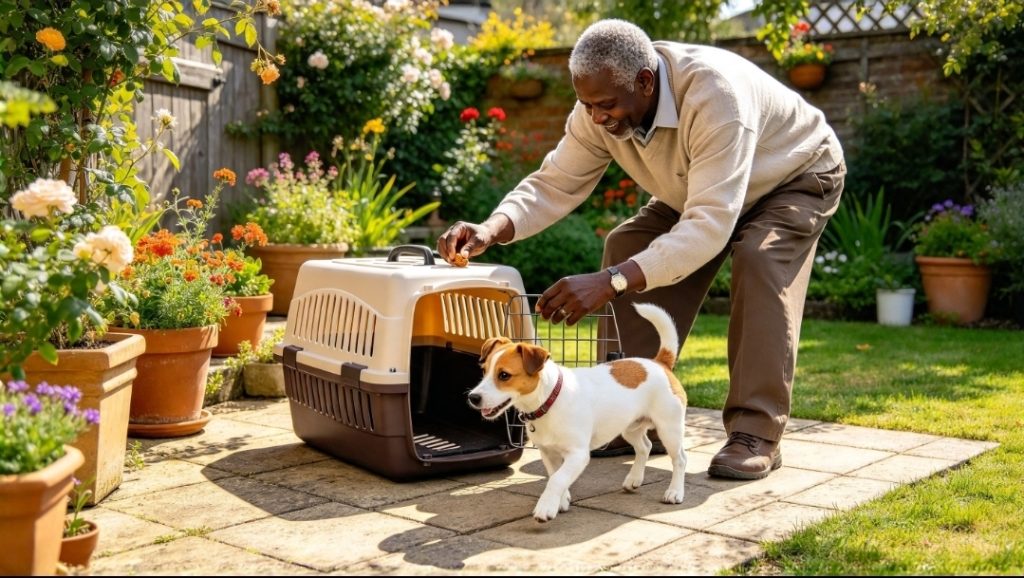
Food can be particularly useful because GPK9 uses food motivation as part of positive reinforcement.
You can:
- Place appropriate food near the crate
- Allow the dog to investigate the crate
- Reward voluntary engagement
- Encourage calm entry
- Reinforce appropriate settling
- Gradually build duration
- Keep sessions appropriate to the dog’s current ability
The important point is not simply putting food inside the crate.
The dog should gradually learn:
CRATE → POSITIVE EXPERIENCE → CALMNESS → SETTLING
Do not rush the process
A common mistake is trying to progress faster than the dog is ready for.
For example, a dog may willingly enter the crate to obtain food but immediately leave again.
That tells you something.
The dog may understand that entering the crate produces a reward, but may not yet understand how to remain there calmly.
Instead of immediately increasing duration, return to what the dog can successfully manage.
Observe.
Interpret.
Decide.
Act.
Reassess.
Use food and positive reinforcement correctly
Food can be used to create positive associations and reinforce desired behaviour.
However, the objective should not be to endlessly lure the dog into the crate.
The long-term goal is for the dog to understand the behaviour and develop calmness.
A useful progression can be:
MOTIVATE → ENTER → REINFORCE → SETTLE → REASSESS → PROGRESS
As the dog becomes more comfortable, the handler can gradually reduce unnecessary prompting and allow the dog’s learned behaviour to become more independent.
Patience is important.
If the dog needs several repetitions before remaining calmly in the crate, that information should influence your progression.
Should I leave the crate door open?
An open crate can provide an opportunity for the dog to investigate and choose to enter without immediately being confined.
This can be useful when building familiarity.
However, an open door alone does not teach the dog everything required for successful crate behaviour.
The dog also needs to learn calmness, duration and appropriate responses to the environment.
The crate should therefore be considered as part of the wider CRATE → PLACEMAT → PLAYPEN structure rather than as an isolated piece of equipment.
What if my dog leaves the crate immediately?
Do not automatically interpret leaving as failure.
Observe what happens.
Does the dog:
- Enter for food and leave?
- Enter and immediately become distracted?
- Enter but struggle to settle?
- Avoid the crate completely?
- Show increased arousal?
- Respond to environmental distractions?
The answer changes what you should do next.
If the dog is simply not ready for duration, reduce the difficulty.
If the environment is too distracting, reduce the distraction.
If the dog is becoming over-aroused, allow calmness before progressing.
If the dog cannot reduce or calm, use the GPK9 reset process rather than continuing to increase pressure.
GPK9 status: GREEN, AMBER and RED
The GPK9 status response system helps determine whether you should continue or adjust the training.
GREEN — OBSERVE → CONTINUE → PROGRESS
If your dog willingly engages with the crate, remains calm and can settle appropriately, continue the training and progress gradually.
Do not increase difficulty simply because the dog is doing well once.
Look for consistency.
AMBER — OBSERVE → ASSESS → REMOVE FROM DISTRACTION → CALM → REASSESS
If your dog begins struggling, observe and assess what has changed.
Remove the dog from the relevant distraction where appropriate, allow the dog to calm and reassess.
If the dog becomes calm:
GREEN → CALM → CONTINUE → PROGRESS
If the dog cannot reduce or calm:
RED → CANNOT REDUCE → CANNOT CALM → RETURN TO CRATE
RED — STOP WHAT YOU ARE DOING
If the dog becomes significantly unsettled and the situation cannot be reduced:
STOP WHAT YOU ARE DOING → OBSERVE → ASSESS → REMOVE FROM DISTRACTION → CALM → REASSESS
If the dog becomes calm, return to GREEN.
If the dog cannot reduce or calm:
RETURN TO CRATE → RESET → HOME & SOCIAL → GREEN → OBSERVE → CONTINUE
The reset is not a punishment. It is a return to an appropriate stage of training.
RECOMMENDED PRODUCTS
How do I know when my dog is ready to progress?
Look at behaviour rather than simply counting repetitions.
Your dog may be ready to progress when it can:
- Enter the crate calmly
- Remain relaxed
- Settle appropriately
- Respond to the handler
- Recover from minor distractions
- Remain calm for an appropriate period
- Repeat the behaviour consistently
Progress can then be gradual.
For example, you might develop:
ENTRY → SHORT DURATION → SETTLE → LONGER DURATION → CALM WITH MINOR DISTRACTION → GREATER FREEDOM
If the dog struggles at any stage, reduce the difficulty.
What if my dog dislikes the crate?
If your dog actively avoids the crate, do not immediately force the dog inside and expect the problem to disappear.
First, observe.
Consider:
- What happens when the crate appears?
- Does the dog avoid entering?
- Does the dog enter but immediately leave?
- Does the dog become vocal?
- Does the dog show increased arousal?
- Has the crate previously been associated with something unpleasant?
- Is the environment too busy?
- Is the dog being asked to remain inside for too long?
The answer should determine the next step.
The GPK9 system is not based on repeating the same action regardless of the dog’s response.
It is based on OBSERVE → INTERPRET → DECIDE → ACT → REASSESS.
Avoid using the crate as punishment
The crate should not become a place the dog associates exclusively with being in trouble.
If the crate is repeatedly used after unwanted behaviour as a form of punishment, the dog may develop a negative association with it.
Instead, use the crate as part of normal management, rest, routine and resetting.
This helps maintain its role within HOME & SOCIAL.
Build calmness after activity
Some dogs find it difficult to settle because they are still highly aroused from activity.
If your dog has just experienced exciting play, visitors, environmental stimulation or another highly engaging activity, placing the dog directly into a crate and expecting immediate relaxation may not produce the response you want.
Observe the dog’s current state.
If arousal is high, allow an appropriate calming period and reduce stimulation.
The objective is to teach the dog that calm behaviour follows activity.
This becomes particularly important when progressing from:
PLAY → CALM → REST
rather than allowing every training or play session to finish with continued high arousal.
Common mistakes when crate training
Making the crate too exciting
The crate should ultimately support calmness and settling, not constant high arousal.
Progressing too quickly
A dog that can remain inside for ten seconds is not automatically ready for ten minutes.
Build duration progressively.
Forcing the dog inside
If the dog is showing that it is not comfortable with the current step, reassess instead of simply increasing pressure.
Using the crate only when leaving the house
This can make the crate strongly associated with separation.
Include the crate naturally within everyday routines.
Ignoring body language
The dog’s posture, facial expression, movement, attention and ability to settle provide valuable information.
Giving too much freedom too soon
Controlled freedom should be earned through appropriate behaviour.
Remember:
MORE FREEDOM REQUIRES MORE BEHAVIOURAL RESPONSIBILITY.
What if my dog cries in the crate?
Crying should be treated as information rather than automatically being labelled as either good or bad behaviour.
Ask:
- Does the dog need the toilet?
- Is the dog overstimulated?
- Is the dog unable to settle?
- Has the routine changed?
- Is the environment distracting?
- Has the dog been left for too long?
- Has the dog previously been comfortable in the crate?
Use the GPK9 decision process to determine the next step.
If the dog is calm, continue and progress.
If the dog is struggling, assess, reduce distraction, calm and reassess.
If the dog cannot reduce or calm, reset and return to the appropriate stage of HOME & SOCIAL.
When should I get professional help?
If your dog consistently shows significant distress around the crate, cannot settle despite appropriate progression, or its behaviour is becoming increasingly difficult to manage, individual professional assessment may be appropriate.