
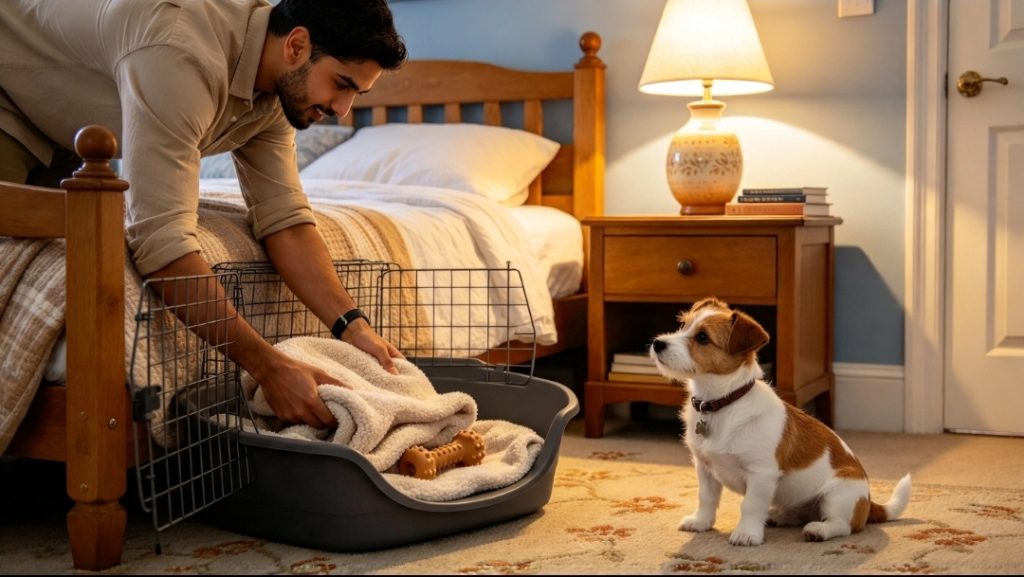
How do I crate train my puppy?
If you are learning how to crate train your puppy, the goal is to teach the crate as a safe, calm and predictable part of your puppy’s daily routine. The crate should become a place where your puppy can rest, settle, reset and learn appropriate boundaries rather than somewhere associated with fear or punishment.
RECOMMENDED PRODUCTS

What is crate training?
Crate training is the process of teaching a puppy to become comfortable and settled in its crate.
Within the GPK9 PROFESSIONAL TRAINING SYSTEM, the crate forms part of the HOME & SOCIAL area.
The GPK9 pathway is:
CRATE → PLACEMAT → PLAYPEN
This is not necessarily a fixed linear process.
Your puppy may move forward and later return to an earlier stage when additional structure is required.
The crate provides the foundation for rest, routine, boundaries and resetting.
RECOMMENDED PRODUCTS
What should the crate mean to your puppy?
The crate should become a conditioned safe space.
Your puppy should learn that entering the crate can mean:
- Rest
- Calmness
- Routine
- Recovery
- Quiet time
- A controlled environment
- A reset when necessary
The crate should not be used as a place to frighten or punish the puppy.
The objective is to build a positive association through patience, consistency and appropriate reinforcement.
Choose an appropriate crate
The crate should provide enough space for your puppy to be comfortable while still providing a structured environment.
Consider:
- Your puppy’s current size
- Expected adult size
- Safe positioning
- Ventilation
- Accessibility
- Location within the home
- The puppy’s ability to rest comfortably
The crate should be positioned somewhere that allows your puppy to become accustomed to normal household activity without being placed directly in the middle of constant disruption.
Start with the crate open
When introducing the crate, there is no need to immediately expect your puppy to remain inside with the door closed.
Allow your puppy to investigate it.
You can place appropriate food rewards inside the crate and allow the puppy to choose to enter.
Use calm, positive interaction.
The puppy begins to learn:
CRATE → POSITIVE EXPERIENCE
rather than:
CRATE → FORCED EXPERIENCE
Use food motivation
Food can be an effective form of positive reinforcement when your puppy has suitable food motivation.
Place food inside the crate.
Allow the puppy to enter.
Reward the behaviour you want.
Repeat the process calmly.
The objective is not simply to get the puppy physically inside the crate.
The objective is to build a positive association with being inside it.
Do not rush the door
One of the common mistakes when learning how to crate train my puppy is progressing too quickly.
A puppy that is happily entering an open crate is not necessarily ready to have the door closed for an extended period.
Progress gradually.
For example:
ENTER → REWARD → EXIT
Then:
ENTER → SETTLE → REWARD → EXIT
Then:
ENTER → SETTLE → SHORT DOOR CLOSURE → OPEN
As your puppy becomes comfortable, duration can gradually increase.
Build calmness before duration
Do not make duration the only objective.
Your puppy should learn how to settle calmly.
Observe:
- Body posture
- Movement
- Attention
- Engagement
- Arousal
- Ability to settle
- Responsiveness
- Recovery
If your puppy is becoming unsettled, reassess the situation rather than simply demanding a longer period in the crate.
Use the GPK9 decision process
The GPK9 decision process is:
OBSERVE → INTERPRET → DECIDE → ACT → REASSESS
OBSERVE
Look at your puppy’s behaviour.
Is the puppy:
- Calm?
- Restless?
- Engaged?
- Settled?
- Highly aroused?
- Trying to leave?
- Able to recover?
INTERPRET
Consider:
- Status
- Drive
- Environment
- Distractions
- Engagement
- Calmness
- Responsiveness
- Recovery
DECIDE
Decide whether to:
- Continue
- Progress
- Reduce the difficulty
- Calm
- Reset
ACT
Make the appropriate adjustment.
REASSESS
Observe your puppy again.
If the puppy has returned to an appropriate state:
GREEN → OBSERVE → CONTINUE → PROGRESS
If the puppy is struggling:
AMBER → OBSERVE → ASSESS → REMOVE FROM DISTRACTION → CALM → REASSESS
What if my puppy cries in the crate?
Do not immediately assume that crying means your puppy needs to be forced to remain inside.
First, observe and assess the situation.
Consider:
- How long has the puppy been in the crate?
- Was the puppy calm beforehand?
- Has the puppy had an appropriate toilet opportunity?
- Is the environment distracting?
- Was the duration increased too quickly?
- Is the puppy tired?
- Has the puppy been given enough opportunity to settle?
The answer should come from observing the individual puppy rather than automatically increasing or decreasing crate time.
Use the crate as part of a routine
A consistent routine can help your puppy understand what happens before and after crate time.
For example:
ACTIVITY → TOILET → CALM → CRATE → REST
The exact routine will depend on your puppy and your household.
The important point is consistency.
Your puppy learns through repeated experiences.
Crate training and toilet training
The crate can also support toilet training by providing a controlled environment between appropriate toilet opportunities.
The crate should not replace a proper toilet routine.
Instead, the two systems can work together:
CRATE → TOILET → ACTIVITY → TOILET → CRATE
The puppy gradually learns a predictable pattern.
For toilet training, the relevant GPK9 pathway remains:
RESET → TOILET → GREEN → OBSERVE → CONTINUE
When should I let my puppy out?
Avoid treating the crate simply as a place where the puppy waits until someone decides it can leave.
Observe the puppy and consider what the next activity should be.
The next stage may be:
- Toilet
- Calm interaction
- Training
- Play
- Controlled freedom
- Rest
The crate should form part of a wider routine rather than becoming the entire routine.
Progress from crate to placemat
Once your puppy can settle appropriately in the crate, you can begin developing calmness outside it.
This is where the PLACEMAT becomes useful.
The GPK9 HOME & SOCIAL progression is:
CRATE → PLACEMAT → PLAYPEN
The placemat develops:
- Stationing
- Duration
- Settling
- Calmness
- Controlled freedom
The puppy learns that calm behaviour is not restricted to the crate.
Progress from placemat to playpen
The playpen introduces another level of controlled freedom.
Your puppy now has more space but remains within a defined boundary.
This develops responsibility.
The GPK9 principle is:
MORE FREEDOM REQUIRES MORE BEHAVIOURAL RESPONSIBILITY.
If your puppy cannot cope with increased freedom, return to the previous stage.
There is no need to rush progression.
What if my puppy becomes unsettled?
Use the GPK9 status response system.
GREEN
OBSERVE → CONTINUE → PROGRESS
Your puppy is in a suitable state to continue.
AMBER
OBSERVE → ASSESS → REMOVE FROM DISTRACTION → CALM → REASSESS
If calm returns:
GREEN → CALM → CONTINUE → PROGRESS
RED
STOP WHAT YOU ARE DOING → OBSERVE → ASSESS → REMOVE FROM DISTRACTION → CALM → REASSESS
If the puppy cannot reduce or calm:
RED → CANNOT REDUCE → CANNOT CALM → RETURN TO CRATE
Then:
RESET → HOME & SOCIAL → GREEN → OBSERVE → CONTINUE
The crate can therefore be part of the reset process rather than something associated with punishment.
Do not use the crate as punishment
A puppy should not learn that the crate means:
“I have done something wrong.”
The crate should instead represent:
SAFE → CALM → REST → RESET
This distinction is important.
If the crate is repeatedly used as punishment, it can undermine the positive association you are trying to develop.
Common crate-training mistakes
Closing the door too quickly
Build comfort before expecting extended duration.
Increasing duration too quickly
Progress should follow the puppy’s ability to remain calm.
Using the crate as punishment
The crate should remain a safe and predictable environment.
Ignoring the puppy’s behaviour
Observe what your puppy is communicating through its behaviour.
Allowing too much freedom too soon
Progression should be based on behavioural responsibility.
Failing to provide a toilet routine
Crate training and toilet training should work together.
Making the crate the only place for calmness
Progress towards the placemat and controlled freedom when appropriate.
Moving forward when the puppy is struggling
If the puppy cannot settle, reassess rather than simply increasing difficulty.
How long should crate training take?
There is no single timeframe that applies to every puppy.
Progress depends on:
- Individual temperament
- Previous experience
- Environment
- Routine
- Distractions
- Food motivation
- Ability to settle
- Current behavioural responsibility
The aim should be reliable calm behaviour rather than reaching a particular duration as quickly as possible.
How do I know when my puppy is ready to progress?
Look for consistent behaviour.
Your puppy should be increasingly able to:
- Enter the crate calmly
- Settle
- Remain comfortable
- Respond appropriately
- Recover from distractions
- Transition between activities
- Accept short periods of reduced interaction
When these behaviours are reliable, you can gradually introduce the next level of responsibility.
If reliability decreases, return to the previous stage.
RECOMMENDED PRODUCTS
A simple GPK9 crate-training pathway
The process can be viewed as:
CRATE
↓
POSITIVE ASSOCIATION
↓
ENTER
↓
SETTLE
↓
SHORT DURATION
↓
REASSESS
↓
PROGRESS
↓
PLACEMAT
↓
CONTROLLED FREEDOM
↓
PLAYPEN
The process is not a race.
Your puppy can move backwards when necessary.
Returning to the crate is not failure.
It is part of the GPK9 HOME & SOCIAL system.
When should you reset crate training?
If your puppy becomes increasingly unsettled or cannot return to an appropriate state, stop increasing the difficulty.
Observe.
Assess.
Reduce distractions.
Allow the puppy to calm.
Reassess.
If necessary:
RED → CANNOT REDUCE → CANNOT CALM → RETURN TO CRATE
Then:
RESET → HOME & SOCIAL → GREEN → OBSERVE → CONTINUE
The objective is to rebuild calmness before progressing again.




