
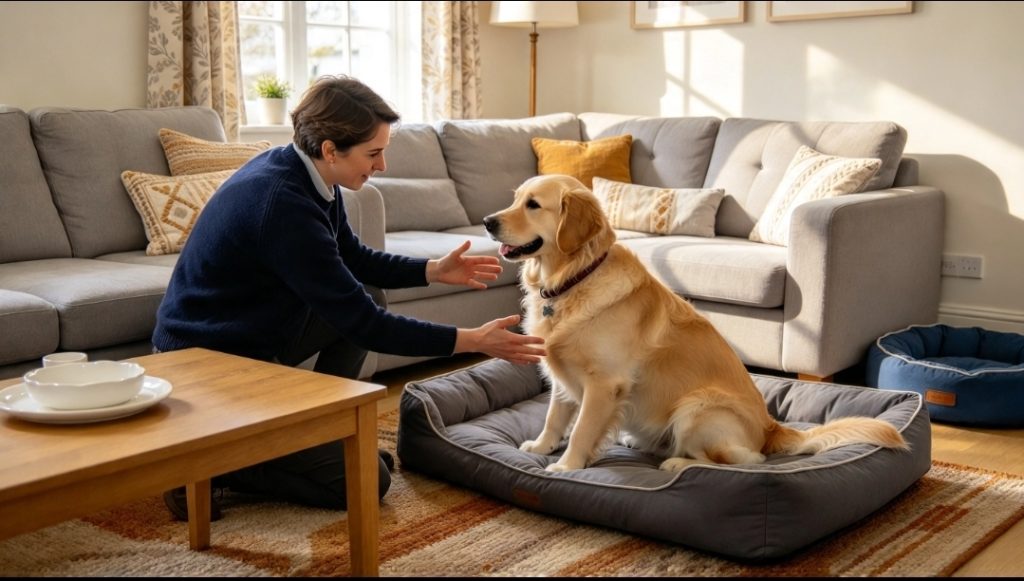
How Do I Establish House Rules for My Dog?
To establish house rules for your dog, decide which behaviours are acceptable in your home, create consistent daily routines and make sure everyone in the household responds in the same way. Use supervision, appropriate boundaries and positive reinforcement to teach your dog what to do, rather than relying on repeated corrections after unwanted behaviour occurs.
House training is about more than preventing chewing, jumping or other unwanted habits. It helps your dog understand how to live comfortably with people, where to rest, which areas they can access and what is expected during everyday activities.
The most effective house rules are clear, realistic and consistent. When your dog receives predictable guidance and regular opportunities to practise appropriate behaviour, it becomes easier to develop good habits throughout the home.
Why Are House Rules Important for Dogs?
Dogs learn through everyday experiences. The way people respond to their behaviour, the freedom they receive and the routines they follow all influence which habits develop.
Without consistent expectations, a dog may receive mixed messages. For example, one person might encourage jumping up as a greeting while another discourages it. The dog is then left to work out which response applies in each situation.
Clear house rules help reduce this confusion by establishing predictable expectations.
House rules can help you:
- Encourage calm behaviour around family members and visitors.
- Manage access to rooms, furniture and household objects.
- Reduce opportunities for chewing, stealing and other unwanted habits.
- Establish consistent feeding, toilet and resting routines.
- Teach appropriate greetings and everyday interactions.
- Help your dog become more comfortable with household expectations.
Rules should be appropriate for your dog’s age, experience, temperament and individual needs. A young puppy will need more supervision and management than a mature dog that has already developed reliable habits.
How Do I Decide Which House Rules My Dog Needs?
Start by identifying the situations that cause the most difficulty in your home. Consider what your dog currently does, what you would prefer them to do and how you can make that alternative easier to learn.
For example, if your dog jumps on visitors, your goal might be to encourage greetings with all four paws on the floor. If your dog chews household objects, you might need to improve supervision and provide suitable alternatives.
Choose a small number of priorities rather than trying to change every behaviour at once.
Establish Clear Household Boundaries
Decide which rooms your dog can access, where they can rest and which household objects are off-limits. Make these boundaries easy to understand by managing the environment and applying the rules consistently.
If a room is out of bounds, use a closed door or suitable barrier rather than repeatedly telling your dog to leave it. If certain objects must not be chewed, keep them out of reach and provide appropriate toys.
Boundaries should teach your dog what is expected without creating unnecessary frustration or fear.
Make Sure Everyone Follows the Same Rules
House rules work best when everyone in the household understands them.
Agree on how to respond to behaviours such as jumping, begging, mouthing, rushing through doors and demanding attention. Use consistent cues and reward the behaviour you want to encourage.
Consistency does not mean every situation must be handled identically regardless of context. It means your dog receives clear, predictable guidance rather than conflicting expectations.
How Do I Establish a Daily Routine for My Dog?
A predictable routine helps your dog understand what happens throughout the day and provides regular opportunities to practise appropriate behaviour.
Build your routine around your dog’s needs, including feeding, toilet breaks, exercise, play, training, interaction and rest.
Create Predictable Feeding and Toilet Times
Feed your dog according to a suitable schedule and provide regular opportunities to toilet. Puppies and dogs still learning toilet habits will generally need more frequent opportunities and closer supervision.
Notice when your dog usually needs to go outside, particularly after waking, eating, drinking and playing. Reward successful toileting in the appropriate place and respond calmly to accidents.
For more specific guidance, Golden Rule 4 — Toilet covers the foundations of toilet training, including routine, supervision, suitable opportunities and consistent responses.
Make Rest Part of Everyday Life
Dogs need suitable opportunities to relax without being constantly disturbed or encouraged to interact. Provide a comfortable resting area and help your dog learn that quiet periods are a normal part of household life.
Avoid assuming that every instance of restlessness means your dog needs more activity. Depending on the circumstances, your dog may need exercise, mental engagement, a toilet break or simply a quieter environment.
Reward calm behaviour when appropriate, and give your dog space to rest.
Keep Everyday Activities Consistent
Use daily activities to reinforce the house rules you have established. For example, encourage your dog to wait calmly while you prepare their food, settle while the household is quiet or respond to a familiar cue before moving through a doorway.
Keep expectations realistic and practise at a level your dog can manage. Gradually increase difficulty as they become more reliable.
How Can I Manage Unwanted Behaviour at Home?
The best way to manage unwanted behaviour is to understand the situation, reduce opportunities for repeated mistakes and teach an appropriate alternative.
Repeatedly telling a dog off may interrupt a behaviour temporarily without showing them what you would prefer them to do instead.
Jumping Up at People
If your dog jumps up when greeting family members or visitors, manage the greeting so that jumping does not become the easiest way to gain attention.
Encourage calm approaches and reward your dog when they keep their paws on the floor. Ask visitors to follow the same approach where practical.
If your dog becomes too excited to respond, increase the distance or pause the greeting until the situation is manageable.
Chewing Furniture or Household Objects
Dogs may chew because they are exploring, seeking an appropriate chewing outlet, bored, frustrated or responding to other needs.
Keep unsuitable objects out of reach, supervise your dog and provide safe, appropriate chew toys. If your dog starts chewing something they should not, redirect them towards a suitable alternative.
For puppies, environmental management is especially important because they are still learning which objects are appropriate to chew.
Begging During Meals
If you do not want your dog begging at the table, avoid feeding them from your plate or allowing different household members to reward the behaviour inconsistently.
Instead, establish a suitable alternative, such as settling on a bed or resting in a designated area while people eat. Reward that behaviour when appropriate.
Consistency is essential. If begging sometimes produces food, your dog may continue trying because the behaviour has occasionally worked.
Rushing Through Doors
Teach your dog to approach doors calmly and wait for a suitable opportunity to move through. Begin in a quiet situation and practise a brief pause before allowing them to continue.
Use a lead or suitable barrier when necessary to prevent unsafe rushing. Do not rely on a verbal cue alone when an open door could allow your dog to escape into a dangerous area.
How Does Crate Training Support House Rules?
A crate can be useful as part of a wider household routine when it is introduced appropriately and the dog is comfortable using it. It can provide a resting space and help manage situations where close supervision is temporarily unavailable.
However, a crate should never be used as punishment or as a substitute for meeting your dog’s needs.
The Crate Training and Settling course explains how to introduce a crate positively, build comfort gradually and establish supportive settling routines.
Start by allowing your dog to investigate the crate voluntarily. Reward calm entry and build up the duration gradually, paying attention to your dog’s response. Make sure the crate is appropriately sized and that your dog has sufficient opportunities for movement, toilet breaks, interaction and rest outside it.
Crate training and household rules complement one another: both depend on predictable routines, suitable management and teaching your dog what to expect.
How Can I Help My Dog Develop Calm Behaviour Indoors?
Calm behaviour is easier to encourage when your dog has an appropriate balance of activity, interaction and rest.
Provide suitable exercise and enrichment for your dog’s age and needs, but avoid keeping them constantly stimulated. Reward moments when your dog chooses to settle, relax or remain calmly in their designated resting area.
If your dog becomes increasingly excitable, consider what may be contributing to it. They might need a toilet break, a quieter environment, more suitable activity or an opportunity to rest.
The aim is to teach your dog that calm behaviour is a useful part of everyday life, not simply to stop them moving or interacting.
Reward the Behaviour You Want to See
Notice when your dog makes an appropriate choice without being prompted. They might settle while you work, wait calmly before a meal or choose a toy rather than an unsuitable household object.
Reward these moments when appropriate. Over time, consistent reinforcement can help make desirable behaviours more likely to occur again.
Avoid Creating Unnecessary Conflict
If your dog struggles with a rule, consider whether the expectation is clear and whether the environment allows them to succeed.
For example, if your dog repeatedly steals items from a low table, move those items out of reach while teaching an appropriate alternative. If visitors overwhelm your dog, manage the greeting rather than expecting them to remain calm in a situation they cannot yet handle.
Good household management makes training easier and helps prevent repeated conflict.
How Do Puppy Training Foundations Help Establish House Rules?
Puppies need to learn household expectations from the beginning. They are still developing their understanding of routines, communication, boundaries and appropriate behaviour, so supervision and consistency are particularly important.
The Puppy Training Foundations course focuses on early learning, communication, engagement and everyday routines. These skills help prepare a puppy for life in the home and provide a starting point for learning household rules.
Begin with manageable expectations, such as responding to their name, being guided towards appropriate toys, settling after play and learning where to toilet.
As your puppy develops, gradually increase their freedom when they demonstrate that they can manage it responsibly. Avoid giving unrestricted access to the entire home before they are ready.
For an older dog, the same principle applies: begin with the skills and routines they currently need, then progress as their behaviour becomes more reliable.
What House-Training Mistakes Should I Avoid?
Inconsistent rules: Allowing a behaviour sometimes and discouraging it at other times can make expectations confusing.
Giving too much freedom too soon: Increase access to rooms and household objects gradually as your dog demonstrates reliable behaviour.
Relying on corrections alone: Teach an appropriate alternative rather than simply interrupting unwanted behaviour.
Ignoring the environment: Barriers, storage, supervision and suitable resting areas can prevent many problems before they occur.
Expecting instant results: Habits develop through repetition. Give your dog time to practise and learn.
Overlooking your dog’s needs: Restlessness, chewing or unwanted behaviour may be influenced by discomfort, stress, boredom, insufficient rest or other unmet needs.
Using a crate as punishment: Keep the crate associated with comfortable rest and positive experiences.
Frequently Asked Questions
How Long Does It Take to Establish House Rules?
There is no fixed timescale. Some rules may become familiar relatively quickly, while others require ongoing practice. Progress depends on your dog’s age, previous learning, environment and the consistency of your approach.
Should My Dog Be Allowed on the Furniture?
That is a household decision. You can allow furniture access or establish a rule that your dog uses their own resting areas instead. The important point is to make the expectation clear and apply it consistently.
How Do I Stop My Dog Ignoring House Rules?
Review whether the rule is clear, whether your dog has practised the behaviour in manageable situations and whether the environment makes the unwanted behaviour easy to repeat. Use supervision, suitable boundaries and rewards for the alternative behaviour. If your dog is struggling, simplify the exercise.
Can I Change House Rules as My Dog Gets Older?
Yes. Household expectations can change as your circumstances or your dog’s needs change. Introduce new rules gradually and manage the environment while your dog learns the updated expectations.
What If My Dog Becomes Anxious or Aggressive at Home?
Do not assume that anxiety or aggression is simply a failure to follow house rules. Consider safety, avoid forcing interactions and seek veterinary advice if the behaviour changes suddenly or may involve pain. Persistent or potentially dangerous behaviour may require assessment by a suitably qualified behaviour professional.
Build Better Household Habits With Consistency
Establishing house rules means creating clear expectations, building predictable routines and rewarding appropriate behaviour throughout everyday life. Start with the most important household challenges, manage the environment and make sure everyone responds consistently.
Explore Home Training and House Rules for guidance on household boundaries and routines. You can also use Golden Rule 1 — Home & Social to explore the wider foundations of home behaviour, Crate Training and Settling for comfortable rest routines, Golden Rule 4 — Toilet for consistent toilet habits and Puppy Training Foundations for early learning.
With patience, suitable management and consistent guidance, you can help your dog understand what is expected and develop habits that make life together calmer and more predictable.




