How do I teach my dog to stay?
OBEDIENCE
RANK MATH DESCRIPTION
How do I teach my dog to stay? Learn how to build a reliable stay using food motivation, clear communication, duration, distance, calmness and gradual progression while understanding your dog’s status, drive, control and ability to respond.
FEATURED IMAGE DESCRIPTION
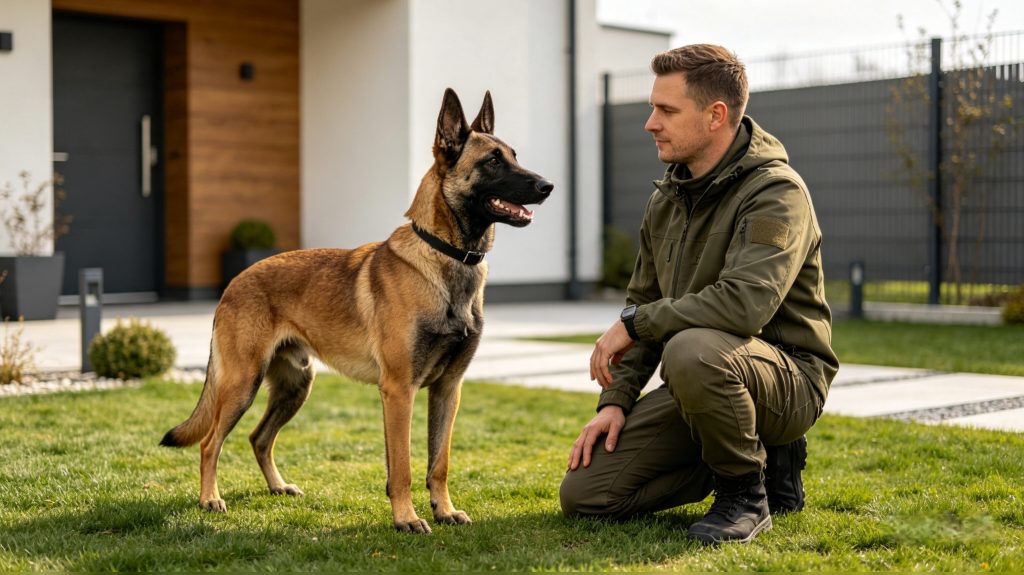
A professional, realistic dog-training scene featuring a healthy adult Border Collie with a medium-length black-and-white coat, athletic build, alert ears and focused expression. The dog is sitting calmly on a clean placemat on the floor inside a bright, uncluttered modern home, facing an adult handler standing several feet away. The handler is relaxed and attentive, using clear body positioning while holding a small food reward in a training pouch at their side rather than constantly presenting it to the dog.
The dog remains in the sit position, maintaining attention towards the handler without moving forward. The scene should clearly communicate controlled duration and distance rather than simply teaching the sit position. The dog’s body language should show calm engagement, self-control and responsiveness without appearing tense or distressed.
A quiet living area should be visible in the background with a sofa, low furniture and an uncluttered training space. A crate can be positioned to one side of the room as part of the wider home-management environment. A small playpen can be visible further away, while the placemat is the primary training surface. Small food rewards and a training pouch should be visible but not distract from the dog.
The image should visually communicate progressive obedience training: the dog maintaining its position while the handler creates distance, with the environment controlled and the dog remaining calm. No text, logos, watermarks, branded products or artificial graphic elements.
BLOG
How do I teach my dog to stay?
How do I teach my dog to stay? Teaching a dog to stay means developing the ability to remain in an established position while the handler gradually introduces duration, distance and appropriate distractions. A stay is not simply another version of sit or down. The dog must understand that remaining in position is part of the behaviour, and the difficulty should be increased only when the dog is ready. The GPK9 PROFESSIONAL TRAINING SYSTEM approaches this through structured obedience, food motivation, engagement, control, observation, calmness, reassessment and gradual progression. RECOMMENDED PRODUCTS — Obedience Training
What does “stay” mean?
A stay asks the dog to maintain its current position rather than immediately moving when the handler changes position or the environment changes.
For example:
Sit → Stay → remain sitting
or:
Down → Stay → remain lying down
The important part is the remaining.
A dog may already understand sit or down but still need to learn that it must maintain the position.
Teaching stay therefore introduces additional requirements:
- Duration.
- Handler movement.
- Distance.
- Environmental changes.
- Distractions.
- Calmness.
- Responsiveness.
- Release from the position.
These requirements should be developed progressively.
Start with a behaviour your dog already understands
Teaching stay is easier when the dog already understands a stable position such as sit or down.
Begin with a position the dog can perform reliably.
Ask for the position.
When the dog is in the correct position, observe whether it is:
- Calm.
- Engaged.
- Responsive.
- Able to remain still.
- Focused sufficiently on the handler.
- Comfortable in the environment.
Do not immediately walk away.
First teach the dog that remaining where it is forms part of the exercise.
Start with very short duration
One of the most common problems when teaching stay is asking for too much too soon.
If your dog can remain in position for only a short period, start there.
For example:
Position → very short stay → reward
Then gradually increase the duration.
The progression should be based on what your dog can actually do.
Do not decide that your dog should remain for one minute simply because you want a one-minute stay.
The dog needs to learn the behaviour progressively.
Use food motivation
Food can help create engagement and reinforce the behaviour you want.
Ask the dog for the chosen position.
Once the dog is in position, use an appropriate food reward to reinforce remaining there.
The reward should be associated with the behaviour you are developing.
The aim is not to constantly wave food in front of the dog’s face.
Instead, food should support the learning process.
As the dog becomes more reliable, gradually develop the behaviour so the dog learns to remain in position even when the reward is not continuously visible.
Reward the stay, not just the position
This distinction is important.
If you ask:
Sit
and immediately reward, you are primarily reinforcing the sit.
If you ask:
Sit → Stay
and the dog remains in position while you create a small amount of duration, the reward can reinforce the staying behaviour.
The dog needs to understand that remaining in the position is part of what produces the reward.
For example:
Sit → remain → reward
rather than:
Sit → immediate reward → dog gets up
Build the duration gradually.
Introduce a clear stay cue
Once the dog can remain in position for a short period, introduce a consistent verbal cue such as:
“Stay.”
The cue should be clear and used consistently.
A simple progression can be:
Ask for position → say “stay” → pause → reward
The dog gradually learns that the cue means remaining in the current position.
Avoid repeatedly saying:
- “Stay, stay, stay.”
- “Stay there.”
- “Don’t move.”
- “Stay please.”
Give the cue once and give the dog an opportunity to respond.
Use a release cue
The dog also needs to understand when the stay exercise has ended.
Use a consistent release word or signal.
The structure becomes:
Position → Stay → Remain → Release
This helps create a clear difference between:
Stay
and:
The exercise has finished.
Without a clear release, some dogs may become uncertain about when they are allowed to move.
Do not immediately add distance
Once your dog understands a short stay, it can be tempting to walk across the room.
That may be too large a progression.
Distance is a separate difficulty.
Build it gradually.
For example:
Stay → one small movement away → return → reward
Then:
Stay → slightly more distance → return → reward
Only increase the distance when the dog is successfully maintaining the stay at the current level.
Build duration separately
Duration is another part of the behaviour.
You can develop:
- Short stay.
- Slightly longer stay.
- Longer stay.
- More consistent duration.
Do not automatically combine long duration with long distance.
If you increase duration and distance simultaneously, you may make the exercise unnecessarily difficult.
Progress one factor carefully where possible.
Add distance gradually
Once the dog can remain calmly for an appropriate duration, introduce small amounts of distance.
A simple progression could be:
Handler beside dog → one step away → return → reward
Then:
Two steps → return → reward
Then gradually increase the distance.
If the dog gets up, do not simply keep increasing the distance.
Observe what happened and reassess the level of difficulty.
Add distractions last
Distractions can make a previously reliable stay much more difficult.
Examples include:
- People moving around.
- Other household activity.
- Toys.
- Food.
- Outdoor sounds.
- Other dogs.
- New environments.
- Handler movement.
Introduce distractions gradually.
The dog should first have a solid understanding of the stay before the environment becomes increasingly difficult.
Use the GPK9 decision process
The GPK9 decision process is:
OBSERVE → INTERPRET → DECIDE → ACT → REASSESS
OBSERVE
Look at:
- Body posture.
- Facial expression.
- Ears.
- Tail.
- Movement.
- Orientation.
- Attention.
- Engagement.
- Arousal.
- Ability to settle.
- Responsiveness.
- Recovery.
- Environmental awareness.
- Social behaviour.
- Changes in behaviour.
- Previously learned criteria.
For a stay, particularly observe whether the dog is:
- Remaining in position.
- Watching the handler appropriately.
- Becoming increasingly distracted.
- Becoming restless.
- Losing engagement.
- Showing signs of increasing arousal.
- Recovering appropriately after a distraction.
INTERPRET
Consider what the behaviour means in the current situation.
Ask:
- Is the dog ready for more duration?
- Is the distance too great?
- Is the environment too distracting?
- Is the dog still engaged?
- Is the dog calm?
- Is the dog responding appropriately?
- Has the difficulty increased too quickly?
DECIDE
Decide whether to:
- Continue.
- Progress.
- Reduce duration.
- Reduce distance.
- Remove a distraction.
- Allow the dog to calm.
- Reassess.
- Stop.
- Reset.
ACT
Apply the appropriate training, motivation, control, management, environment and equipment.
REASSESS
Observe the dog again.
Determine whether the dog:
- Has returned to calm.
- Can engage appropriately.
- Can respond appropriately.
- Can maintain the stay.
- Can continue.
- Can progress.
If not, reduce the difficulty and return to an appropriate level.
Consider your dog’s status
The GPK9 system begins with:
CATEGORY → STATUS → DRIVE → CONTROL
For teaching stay, the relevant category is OBEDIENCE.
The dog’s current status determines whether it is appropriate to continue.
GREEN
OBSERVE → CONTINUE → PROGRESS
The dog is in a suitable state.
If the dog is calmly maintaining the stay, continue the appropriate exercise and progress when ready.
AMBER
OBSERVE → ASSESS → REMOVE FROM DISTRACTION → CALM → REASSESS
If the dog begins struggling:
- Observe.
- Assess.
- Reduce or remove the distraction.
- Allow the dog to calm.
- Reassess.
If the dog returns to a suitable state:
GREEN → CALM → CONTINUE → PROGRESS
If the dog cannot reduce or calm:
RED → CANNOT REDUCE → CANNOT CALM → RETURN TO CRATE
RED
STOP WHAT YOU ARE DOING → OBSERVE → ASSESS → REMOVE FROM DISTRACTION → CALM → REASSESS
If the dog reaches a state where continuing the stay is no longer appropriate, stop the activity.
Remove the dog from the distraction and allow calmness before reassessing.
If the dog cannot reduce or calm:
RED → CANNOT REDUCE → CANNOT CALM → RETURN TO CRATE
Then:
RESET → RELEVANT GOLDEN RULE → GREEN → OBSERVE → CONTINUE
What if my dog keeps getting up?
If your dog repeatedly gets up during the stay, do not simply repeat the cue.
Ask why.
Possible factors include:
- The duration is too long.
- The distance is too great.
- The distraction is too difficult.
- The dog does not yet understand the stay.
- The dog is too excited.
- The dog is tired.
- The environment is too distracting.
- The dog has not been sufficiently engaged.
- The progression has moved too quickly.
Reduce the difficulty.
For example, if your dog can stay for five seconds but repeatedly gets up at fifteen seconds, return to a shorter duration.
Build success again before progressing.
What if my dog follows me?
Following the handler can indicate that the distance has been increased too quickly.
Start again with a smaller movement.
For example:
Stay → one step → return → reward
Rather than:
Stay → walk across the room
The dog needs to learn that your movement does not automatically mean it should leave the position.
Progress distance gradually.
What if my dog breaks the stay?
If the dog breaks the stay, avoid turning the exercise into a confrontation.
Instead, observe what happened.
Ask:
- How long had the dog been waiting?
- How far away were you?
- What changed in the environment?
- Was there a distraction?
- Was the dog still calm?
- Was the dog responding appropriately before moving?
Then reduce the difficulty.
The objective is to identify the level the dog can successfully manage and build from there.
Do not punish a failed stay
A failed repetition provides information about the training level.
If the dog gets up, determine what caused the failure.
You may need to reduce:
- Duration.
- Distance.
- Distraction.
- Environmental difficulty.
Then try again at a level the dog can manage.
The GPK9 approach is based on observing, interpreting, deciding, acting and reassessing rather than simply continuing regardless of the dog’s response.
Consider food drive
The relevant drive for structured obedience is food drive.
Some dogs may be highly motivated by food.
Others may have lower food drive.
A high food-drive dog may become so focused on the reward that remaining calmly in position becomes difficult.
A lower food-drive dog may require more careful attention to engagement and motivation.
Consider:
- Is the reward motivating?
- Is the dog calm enough to work?
- Is the food creating excessive arousal?
- Is the dog engaged with you?
- Is the environment appropriate?
The correct approach depends on the individual dog’s response.
Build calmness into the stay
A good stay is not simply about preventing movement.
The dog needs to be able to remain in position while maintaining an appropriate state.
Observe:
- Body posture.
- Breathing and general physical relaxation.
- Attention.
- Engagement.
- Arousal.
- Ability to settle.
- Responsiveness.
- Recovery.
If the dog is physically staying in position but becoming increasingly distressed, distracted or over-aroused, the answer is not necessarily to demand a longer stay.
Reduce the difficulty and reassess.
Stay on a placemat
The placemat can provide a useful controlled area for stationing and duration within the HOME & SOCIAL area of the GPK9 system.
For example:
PLACEMAT → STATION → DURATION → SETTLE
However, the placemat and the obedience stay are not identical concepts.
The placemat provides a defined location for stationing, duration and settling.
The obedience stay is a structured response in which the dog maintains a position.
They can support each other, but the training requirement should remain clear.
How do I teach stay when I leave the room?
Do not begin by leaving the room.
First establish:
- Position.
- Very short duration.
- Clear stay cue.
- Clear release.
- Small amounts of handler movement.
- Short distance.
Then gradually increase distance.
Only when the dog can reliably maintain the stay with the handler nearby should you begin introducing greater separation.
Leaving the room adds a significant distance and environmental change.
Build towards it rather than expecting the dog to understand it immediately.
How do I teach stay around other people?
Start with a controlled environment.
Have another person remain at a suitable distance.
Ask for the stay.
Observe the dog.
If the dog remains calm and responsive, continue.
If the person becomes a significant distraction:
- Reduce the distance.
- Reduce the duration.
- Remove the distraction.
- Allow the dog to calm.
- Reassess.
Only progress when the dog can manage the current level.
How do I teach stay around other dogs?
Other dogs can create a significant distraction.
Begin at a distance where your dog can still engage appropriately.
Do not immediately expect the dog to remain in a stay close to another dog.
Observe:
- Orientation.
- Attention.
- Arousal.
- Responsiveness.
- Recovery.
- Ability to settle.
If the dog cannot respond appropriately, increase distance or otherwise reduce the difficulty.
The objective is to develop the stay progressively rather than testing the dog beyond its current ability.
How long should my dog stay?
There is no single correct duration for every dog.
The appropriate duration depends on:
- Training experience.
- Current status.
- Environment.
- Distractions.
- Distance.
- Engagement.
- Ability to settle.
- Previous learning.
Start with a duration the dog can successfully manage.
Then gradually increase it.
Reliability is more important than choosing an arbitrary target time.
How often should I practise?
Use short, regular training opportunities.
A session could include several successful repetitions rather than one very long stay.
For example:
Short stay → reward → release → reset → repeat
As the dog becomes reliable, gradually introduce duration, distance and distractions.
Stop before the dog becomes unable to engage appropriately.
Stay should be built progressively
A useful progression is:
POSITION → SHORT DURATION → RELEASE → REPEAT → LONGER DURATION → SMALL DISTANCE → GREATER DISTANCE → CONTROLLED DISTRACTIONS → PROGRESSION
Do not rush through the stages.
If the dog struggles at a later stage, return to the previous successful stage.
This is not failure.
It is part of progression.
A simple stay training example
Step 1 — Ask for a known position
Ask the dog to sit or lie down.
Step 2 — Establish the stay
Give the stay cue.
Step 3 — Wait briefly
Remain close to the dog.
Step 4 — Reward
Reward the dog for maintaining the position.
Step 5 — Release
Use a clear release cue.
Step 6 — Repeat
Repeat several short successful repetitions.
Step 7 — Increase duration
Gradually increase how long the dog remains in position.
Step 8 — Introduce movement
Take one small step away, return and reward.
Step 9 — Increase distance
Gradually move further away when the dog is ready.
Step 10 — Introduce distractions
Only introduce controlled distractions once the dog can manage the existing difficulty.
Step 11 — Reassess
If the dog struggles, reduce the difficulty and rebuild from a successful level.
Common mistakes when teaching stay
Avoid:
- Starting with excessive duration.
- Walking too far away immediately.
- Introducing major distractions too early.
- Repeating the stay cue continuously.
- Rewarding too late.
- Expecting sit and stay to mean the same thing.
- Increasing several difficulties simultaneously.
- Continuing when the dog is clearly struggling.
- Ignoring changes in arousal.
- Assuming every failure is disobedience.
- Using physical force to keep the dog in position.
- Progressing before the dog is ready.
Instead, use the dog’s behaviour to determine the next step.
When should I increase difficulty?
Increase difficulty when the dog is consistently:
- Calm.
- Engaged.
- Responsive.
- Maintaining position.
- Recovering appropriately.
- Successful at the current level.
Change one major factor at a time where possible.
For example:
Duration increases
before:
Distance increases
before:
Distraction increases
This gives the dog a clearer learning pathway.
When should I stop the exercise?
Stop or reduce the exercise when the dog can no longer engage appropriately.
Signs may include:
- Repeatedly breaking the stay.
- Increasing distraction.
- Loss of responsiveness.
- Difficulty settling.
- Excessive arousal.
- Poor recovery.
- Repeated unsuccessful repetitions.
At that point, more repetitions may simply make the exercise harder.
Observe.
Interpret.
Decide.
Act.
Reassess.
Then choose whether to continue, reduce the difficulty or reset.
Final checklist for teaching a reliable stay
Remember:
- Start with a position your dog already understands.
- Use food motivation appropriately.
- Introduce a clear stay cue.
- Reward remaining in position.
- Use a clear release cue.
- Begin with very short duration.
- Increase duration gradually.
- Introduce distance gradually.
- Introduce distractions carefully.
- Avoid increasing every difficulty at once.
- Observe body language and engagement.
- Consider food drive.
- Maintain an appropriate level of control.
- Reduce the situation if your dog struggles.
- Allow the dog to calm when necessary.
- Reassess after making changes.
- Do not punish a failed repetition.
- Do not confuse stay with sit or down.
- Progress according to the dog’s actual performance.
- Return to an easier level when required.
- Stop when the dog can no longer respond appropriately.
RECOMMENDED COURSES
1. GOLDEN RULE 1 — HOME AND SOCIAL
This course is relevant when stay training is connected to settling, calmness, boundaries, controlled freedom and the home environment. The placemat can support stationing, duration and settling, while the wider HOME & SOCIAL structure provides environmental management when required.
2. GOLDEN RULE 2 — OBEDIENCE
This is the directly relevant course for teaching a dog to stay.
The course covers structured obedience, food motivation, engagement, control, suitable equipment, suitable environments and progression.
Stay training directly involves these areas because the dog must learn to maintain a position while duration, distance and distractions are progressively introduced.
The traffic-light system can help determine how to progress:
- GREEN: The dog is calm, engaged and maintaining the stay appropriately. Observe, continue and progress when ready.
- AMBER: The dog is struggling. Observe, assess, reduce or remove the distraction, allow calmness and reassess.
- RED: Stop the exercise, observe, assess, remove the distraction, allow the dog to calm and reassess. If the dog cannot reduce or calm, return to an appropriate reset before continuing.
3. GOLDEN RULE 3 — PLAY DRIVE AND PLAY
This course is relevant when toy motivation, prey drive or controlled play becomes part of the dog’s wider training and reward structure. It is not the primary course for teaching the stay.
4. GOLDEN RULE 4 — TOILET
This course covers toilet routine, toilet location, toilet command, management, control, routine and progression. It is not directly responsible for teaching stay but remains part of the wider connected GPK9 system.
5. GOLDEN RULE 5 — SOCIAL WALKING
This course covers calm social walking, IGNORE THE WORLD, environmental awareness, control, distractions, calmness and structured walking. It becomes relevant when the dog needs to maintain calm, controlled behaviour in walking environments.
GPK9’S FIVE GOLDEN RULES
GPK9’S FIVE GOLDEN RULES. The GPK9 PROFESSIONAL TRAINING SYSTEM is divided into five accessible areas, with each area dealing with a particular part of dog training while remaining part of one connected framework. An individual course can provide specific help for a particular training requirement, but no single course represents the entire system. The five areas work together so that first-time dog owners and professional trainers can understand how different training requirements connect, while the bite-sized structure allows information to be learned progressively. Teaching a dog to stay relates particularly strongly to the structured obedience requirements addressed in this article, but that area remains part of the wider system. Understanding all five areas provides the complete GPK9 framework and helps the reader understand the type of training problem, question and requirement being addressed, rather than treating the stay as an isolated behaviour. The wider system determines how the dog’s situation is considered, how the appropriate response is identified, how control and management are selected, how calmness and reassessment are handled, when a reset is required and how progression takes place. For teaching a dog to stay, this means considering the dog’s current category, status, relevant food drive and control, then observing whether the dog can maintain the position before deciding whether to continue, increase duration, introduce distance, add distractions, reduce the difficulty or reset. Understanding the wider GPK9 system therefore provides the framework for turning a simple stay exercise into a structured process of observation, learning, control, reassessment and progressive development.