How do I teach my dog boundaries in the home?
Home boundaries are the rules and limits that help a dog understand how to behave appropriately around people, furniture, rooms, doors, food, possessions and everyday household activity.
A boundary might mean teaching your dog to:
- settle rather than constantly follow you around;
- remain calmly on a placemat;
- wait rather than rush through a doorway;
- leave household objects alone;
- avoid jumping on furniture when that is not permitted;
- settle when visitors arrive;
- remain calm around food;
- move between areas of the home appropriately;
- play in a suitable area rather than turning the whole house into a play zone;
- accept periods of controlled freedom;
- return to a controlled environment when freedom becomes too difficult.
The important point is that boundaries need to be understandable and consistent.
Your dog should be given an opportunity to learn what behaviour works within the home rather than simply being corrected whenever it makes a mistake.
RECOMMENDED PRODUCTS

Why do dogs need boundaries in the home?
The home is where many dogs spend a large part of their lives. It contains food, furniture, people, doors, toys, sounds, smells, visitors and movement.
Without structure, a dog may learn that it can move around the environment and make its own decisions regardless of whether those decisions are appropriate.
For example, a dog may learn that:
- jumping gets attention;
- stealing objects starts a game;
- rushing towards the door creates excitement;
- barking causes people to react;
- climbing onto furniture produces interaction;
- following a person everywhere becomes rewarding;
- grabbing household objects creates movement and engagement.
The behaviour is not necessarily caused by the dog deliberately trying to break a rule. The dog may simply have learned that a particular behaviour produces a particular result.
Home boundaries therefore need to be taught through management, repetition and reinforcement.
Start with the environment
Before expecting your dog to understand household boundaries, look at the environment.
Ask yourself:
- What areas does the dog currently have access to?
- What objects can the dog reach?
- Where does the dog rest?
- Where does the dog eat?
- Where does the dog play?
- Where can the dog settle?
- Where does the dog become overexcited?
- What household activities create distractions?
- Does the dog have more freedom than it can currently manage?
This is the first part of the GPK9 decision process:
OBSERVE → INTERPRET → DECIDE → ACT → REASSESS
You observe what the dog is actually doing before deciding what needs to change.
Use the CRATE → PLACEMAT → PLAYPEN pathway
The GPK9 HOME & SOCIAL structure uses three important areas of control:
CRATE → PLACEMAT → PLAYPEN
This is not a rigid progression where every dog must move permanently from one stage to the next.
A dog may move between them depending on its current behaviour.
The crate
The crate provides a conditioned safe space for rest, routine and resetting.
It can help prevent a dog from repeatedly practising inappropriate behaviour when the dog is tired, overexcited or unable to settle.
The crate should not be used as a punishment for getting something wrong.
Instead, it forms part of the dog’s overall home structure.
The placemat
The placemat teaches the dog to remain in a defined location and develop:
- stationing;
- duration;
- calmness;
- settling;
- attention;
- responsiveness.
This makes the placemat particularly useful when teaching boundaries around everyday household activity.
You can ask the dog to settle on the placemat while you move around the room, prepare food, watch television or carry out normal household tasks.
The playpen
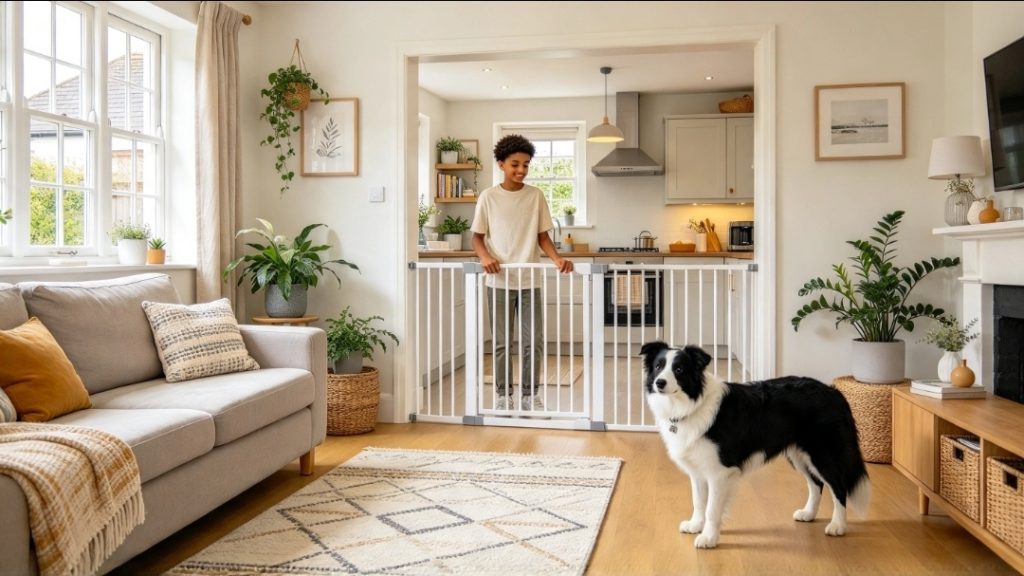
The playpen provides controlled freedom within a boundary.
It gives the dog more space while still limiting access to the entire environment.
This is particularly useful when a dog is progressing beyond the crate but is not yet ready for unrestricted freedom.
The principle is simple:
MORE FREEDOM REQUIRES MORE BEHAVIOURAL RESPONSIBILITY.
How do I teach my dog where it is allowed to go?
Start by making the dog’s environment manageable.
Rather than giving unlimited access to the whole house immediately, provide an appropriate area where the dog can succeed.
Reward calm and appropriate behaviour.
If the dog consistently leaves the appropriate area, becomes distracted or begins practising unwanted behaviour, observe what happened.
The answer is not automatically to give more freedom.
Ask whether the dog has demonstrated the behavioural responsibility required for that level of freedom.
If it has, progress gradually.
If it has not, reduce the freedom and continue training at a level the dog can manage.
Teach boundaries through positive reinforcement
GPK9 training focuses on positive reinforcement, food, patience and appropriate control.
When your dog makes the correct choice, that behaviour can be reinforced.
For example, if your dog:
- settles on the placemat;
- ignores an item on the floor;
- waits calmly at a doorway;
- remains relaxed when you move around;
- chooses to settle rather than jump;
- responds when called away from something;
- calmly returns to its designated area;
you can reinforce the behaviour with appropriate food motivation or another suitable reward.
The objective is to make the correct behaviour clear and repeatable.
What if my dog keeps breaking the boundary?
Do not immediately assume that the dog needs stronger correction.
First observe.
What happened immediately before the behaviour?
Was there:
- food?
- movement?
- another person?
- another dog?
- a toy?
- excitement?
- tiredness?
- a new environment?
- an interesting sound?
- an opportunity for attention?
Then interpret the situation.
The dog’s behaviour may indicate that the current level of freedom, distraction or difficulty is too high.
You can then decide what action is appropriate.
Use the GPK9 status system
The GPK9 status response system helps determine what to do when teaching home boundaries.
GREEN — OBSERVE → CONTINUE → PROGRESS
If your dog is calm, responsive and managing the environment appropriately:
OBSERVE → CONTINUE → PROGRESS
Continue the activity and gradually progress when appropriate.
For example, if your dog can calmly remain on its placemat while you walk around the room, you may gradually increase movement, duration or environmental activity.
AMBER — OBSERVE → ASSESS → REMOVE FROM DISTRACTION → CALM → REASSESS
If your dog begins struggling with the boundary:
OBSERVE → ASSESS → REMOVE FROM DISTRACTION → CALM → REASSESS
The aim is to reduce the difficulty rather than allow the dog to continue rehearsing inappropriate behaviour.
If the dog becomes calm and responsive again, it can return to GREEN.
RED — STOP WHAT YOU ARE DOING → OBSERVE → ASSESS → REMOVE FROM DISTRACTION → CALM → REASSESS
If the dog cannot manage the situation:
STOP WHAT YOU ARE DOING → OBSERVE → ASSESS → REMOVE FROM DISTRACTION → CALM → REASSESS
If the dog cannot reduce its arousal or cannot calm, the appropriate response may be to return the dog to the crate for a reset.
The objective is not punishment.
The objective is to stop the current situation, restore calmness and return to an appropriate level of control.
Teach boundaries around furniture
If your dog is not allowed on particular furniture, consistency is important.
Do not allow the dog onto the sofa one day and then expect it to understand why the same behaviour is unacceptable the next day.
Provide an appropriate alternative.
A placemat can give the dog a clear location where settling is encouraged.
When the dog chooses the appropriate location and remains calm, reinforce that behaviour.
This creates a clearer alternative than simply preventing access to furniture.
Teach boundaries around doors
Doors can create significant excitement.
A dog may learn that the sound of a door opening means it should rush towards it.
Instead, teach calm behaviour around the doorway.
Start at a level the dog can manage.
Observe the dog’s posture, attention and arousal.
If the dog remains calm, continue.
If the dog becomes increasingly excited, reduce the difficulty, allow the dog to calm and reassess.
The goal is controlled behaviour rather than simply physically preventing the dog from reaching the door.
Teach your dog not to steal household objects
Dogs naturally investigate their environment.
If your dog repeatedly picks up shoes, clothing, remote controls or other household objects, first manage access to those items.
Then teach appropriate alternatives.
Food motivation can help reinforce the desired behaviour.
The important principle is not to turn every stolen object into an exciting interaction.
If grabbing an object consistently produces chasing, the dog may learn that stealing creates a rewarding game.
Instead, create appropriate opportunities for play, training and interaction.
Boundaries and food
Food can be a major household distraction.
Your dog may learn that kitchen activity, meal preparation or people eating means that it should rush around looking for opportunities.
A placemat can provide a structured alternative.
The dog can learn that remaining settled in its designated location is part of the household routine.
This also gives you an opportunity to observe food drive.
A dog with high food drive may be highly motivated by food but may also need appropriate control around food.
A dog with lower food drive may require different motivation and reinforcement strategies.
The important point is that drive affects how training is delivered; it does not replace control.
Boundaries and visitors
Visitors can change the entire environment.
A dog that normally settles calmly may become highly excited when someone enters the home.
This is another situation where the GPK9 decision process is useful.
Observe the dog.
Interpret the behaviour.
Decide what level of control is appropriate.
Act accordingly.
Then reassess.
The dog may initially require greater management, such as the crate, playpen or placemat, before gradually being given more freedom.
What if my dog follows me everywhere?
Constantly following a person around the home can become part of the dog’s normal routine.
Rather than allowing the dog to make every decision about where it should be, teach structured periods of settling.
The placemat can provide a defined location for calmness and duration.
You can move around the home while the dog learns that it does not need to follow every movement.
If the dog struggles, reduce the difficulty and reassess rather than simply increasing the duration.
RECOMMENDED PRODUCTS
Boundaries are not the same as punishment
A household boundary tells the dog how the environment is organised.
Punishment does not automatically teach the dog what behaviour you want instead.
GPK9 focuses on creating clear alternatives.
If the dog should not be jumping on visitors, teach an appropriate behaviour.
If the dog should not be running around the house during meal preparation, teach an appropriate settling behaviour.
If the dog should not be taking household objects, provide appropriate opportunities for play, training and rewards.
The objective is to build understanding through repetition, structure and reinforcement.
When should I give my dog more freedom?
Freedom should increase according to behaviour, not simply age.
A dog may be physically mature but still require more structure in particular situations.
Another dog may manage certain areas of the home very well but struggle with visitors, food or household movement.
Look at the dog’s actual behaviour.
If the dog is consistently calm, responsive and able to make appropriate choices, you can consider increasing freedom gradually.
If the dog repeatedly returns to inappropriate behaviour, reduce the level of freedom and continue working at a manageable stage.
Remember:
MORE FREEDOM REQUIRES MORE BEHAVIOURAL RESPONSIBILITY.
What should I do when my dog cannot manage the boundary?
Use the GPK9 process rather than simply repeating the same instruction.
OBSERVE → INTERPRET → DECIDE → ACT → REASSESS
If the dog is GREEN:
OBSERVE → CONTINUE → PROGRESS
If the dog becomes AMBER:
OBSERVE → ASSESS → REMOVE FROM DISTRACTION → CALM → REASSESS
If the dog becomes RED:
STOP WHAT YOU ARE DOING → OBSERVE → ASSESS → REMOVE FROM DISTRACTION → CALM → REASSESS
If the dog cannot reduce or calm, return to an appropriate controlled environment, such as the crate, and reset.
Then:
RESET → HOME & SOCIAL → GREEN → OBSERVE → CONTINUE
This allows the dog to return to training from a calmer starting point.
A simple daily home-boundary routine
A practical routine could include:
Morning
Allow the dog to complete its appropriate morning routine, then provide a controlled opportunity for calmness.
Training
Use short, focused sessions with food motivation where appropriate.
Household activity
Place the dog on its placemat while normal household activities take place.
Controlled freedom
Allow access to an appropriate area when the dog’s behaviour shows that it can manage it.
Rest
Return to the crate or another appropriate resting arrangement when the dog needs to rest or when the current level of freedom is too difficult.
Reassessment
Throughout the day, observe the dog’s behaviour and adjust the level of control accordingly.
The objective is not to keep the dog restricted permanently.
The objective is to teach the dog how to manage increasing freedom responsibly.
How do I know if my dog is learning the boundaries?
Look at behaviour rather than simply whether the dog obeys one instruction.
Signs of progress include:
- the dog settles more quickly;
- the dog responds to appropriate guidance;
- the dog can remain calm while you move around;
- the dog makes more appropriate choices;
- the dog needs less physical management;
- the dog can handle gradually increasing freedom;
- the dog recovers more quickly after becoming distracted;
- the dog can return to a calm state after excitement;
- the dog can move between controlled areas appropriately.
The most important question is whether the dog can manage the environment at its current level of freedom.
What if boundaries need to be reduced again?
Moving backwards is not failure.
The GPK9 HOME & SOCIAL pathway is not permanently linear.
A dog may progress from crate to placemat to playpen and later need to return to the placemat or crate because of:
- increased distraction;
- changes in the home;
- visitors;
- illness or discomfort;
- changes in routine;
- excessive excitement;
- poor recovery;
- insufficient training;
- too much freedom too quickly.
The correct response is to observe, interpret, decide, act and reassess.
If more control is required, provide it.
When the dog is ready, progress again.
Final thoughts
Teaching your dog boundaries in the home is about creating a clear structure that the dog can understand and manage.
Start with the environment.
Provide appropriate control.
Use the crate as a safe space for rest and resetting, the placemat for stationing and settling, and the playpen for controlled freedom.
Use positive reinforcement, food and patience to reinforce appropriate behaviour.
Watch your dog’s body language, attention, arousal, responsiveness and recovery.
When the dog is GREEN, continue and progress appropriately.
When the dog becomes AMBER, assess, remove the distraction, allow calmness and reassess.
When the dog becomes RED, stop, reduce the situation, calm and reset.
The aim is not simply to stop unwanted behaviour.
The aim is to teach the dog how to behave appropriately within the home and gradually develop the behavioural responsibility required for greater freedom.