How do I stop my dog being demanding?
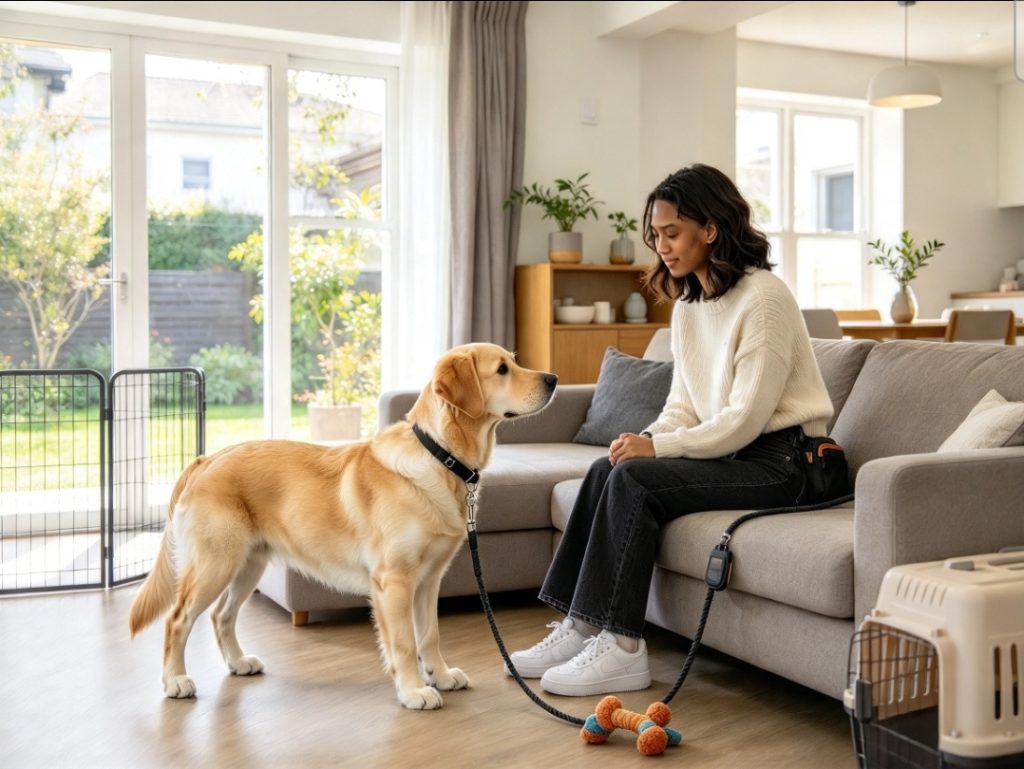
Show a realistic living room with a sofa, coffee table, side furniture and normal household items. Include a clearly visible placemat where the dog can learn to settle, an open crate positioned in a quiet area as a safe rest and reset space, and a secure playpen representing controlled freedom. Include a small number of appropriate dog-training items, such as a training pouch and suitable dog toy, positioned naturally within the room.
The dog’s body language should communicate alertness and expectation rather than fear, aggression or distress. The owner should demonstrate calm boundaries and avoid physically restraining, intimidating or punishing the dog. The image should visually communicate the difference between demanding interaction and appropriate calm behaviour.
Use natural indoor lighting, realistic proportions, high detail and professional editorial photography. The environment should look like an ordinary residential home rather than a commercial training centre. No logos, text, watermarks or branding.
RECOMMENDED PRODUCTS

How do I stop my dog being demanding?
How do I stop my dog being demanding? The first step is to understand what your dog is demanding and what happens immediately afterwards. A dog may demand attention, food, play, access to something, interaction or movement, and the behaviour can become persistent when it repeatedly produces the result the dog wants. The GPK9 PROFESSIONAL TRAINING SYSTEM approaches the problem by observing the behaviour, understanding the dog’s current status and relevant motivation, identifying the appropriate level of control and then changing the situation so that calm and appropriate behaviour can be developed.
What does demanding behaviour look like?
Demanding behaviour can take many forms.
Your dog may:
- Bark for attention.
- Whine.
- Paw at you.
- Nudge you.
- Stare at you.
- Bring toys repeatedly.
- Jump up.
- Push into you.
- Follow you around.
- Interrupt you.
- Demand food.
- Attempt to take food.
- Repeatedly initiate play.
- Become frustrated when interaction stops.
- Become restless when you are occupied.
The behaviour itself does not tell you everything you need to know.
The important question is:
What is the dog trying to achieve, and what happens when they display the behaviour?
Why does my dog become demanding?
Dogs learn from consequences.
If your dog repeatedly demands attention and receives attention, the behaviour can become established.
For example:
Dog paws owner → owner responds → dog receives attention.
Or:
Dog barks → owner gives food → dog learns barking can produce food.
Or:
Dog brings toy → owner immediately plays → dog learns persistent toy presentation produces play.
The response does not always have to be intentional.
Even telling the dog to stop, pushing them away or repeatedly speaking to them can provide interaction.
The aim is therefore not simply to stop the behaviour.
The aim is to understand the pattern and teach an appropriate alternative.
Start with the GPK9 decision process
The GPK9 decision process is:
OBSERVE → INTERPRET → DECIDE → ACT → REASSESS
OBSERVE
Look at:
- Body posture.
- Facial expression.
- Ears.
- Tail.
- Movement.
- Orientation.
- Attention.
- Engagement.
- Arousal.
- Ability to settle.
- Responsiveness.
- Recovery.
- Environmental awareness.
- Social behaviour.
- Changes in behaviour.
- Learned criteria.
Observe what happens immediately before the demanding behaviour and immediately afterwards.
Ask:
- What was the dog doing?
- What did the owner do?
- What did the dog receive?
- Did the behaviour produce attention?
- Did it produce food?
- Did it produce play?
- Did it produce access?
- Did the behaviour stop because the dog received what they wanted?
This helps identify the pattern.
INTERPRET the behaviour
Consider:
- Status.
- Drive.
- Control.
- Environment.
- Distractions.
- Engagement.
- Calmness.
- Responsiveness.
- Recovery.
For example, a dog that calmly brings a toy and waits is behaving differently from a dog that repeatedly jumps, barks and pushes into the owner until the owner plays.
The response should reflect the behaviour you are actually observing.
DECIDE what should happen next
Once you understand the situation, determine whether the dog should:
- Continue an appropriate activity.
- Remain settled.
- Be redirected.
- Have reduced access.
- Have the distraction removed.
- Calm down.
- Return to an appropriate level of control.
- Reset.
The objective is to avoid allowing demanding behaviour to control every interaction.
RECOMMENDED PRODUCTS
Teach an alternative behaviour
Stopping demanding behaviour is easier when the dog understands what they should do instead.
An alternative may be:
- Sitting calmly.
- Settling on a placemat.
- Waiting appropriately.
- Remaining in an appropriate location.
- Engaging when invited.
- Playing when play is initiated.
- Waiting for food appropriately.
- Remaining calm while the owner is occupied.
The replacement behaviour needs to be clear and achievable.
Use calmness rather than confrontation
Demanding behaviour can become more intense if the interaction itself becomes exciting.
If your dog is barking for attention and you repeatedly shout, push them away or move around quickly, the dog is still receiving a response.
The objective is to reduce unnecessary interaction and provide a clear alternative.
For example:
Demanding behaviour → no unnecessary interaction → calm behaviour → appropriate interaction.
This helps the dog understand which behaviour is useful.
Do not reward demanding behaviour accidentally
Consider the entire sequence.
If your dog:
Barks → you look at them → they continue → you speak → they receive attention
the dog may learn that barking produces interaction.
Likewise:
Paws → owner pushes dog away → dog receives physical interaction
can still provide a consequence that maintains the behaviour.
Instead, identify the behaviour you want.
When the dog demonstrates it appropriately, provide the relevant interaction.
What if my dog demands food?
Food is a particularly common source of demanding behaviour.
Consider whether your dog has:
- Low Food Drive.
- High Food Drive.
A dog with high food motivation may become highly attentive when food is present.
The objective is not simply to stop feeding the dog.
The objective is to teach appropriate behaviour around food.
For example, calm behaviour can be developed before food is provided.
The dog learns that:
CALM AND APPROPRIATE BEHAVIOUR → FOOD
rather than:
DEMANDING BEHAVIOUR → FOOD
Avoid creating a competition over food
If your dog becomes highly aroused around food, repeated food-based interaction may increase the excitement.
Observe the dog.
If food helps develop the behaviour you want, use it appropriately.
If food is increasing arousal or encouraging demanding behaviour, reassess how it is being used.
The relevant question is:
Is the motivation helping the dog achieve the required behaviour?
What if my dog demands attention?
Attention should not always be available simply because the dog requests it.
Create predictable opportunities for interaction.
Your dog can learn that:
- Interaction happens.
- Training happens.
- Play happens.
- Rest happens.
- Calm independent behaviour happens.
This creates clearer boundaries.
The dog remains socially connected while learning that demanding behaviour does not control every interaction.
Use the placemat to teach calm waiting
The placemat is useful for developing:
- Stationing.
- Duration.
- Settling.
- Calmness.
- Environmental awareness.
For example, if your dog repeatedly demands attention while you are working, eating or carrying out household tasks, an appropriate settling location can provide an alternative behaviour.
The dog learns:
Owner is occupied → dog settles → appropriate calm behaviour.
This is different from simply telling the dog “no”.
You are teaching the dog what to do.
Use controlled freedom
The GPK9 HOME & SOCIAL pathway is:
CRATE → PLACEMAT → PLAYPEN
The pathway is not necessarily linear.
CRATE
The crate provides a conditioned safe space for:
- Rest.
- Routine.
- Recovery.
- Resetting.
PLACEMAT
The placemat provides:
- Stationing.
- Duration.
- Settling.
- Calmness.
PLAYPEN
The playpen provides:
- Controlled freedom.
- A clear boundary.
- More space.
- An opportunity to practise appropriate behaviour.
The central principle is:
MORE FREEDOM REQUIRES MORE BEHAVIOURAL RESPONSIBILITY.
If your dog cannot behave appropriately with more freedom, reduce the level of freedom.
What if my dog becomes demanding when I stop playing?
This is where play and prey drive may be relevant.
Some dogs have high prey drive or high toy motivation.
They may learn that repeatedly bringing a toy, nudging you or initiating movement produces more play.
The PLAY DRIVE AND PLAY area of the GPK9 system covers:
- Prey drive.
- Play.
- Toy motivation.
- Controlled play.
- Handler control.
- Calming.
- Resetting.
- Progression.
Play should have structure.
There should be opportunities for play and opportunities for calmness.
The objective is not to remove play.
It is to teach the dog that play begins and ends appropriately.
Teach your dog that play has an end
A useful pattern is:
PLAY → CALM → RESET → NORMAL ACTIVITY
Rather than:
PLAY → DEMAND MORE PLAY → MORE PLAY
If the dog becomes increasingly aroused after play ends, observe their state.
If they cannot reduce or calm, reduce the situation and use the appropriate reset.
What if my dog barks when I ignore them?
First determine whether ignoring the behaviour is actually appropriate.
If the dog is simply demanding attention, reducing interaction may be useful.
But if the behaviour is escalating, continuing to ignore it without changing the environment may not solve the underlying problem.
Use:
OBSERVE → INTERPRET → DECIDE → ACT → REASSESS
Ask why the dog is escalating.
Consider:
- Arousal.
- Environment.
- Motivation.
- Previous reinforcement.
- Level of control.
- Ability to settle.
Then choose the appropriate response.
RECOMMENDED PRODUCTS
Use the traffic-light system
GREEN — OBSERVE → CONTINUE → PROGRESS
Green means the dog is in a suitable state.
For demanding behaviour, this may mean:
- The dog is calm.
- The dog can settle.
- The dog responds appropriately.
- The dog can wait.
- The dog can engage without demanding.
Continue and gradually progress.
AMBER — OBSERVE → ASSESS → REMOVE FROM DISTRACTION → CALM → REASSESS
Amber means the dog is struggling.
You may see:
- Increasing vocalisation.
- Repeated attention-seeking.
- Increased movement.
- Rising arousal.
- Reduced responsiveness.
- Difficulty settling.
Observe and assess.
Reduce the distraction or activity.
Allow the dog to calm.
Then reassess.
If the dog returns to an appropriate state:
GREEN → CALM → CONTINUE → PROGRESS
RED — STOP AND RESET
If the dog cannot reduce or calm:
RED → STOP WHAT YOU ARE DOING → OBSERVE → ASSESS → REMOVE FROM DISTRACTION → CALM → REASSESS
If the dog still cannot reduce or calm:
RED → CANNOT REDUCE → CANNOT CALM → RETURN TO CRATE
Then:
RESET → HOME & SOCIAL → GREEN → OBSERVE → CONTINUE
What if my dog follows me demanding attention?
Following can become part of demanding behaviour.
For example:
Owner stands → dog follows → dog paws → owner responds.
The dog may learn that following gives them access to interaction.
If this is happening, combine calm movement with appropriate settling.
Ask the dog to remain in an appropriate location while you move around.
Start with a very small amount of movement.
If the dog remains calm:
GREEN → CONTINUE → PROGRESS
If the dog gets up and becomes demanding:
AMBER → ASSESS → REDUCE → CALM → REASSESS
Build independence alongside boundaries
Demanding behaviour can sometimes be reduced by helping the dog become comfortable spending appropriate periods without active interaction.
This does not mean isolating the dog.
It means teaching:
INTERACTION WHEN APPROPRIATE → CALM INDEPENDENCE WHEN APPROPRIATE
Your dog should learn that your attention is not required every second of the day.
Create predictable routines
A predictable routine can help your dog understand when different activities occur.
Include appropriate opportunities for:
- Training.
- Food.
- Play.
- Walking.
- Toilet.
- Social interaction.
- Rest.
- Independent settling.
If the dog knows that play and interaction occur at appropriate times, they have less reason to try to control every interaction.
Do not give in after repeated demands
Consistency matters.
If your dog learns:
Demand → demand again → demand again → eventually receive what they want
then persistence may become part of the behaviour.
The aim is to make calm and appropriate behaviour the route to interaction.
However, consistency does not mean ignoring everything.
It means responding according to the behaviour and situation rather than allowing repeated demands to determine the outcome.
What if my dog demands attention while I am working?
Create an appropriate settling routine.
Your dog can learn:
Owner working → dog settles → calm behaviour → appropriate interaction later.
Use the placemat or another appropriate controlled area according to the dog’s current level of behavioural responsibility.
If the dog cannot settle, reduce the difficulty.
Do not expect a dog that has not learned calm settling to immediately remain quiet for a long period.
RECOMMENDED PRODUCTS
What if my dog demands attention while I am eating?
Food can be a strong motivator.
Observe:
- The dog’s food drive.
- Arousal.
- Previous reinforcement.
- Current control.
- Environment.
The dog should not learn that pushing, barking, staring or jumping results in food.
Instead, develop an appropriate alternative such as settling calmly in an appropriate location.
What if my dog brings me toys constantly?
Consider whether the dog is asking appropriately or demanding interaction.
A dog calmly presenting a toy can be different from a dog repeatedly pushing, barking, pawing or becoming frustrated when play stops.
If the dog is highly motivated by toys:
PLAY → CONTROL → CALM → RESET
should be part of the wider structure.
Play should remain controlled rather than becoming an unlimited source of stimulation.
What if my dog becomes more demanding when I stop responding?
The behaviour may temporarily become more persistent because the dog has previously learned that persistence can work.
This is why the entire interaction needs to be considered.
Do not simply focus on suppressing the behaviour.
Teach the replacement behaviour.
For example:
Demanding → no unnecessary interaction → settle → appropriate interaction.
The dog gradually learns that calm behaviour is more appropriate.
Common mistakes when stopping demanding behaviour
Giving attention every time the dog demands it
This can maintain the behaviour.
Shouting at the dog
This is still interaction and may increase arousal.
Giving food to make the dog quiet
This can teach the dog that demanding behaviour produces food.
Playing until the dog becomes exhausted
Physical exhaustion is not the same as teaching calm behavioural control.
Allowing unlimited access
Freedom should match behavioural responsibility.
Failing to teach an alternative
The dog needs to know what behaviour is appropriate.
Being inconsistent
If demanding behaviour sometimes works, the dog may continue trying.
Ignoring the dog’s status
An over-aroused dog may need to calm and reset before they can respond appropriately.
A practical routine for reducing demanding behaviour
Step 1 — Observe
Identify exactly what your dog does when demanding.
Step 2 — Identify the outcome
Determine what the dog usually receives.
Is it:
- Attention?
- Food?
- Play?
- Access?
- Movement?
- Interaction?
Step 3 — Identify the alternative
Choose an appropriate behaviour such as:
- Settling.
- Waiting.
- Sitting calmly.
- Remaining on a placemat.
- Appropriate engagement.
Step 4 — Control the environment
Reduce unnecessary distractions and provide the appropriate level of freedom.
Step 5 — Wait for appropriate behaviour
Do not make demanding behaviour the route to the desired outcome.
Step 6 — Reinforce calm behaviour
Provide appropriate interaction when the dog demonstrates the behaviour you want.
Step 7 — Reassess
Ask:
- Is the dog calmer?
- Can the dog settle?
- Can the dog respond appropriately?
- Is demanding behaviour reducing?
- Can the dog cope with more freedom?
If yes:
CONTINUE → PROGRESS
If no:
REDUCE → CALM → REASSESS
How do I know if my dog’s demanding behaviour is improving?
Look for consistent changes.
Your dog may begin to:
- Wait rather than demand.
- Settle when you are occupied.
- Stop repeatedly pawing or nudging.
- Reduce barking for attention.
- Accept that play has an end.
- Remain calm around food.
- Respond appropriately when interaction is unavailable.
- Choose to settle rather than constantly seek interaction.
- Recover more quickly after excitement.
- Accept appropriate boundaries.
The objective is not to eliminate communication.
Dogs should still be able to communicate their needs.
The objective is to distinguish appropriate communication from persistent demanding behaviour and teach the dog a more appropriate response.
When should professional support be considered?
If demanding behaviour is accompanied by significant distress, aggression, persistent inability to calm, sudden major behavioural changes or behaviour that you cannot safely manage, professional assessment may be appropriate.
The GPK9 system provides a structure for observing behaviour, identifying status, considering drive, selecting control and reassessing the outcome, but it does not replace an individual professional assessment where one is required.