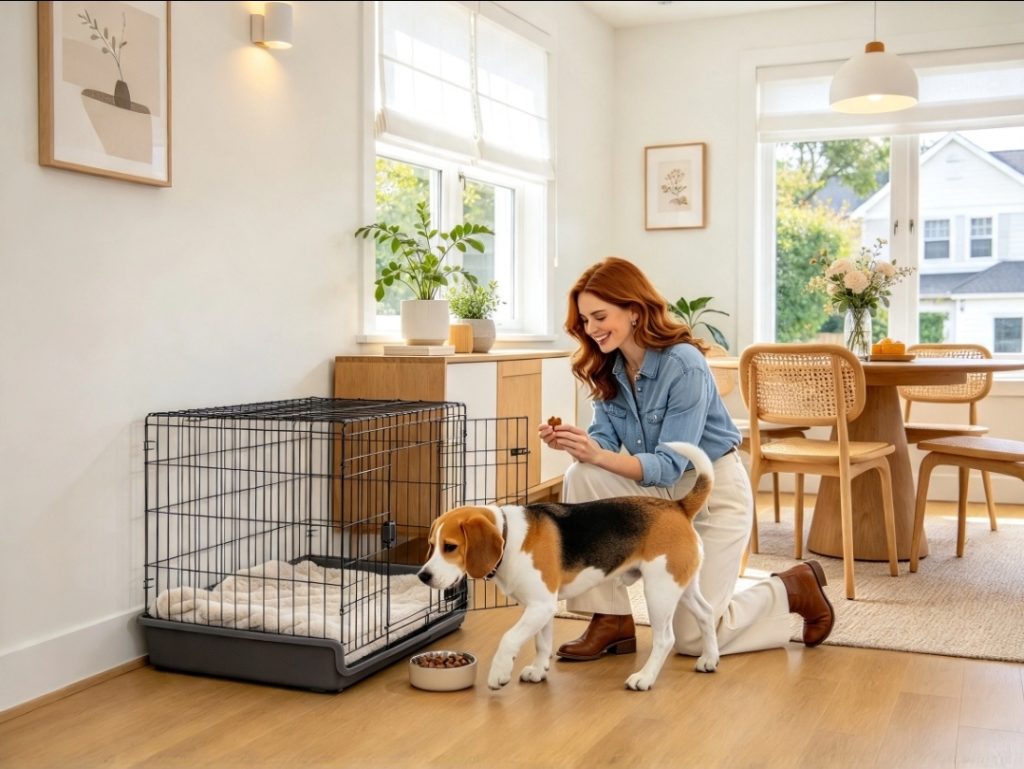
How do I introduce a dog to a crate?
How do I introduce a dog to a crate? The aim is not simply to get the dog physically inside the crate. The aim is to introduce the crate as a conditioned safe space that supports rest, routine, calmness and appropriate management. The process should be based on positive reinforcement, food, patience and observation, allowing the dog to develop an appropriate association with the crate rather than being forced into it.
RECOMMENDED PRODUCTS — Crates and Pens
What is the purpose of introducing a dog to a crate?
Within the GPK9 PROFESSIONAL TRAINING SYSTEM, crate introduction forms part of HOME & SOCIAL.
The crate can provide:
- Rest.
- Routine.
- Calmness.
- Appropriate management.
- Resetting.
- A controlled environment when required.
The introduction should therefore focus on making the crate an appropriate part of the dog’s normal environment.
The objective is not to make the dog enter the crate as quickly as possible.
The objective is to build the behaviour progressively so the dog can enter, remain calm and eventually settle appropriately.
Start with the right environment
Before beginning, consider the environment around the crate.
Choose an area of the home where the dog can be part of normal household activity without being placed directly in the middle of constant movement and distraction.
The crate should be:
- Appropriately sized.
- Secure.
- Comfortable.
- Clean.
- Free from unnecessary hazards.
- Positioned where the dog can gradually become comfortable with it.
The crate should not be introduced as a place where the dog is immediately shut away.
Initially, the dog needs an opportunity to investigate it and understand that it is simply part of the environment.
Begin with the crate door open
Start with the crate door open.
Allow the dog to investigate at its own pace.
Do not push the dog inside.
Do not drag the dog inside.
Do not immediately close the door when the dog enters.
The first objective is simply to allow the dog to become comfortable around the crate.
Observe:
- Does the dog look at the crate?
- Does the dog approach it?
- Does the dog sniff it?
- Does the dog investigate the entrance?
- Does the dog place a foot inside?
- Does the dog enter voluntarily?
- Does the dog remain relaxed?
These observations provide information about the dog’s current state.
Use food to create appropriate engagement
Food can be used as a positive reinforcement tool during crate introduction.
Place food where the dog can comfortably access it without being forced into the crate.
Initially, this may mean rewarding the dog for simply approaching the crate.
As the dog becomes comfortable, food can gradually be used to encourage voluntary movement towards and into the crate.
The process may look like:
APPROACH → INVESTIGATE → ENTER → SETTLE → REMAIN → PROGRESS
Do not rush through the stages.
If the dog is comfortable approaching but becomes uncomfortable when entering, return to the previous stage and build more positive experiences.
Let the dog make the movement
A key part of crate introduction is voluntary engagement.
The dog should learn that entering the crate is a behaviour it can perform successfully.
Avoid physically placing the dog inside simply to achieve the result.
If the dog walks into the crate for food, allow it to come back out.
Repeat the process.
The dog can gradually learn:
CRATE → FOOD → CALM → POSITIVE EXPERIENCE
This helps create a useful association without making the crate itself a source of conflict.
Do not immediately close the door
One of the most common mistakes when introducing a dog to a crate is progressing to a closed door too quickly.
A dog entering the crate does not automatically mean the dog is ready for the door to be closed.
First establish that the dog can:
- Enter voluntarily.
- Remain relaxed.
- Take food calmly.
- Exit calmly.
- Re-enter willingly.
- Spend increasing amounts of time inside without becoming distressed or excessively aroused.
Only then should you begin considering gradual door management.
Introduce short periods of door movement
Once the dog is comfortable entering and remaining inside, begin introducing very small amounts of door movement.
For example, move the door slightly and then return it to its original position.
Observe the dog’s response.
If the dog remains calm, continue gradually.
If the dog becomes concerned, stop and return to an easier stage.
The objective is not:
ENTER → DOOR CLOSED
The objective is:
ENTER → CALM → DOOR MOVES → CALM → DOOR CLOSES BRIEFLY → CALM → PROGRESS
The exact progression will depend on the individual dog.
Use short training sessions
Crate introduction does not need to involve long sessions.
Short, successful repetitions can be more useful than keeping the dog in the crate for an extended period while it is still learning.
You can practise:
- Approaching the crate.
- Looking inside.
- Entering.
- Taking food.
- Remaining briefly.
- Exiting.
- Re-entering.
- Settling.
The dog should have opportunities to succeed.
Positive reinforcement, food and patience are particularly important during this stage.
Observe the dog’s status
The GPK9 PROFESSIONAL TRAINING SYSTEM uses:
CATEGORY → STATUS → DRIVE → CONTROL
For crate introduction, the category is HOME & SOCIAL.
You then observe the dog’s current status and consider the relevant drive and level of control.
The dog’s behaviour should determine whether you continue, progress, modify the exercise or reset.
GREEN
OBSERVE → CONTINUE → PROGRESS
The dog is calm, engaged and able to respond appropriately.
You can continue the appropriate exercise and progress gradually.
For example, if the dog voluntarily enters the crate, takes food and remains relaxed, you may gradually increase the duration.
Progress should remain appropriate to the dog’s behaviour.
AMBER
OBSERVE → ASSESS → REMOVE FROM DISTRACTION → CALM → REASSESS
The dog is beginning to struggle.
You may observe:
- Increased movement.
- Difficulty settling.
- Reduced engagement.
- Increased arousal.
- Repeated attempts to leave.
- Difficulty responding appropriately.
Reduce the difficulty or distraction.
Allow the dog to calm.
Then reassess.
If the dog returns to an appropriate calm state:
GREEN → CALM → CONTINUE → PROGRESS
If the dog cannot reduce or calm:
RED → CANNOT REDUCE → CANNOT CALM → RETURN TO CRATE
The appropriate response depends on the circumstances and the individual dog.
RED
STOP WHAT YOU ARE DOING → OBSERVE → ASSESS → REMOVE FROM DISTRACTION → CALM → REASSESS
If the dog is clearly unable to cope with the current exercise, stop progressing.
The objective is not to force the dog through the situation.
If the dog cannot reduce or calm:
RED → CANNOT REDUCE → CANNOT CALM → RETURN TO CRATE
Then:
RESET → HOME & SOCIAL → GREEN → OBSERVE → CONTINUE
The reset is about returning to an appropriate level of control and beginning again when the dog is ready.
What if the dog will not go inside?
Do not assume that refusing to enter means the dog is being stubborn.
Observe what is happening.
Consider:
- Is the crate unfamiliar?
- Is the environment distracting?
- Is the dog uncomfortable?
- Is the food motivation appropriate?
- Is the dog being asked to progress too quickly?
- Has the dog had enough opportunity to investigate?
- Is the crate positioned appropriately?
Return to an easier stage.
Reward investigation and approach.
There is no requirement for the dog to enter the crate immediately.
What if the dog enters but immediately comes back out?
That can still be useful progress.
The dog has entered.
Do not automatically close the door.
Instead, continue creating positive experiences around voluntary entry.
Reward the dog for entering.
Allow the dog to leave.
Repeat.
Over time, the dog can learn that entering the crate does not mean it immediately loses access to the wider environment.
This can help the crate become a predictable and positive part of the home.
What if the dog is nervous around the crate?
Slow the process down.
Do not force the dog inside.
Use distance and gradual exposure.
Food can be used to reinforce calm investigation, provided the dog is able to eat and engage appropriately.
If the dog is too concerned to engage with food or cannot reduce its response, continuing to increase exposure may not be appropriate.
Observe, assess and reduce the difficulty.
If the concern persists or the behaviour is significant, professional assessment may be appropriate.
What if the dog becomes excited?
Not every positive response is calm engagement.
A dog can be highly motivated by food and become excessively aroused around the crate.
This is where DRIVE becomes relevant.
A dog with high food drive may rush into the crate to obtain food without actually learning to settle.
The objective is therefore not simply:
ENTER FAST
It is:
ENTER → ENGAGE → CALM → SETTLE
Food should help build the desired behaviour rather than create unnecessary excitement.
What if my dog already dislikes the crate?
The process may need to start further away from the crate.
Do not assume that the answer is to close the dog inside until it stops reacting.
Instead, identify what the dog can currently manage.
The GPK9 decision process is:
OBSERVE → INTERPRET → DECIDE → ACT → REASSESS
Observe
Watch the dog’s body language, attention, movement, arousal, responsiveness and recovery.
Interpret
Consider what the behaviour means within the current environment.
Decide
Determine whether to continue, reduce the difficulty, remove a distraction, calm, reassess or reset.
Act
Change the environment, motivation, distance, duration or level of control appropriately.
Reassess
Determine whether the dog has returned to an appropriate state.
If it has:
GREEN → OBSERVE → CONTINUE → PROGRESS
If not, reduce the situation and reset.
Build duration gradually
Once the dog is comfortable entering and remaining in the crate, duration can be developed gradually.
Do not jump from a few seconds to a long period simply because the dog has successfully remained inside once.
Build duration according to the dog’s behaviour.
For example:
SHORT DURATION → CALM → REWARD → REASSESS → SLIGHTLY LONGER DURATION
The progression should remain controlled.
Introduce normal household movement
The crate should eventually become part of normal home life.
Once the dog is comfortable with the crate itself, gradually introduce normal household activity around it.
The dog may need to learn to remain settled while:
- People move around the room.
- Household sounds occur.
- Doors open and close.
- People sit down.
- Normal activity takes place nearby.
Again, progression depends on status.
If the dog remains calm:
GREEN → OBSERVE → CONTINUE → PROGRESS
If the dog begins struggling:
AMBER → OBSERVE → ASSESS → REMOVE FROM DISTRACTION → CALM → REASSESS
The crate is not the end goal
The crate is one part of the HOME & SOCIAL pathway.
The wider pathway is:
CRATE → PLACEMAT → PLAYPEN
This is not necessarily a strict linear progression.
The dog may move between stages depending on its behaviour and the level of freedom it can currently manage.
The crate provides a higher level of environmental control.
The placemat develops stationing, duration and settling.
The playpen introduces controlled freedom within a boundary.
This reflects an important GPK9 principle:
MORE FREEDOM REQUIRES MORE BEHAVIOURAL RESPONSIBILITY.
When should I start giving more freedom?
Do not base freedom simply on age or how long the dog has lived in the crate.
Base progression on behaviour.
Observe whether the dog can:
- Settle appropriately.
- Respond to the handler.
- Remain calm.
- Manage environmental distractions.
- Recover appropriately.
- Follow established criteria.
- Maintain appropriate behaviour when given additional freedom.
If the dog can manage the next level of freedom appropriately, progression may be considered.
If the dog cannot, return to the level of control it can manage.
Introducing a puppy to a crate
Puppies may need particularly gradual introduction because the crate is a new part of their environment.
A puppy may initially investigate through:
- Smelling.
- Looking.
- Touching.
- Entering briefly.
- Exiting.
- Re-entering.
Allow the puppy to learn through repeated positive experiences.
Food can help create motivation.
Patience allows the puppy time to understand the environment.
Observation tells you when the puppy is ready to progress.
The crate should also form part of a wider routine that includes appropriate toilet management, rest and controlled freedom.
Avoid turning the crate into a punishment
The crate should not become associated with punishment.
Within GPK9 HOME & SOCIAL, the crate is a conditioned safe space for rest, routine, management and resetting.
If the dog makes an inappropriate choice, the response should be based on the current situation and the appropriate level of control rather than using the crate as a threat.
A crate can be used as part of a reset, but that is different from using it as punishment.
The distinction is important.
The objective is to maintain the crate as a useful and predictable part of the dog’s environment.
What should be inside during introduction?
Keep the setup simple.
A suitable resting surface may be appropriate.
Food can be used during training where appropriate.
A suitable durable item may be introduced when the dog can safely manage it.
Do not overcrowd the crate.
Every item should have a reason for being there.
Ask:
Does this support safety, comfort, calmness or appropriate training?
If not, it may not need to be inside.
A simple crate introduction process
The overall process can be understood as:
Stage 1 — Investigate
Allow the dog to approach and investigate the crate.
Stage 2 — Engage
Use positive reinforcement and food to create appropriate engagement.
Stage 3 — Enter
Encourage voluntary entry.
Stage 4 — Settle
Reward calm behaviour inside the crate.
Stage 5 — Remain
Gradually increase the time the dog can remain appropriately settled.
Stage 6 — Door movement
Introduce movement of the door gradually.
Stage 7 — Brief closure
Close the door for short periods when the dog is ready.
Stage 8 — Progress
Gradually develop duration and environmental distractions according to the dog’s status.
Stage 9 — Reassess
Continue observing the dog and adjust the level of control as behaviour develops.
The process is not about completing every stage as quickly as possible.
It is about establishing each behaviour before progressing.
What if the dog struggles at any stage?
Return to the GPK9 decision process:
OBSERVE → INTERPRET → DECIDE → ACT → REASSESS
Ask:
- What is the dog doing?
- What has changed?
- What is the dog’s current status?
- What drive is relevant?
- What level of control is required?
- Can the distraction be reduced?
- Can the dog calm?
- Is the dog ready to progress?
If the dog returns to an appropriate state:
GREEN → OBSERVE → CONTINUE → PROGRESS
If not:
RESET → HOME & SOCIAL → GREEN → OBSERVE → CONTINUE
If the dog cannot reduce or calm, professional support may be appropriate, particularly where there is persistent distress, significant fear or behaviour that cannot be safely managed through gradual training.
RECOMMENDED COURSES
The GPK9 PROFESSIONAL TRAINING SYSTEM contains five connected training areas. For this subject, GOLDEN RULE 1 — HOME AND SOCIAL is the directly relevant course because introducing a dog to a crate concerns the home environment, settling, controlled freedom, routine, calmness, management and resetting.
1. GOLDEN RULE 1 — HOME AND SOCIAL
This is the primary course relevant to crate introduction.
It covers:
- Crate.
- Placemat.
- Playpen.
- Boundaries.
- Controlled freedom.
- Settling.
- Calmness.
- Routine.
- Resetting.
- Progression.
The wider GPK9 system also includes:
2. GOLDEN RULE 2 — OBEDIENCE
Covers structured obedience, food motivation, engagement, control, suitable equipment, suitable environments and progression.
3. GOLDEN RULE 3 — PLAY DRIVE AND PLAY
Covers prey drive, play, toy motivation, controlled play, handler control, calming, resetting and progression.
4. GOLDEN RULE 4 — TOILET
Covers toilet routine, toilet location, toilet command, management, control, routine and progression.
5. GOLDEN RULE 5 — SOCIAL WALKING
Covers calm social walking, IGNORE THE WORLD, environmental awareness, control, distractions, calmness and structured walking.
For How do I introduce a dog to a crate?, GOLDEN RULE 1 — HOME AND SOCIAL is the most directly relevant because the question is fundamentally about establishing the crate as an appropriate part of the dog’s home environment.
The introduction should be gradual
Introducing a dog to a crate is not a race.
A dog does not need to spend a long period inside simply because it has entered once.
Build the behaviour progressively.
Use positive reinforcement, food and patience.
Observe the dog’s response.
Progress when the dog is ready.
Reduce the difficulty when the dog struggles.
The goal is to create a dog that can view the crate as a normal, safe and predictable part of its environment.
Final thoughts
The best way to introduce a dog to a crate is to make the crate part of a positive, calm and controlled home environment rather than forcing the dog into it. Start with the door open, allow investigation, use food and positive reinforcement to encourage appropriate engagement, reward voluntary entry and build duration gradually. Do not rush to close the door, increase duration or introduce distractions before the dog is ready. Use the GPK9 decision process of OBSERVE → INTERPRET → DECIDE → ACT → REASSESS, and use the GREEN, AMBER and RED responses to determine whether to continue, modify, calm, reset or seek appropriate professional support. The crate should remain a conditioned safe space for rest, routine and resetting while the dog gradually develops the behavioural responsibility needed for greater freedom.
GPK9’S FIVE GOLDEN RULES
GPK9’S FIVE GOLDEN RULES. The GPK9 PROFESSIONAL TRAINING SYSTEM is divided into five accessible areas, with each area dealing with a particular part of dog training while remaining connected to the wider framework. An individual course can provide specific help for a particular training requirement, but no single course represents the entire system. The five areas work together as one connected framework, and the bite-sized structure allows the information to be learned progressively by first-time dog owners and professional trainers. The question of how to introduce a dog to a crate relates particularly strongly to HOME & SOCIAL because it involves the crate, settling, calmness, routine, controlled freedom, management, resetting and progression, but it remains part of the wider system. Understanding all five provides a complete framework for understanding how different areas of training connect. In this subject, the system determines how the dog’s current situation is observed, how status, drive and control are considered, how the environment and motivation are managed, how calmness is established, how progress is assessed and how the dog can move from the crate towards the placemat and playpen as appropriate. Understanding all five Golden Rules therefore provides the wider framework for understanding not only crate introduction but the connected training requirements that follow as the dog develops.