How do I train my dog in the house?
How do I train my dog in the house? Start by understanding that training in the house is not simply about teaching a list of commands. The home is where your dog learns how to settle, engage with you, follow boundaries, respond to routine and gradually manage greater freedom. Within the GPK9 PROFESSIONAL TRAINING SYSTEM, the home environment is primarily part of HOME & SOCIAL, while obedience, toilet training and play can also become relevant depending on what you are trying to teach.
RECOMMENDED PRODUCTS — Obedience Training
Why train your dog in the house?
The home is one of the most important environments in which a dog learns how to behave appropriately.
Before expecting a dog to cope with increasingly difficult environments, it is useful to establish appropriate behaviour in a controlled environment where distractions can be managed.
Training in the house can help develop:
- Calmness.
- Routine.
- Engagement.
- Boundaries.
- Settling.
- Responsiveness.
- Controlled freedom.
- Appropriate household behaviour.
- Progression towards greater behavioural responsibility.
The aim is not to keep the dog under constant control.
The aim is to teach the dog how to behave appropriately so that control can gradually be adjusted according to its behaviour.
Start with the HOME & SOCIAL environment
Within the GPK9 PROFESSIONAL TRAINING SYSTEM, the home environment is part of HOME & SOCIAL.
The core pathway is:
CRATE → PLACEMAT → PLAYPEN
This is not necessarily a strict linear progression.
A dog may move backwards and forwards between these stages depending on its current behaviour and the level of freedom it can responsibly manage.
CRATE
The crate provides a conditioned safe space for:
- Rest.
- Routine.
- Calmness.
- Management.
- Resetting.
PLACEMAT
The placemat develops:
- Stationing.
- Duration.
- Settling.
- Calmness.
- Controlled participation in the household environment.
PLAYPEN
The playpen provides:
- Controlled freedom.
- A defined boundary.
- More environmental access.
- An opportunity to develop behavioural responsibility.
The principle is:
MORE FREEDOM REQUIRES MORE BEHAVIOURAL RESPONSIBILITY.
Start with routine
Dogs learn through repetition and consistency.
Create a predictable household routine around:
- Rest.
- Food.
- Toilet opportunities.
- Training.
- Play.
- Walking.
- Settling.
- Controlled freedom.
A predictable routine makes it easier to observe what your dog is doing and identify changes in behaviour.
The objective is not to make every minute of the day identical.
It is to establish enough consistency that the dog can understand what is expected within the home.
Teach your dog where to settle
One of the most useful behaviours to develop inside the house is the ability to settle.
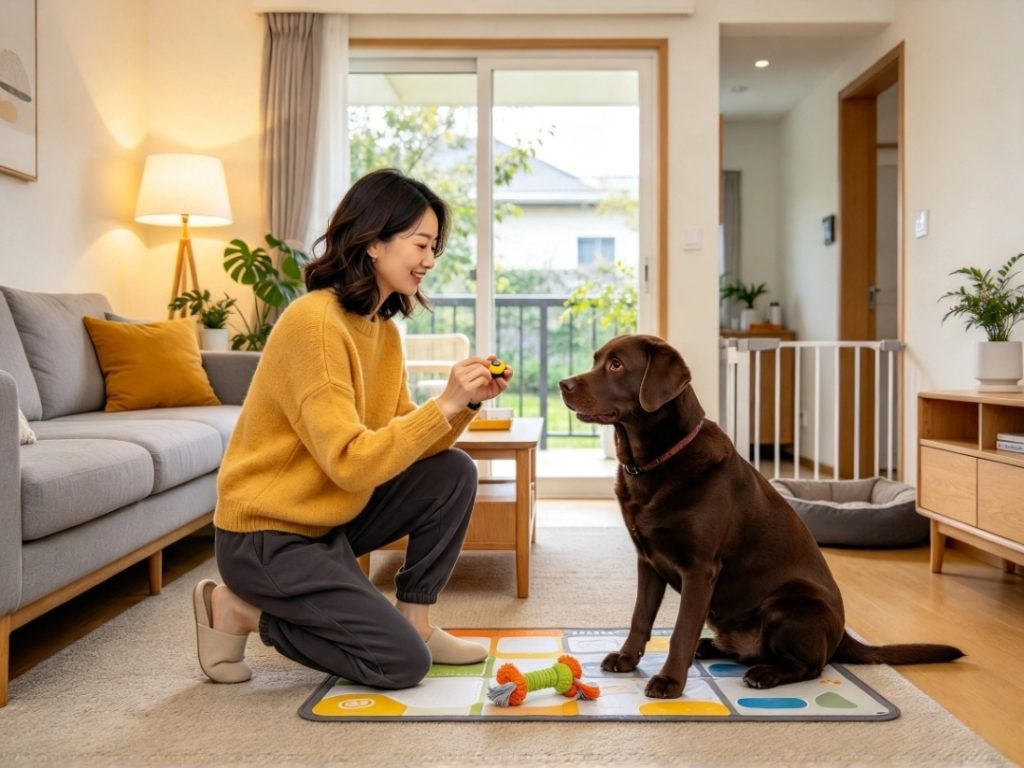
The placemat provides a structured location for this.
Begin with a suitable environment and use positive reinforcement and food to encourage the dog onto the placemat.
Reward appropriate engagement and calm behaviour.
Gradually develop:
GO TO PLACEMAT → SETTLE → REMAIN → REASSESS
Do not immediately expect a young or inexperienced dog to remain there for a long period.
Build duration according to the dog’s behaviour.
Use food and positive reinforcement
Food can be an effective form of motivation during indoor training.
Within the GPK9 system, food drive is considered as part of:
CATEGORY → STATUS → DRIVE → CONTROL
Some dogs have low food drive.
Others have high food drive.
The amount of motivation should therefore be considered alongside the dog’s current status and the behaviour being taught.
Use food purposefully.
The objective is not simply to feed the dog for doing anything.
The objective is to reinforce appropriate behaviour and help the dog understand what is being developed.
Train when your dog can learn
Training is affected by the dog’s current state.
Before beginning an exercise, observe the dog.
Consider:
- Is the dog calm?
- Is the dog engaged?
- Is the dog highly aroused?
- Is the dog distracted?
- Can the dog respond?
- Can the dog settle?
- Is the dog showing appropriate recovery?
- Is the environment suitable?
This follows the GPK9 decision process:
OBSERVE → INTERPRET → DECIDE → ACT → REASSESS
Do not simply continue because a training session has been planned.
The dog’s current behaviour should influence what happens next.
GREEN
OBSERVE → CONTINUE → PROGRESS
When your dog is calm, engaged and responding appropriately, continue the appropriate exercise.
You can progress gradually by:
- Increasing duration.
- Increasing distance.
- Introducing a small amount of distraction.
- Developing greater independence.
- Increasing appropriate freedom.
Progress should remain controlled.
AMBER
OBSERVE → ASSESS → REMOVE FROM DISTRACTION → CALM → REASSESS
If the dog begins to struggle, do not automatically increase control through repeated commands.
First observe what has changed.
Reduce the distraction.
Allow the dog to calm.
Then reassess.
If the dog returns to an appropriate state:
GREEN → CALM → CONTINUE → PROGRESS
If the dog cannot reduce or calm:
RED → CANNOT REDUCE → CANNOT CALM → RETURN TO CRATE
RED
STOP WHAT YOU ARE DOING → OBSERVE → ASSESS → REMOVE FROM DISTRACTION → CALM → REASSESS
When the dog is unable to continue appropriately, stop the current activity.
Assess what has happened.
Reduce the situation.
Allow the dog to calm.
If the dog cannot reduce or calm, return to the appropriate level of control.
Within HOME & SOCIAL, that may mean returning to the crate as part of a reset.
Then:
RESET → HOME & SOCIAL → GREEN → OBSERVE → CONTINUE
The crate is not being used as punishment.
It is part of the management and reset structure.
Teach household boundaries
Training in the house also involves teaching your dog how to behave around normal household activity.
This can include learning to:
- Remain calm when people move around.
- Wait appropriately.
- Settle while people are occupied.
- Avoid inappropriate household objects.
- Respond to the handler.
- Move between controlled areas appropriately.
- Remain calm around normal environmental activity.
The objective is not to prevent the dog from experiencing the household environment.
The objective is to teach the dog how to participate appropriately in it.
Do not give too much freedom too quickly
A common mistake is giving a dog unrestricted access to the entire house before it has developed the behavioural responsibility required to manage that freedom.
The GPK9 HOME & SOCIAL structure provides graduated control.
A dog may begin with:
CRATE
Then develop:
PLACEMAT
Then:
PLAYPEN
Then gradually move towards greater controlled freedom.
The dog may return to an earlier stage whenever its behaviour indicates that additional control is required.
This is not failure.
It is appropriate management.
What if my dog runs around the house?
Observe what is happening before deciding what to do.
Consider:
- Is the dog over-aroused?
- Is the dog seeking interaction?
- Is the dog tired?
- Is the dog responding to environmental stimulation?
- Has the dog been given too much freedom?
- Is there an appropriate outlet for play?
- Can the dog settle?
The response should depend on the situation.
If the dog is calm and appropriately engaged, continue the relevant activity.
If the dog is becoming increasingly aroused, reduce stimulation and reassess.
If the dog cannot reduce or calm, return to an appropriate level of control and reset.
What if my dog jumps up at people?
Jumping should be considered within the wider behaviour of the dog rather than treated as an isolated command problem.
Observe:
- When does the jumping occur?
- Who is the dog jumping at?
- What happens immediately before it?
- Is the dog highly excited?
- Is the dog seeking food or interaction?
- Does the behaviour increase with particular people or situations?
Then decide what behaviour you want to reinforce instead.
Calm engagement can be reinforced with food and appropriate attention.
The aim is to teach an alternative behaviour rather than simply repeating a correction.
What if my dog steals household objects?
Management is important.
Do not allow a dog unlimited access to objects it repeatedly takes, destroys or swallows.
Control the environment.
Provide appropriate alternatives.
Observe the dog’s motivation.
Consider whether the behaviour is connected to play, prey drive, attention, exploration or another part of the environment.
The GPK9 structure allows you to consider:
CATEGORY → STATUS → DRIVE → CONTROL
before deciding how to respond.
Play should have its own purpose
Play is important, but play and obedience should not simply become one continuous activity.
Within the GPK9 system, PREY DRIVE & PLAY is a separate training area.
Play can involve:
- Toy motivation.
- Prey drive.
- Controlled movement.
- Handler interaction.
- Appropriate arousal.
- Calming.
- Resetting.
If the dog becomes highly aroused during play, observe its ability to reduce that arousal afterwards.
The objective is controlled play rather than allowing play to become uncontrolled household behaviour.
Toilet training is also part of house training
If by “train my dog in the house” you mean teaching your dog where to toilet, that is specifically covered by TOILET within the GPK9 PROFESSIONAL TRAINING SYSTEM.
The core approach is:
- Consistent location.
- Consistent routine.
- Toilet command.
- Appropriate management.
- Observation.
- Progression.
For puppies especially, toilet training needs to be integrated into the wider home routine.
The crate, controlled freedom and toilet routine should work together rather than being treated as completely separate activities.
Build obedience inside the home
Indoor training is also a useful environment for structured obedience.
The GPK9 OBEDIENCE area focuses on:
- Food motivation.
- Engagement.
- Structured training.
- Control.
- Suitable equipment.
- Suitable environments.
- Progression.
Start in an environment where the dog can succeed.
Use food appropriately.
Keep the exercise structured.
Observe the dog’s engagement.
Then gradually increase the level of difficulty.
Use the right level of control
Control should match the dog’s current status.
Within the GPK9 system, control may include:
GREEN
- Short Line.
- Harness.
- Long Line.
- Free Roam.
AMBER
- Short Line.
- Muzzle.
RED
- Short Line.
- Muzzle.
The specific equipment used should be appropriate to the dog, situation and training requirement.
Control is not about restricting the dog unnecessarily.
It is about providing an appropriate level of management while the dog develops behavioural responsibility.
What if my dog ignores me?
Avoid immediately assuming that the dog simply needs more commands.
Observe the situation.
Ask:
- Is the dog engaged?
- Is the environment too distracting?
- Is the dog highly aroused?
- Is the food motivation appropriate?
- Is the behaviour understood?
- Is the current exercise too difficult?
- Is the dog capable of responding at this level?
You may need to reduce the difficulty rather than repeatedly asking for the same behaviour.
Use:
OBSERVE → INTERPRET → DECIDE → ACT → REASSESS
What if my dog becomes distracted?
Distraction is information.
Observe what has captured the dog’s attention.
Then assess whether the dog can still respond.
If the dog remains engaged:
GREEN → OBSERVE → CONTINUE → PROGRESS
If the dog begins struggling:
AMBER → OBSERVE → ASSESS → REMOVE FROM DISTRACTION → CALM → REASSESS
The objective is not necessarily to eliminate every distraction.
The objective is to develop the dog’s ability to remain appropriately engaged as difficulty increases.
Develop calmness before increasing freedom
Freedom should be earned through behavioural responsibility.
If a dog can settle on a placemat, respond appropriately and remain calm around normal household activity, it may be ready for greater controlled freedom.
If the dog begins making inappropriate choices when freedom increases, reduce the level of freedom.
Return to the previous stage.
Re-establish the behaviour.
Then reassess.
The principle remains:
MORE FREEDOM REQUIRES MORE BEHAVIOURAL RESPONSIBILITY.
The house should become a training environment
Training should not be limited to a ten-minute session.
Normal household activity provides opportunities for learning.
Your dog can learn through:
- Mealtimes.
- Rest periods.
- Moving around the home.
- Door routines.
- Settling.
- Controlled play.
- Toilet routines.
- Short obedience sessions.
- Moving between crate, placemat and playpen.
- Gradual increases in freedom.
The objective is to build appropriate behaviour into everyday life.
A simple indoor training structure
A practical session can follow:
1. OBSERVE
Look at your dog’s current state.
2. INTERPRET
Consider status, drive, control, environment and distractions.
3. DECIDE
Choose whether to continue, progress, modify, calm, remove distraction or reset.
4. ACT
Use appropriate training, motivation, management and control.
5. REASSESS
Determine whether the dog has returned to an appropriate state.
Then:
CONTINUE → PROGRESS
or:
RESET → RELEVANT GOLDEN RULE → GREEN → OBSERVE → CONTINUE
This keeps the training responsive rather than mechanical.
Do not try to teach everything at once
A dog learning the house rules does not need every behaviour introduced simultaneously.
Start with the most important foundations:
- Appropriate rest.
- Calmness.
- Routine.
- Engagement.
- Toilet management.
- Household boundaries.
- Controlled freedom.
Then develop additional behaviours as the dog becomes more capable.
Progressive learning is more useful than overwhelming the dog with multiple competing requirements.
What does a well-trained dog in the house look like?
The objective is not a dog that is constantly performing commands.
Appropriate household behaviour may simply look like a dog that:
- Rests when appropriate.
- Responds to its handler.
- Can settle.
- Understands boundaries.
- Uses its available space appropriately.
- Can engage with food.
- Can play appropriately.
- Can recover after excitement.
- Can manage increasing freedom.
- Can return to a controlled environment when necessary.
The dog should be able to participate in household life while maintaining appropriate behaviour.
RECOMMENDED COURSES
The GPK9 PROFESSIONAL TRAINING SYSTEM contains five connected training areas. For How do I train my dog in the house?, GOLDEN RULE 1 — HOME AND SOCIAL is the primary course because the subject concerns household behaviour, boundaries, settling, routine, controlled freedom, the crate, placemat, playpen, resetting and progression.
1. GOLDEN RULE 1 — HOME AND SOCIAL
This is the most directly relevant course for establishing appropriate behaviour within the home.
It covers:
- Crate.
- Placemat.
- Playpen.
- Boundaries.
- Controlled freedom.
- Settling.
- Calmness.
- Routine.
- Resetting.
- Progression.
2. GOLDEN RULE 2 — OBEDIENCE
Relevant where the focus is structured obedience, food motivation, engagement, control, suitable equipment, suitable environments and progression.
3. GOLDEN RULE 3 — PLAY DRIVE AND PLAY
Relevant where indoor behaviour involves prey drive, toy motivation, controlled play, handler control, calming, resetting and progression.
4. GOLDEN RULE 4 — TOILET
Relevant where “training in the house” specifically means toilet training, including routine, location, toilet command, management and progression.
5. GOLDEN RULE 5 — SOCIAL WALKING
Relevant when home training needs to connect with calm social walking, environmental awareness, distractions, control and the IGNORE THE WORLD approach.
The most directly relevant starting point for How do I train my dog in the house? is GOLDEN RULE 1 — HOME AND SOCIAL, because the home provides the foundation for calmness, routine, boundaries and controlled freedom.
Progress when the dog is ready
Training in the house should develop progressively.
Start with behaviour the dog can understand.
Use positive reinforcement, food and patience.
Observe the response.
Increase difficulty when the dog can manage the current level.
Reduce difficulty when the dog struggles.
Use the crate, placemat and playpen according to the level of control required.
The objective is not to control the dog forever.
The objective is to develop the dog’s ability to behave appropriately with progressively greater freedom.
Final thoughts
How do I train my dog in the house? Start by creating a structured HOME & SOCIAL environment in which your dog can learn calmness, routine, boundaries, engagement and controlled freedom. Use the crate as a safe space for rest, routine and resetting, the placemat for stationing and settling, and the playpen for controlled freedom within a boundary. Use positive reinforcement, food and patience while observing your dog’s current status, drive and ability to respond. When your dog is GREEN, continue and progress; when it becomes AMBER, assess, reduce distraction, calm and reassess; when it reaches RED, stop, manage the situation, calm and reset. Training inside the house should develop behavioural responsibility rather than simply producing a dog that responds to commands. As your dog becomes more capable, gradually increase freedom while continuing to observe, interpret, decide, act and reassess.
GPK9’S FIVE GOLDEN RULES
GPK9’S FIVE GOLDEN RULES. The GPK9 PROFESSIONAL TRAINING SYSTEM is divided into five accessible areas, with each area dealing with a particular part of dog training while remaining connected to the wider framework. An individual course can provide specific help for a particular training requirement, but no single course represents the entire system. The five areas work together as one connected framework, and the bite-sized structure allows progressive learning for first-time dog owners and professional trainers. The subject of training a dog in the house relates particularly strongly to HOME & SOCIAL because the home is where the dog develops routine, boundaries, settling, calmness, controlled freedom and appropriate behavioural responsibility, but the subject also connects with OBEDIENCE, PLAY DRIVE AND PLAY, TOILET and SOCIAL WALKING. Understanding all five Golden Rules provides the complete framework for understanding how these areas connect rather than treating each behaviour as an isolated exercise. The GPK9 system determines how the dog’s situation is observed, how status, drive and control are considered, how the appropriate training or management response is selected, how calmness and reassessment are handled, and when the dog should continue, progress, reduce distraction or reset. For training in the house, this wider system helps the owner understand not only what behaviour to teach but how the crate, placemat, playpen, obedience, play, toilet routine and wider environmental control can work together as the dog develops greater behavioural responsibility and appropriate freedom.