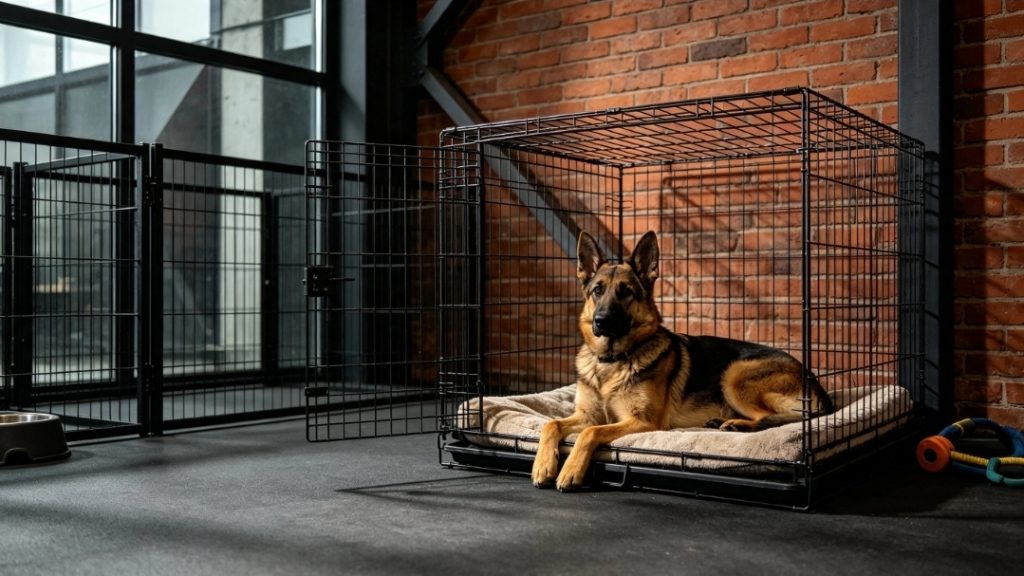
What should I put in my dog’s crate?
What should I put in my dog’s crate? The answer depends on what the crate is being used for and what is safe and appropriate for your individual dog. A crate should provide a comfortable, practical environment that supports rest, routine and resetting without becoming overcrowded or filled with items that could create a safety problem.
RECOMMENDED PRODUCTS — Crates and Pens
What is the purpose of the crate?
Within the GPK9 PROFESSIONAL TRAINING SYSTEM, the crate is part of HOME & SOCIAL.
The crate is a conditioned safe space that can provide:
- Rest.
- Routine.
- Calmness.
- Appropriate management.
- Resetting.
- A controlled environment when required.
What you put inside the crate should therefore support those purposes.
The objective is not to fill the crate with as many products as possible.
The objective is to create an appropriate environment in which your dog can settle safely.
Start with a suitable crate
Before deciding what goes inside the crate, make sure the crate itself is appropriate for your dog.
Your dog should have enough room to:
- Stand naturally.
- Turn around.
- Lie down comfortably.
- Change position.
- Rest without being cramped.
The crate should also be positioned in an appropriate part of the home.
It should be part of the dog’s normal environment rather than somewhere isolated simply because the dog is being confined.
What should go inside the crate?
The contents will depend on the individual dog, its age, behaviour and the purpose of the crate.
Common items may include:
- Comfortable bedding.
- A suitable washable crate mattress.
- A safe blanket where appropriate.
- An appropriate durable toy.
- A suitable enrichment item where appropriate.
- Water when appropriate for the situation.
However, not every dog needs every item.
The contents should be selected according to what the individual dog can safely manage.
Bedding
Comfortable bedding can help make the crate suitable for resting.
A washable dog bed, crate mattress or suitable bedding can provide a comfortable surface for lying down.
However, observe how your dog behaves with bedding.
Some dogs will simply sleep on it.
Others may chew, pull apart or ingest bedding.
If your dog repeatedly destroys or attempts to eat bedding, leaving loose material inside the crate may not be appropriate.
The important question is not simply:
“Does every dog need a bed in a crate?”
It is:
“What type of resting surface can this individual dog safely manage?”
Blankets
A blanket can provide additional comfort and warmth for some dogs.
However, loose blankets should be used with consideration.
If your dog:
- Chews the blanket.
- Pulls it apart.
- Swallows pieces.
- Becomes tangled in it.
- Uses it as something to play with rather than rest on.
then the blanket may not be appropriate.
The dog’s behaviour should determine what is safely suitable.
Toys
Some dogs can safely have an appropriate durable toy in their crate.
A suitable toy can provide an appropriate activity while the dog is resting or settling.
However, not every toy is appropriate for unsupervised crate use.
Avoid automatically placing a toy inside simply because your dog likes playing with it.
Consider:
- Can the dog destroy it?
- Can pieces be removed?
- Could the dog swallow parts?
- Is it appropriately sized?
- Does the dog become excessively excited by it?
- Does the toy encourage calm engagement or frantic activity?
The crate is primarily a place for rest and routine within the GPK9 HOME & SOCIAL framework.
If an item increases arousal rather than supporting appropriate behaviour, reconsider whether it belongs in the crate.
Food-based enrichment
Food-based enrichment can be useful in some training situations, but it should be selected carefully.
If you use an enrichment item containing food, consider whether the dog can safely use it without supervision.
The individual dog’s chewing behaviour, food drive and ability to manage the item are relevant.
A dog with high food drive may interact with an item very differently from a dog with low food drive.
This is where the GPK9 framework of:
CATEGORY → STATUS → DRIVE → CONTROL
can help you think about what is appropriate.
The item should match the dog’s current behaviour and the level of control required.
Water in the crate
Whether water should be available inside the crate depends on the individual circumstances, including the dog’s routine, age, environment and how long the dog will be inside.
Water should not simply be removed as a way of making crate management easier.
Where water is required, use an appropriate, stable container or suitable crate-safe solution.
Puppies in particular require careful consideration because toilet routines are still developing.
The crate should support the wider routine rather than interfere with appropriate hydration or toilet management.
What should you not put in the crate?
Avoid putting unnecessary or potentially hazardous objects inside the crate.
Potential concerns include:
- Items the dog can easily destroy.
- Small objects that could be swallowed.
- Toys with detachable pieces.
- Damaged toys.
- Loose materials the dog repeatedly ingests.
- Unsafe household objects.
- Items that create excessive excitement.
- Anything that could become trapped or cause injury.
The safest choice is not always the item marketed specifically for use with dogs.
Observe your own dog’s behaviour with the item.
What if my dog destroys its bedding?
This is where observation becomes more important than simply following a generic crate checklist.
Use the GPK9 decision process:
OBSERVE → INTERPRET → DECIDE → ACT → REASSESS
Observe
Watch what your dog actually does with the bedding.
Does the dog:
- Lie on it?
- Move it around?
- Chew it?
- Tear it?
- Swallow pieces?
- Become excited by it?
Interpret
Consider the dog’s:
- Status.
- Drive.
- Control.
- Environment.
- Arousal.
- Ability to settle.
A dog repeatedly destroying bedding may not currently be able to manage that particular item safely.
Decide
Determine whether to:
- Continue using the bedding.
- Change the bedding.
- Remove the unsafe item.
- Reduce stimulation.
- Reassess the crate environment.
Act and reassess
Make the change and observe your dog again.
The objective is not to provide the largest amount of bedding or the greatest number of objects.
The objective is an appropriate and safe resting environment.
Does a crate need lots of toys?
No.
A crate does not need to be packed with toys.
Too many objects can reduce the available resting space and may create unnecessary stimulation.
Think about the purpose of the crate.
If the dog is supposed to be settling, the environment should support settling.
A simple arrangement can often be more appropriate than a crowded crate.
What about a favourite toy?
A favourite toy can be appropriate if your dog can use it safely and calmly.
However, observe how your dog interacts with it.
If the toy causes:
- Excessive excitement.
- Persistent chewing.
- Frustration.
- Possessive behaviour.
- Destructive behaviour.
then it may not be appropriate for the crate at that particular time.
The same toy can be appropriate in one environment and inappropriate in another.
Should I cover the crate?
A crate cover can sometimes help reduce visual stimulation, depending on the individual dog and environment.
However, covering a crate should not be used automatically.
Consider:
- Ventilation.
- Temperature.
- Lighting.
- The dog’s response.
- The surrounding environment.
- Whether visual stimulation is actually causing difficulty.
A cover should never create an unsafe or excessively hot environment.
Observe the dog’s response after making any environmental change.
What about the crate door?
The crate door should be managed according to the purpose of the training session and the dog’s current status.
An open crate can provide an available resting space while the dog has controlled access to the wider environment.
This is particularly useful as the dog progresses through the HOME & SOCIAL pathway:
CRATE → PLACEMAT → PLAYPEN
The pathway is not necessarily linear.
A dog can move back to the crate when it needs a greater level of control or a reset.
The crate should not become overcrowded
One common mistake is assuming that making the crate more comfortable means putting more things inside it.
That is not necessarily the case.
The dog needs sufficient room to rest comfortably.
Consider the available space after bedding, toys and other items have been added.
If the contents prevent the dog from comfortably changing position, the crate environment needs to be reconsidered.
What if my dog becomes excited by the things inside the crate?
This is an important observation.
If your dog is supposed to be settling but becomes highly engaged with toys, bedding or enrichment, consider whether the item is appropriate at that particular time.
The GPK9 STATUS RESPONSE SYSTEM can help.
GREEN
OBSERVE → CONTINUE → PROGRESS
The dog remains calm and can settle appropriately.
Continue the appropriate routine.
AMBER
OBSERVE → ASSESS → REMOVE FROM DISTRACTION → CALM → REASSESS
The dog is beginning to struggle.
Reduce the distraction and allow the dog to calm before reassessing.
RED
STOP WHAT YOU ARE DOING → OBSERVE → ASSESS → REMOVE FROM DISTRACTION → CALM → REASSESS
If the dog cannot reduce or calm:
RED → CANNOT REDUCE → CANNOT CALM → RETURN TO CRATE
In a HOME & SOCIAL situation, the crate itself can be the appropriate controlled environment for resetting.
The important distinction is that the crate should not be used as punishment.
It is part of the management and reset process.
The crate should support calmness
The contents of the crate should support its purpose.
If your dog is going into the crate to rest, consider whether the environment encourages rest.
If your dog is going into the crate as part of a reset, consider whether the environment helps reduce stimulation.
If your dog is spending time in the crate as part of a routine, consider whether the setup is comfortable and practical.
The contents should serve the purpose of the crate rather than become the focus of the exercise.
Puppies may need a simpler setup
Puppies often explore their environment using their mouths.
That means items that appear harmless can become inappropriate if a puppy chews, tears or swallows them.
A puppy’s crate setup may therefore need to be simpler while its behaviour develops.
Observe:
- Chewing.
- Swallowing.
- Bedding destruction.
- Toy destruction.
- Toilet behaviour.
- Ability to settle.
As the puppy develops greater behavioural responsibility, appropriate items can be introduced or changed.
What about food and treats?
Food can be highly relevant to training, particularly when considering FOOD DRIVE.
However, food should be used purposefully.
A dog with high food drive may become highly motivated by food-based items, while another dog may show little interest.
Consider whether the food-based activity:
- Supports the intended training.
- Encourages appropriate engagement.
- Can be used safely.
- Creates excessive arousal.
- Is appropriate for the duration and circumstances.
The goal is not simply to put food into the crate.
The goal is to use motivation appropriately within the wider training structure.
The crate is one part of the dog’s environment
A well-designed crate setup should not become the dog’s entire world.
The wider HOME & SOCIAL environment also includes:
- The placemat.
- The playpen.
- Controlled freedom.
- Household boundaries.
- Settling.
- Routine.
- Environmental management.
As the dog develops, these areas should work together.
The crate provides one level of control.
The placemat provides stationing and settling.
The playpen provides controlled freedom within a boundary.
This progression supports the principle:
MORE FREEDOM REQUIRES MORE BEHAVIOURAL RESPONSIBILITY.
What should I put in my dog’s crate overnight?
For overnight rest, simplicity is often useful.
The dog should have an appropriate resting surface and a safe environment suitable for sleep.
The exact setup depends on the individual dog.
For example, a dog that settles quietly on a crate mattress may not need additional toys.
Another dog may safely use an appropriate durable item as part of its routine.
The important consideration is whether the contents support safe, calm rest.
What should I put in a puppy’s crate overnight?
Puppy crate setups require additional consideration because puppies are still developing toilet control and may chew or destroy objects.
The crate should be comfortable and safe, while the puppy’s toilet routine and developmental stage are taken into account.
Do not assume that a puppy can manage exactly the same crate setup as an adult dog.
Observe the individual puppy and adjust the environment accordingly.
A simple crate checklist
Before leaving your dog in its crate, consider:
- Is the crate appropriately sized?
- Is there a comfortable and safe resting surface?
- Can my dog safely manage the items inside?
- Is anything likely to be destroyed or swallowed?
- Does the setup allow the dog to rest comfortably?
- Is the environment appropriately calm?
- Is water required for the circumstances?
- Is the crate being used for an appropriate purpose?
- Can the dog settle appropriately?
These questions help you decide what belongs in the crate rather than relying on a fixed list of objects.
RECOMMENDED COURSES
The GPK9 PROFESSIONAL TRAINING SYSTEM contains five connected training areas. For this subject, GOLDEN RULE 1 — HOME AND SOCIAL is the directly relevant course because it covers the crate, settling, boundaries, controlled freedom, calmness, resetting and progression.
1. GOLDEN RULE 1 — HOME AND SOCIAL
This is the primary course relevant to deciding how the crate should be used and how its environment should support the dog’s development.
It covers:
- Crate.
- Placemat.
- Playpen.
- Boundaries.
- Controlled freedom.
- Settling.
- Calmness.
- Routine.
- Resetting.
- Progression.
The wider GPK9 system also includes:
2. GOLDEN RULE 2 — OBEDIENCE
Covers structured obedience, food motivation, engagement, control, suitable equipment, suitable environments and progression.
3. GOLDEN RULE 3 — PLAY DRIVE AND PLAY
Covers prey drive, play, toy motivation, controlled play, handler control, calming, resetting and progression.
4. GOLDEN RULE 4 — TOILET
Covers toilet routine, toilet location, toilet command, management, control, routine and progression.
5. GOLDEN RULE 5 — SOCIAL WALKING
Covers calm social walking, IGNORE THE WORLD, environmental awareness, control, distractions, calmness and structured walking.
For What should I put in my dog’s crate?, GOLDEN RULE 1 — HOME AND SOCIAL is the most directly relevant because the question concerns the dog’s resting environment, settling, management and progression toward greater freedom.
Keep the crate practical
There is no requirement to make a crate look like a miniature bedroom filled with equipment.
A practical crate may contain only the items that the individual dog can safely and comfortably manage.
The basic principle is:
SAFE → COMFORTABLE → APPROPRIATE → CALM
If an item does not contribute to one of those objectives, consider whether it actually needs to be there.
Reassess the crate as your dog develops
Your dog’s needs may change.
A puppy that once destroyed bedding may eventually be able to use it safely.
A toy that was appropriate at one stage may become damaged and need replacing.
A dog that previously needed a more controlled environment may eventually manage greater freedom.
The crate setup should therefore be reviewed as the dog’s behaviour develops.
Use:
OBSERVE → INTERPRET → DECIDE → ACT → REASSESS
rather than assuming that the same setup will always be appropriate.
Final thoughts
What you put in your dog’s crate should be determined by safety, comfort, the dog’s behaviour and the purpose of the crate. A comfortable resting surface may be appropriate, while suitable toys or enrichment items can be considered when the individual dog can safely manage them. Avoid filling the crate with unnecessary or potentially hazardous objects, particularly where the dog chews, destroys or swallows items. Within the GPK9 PROFESSIONAL TRAINING SYSTEM, the crate is a conditioned safe space for rest, routine and resetting, so its contents should support calmness and appropriate management. As your dog’s behaviour develops, observe, interpret, decide, act and reassess so that the crate environment continues to match what your dog can safely and responsibly manage.
GPK9’S FIVE GOLDEN RULES
GPK9’S FIVE GOLDEN RULES. The GPK9 PROFESSIONAL TRAINING SYSTEM is divided into five accessible areas, with each area dealing with a particular part of dog training while remaining connected to the wider framework. An individual course can provide specific help for a particular training requirement, but no single course represents the entire system. The five areas work together as one connected framework, and the bite-sized structure allows the information to be learned progressively by first-time dog owners and professional trainers. The question of what should be placed in a dog’s crate relates particularly strongly to HOME & SOCIAL because it involves the crate, settling, calmness, environmental management, controlled freedom, resetting and progression, but that area remains part of the wider system. Understanding all five provides the complete GPK9 framework and helps the reader understand how the dog’s situation is considered, how status, drive and control influence decisions, how appropriate management and equipment are selected, how calmness and reassessment are handled, how resetting works and how progression takes place. In relation to the crate, this wider understanding helps the owner select an environment and equipment that support the dog’s individual needs while understanding how the crate connects to the wider process of developing appropriate behaviour and greater responsibility.