How do I know when my puppy needs to go outside?
Knowing how do I know when my puppy needs to go outside? is an important part of successful toilet training. Puppies do not always give an obvious signal before they need to toilet, so the handler needs to combine observation with a consistent routine. Learning to recognise changes in behaviour can help you take the puppy outside at the right time and create opportunities for successful toilet training.
RECOMMENDED PRODUCTS

How do I know when my puppy needs to go outside?
The most useful starting point is to observe the puppy.
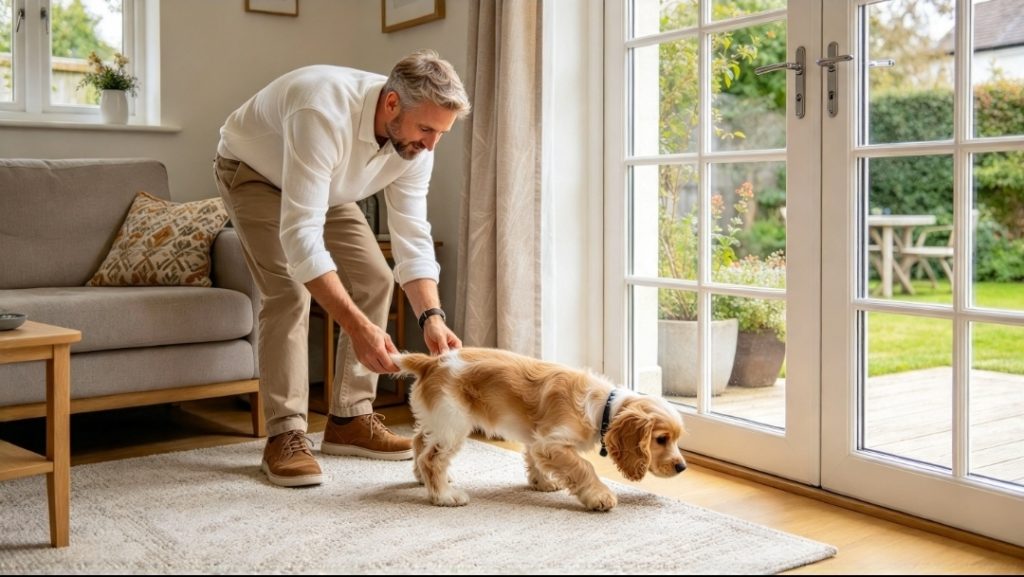
A puppy may show changes in behaviour when it needs to toilet, including:
- Sniffing the floor
- Circling
- Becoming restless
- Moving away from play
- Searching for a quiet area
- Walking towards a door
- Returning to an area where it has previously toileted
- Suddenly stopping what it is doing
- Becoming more active after resting
- Showing changes in attention
However, these signs can be subtle.
A puppy may also have an accident without giving a clear signal, particularly when it is very young.
This is why toilet training should combine observation and routine rather than relying entirely on the puppy to ask to go outside.
Watch what happens after important activities
There are predictable situations when it is sensible to consider taking a puppy outside.
These include:
- After waking
- After a nap
- After eating
- After drinking
- After active play
- After training
- After periods of excitement
- Before settling for a longer period
These events can become part of a predictable routine.
The aim is to learn the individual puppy’s pattern rather than expecting every puppy to behave exactly the same way.
Use the GPK9 decision process
The GPK9 Professional Training System uses:
OBSERVE → INTERPRET → DECIDE → ACT → REASSESS
This provides a structured way to answer how do I know when my puppy needs to go outside?
OBSERVE
Look at the puppy’s:
- Body posture
- Movement
- Attention
- Activity level
- Engagement
- Ability to settle
- Environmental awareness
- Changes in behaviour
Look for anything different from the puppy’s normal behaviour.
INTERPRET
Consider what has happened recently.
Has the puppy:
- Woken up?
- Eaten?
- Drunk?
- Played?
- Trained?
- Become excited?
- Been resting for a long period?
These circumstances can help you interpret the puppy’s behaviour.
DECIDE
Decide whether the puppy should be taken to its appropriate toilet location.
Do not wait until the puppy is already having an accident if the signs indicate that it is time to go.
ACT
Take the puppy to the appropriate toilet location.
Keep the routine clear and consistent.
Use the toilet command consistently and reward the correct behaviour.
REASSESS
After the puppy has had the opportunity to toilet, observe what happens next.
If the puppy remains calm and follows the routine:
GREEN → OBSERVE → CONTINUE → PROGRESS
Learn your puppy’s individual signs
There is no single sign that every puppy gives.
One puppy may walk towards the door.
Another may suddenly start sniffing the floor.
Another may become restless or stop playing.
Another may simply wander away from the handler.
This means the owner needs to learn the individual puppy’s normal behaviour.
Keep paying attention to what happens before successful toilet trips.
Over time, patterns become easier to recognise.
RECOMMENDED PRODUCTS
Sniffing and circling
Sniffing and circling are commonly noticed during toilet training.
If a puppy suddenly starts intensely sniffing the floor or moving around in circles, consider whether it may need to toilet.
Rather than waiting to see whether an accident happens, take the puppy to the appropriate toilet location and allow it the opportunity to perform the behaviour there.
The goal is to create more successful repetitions.
Walking towards the door
Some puppies eventually learn to move towards a door when they need to go outside.
This can become a useful communication signal.
However, do not rely on the door signal too early.
A young puppy may need to toilet before it has learned to communicate this clearly.
Continue using a proactive routine while the puppy’s communication develops.
Suddenly stopping play
A puppy that suddenly stops playing and begins wandering or sniffing may be showing a change in behaviour worth observing.
This is particularly relevant after active play.
Instead of automatically restarting the game, observe the puppy and consider whether it needs an outdoor toilet opportunity.
After waking
Taking the puppy outside after waking can help establish a predictable routine.
This applies after:
- Overnight sleep
- Daytime naps
- Resting in the crate
- Extended periods of settling
The transition can become:
WAKE → OUTSIDE → TOILET → REWARD → HOME
This helps the puppy understand what happens after waking.
After food and water
Eating and drinking should also be considered when deciding whether the puppy needs to go outside.
Rather than relying on a fixed period, observe the individual puppy.
If the puppy regularly needs to toilet after eating or drinking, build that pattern into the routine.
The aim is to create a predictable system based on the puppy’s actual behaviour.
After play and training
Active play and training can change the puppy’s level of activity.
After a period of activity, observe the puppy before moving to the next part of the routine.
If the puppy becomes highly excited or distracted, allow it to calm where appropriate.
The GPK9 approach is:
OBSERVE → ASSESS → REMOVE FROM DISTRACTION → CALM → REASSESS
If calm returns:
GREEN → CALM → CONTINUE → PROGRESS
This can help prevent the handler from missing normal toilet signals because the puppy is highly focused on another activity.
What if you are not sure?
If you are unsure whether the puppy needs to go outside, it is generally better within a structured toilet-training routine to provide an appropriate opportunity rather than simply ignore the behaviour.
Take the puppy to the normal toilet location.
Use the toilet command.
Allow the puppy time to respond.
If it toilets, reward the correct behaviour.
If it does not, return to the appropriate routine and continue observing.
This gives the puppy an opportunity to succeed without turning every uncertain moment into a major training event.
RECOMMENDED PRODUCTS
What if the puppy does not toilet outside?
A puppy can become distracted outside.
It may be interested in:
- Smells
- People
- Dogs
- Movement
- Sounds
- Wildlife
- Toys
- Exploring
If the puppy does not toilet, observe its behaviour rather than immediately assuming it no longer needs to go.
Keep the routine calm.
If necessary, reduce distractions and allow the puppy to settle.
Then reassess.
If the puppy still does not toilet, return to appropriate supervision and try again according to the established routine.
Use controlled freedom inside the home
Recognising when a puppy needs to go outside becomes more difficult when the puppy has unrestricted access to the home.
The GPK9 HOME & SOCIAL structure uses:
CRATE → PLACEMAT → PLAYPEN
The crate provides a structured space for rest and routine.
The placemat develops stationing, duration and settling.
The playpen provides controlled freedom within a boundary.
These levels of management allow the handler to observe the puppy more effectively.
The principle is:
MORE FREEDOM REQUIRES MORE BEHAVIOURAL RESPONSIBILITY.
If the puppy begins having accidents when given more freedom, reduce the level of freedom and rebuild reliability before progressing again.
What if the puppy becomes distracted?
The GPK9 status system provides a structured response.
GREEN — OBSERVE → CONTINUE → PROGRESS
The puppy is calm and able to respond appropriately.
Continue the appropriate activity and progress when suitable.
AMBER — OBSERVE → ASSESS → REMOVE FROM DISTRACTION → CALM → REASSESS
The puppy is struggling.
Observe the puppy, assess the distraction, remove the puppy from the distraction where appropriate, allow calm and reassess.
If calm returns:
GREEN → CALM → CONTINUE → PROGRESS
RED — STOP WHAT YOU ARE DOING → OBSERVE → ASSESS → REMOVE FROM DISTRACTION → CALM → REASSESS
If the puppy cannot reduce or calm:
RED → CANNOT REDUCE → CANNOT CALM → RETURN TO CRATE
Then:
RESET → TOILET → GREEN → OBSERVE → CONTINUE
The objective is to return the puppy to an appropriate level of control rather than continuing an activity that is no longer productive.
What if the puppy has an accident?
An accident should provide information.
Ask:
- What was the puppy doing beforehand?
- When did it last go outside?
- Had it just woken?
- Had it eaten or drunk?
- Had it been playing?
- Was it distracted?
- Was it given too much freedom?
- Were its signals missed?
- Was the normal routine followed?
The answer can help identify what needs to change.
Do not treat the accident simply as bad behaviour.
Use it to reassess the training routine.
Build the puppy’s communication
As toilet training develops, the puppy may begin communicating more clearly.
It may:
- Move towards the door
- Look at the handler
- Wait near the exit
- Become restless
- Change its normal behaviour
When a useful communication signal appears, respond consistently.
The puppy can begin learning that communicating the need to go outside results in an appropriate toilet opportunity.
However, continue observing and managing the puppy rather than expecting it to communicate perfectly at an early stage.
Common mistakes
Waiting for a perfect signal
A young puppy may not give an obvious warning.
Assuming every puppy gives the same signs
Individual behaviour varies.
Ignoring the routine
Routine reduces the need to rely entirely on last-minute signals.
Giving too much freedom
More freedom can make observation and management more difficult.
Missing the signs during play
Excitement can make subtle changes in behaviour easier to overlook.
Becoming frustrated after an accident
An accident is an opportunity to reassess the routine and management.
Repeatedly changing the toilet command
Consistency helps the puppy build a clear association.
The aim is not just to recognise the signal
The ultimate goal is not simply to become better at spotting accidents before they happen.
The goal is to help the puppy develop reliable toilet habits.
That means combining:
OBSERVATION + ROUTINE + MANAGEMENT + POSITIVE REINFORCEMENT + PATIENCE
As the puppy becomes more reliable, you can gradually increase freedom and reduce the level of management.
If reliability decreases, return to the appropriate level of control.