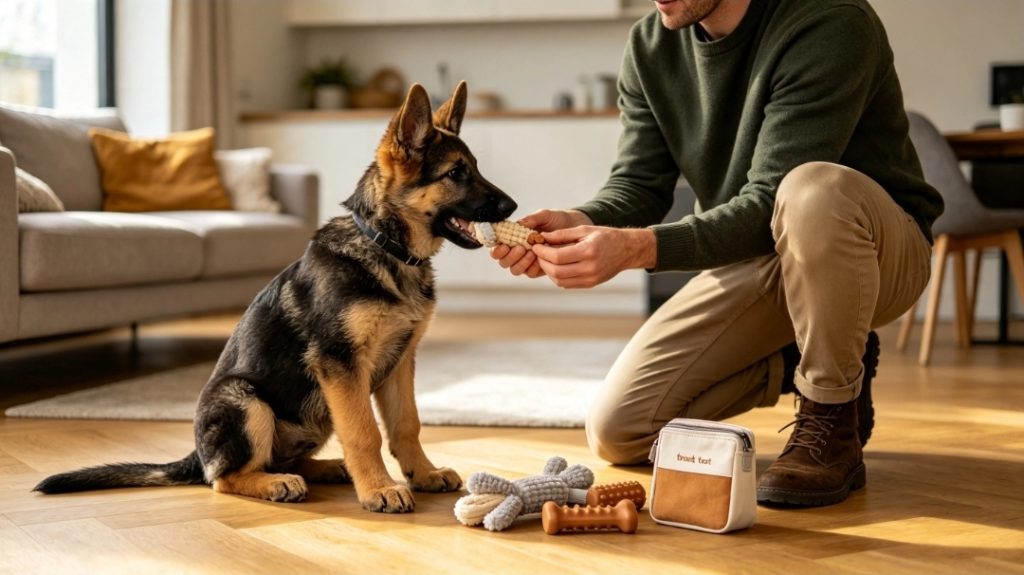
How do I teach my puppy to drop something?
Teaching a puppy to release an object is part of developing appropriate control, engagement and understanding during training. Puppies naturally investigate objects and may become interested in carrying or holding things, so the process should focus on developing a clear and positive response rather than creating unnecessary conflict. Begin by observing the puppy and understanding its individual motivation before deciding how to progress.
The puppy’s individual food drive should be considered. A puppy with a high food drive may respond readily to food motivation, while a puppy with a low food drive may require a different pace and greater patience. The objective is to develop the behaviour gradually while keeping the training environment appropriate for the puppy.
RECOMMENDED PRODUCTS

How do I teach my puppy to release an object?
Begin in a controlled environment where the puppy can focus on the training process without unnecessary distractions.
Allow the puppy to engage with an appropriate object and carefully observe its response. Use appropriate food motivation where relevant and reward the puppy when it releases the object. The puppy should be given the opportunity to understand that releasing the object results in something positive.
Keep the training process calm and progressive. The objective is not to create pressure around the object but to develop the puppy’s understanding through positive reinforcement, appropriate motivation and repetition.
As the puppy begins to respond consistently, the training can gradually become more difficult. Progression should be based on the puppy’s response rather than simply increasing difficulty because the puppy has completed one successful repetition.
How does food motivation help teach a puppy to drop something?
Food can provide useful motivation when teaching a puppy to release an object. However, the puppy’s individual food drive should always be considered.
A puppy with a high food drive may quickly understand that releasing the object produces an appropriate reward. A puppy with a lower food drive may require greater patience and a carefully managed training environment.
Observe the puppy’s engagement throughout the exercise. If the puppy is becoming distracted or losing interest, assess the environment and consider whether the training difficulty needs to be reduced.
Food should be used as appropriate motivation within the training process rather than creating unnecessary pressure. Positive reinforcement allows the puppy to build an association between the desired behaviour and a positive outcome.
What if my puppy will not drop the object?
If the puppy does not release the object, avoid simply increasing pressure. Instead, observe and assess what is happening.
Consider:
- Is the puppy sufficiently engaged?
- Is the food motivation appropriate for the puppy’s individual food drive?
- Is there too much environmental distraction?
- Is the training environment appropriate?
- Has the puppy been asked to progress too quickly?
- Is the puppy becoming overexcited?
- Does the puppy need to calm before continuing?
If the current situation is no longer productive, reduce the difficulty and allow the puppy to return to a calmer training state.
Once the puppy is calm and ready to engage again, return to the relevant exercise and continue with an easier stage of progression.
RECOMMENDED PRODUCTS — Training Pouches
How do I make dropping an object more reliable?
Reliability develops through consistent training and gradual progression.
Begin in an environment where the puppy can focus. As the puppy becomes more responsive, gradually introduce appropriate changes to the training environment while continuing to observe the puppy’s behaviour.
The puppy’s individual drive should remain part of the assessment. Food motivation may be highly effective for one puppy and less effective for another. Prey drive may also influence how strongly the puppy engages with particular toys or objects.
The handler should assess the puppy’s response rather than assuming that one approach will work identically for every dog.
If the puppy struggles after the difficulty increases, return to an easier stage. This allows the behaviour to be developed progressively rather than allowing repeated unsuccessful responses.
What equipment should I use when teaching my puppy to drop something?
The equipment should support the training environment rather than make the exercise unnecessarily complicated.
An appropriate training toy can provide the object the puppy interacts with. Food can provide motivation where appropriate. A placemat may be useful when the puppy needs a controlled area for stationing and settling within the home.
Where additional management is required, the wider GPK9 home environment can include the crate and playpen to help maintain appropriate boundaries and controlled freedom.
The level of control should always reflect what the puppy can currently manage. As behavioural responsibility develops, freedom can increase appropriately.
RECOMMENDED PRODUCTS — Dog Toys and Rewards
How do I know when my puppy is ready to progress?
Observation should determine progression.
If the puppy can remain engaged, respond appropriately and release the object consistently within the current training environment, the exercise can gradually become more challenging.
If the puppy becomes distracted, overexcited or unable to respond, reassess the situation rather than simply continuing.
Remove unnecessary distractions, reduce the difficulty and allow the puppy to calm where appropriate. Once the puppy has returned to a suitable training state, return to the exercise and continue from a level the puppy can manage.
More freedom and greater environmental difficulty should be accompanied by appropriate behavioural responsibility.
How can I prevent the exercise becoming a struggle?
The training process should remain calm, structured and progressive.
Avoid allowing the exercise to become a confrontation over the object. Instead, observe the puppy, assess its motivation and use appropriate positive reinforcement.
If the puppy is unable to continue appropriately, reset the situation rather than repeatedly asking for a response that the puppy is not currently able to provide.
Following an appropriate reset, return to the relevant training exercise and begin again at a manageable level. Reassessment allows the handler to determine whether the puppy is ready to progress or whether the training environment needs further adjustment.
RECOMMENDED PRODUCTS
Developing a reliable release response
Teaching a puppy to drop something should be treated as a progressive training process. Start in an appropriate environment, use suitable positive reinforcement and food motivation where relevant, observe the puppy’s individual response and increase difficulty gradually.
If the puppy cannot respond appropriately, reassess the environment, reduce unnecessary distractions and allow the puppy to calm before returning to training. The puppy’s response should guide the next step.
With patience, appropriate motivation, control and consistent progression, the puppy can develop a clearer and more reliable response when asked to release an object.