How do I puppy-proof my house?
Puppy-proofing your house is about creating a safe, manageable environment where your puppy can explore, learn and gradually develop appropriate behaviour. A puppy should not be expected to understand every household boundary immediately, so the environment should be arranged to reduce unnecessary distractions and prevent access to areas or objects that the puppy cannot yet manage.
The aim is not simply to restrict your puppy. It is to create a structured environment that supports observation, assessment, appropriate management and gradual progression.
can help create controlled areas within the home while your puppy learns how to manage increasing freedom.
RECOMMENDED PRODUCTS

Start by looking at your puppy’s environment
Before bringing a puppy into an area of the house, look at the environment from the puppy’s perspective.
Consider:
- What can the puppy reach?
- What can the puppy investigate?
- Which areas provide unnecessary distractions?
- Where can the puppy settle?
- Where can the puppy be safely managed?
- How much freedom can the puppy currently handle?
- What happens when the puppy becomes distracted?
- Can the puppy return to a calm and appropriate state?
Puppy-proofing should therefore be more than simply moving objects out of reach. It should create an environment that allows you to observe how your puppy behaves and make appropriate decisions as their training develops.
Create controlled areas for your puppy
The GPK9 approach uses the crate, placemat and playpen as connected parts of home and social training.
The crate
The crate provides a conditioned safe space for rest, routine and resetting when necessary.
It should form part of your puppy’s normal home environment rather than simply being introduced when something has gone wrong.
The placemat
The placemat provides a defined area for stationing, duration and settling.
It can help your puppy learn that being inside the home does not always mean moving around and investigating everything.
The playpen
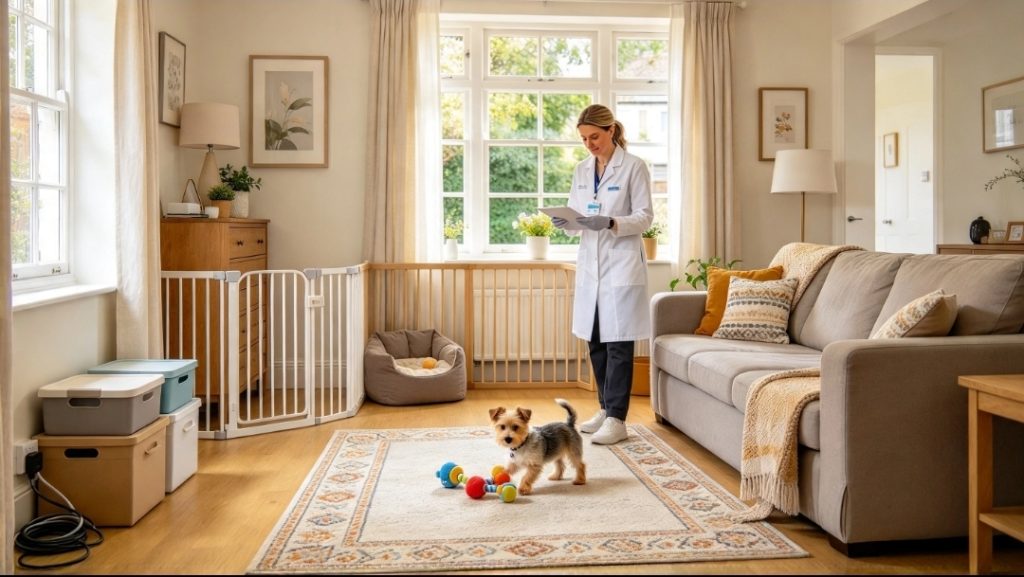
The playpen provides greater freedom while maintaining a clear boundary.
It allows your puppy to experience more of the home environment without immediately being given unrestricted access to the entire house.
The three areas are not a rigid one-way progression. Your puppy may need to move between them depending on what you observe.
Remove unnecessary distractions
A puppy-proofed house should reduce access to things that are likely to create unnecessary distractions.
Look carefully at areas where your puppy will spend time and consider whether there are objects, spaces or activities that are likely to draw their attention away from appropriate behaviour.
The objective is not to make the entire house completely empty. Instead, create an environment where your puppy can learn successfully without being overwhelmed by too many opportunities to investigate.
This becomes particularly important when a puppy has high prey drive or high food drive.
Consider your puppy’s individual drives
Not every puppy responds to the same environment in the same way.
Some puppies may have low prey drive, while others may have high prey drive. Some may have low food drive, while others may have high food drive.
These individual differences can affect what your puppy notices and how strongly they respond to particular distractions.
Observation helps you identify what is influencing your puppy’s behaviour.
For example, if movement continually attracts your puppy’s attention, the environment may need to be managed differently from a puppy that is primarily interested in finding food or investigating objects.
Understanding the individual puppy allows you to make better decisions about management and progression.
RECOMMENDED PRODUCTS
Give your puppy freedom gradually
Puppy-proofing should support gradual increases in freedom.
A puppy that is successful within a controlled area can gradually be given more freedom when their behaviour demonstrates that they are ready.
However, if increasing freedom results in the puppy immediately becoming distracted, investigating everything or struggling to settle, reduce the freedom and return to an environment the puppy can manage.
More freedom requires more behavioural responsibility.
Freedom should therefore be treated as something that develops alongside appropriate behaviour rather than something automatically provided because the puppy has reached a particular age.
Teach your puppy how to settle
A puppy-proofed house should include somewhere appropriate for your puppy to settle.
The placemat can provide a defined area for stationing and duration, while the crate can provide a safe space for rest and resetting.
Learning to settle is an important part of helping a puppy understand that the home is not simply an environment for constant exploration.
Observe your puppy’s behaviour and give them opportunities to practise remaining calm within an appropriate environment.
If the puppy becomes distracted, remove unnecessary distractions and allow them to calm before continuing.
What should you do when your puppy gets into something?
When your puppy starts investigating something they should not be accessing, avoid simply continuing to give them more freedom.
Instead:
- Observe what has attracted your puppy.
- Interpret what may be influencing the behaviour.
- Decide what change is appropriate.
- Act by managing the environment or reducing freedom.
- Reassess how your puppy responds.
If your puppy returns to an appropriate state, continue training at a suitable level.
If your puppy cannot reduce their attention or settle, the environment may currently be too difficult for them. Remove unnecessary distractions, reduce freedom and use an appropriate reset before returning to training.
Puppy-proofing should change as your puppy develops
Your puppy’s environment does not need to remain exactly the same throughout their development.
As your puppy learns to manage their surroundings, you can gradually introduce more freedom and reassess their behaviour.
A puppy-proofed house should therefore be viewed as a changing training environment.
As freedom increases, continue observing:
- Your puppy’s body posture.
- Facial expression.
- Ears and tail.
- Movement.
- Orientation.
- Attention and engagement.
- Arousal.
- Ability to settle.
- Responsiveness.
- Recovery after distractions.
- Environmental awareness.
- Changes in behaviour.
These observations help you decide whether your puppy is ready for greater freedom or whether the environment needs to be simplified again.
Build the right environment before increasing freedom
Good puppy-proofing makes training easier because it allows your puppy to experience success.
Instead of giving a puppy unrestricted access and repeatedly correcting unwanted behaviour, create appropriate boundaries and gradually increase freedom as the puppy demonstrates that they can manage it.
This creates a clearer learning process:
Controlled environment → Observe → Assess → Appropriate action → Reassess → Progress
If the puppy cannot manage the environment, reduce the difficulty and reset before trying again.