How do I start training a new puppy?
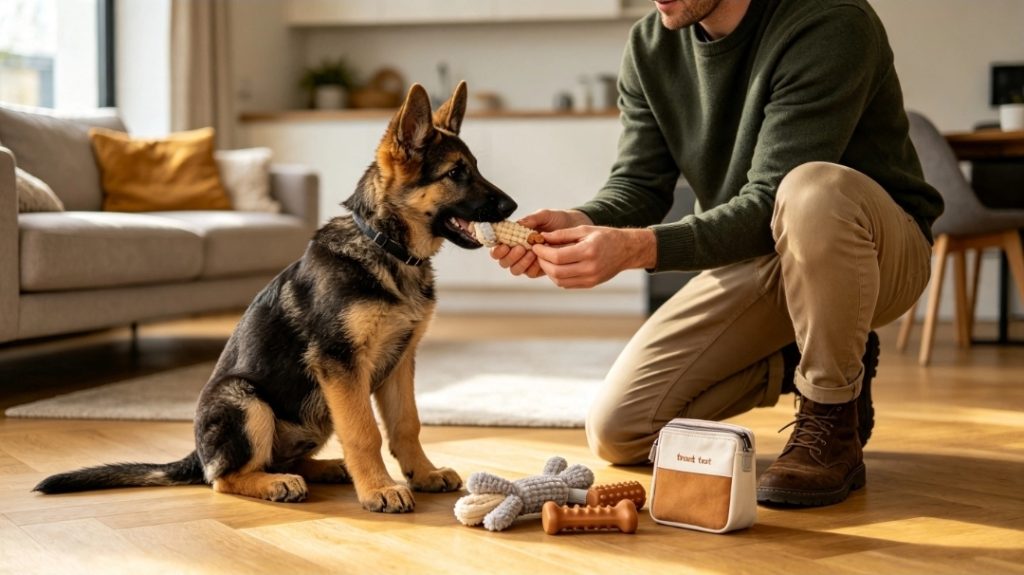
A young puppy beginning its first training at home in a calm, clean and organised living environment. The puppy should be positioned on a comfortable placemat near its owner, showing relaxed attention and engagement. A suitable crate should be visible nearby as part of the puppy’s safe resting and management area, with a playpen positioned within the same room to provide controlled freedom and clear boundaries. The owner should be calmly interacting with the puppy using food as positive reinforcement, with a small supply of training treats available. The room should have clear pathways, minimal distractions, appropriate furniture and a professional but natural home-training atmosphere. The image should communicate the beginning of a structured puppy-training routine, with the puppy learning to settle, engage with its owner and gradually develop appropriate freedom and responsibility. No logos, text, branding or watermarks.
Starting to train a new puppy is about creating the right environment, establishing a clear routine and teaching the puppy how to respond appropriately to the world around it. Training should begin in a calm home environment where the puppy can be observed carefully and supported with positive reinforcement, food, patience and appropriate motivation.
RECOMMENDED PRODUCTS — Puppy Training
Start Training In The Home
The home is the starting point for the GPK9 PROFESSIONAL TRAINING SYSTEM. Before increasing the puppy’s freedom, create an environment where the puppy can be observed, managed and supported.
The GPK9 approach uses a progression between the crate, placemat and playpen. These are not simply separate pieces of equipment; they provide different levels of management and controlled freedom as the puppy develops.
The crate provides a safe place for rest, routine and resetting when required. The placemat provides a defined place for stationing, settling and controlled freedom within the home. The playpen provides greater freedom within a defined boundary.
The important principle is that more freedom requires more behavioural responsibility. A new puppy should not automatically receive unrestricted access to the home simply because it has arrived. Freedom should increase as the puppy demonstrates that it can manage that freedom appropriately.
Observe Your Puppy Before Increasing Training
Every puppy is an individual. Some puppies may have a low food drive or high food drive, while others may have a low prey drive or high prey drive. These differences can affect how the puppy responds to training, food, movement, toys and its environment.
Start by observing the puppy carefully.
Look at how the puppy responds to:
- The home environment
- Its owner and handler
- Food and motivation
- Movement and play
- New surroundings
- Distractions
- Rest and settling
- Changes in the environment
- Increased freedom
- Different levels of interaction
Observation helps you understand what the puppy is showing you before deciding what to do next.
Use Food And Positive Reinforcement
Food can be an important part of early puppy training, particularly when developing engagement and motivation.
If the puppy has a high food drive, food can provide a strong source of motivation during training. If the puppy has a low food drive, the handler should observe the puppy and consider whether the environment, timing, distractions or current state are affecting its engagement.
The aim is not simply to give food repeatedly. The puppy should learn through appropriate motivation, patience and carefully managed training opportunities.
Keep the training environment simple enough for the puppy to understand what is expected. If unnecessary distractions interfere with the training process, remove them and allow the puppy to return to a calmer and more appropriate training environment.
Introduce Controlled Freedom Gradually
A new puppy needs opportunities to explore and learn, but freedom should be managed.
The placemat can provide a defined area for settling and controlled freedom within the home. The playpen can provide a larger controlled area when the puppy requires more freedom while still needing clear boundaries.
As the puppy develops, observe how it responds to the increased freedom. If the puppy manages the environment appropriately, training can continue and progress gradually.
If the puppy becomes unable to manage the situation, do not simply continue increasing freedom. Assess what has changed, remove unnecessary distractions and help the puppy return to a calmer state.
Where the situation cannot be reduced or the puppy cannot calm appropriately, the crate can provide a controlled space for rest, routine and resetting before returning to training.
Build A Training Routine
Starting puppy training is easier when the puppy experiences a consistent and structured environment.
Training should not be treated as a single event. The puppy needs repeated opportunities to observe, learn, respond and experience appropriate progression.
A useful GPK9 process is:
OBSERVE → ASSESS → ACT → REASSESS
Observe what the puppy is doing. Assess whether the current environment and level of freedom are appropriate. Take the appropriate action. Then reassess the puppy’s response before deciding whether to continue or progress.
This prevents training from becoming a process of simply adding more freedom or more difficulty without considering whether the puppy is ready.
Know When To Reduce The Difficulty
A new puppy may respond appropriately in one situation and struggle in another. Changes in the environment, increased freedom or additional distractions can affect the puppy’s ability to continue learning.
When this happens, go back to the information the puppy has already shown you.
Remove unnecessary distractions, reduce the difficulty, allow the puppy to calm and reassess. If the puppy returns to an appropriate state, continue from that point and progress gradually.
If the puppy cannot reduce or cannot calm, the appropriate response is to stop the current activity, return to controlled management and use the crate as part of the reset process before returning to the relevant training.
This is not a failure of training. It is information that helps determine the next appropriate step.
Progress According To The Puppy
There is no single starting point that will be identical for every puppy. The GPK9 PROFESSIONAL TRAINING SYSTEM uses observation and assessment to determine the appropriate next step.
A puppy that is calm, engaged and responding appropriately can continue and progress. A puppy that is struggling requires the handler to assess the situation and make the environment easier to manage.
The aim is to build appropriate behaviour progressively rather than introducing unnecessary difficulty.
As freedom increases, responsibility must increase with it. As distractions increase, the puppy’s ability to remain engaged and respond appropriately should be reassessed.
RECOMMENDED PRODUCTS
Puppy Training
Puppy training equipment should support the training process rather than replace it. The relevant equipment may include items that help establish controlled areas, provide appropriate management and support positive reinforcement during training.
RECOMMENDED COURSES
GOLDEN RULE 1 — HOME AND SOCIAL
Starting training with a new puppy begins with the home and social environment, making GOLDEN RULE 1 — HOME AND SOCIAL directly relevant to this subject.
The course explains how the GPK9 PROFESSIONAL TRAINING SYSTEM can be applied through appropriate boundaries, controlled freedom, settling, calmness, the crate, placemat and playpen, together with resetting when necessary and progressing through the appropriate training process.
The GPK9 system uses a simple structured approach that can be followed by both first-time dog owners and professional dog trainers. The system helps the handler understand the puppy’s current situation, apply an appropriate process, manage the environment, reset when necessary and continue progressing.
Within this course, the GPK9 traffic-light system provides an additional way of understanding the puppy’s current training state:
- GREEN: OBSERVE → CONTINUE → PROGRESS
- AMBER: OBSERVE → ASSESS → REMOVE FROM DISTRACTION → CALM → REASSESS
- RED: STOP WHAT YOU ARE DOING → OBSERVE → ASSESS → REMOVE FROM DISTRACTION → CALM → REASSESS
If the puppy returns to a calm state, training can continue and progress. If the puppy cannot reduce or cannot calm, the process returns to controlled management and the crate before resetting back to HOME & SOCIAL and continuing from an appropriate starting point.
Starting Training With A New Puppy
Starting training with a new puppy is not about giving the puppy maximum freedom immediately. It is about creating an environment where the puppy can learn, be observed and gradually develop appropriate behavioural responsibility.
Begin at home, establish appropriate management, use positive reinforcement and food where suitable, observe the puppy carefully and progress gradually. When the puppy struggles, assess the environment, remove unnecessary distractions, allow the puppy to calm and reset when necessary before returning to training.
GPK9’S FIVE GOLDEN RULES
The GPK9 Five Golden Rules have been broken down into bite-sized, easy-to-understand sections to make the wider GPK9 PROFESSIONAL TRAINING SYSTEM easier to learn progressively. The Five Golden Rules are separate parts of one connected system, and there is no single Golden Rule course that teaches the entire system. An individual course may provide useful information for a specific training requirement, such as starting training with a new puppy, but understanding how the complete GPK9 PROFESSIONAL TRAINING SYSTEM works requires understanding all five Golden Rules. The system is designed to be practical and understandable for both a first-time dog owner and a professional dog trainer. Learning the Five Golden Rules provides a broader understanding of how different areas of dog training connect, while helping the reader understand that the Golden Rule most relevant to their current situation is still only one part of the wider system. Learning all five provides the complete framework and a fuller understanding of how the GPK9 PROFESSIONAL TRAINING SYSTEM can be applied across different training situations.