FEATURED IMAGE — DALL·E DESCRIPTION
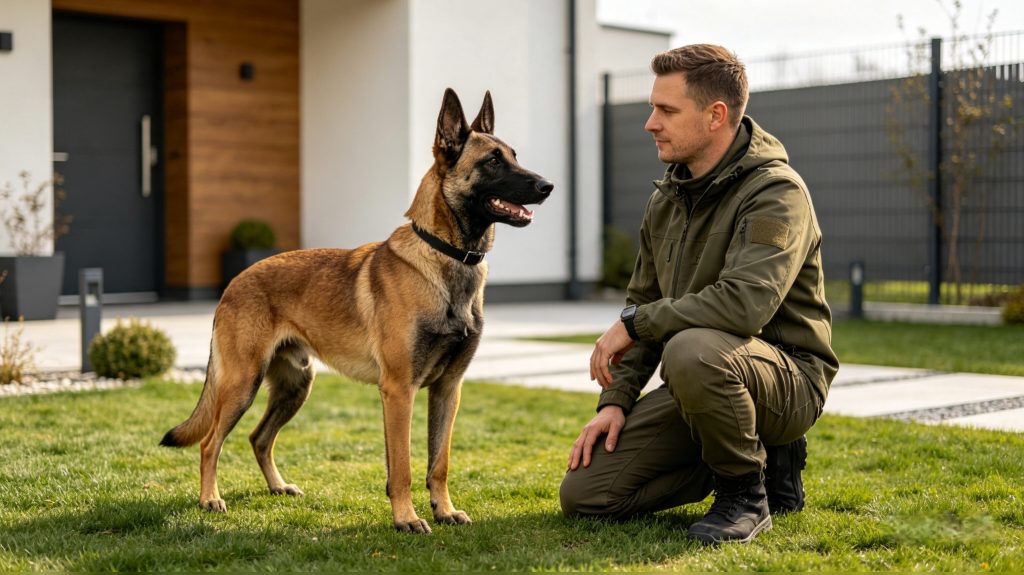
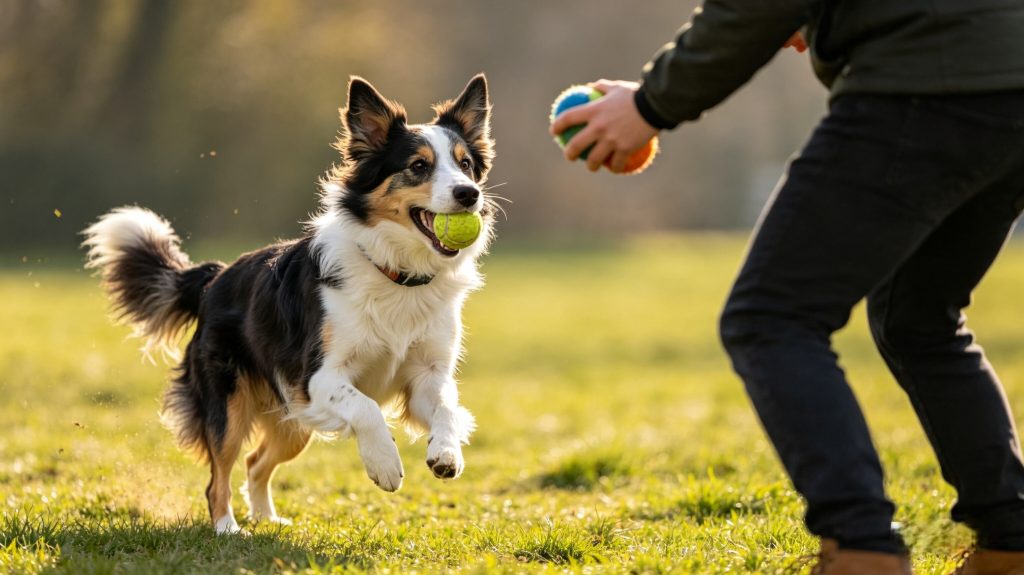
Thank you for reading this post, don't forget to subscribe!A cinematic, photorealistic professional puppy-training environment featuring a confident young German Shepherd puppy working closely with a professional handler. The puppy is focused on the handler during a foundation training exercise, with a small training treat positioned naturally in the handler’s hand. Dark-grey flooring, rich red-brick detailing, black metal fencing, industrial glass panels and dark structural elements create the established GPK9 training environment. Professional cinematic lighting creates realistic highlights and detailed shadows while maintaining balanced exposure. Realistic puppy anatomy, natural fur texture, realistic training equipment and authentic handler positioning. Premium professional dog-training atmosphere, shallow depth of field, realistic materials, cinematic composition, highly detailed, no text, no logos, no watermarks.
Puppy Training: Essential Skills, Equipment & Techniques
Puppy training is about far more than teaching a young dog to sit on command. It is the process of establishing communication, building confidence, developing reliable behaviours and teaching a puppy how to understand and respond to the person handling them.
Puppy Training: Essential Skills, Equipment & Techniques brings together the foundations that can help turn early learning into practical everyday behaviour. From name recognition and engagement to recall, loose-lead walking and settling, the objective is not simply to make a puppy perform individual commands. It is to build a clear relationship in which the puppy understands what is expected and learns that working with its handler is worthwhile.
Good puppy training also develops gradually. A young puppy cannot be expected to immediately perform perfectly in a busy environment simply because it understands a behaviour inside the home. Training needs to progress from simple, controlled situations towards increasing levels of distraction.
Understanding Puppy Training
What puppy training actually means
Puppy training is the structured process of teaching a young dog behaviours, communication skills and appropriate responses to everyday situations.
This includes formal behaviours such as sit, down and recall, but it also includes learning how to settle, accept handling, remain engaged with a handler, walk appropriately and respond when distractions are present.
The most useful approach is to think about puppy training as building a foundation. Each behaviour becomes part of a larger communication system between puppy and handler.
Why early training matters
Early training gives a puppy opportunities to learn how its environment works and how to interact with people appropriately.
A puppy is constantly learning, whether the owner is actively training or not. Repeated experiences can influence what the puppy considers rewarding, interesting, frightening or normal.
This makes consistency important. If a puppy receives one response for jumping up on Monday and a completely different response on Tuesday, the communication becomes unclear.
The aim is not to demand adult-level reliability from a puppy. Instead, early training should establish simple behaviours that can gradually become stronger as the puppy develops.
How puppies learn
Puppies learn through consequences, repetition, observation and experience.
When a behaviour produces something the puppy values, such as food, play, attention or access to something interesting, the puppy has a reason to repeat that behaviour.
This is where reward-based training becomes particularly useful. The handler can deliberately identify desirable behaviour and reinforce it rather than waiting for the puppy to understand everything through trial and error.
Timing matters. If the reward arrives immediately after the desired behaviour, the puppy has a much clearer opportunity to understand what produced the reward.
Learning stages and developmental considerations
Puppies develop rapidly, but development is not a perfectly straight line.
Attention span, confidence, curiosity, energy and ability to cope with distractions can change as a puppy grows. A behaviour that appears reliable one day may suddenly become inconsistent when the environment becomes more exciting.
Training should therefore match the puppy’s current ability.
A young puppy may begin with a few seconds of engagement in a quiet room. That can later become engagement in a garden, on a quiet walk, around controlled distractions and eventually in more demanding environments.
Building communication between puppy and handler
Communication begins before the first formal command.
The puppy learns to watch the handler. The handler learns to recognise the puppy’s body language, motivation and limitations.
Name recognition and attention are particularly important because they create a communication bridge. Before expecting a puppy to perform complicated behaviours, the handler needs a reliable way of gaining the puppy’s attention.
Foundation Behaviours
Name recognition and attention
A puppy’s name should become meaningful.
The handler can say the puppy’s name and reward the puppy when it looks towards them. Initially, this should happen in environments where the puppy can succeed easily.
Attention and engagement then develop from this foundation.
The objective is not simply for the puppy to hear its name. The objective is for the puppy to learn that responding to its handler is worthwhile.
Sit, down and stay
Sit and down are useful foundation behaviours because they introduce the concept of responding to a clear cue.
Stay adds another layer: maintaining a position rather than immediately moving.
Start with extremely short durations. Once the puppy understands the behaviour, duration can gradually increase before distance and distractions are added.
Trying to increase all three variables simultaneously can make the exercise unnecessarily difficult.
Recall
Recall is one of the most important behaviours a puppy can learn.
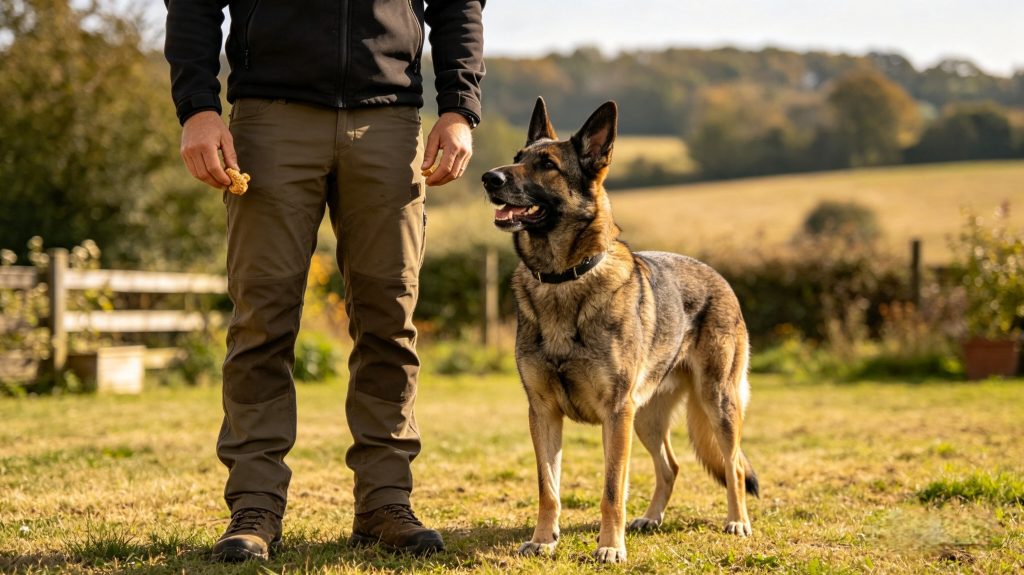
A puppy should learn that returning to its handler produces something valuable. Food, play, praise or access to another reward can all contribute depending on the individual puppy.
Recall training should begin in controlled environments before introducing greater distance and distractions.
A long line can provide useful management while practising recall outdoors.
RELATED ARTICLES: Puppy Essentials: Everything You Need for a NewPuppy Dog Training Leads & Long Lines: What to Choose & Why Obedience Dog Training: Equipment, Commands & Techniques
RECOMMEND PRODUCT
When recall is being developed outside, understanding the difference between standard leads and long lines can help the handler choose equipment appropriate to the training exercise.
Leave it and drop it
Leave it teaches a puppy to disengage from something when asked.
Drop it teaches the puppy to release an item already in its mouth.
Both behaviours can become particularly useful during everyday life, especially when puppies naturally investigate objects by putting them in their mouths.
The training should remain clear and controlled. The puppy needs to understand that releasing an item does not automatically mean the interaction ends negatively.
Place, settle and loose-lead walking
Place or settle training teaches the puppy that remaining calmly in a particular location can be rewarding.
This can help develop impulse control and the ability to switch from activity into calm behaviour.
Loose-lead walking works on a similar principle of communication. Rather than simply attempting to physically control the puppy, the handler teaches the puppy that staying close and paying attention produces rewards.
RECOMMEND PRODUCT
Dog Training Harnesses: Types, Uses & How to Choose
Harnesses can form part of a puppy’s walking equipment, but the choice should be based on the individual puppy, the intended activity and the training objective.
Training Techniques
Reward-based training
Reward-based training focuses on reinforcing behaviours the handler wants to see repeated.
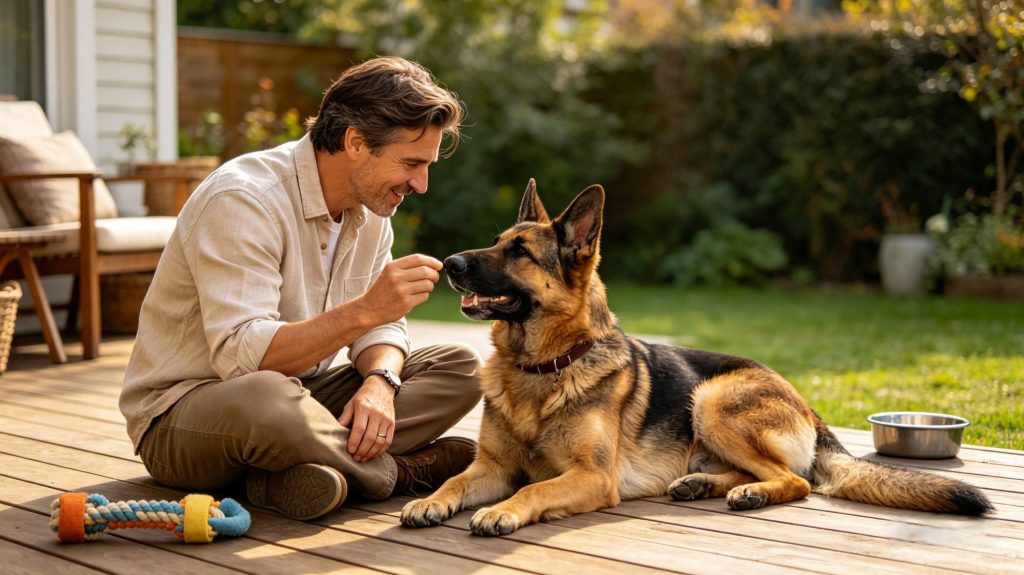
The reward needs to have value to the puppy. For some puppies that may be food; for others, toys, play or another form of interaction can be highly motivating.
The handler should learn what genuinely motivates the individual puppy rather than assuming every puppy will respond identically.
RECOMMEND PRODUCT
Dog Training Treats: Choosing the Right Rewards for Training
Training treats can be useful for reinforcing new behaviours, particularly during early foundation work when the puppy is learning the relationship between behaviour and reward.
Luring
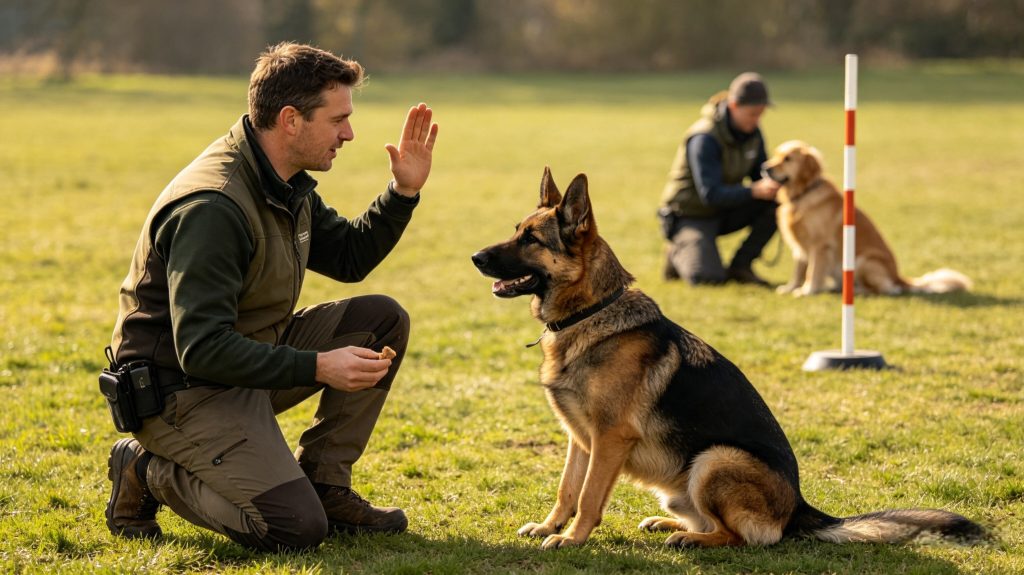
Luring uses a reward to guide the puppy into a desired position or movement.
For example, a treat can be moved carefully to guide a puppy into a sit or down.
The important point is to eventually develop the behaviour beyond simply following the food. The puppy should learn to respond to a cue rather than becoming permanently dependent on seeing a treat first.
RECOMMEND COURSE
Advanced Luring
Advanced Luring provides a natural progression for handlers who want to develop their understanding of using luring as a structured training technique.
Capturing behaviours
Capturing means rewarding a behaviour that the puppy naturally performs.
If a puppy naturally lies down and the handler marks and rewards that moment, the puppy begins to understand that the behaviour has value.
This can be particularly useful for calm behaviours such as settling.
Shaping
Shaping breaks a behaviour into smaller stages.
Instead of expecting the finished behaviour immediately, the handler rewards successive steps towards the final objective.
This encourages the puppy to think and actively participate in the learning process.
Marking correct behaviour and timing rewards
A marker can help identify the precise moment the puppy performs the desired behaviour.
The timing of the reward then becomes extremely important.
If the puppy sits and the reward arrives several seconds later after the puppy has stood up, the communication becomes less precise. The closer the reward is to the desired action, the easier it is for the puppy to make the connection.
Repetition, consistency and distractions
Training requires repetition, but repetition should not mean endlessly drilling the same behaviour.
Short, focused sessions can provide opportunities to practise while maintaining engagement.
Once the puppy understands a behaviour, distractions can be increased gradually.
A useful progression might be:
Quiet room → garden → quiet outdoor area → mild distractions → busier environment.
The exact progression should depend on the puppy’s confidence and ability to succeed.
Training Equipment
Equipment should support training rather than replace it.
Collars, harnesses, leads and long lines
Collars and harnesses can both have practical roles depending on the individual dog and activity.
A suitable lead gives the handler control while allowing enough freedom for the exercise being performed. Long lines can provide additional distance during recall and other controlled outdoor training.
RECOMMEND PRODUCT
Dog Training Collars: Types, Uses & Choosing the Right Collar
Understanding different collar options can help handlers make an informed equipment choice while keeping the puppy’s age, size, behaviour and intended use in mind.
Treats and treat pouches
Training becomes considerably easier when rewards are accessible at the right moment.
A treat pouch allows the handler to carry rewards without repeatedly reaching into a pocket or bag.
RECOMMEND PRODUCT
Dog Training Treat Pouches: How to Choose the Right One
A suitable treat pouch can make reward timing more efficient, particularly during short training sessions and outdoor exercises.
Toys and rewards
Food is not the only reward available.
Some puppies become highly motivated by toys, movement or interactive play. Toys can therefore become useful training rewards when introduced appropriately.
RECOMMEND PRODUCT
Dog Toys & Rewards: Choosing Toys for Training & Play
Understanding different toy and reward options can help the handler build variety into training while maintaining motivation.
Crates and pens
Crates and pens can provide structured spaces for rest, management and routine when introduced correctly.
They should be used as appropriate training and management tools rather than as a substitute for exercise, interaction and training.
RECOMMEND PRODUCT
Dog Crates & Pens: How to Choose and Use Them Correctly
This provides additional information for owners considering how crates and pens can be incorporated into a puppy’s daily routine.
Puppy Development
Building confidence
Confidence develops through appropriate experiences.
A puppy should have opportunities to encounter different surfaces, sounds, environments and situations without being overwhelmed.
The handler should pay attention to the puppy’s responses and adjust the difficulty accordingly.
Socialisation
Socialisation is more than allowing a puppy to meet as many dogs and people as possible.
It involves helping the puppy develop appropriate responses to the world around it.
Calm observation, controlled interactions and positive experiences can all form part of a balanced socialisation programme.
Environmental exposure
A puppy may encounter stairs, vehicles, different flooring, household noises, outdoor environments, unfamiliar objects and new locations.
Gradual exposure allows the puppy to experience these situations while maintaining an appropriate level of confidence.
Impulse control
Impulse control develops through training and maturity.
Simple exercises such as waiting briefly for food, remaining in place, disengaging from an object or waiting before moving through a doorway can introduce the concept of self-control.
Bite inhibition
Puppies naturally investigate and interact with their environment using their mouths.
Teaching appropriate interaction and providing suitable outlets for chewing and play can help the handler manage normal puppy behaviour.
RECOMMEND PRODUCT
Dog Enrichment: Toys, Activities & Ideas for Mental Stimulation
Appropriate enrichment can give puppies constructive outlets for exploration, chewing, problem-solving and mental activity.
Settling and handling
A puppy should gradually learn that calm behaviour is valuable.
Handling should also become a normal part of life. Grooming, checking paws, examining ears and routine handling can be introduced gradually and positively.
The objective is to make handling predictable rather than turning every interaction into a struggle.
RECOMMEND PRODUCT
Dog Grooming Essentials: Brushes, Combs & Everyday Care
Good everyday handling and grooming routines can complement wider puppy training by helping the puppy become comfortable with routine care.
Structuring Effective Puppy Training Sessions
A useful puppy training session does not need to be long.
Begin with a behaviour the puppy already understands, introduce something new, practise the new behaviour several times and finish with something achievable.
For example:
- Gain attention.
- Practise name recognition.
- Ask for sit.
- Introduce a new behaviour.
- Reward correct responses.
- Add a small distraction.
- Return to an easy behaviour.
- Finish positively.
This structure helps maintain engagement while allowing the handler to control the difficulty.
RECOMMEND COURSE
Fundamentals 1
Fundamentals 1 provides a natural connection to the foundational stage of puppy training because the early stages of education are focused on establishing communication, basic behaviours and reliable training habits.
As the puppy matures and its ability to work around distractions develops, Fundamentals 2 and later Fundamentals 3 can provide progression appropriate to the dog’s changing stage of training.
Progressing From Simple Behaviours to Distractions
Reliability is built gradually.
A puppy that performs a perfect sit in the kitchen has demonstrated that it understands something about the behaviour. It has not necessarily demonstrated that it can perform the same behaviour while surrounded by distractions.
The handler should therefore change one variable at a time.
Increase distance.
Increase duration.
Introduce mild distractions.
Change location.
Increase environmental complexity.
Then practise again.
This approach gives the puppy repeated opportunities to succeed rather than constantly placing it in situations beyond its current ability.
RECOMMEND COURSE
90-Day Transformation
The 90-Day Transformation provides a relevant pathway for owners who want to take foundation work and turn it into a structured period of consistent training and development.
RECOMMENDED ARTICLES
The wider GPK9 topic cluster can provide additional information as the puppy’s training develops.
Puppy Essentials: Everything You Need for a New Puppy
This connects naturally with puppy training because equipment, preparation and daily routines influence the environment in which training takes place.
Obedience Dog Training: Equipment, Commands & Techniques
Once the puppy has established its foundations, obedience training provides a natural next step for developing commands and practical reliability.
Dog Walking Essentials: Equipment for Safe Outdoor Adventures
This connects with loose-lead walking, recall and outdoor training, particularly when the puppy begins moving from controlled indoor sessions into real-world environments.
Dog Feeding & Hydration: Essential Equipment and Practical Advice
Feeding and hydration form part of the puppy’s wider daily routine and can influence how training sessions are planned and managed.
Dog Care & Health: Essential Everyday Care for Your Dog
Training should form part of a wider approach to responsible dog ownership, including everyday care and observation.
Building Reliable Foundations
The most important lesson from Puppy Training: Essential Skills, Equipment & Techniques is that reliable training is built rather than rushed.
A puppy does not need to know everything immediately.
It needs clear communication.
It needs opportunities to succeed.
It needs appropriate rewards.
It needs repetition and consistency.
It needs suitable equipment.
And it needs training that develops alongside its confidence, maturity and ability to cope with distractions.
Start with name recognition and engagement. Build towards foundation behaviours such as sit, down, stay, recall, leave it, drop it and settle. Introduce loose-lead walking and gradually increase the complexity of the environment.
Use reward-based training, luring, capturing and shaping where appropriate. Learn to recognise correct behaviour and reward it with accurate timing.
Choose equipment that supports the training objective, whether that means a suitable collar, harness, lead, long line, treat pouch, toy, crate or pen.
Most importantly, remember that puppy training is not simply about controlling behaviour. It is about establishing communication between puppy and handler.
When that foundation is built carefully, individual commands become part of something much larger: a dog that understands how to work with its handler and a handler who understands how to communicate clearly with their dog.