
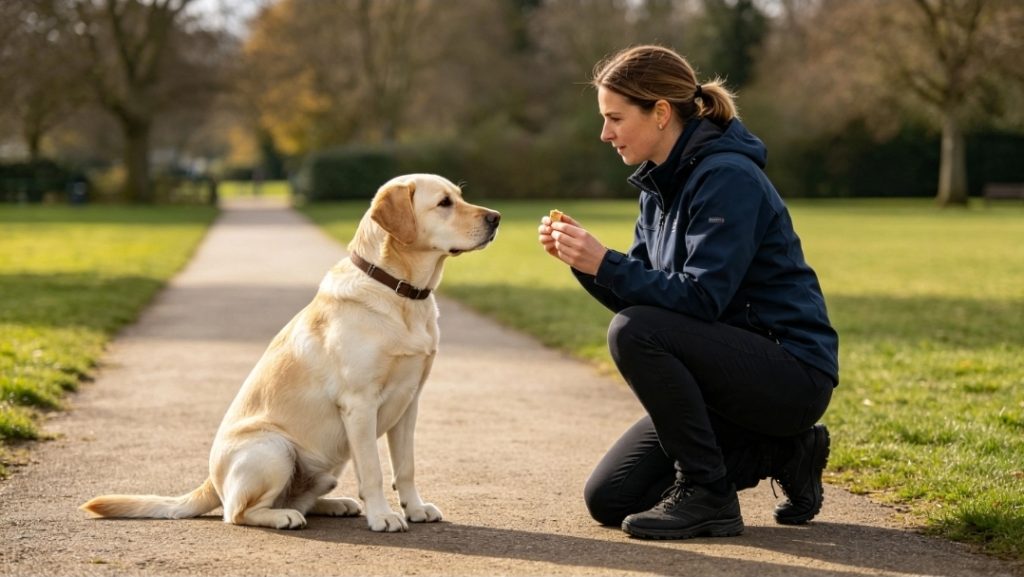
Teaching your dog to sit, stay and come gives you three incredibly useful obedience behaviours that can be used throughout everyday life.
These commands aren’t simply tricks.
A reliable sit can help your dog remain controlled.
A stay can teach patience and impulse control.
A good recall can help you bring your dog back when they’re moving away from you.
Together, they form an important foundation for basic dog obedience.
But dogs don’t automatically understand what these words mean.
You need to teach each behaviour clearly, build it gradually and practise it in different environments.
If you’re wondering how to teach a dog to sit, stay and come, the key is to avoid rushing through the process.
Teach each behaviour separately.
Build reliability.
Then begin combining them.
Why Teach Sit, Stay and Come?
These three behaviours can be useful in countless everyday situations.
You may ask your dog to sit before:
- Feeding
- Crossing a road
- Greeting someone
- Putting on their lead
- Getting into the car
Stay can help when:
- Opening doors
- Preparing food
- Grooming
- Waiting before crossing a road
- Managing distractions
Come can be particularly important when:
- Your dog moves away from you
- You’re practising recall
- Your dog is distracted
- You need them to return to you
The objective isn’t simply to make your dog obey three words.
You’re developing communication between you and your dog.
How to Teach a Dog to Sit
Sit is often one of the easiest obedience behaviours to introduce.
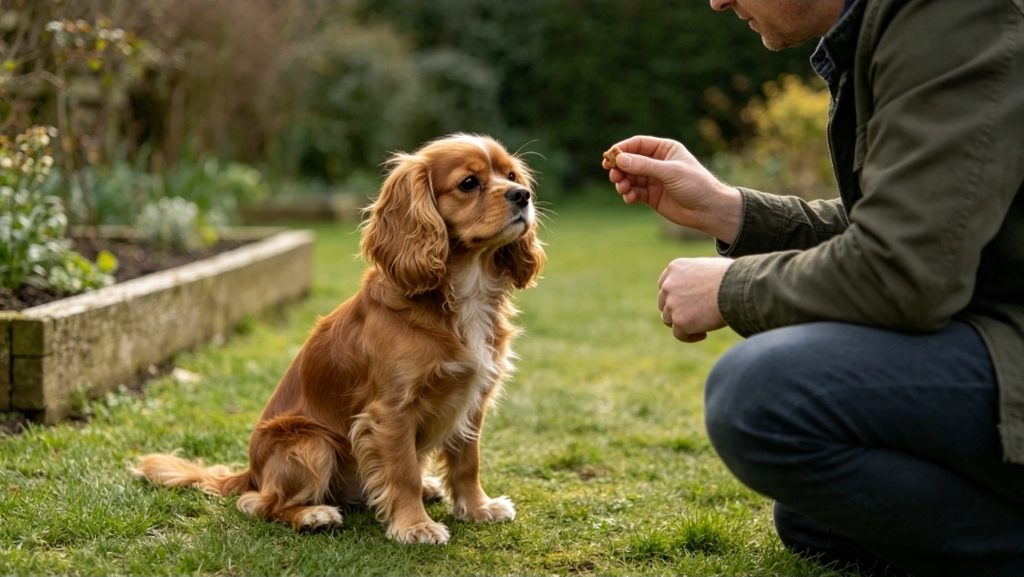
Start somewhere quiet where your dog can concentrate.
Hold a small reward close to your dog’s nose.
Slowly move the reward upwards and slightly backwards.
As your dog’s head follows the reward, their bottom will often move naturally towards the ground.
The moment your dog’s bottom reaches the floor, reward them.
Repeat this several times.
Once your dog begins to understand the movement, introduce the verbal cue:
“Sit.”
Say the cue clearly before guiding your dog into the position.
Eventually, your dog should begin associating the word with the behaviour.
Reward the Correct Moment
Timing matters when you’re learning how to teach a dog to sit, stay and come.
Your dog needs to understand exactly which behaviour produced the reward.
If you reward too early, you may accidentally reinforce your dog before they have completed the behaviour.
Wait for the correct position.
Then reward.
Keep your timing consistent.
Don’t Repeat the Command Over and Over
Avoid turning:
“Sit, sit, sit, sit!”
into one long command.
Give the cue clearly.
Allow your dog time to respond.
If they don’t understand, simplify the exercise rather than repeatedly saying the word.
Your dog needs to learn that the first cue has meaning.
Build the Sit Gradually
Once your dog understands sit, practise in different situations.
Start with:
Quiet room → garden → quiet street → park → more distracting environments.
Don’t immediately expect your dog to sit while surrounded by exciting distractions.
Build the behaviour progressively.
How to Teach a Dog to Stay
Stay is different from sit.
When you teach your dog to sit, you’re teaching a position.
When you teach stay, you’re teaching your dog to maintain that position until you give them another instruction or release them.
This requires patience and impulse control.
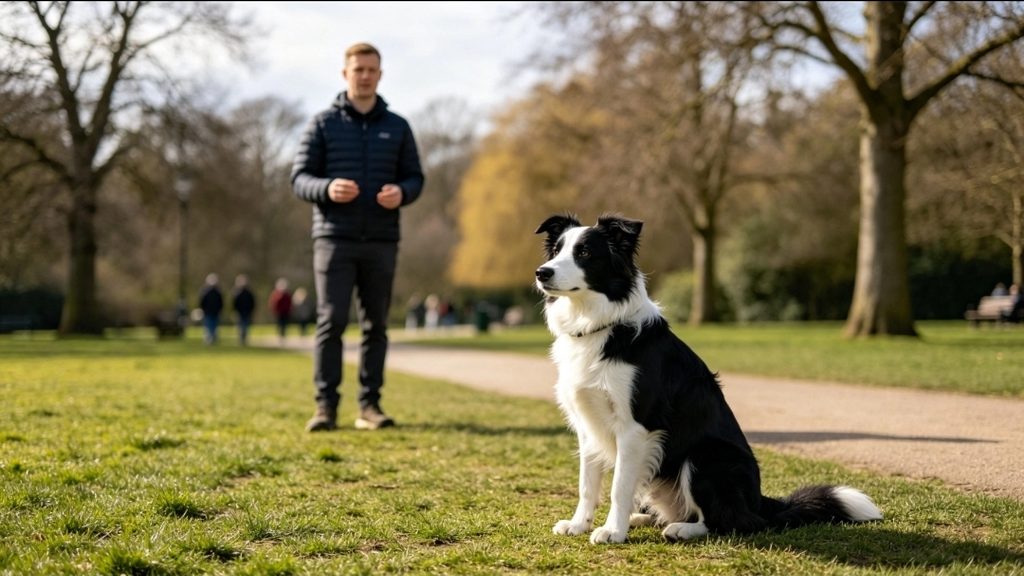
Start With Very Short Stays
Ask your dog to sit.
Give your stay cue.
Wait for just a moment.
If your dog remains in position, reward them.
Don’t immediately expect thirty seconds.
One second of successful behaviour is better than asking for thirty seconds and allowing your dog to fail.
Build gradually.
One second.
Two seconds.
Three seconds.
Then increase the duration when your dog is ready.
Add Distance Separately
Once your dog can remain in position for a reasonable period, begin introducing distance.
Take one step backwards.
Return.
Reward.
Then two steps.
Return.
Reward.
Gradually increase the distance.
This is important because duration and distance are different challenges.
Your dog may be able to stay for thirty seconds when you’re standing beside them but struggle when you walk ten metres away.
Build each part separately.
Add Distractions Slowly
Distractions make the exercise harder.
Your dog may understand stay in your living room but struggle when:
- Another dog walks past
- Someone knocks at the door
- A ball is thrown
- Children are playing
- Someone runs past
- You’re in a busy park
Introduce distractions gradually.
Don’t deliberately overwhelm your dog.
How to Teach a Dog to Come
Come, or recall, is one of the most valuable behaviours you can teach.
Your dog needs to learn that returning to you is worthwhile.
Start somewhere safe and quiet.
Move a short distance away.
Use your recall cue.
Encourage your dog towards you.
When they arrive, reward them.
Make returning to you a positive experience.
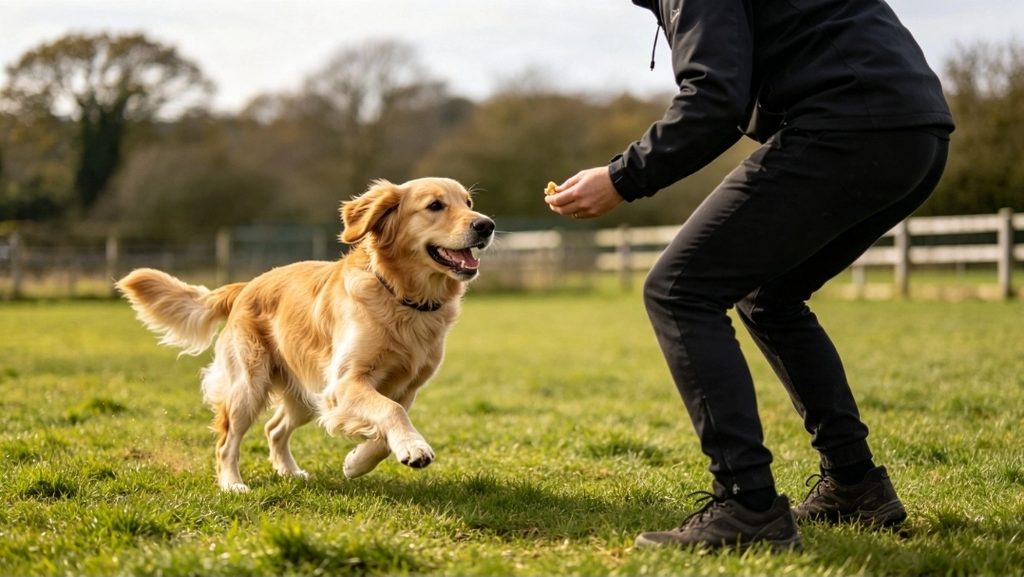
Make Coming Back to You Rewarding
One of the biggest mistakes owners can make is making recall predict something their dog doesn’t enjoy.
For example:
“Come!”
Dog returns.
Lead goes on.
Walk ends.
Dog goes home.
If this happens every time, your dog may eventually learn that coming back means the fun is over.
Practise recalls that don’t always end the enjoyable activity.
Call your dog.
Reward them.
Release them again.
This helps create a positive association with returning to you.
Start With Short Distances
Don’t begin recall training by calling your dog from the other side of a huge field.
Start close.
Call.
Reward.
Repeat.
As your dog becomes reliable, gradually increase the distance.
You can then begin introducing controlled distractions.
Never Chase Your Dog
If your dog doesn’t come when called, chasing them can turn the situation into a game.
Instead, where safe and appropriate, encourage your dog towards you.
Use enthusiasm.
Make yourself interesting.
Reward them when they return.
Recall should become something your dog wants to respond to.
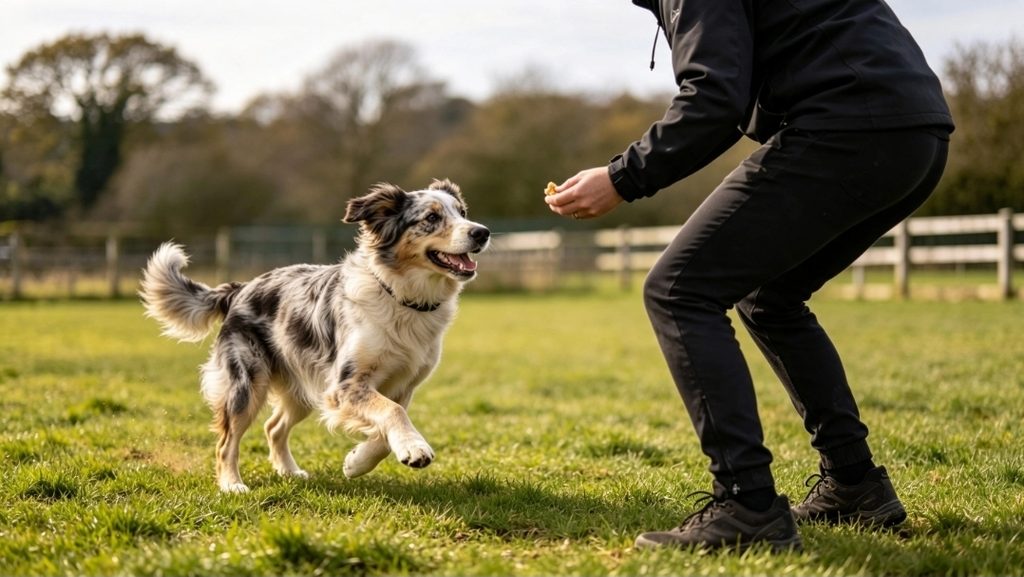
How to Teach Sit, Stay and Come Together
Once your dog understands each behaviour individually, you can begin combining them.
For example:
Sit → Stay → Come
Ask your dog to sit.
Give the stay cue.
Take a short distance away.
Wait.
Give your recall cue.
Your dog comes to you.
Reward.
This combines three behaviours into one exercise.
Don’t Combine Everything Too Soon
Your dog needs to understand each behaviour individually before you expect them to perform a sequence.
If sit isn’t reliable, work on sit.
If stay isn’t reliable, reduce the duration or distance.
If recall isn’t reliable, go back to easier recall exercises.
Build the individual components first.
Then combine them.
Use a Release Cue
Your dog should understand when an exercise is finished.
For example:
Sit.
Stay.
Come.
Release.
A release cue tells your dog that they are free to move.
This can make your communication much clearer.
Without a clear release, your dog may decide for themselves when the exercise is finished.
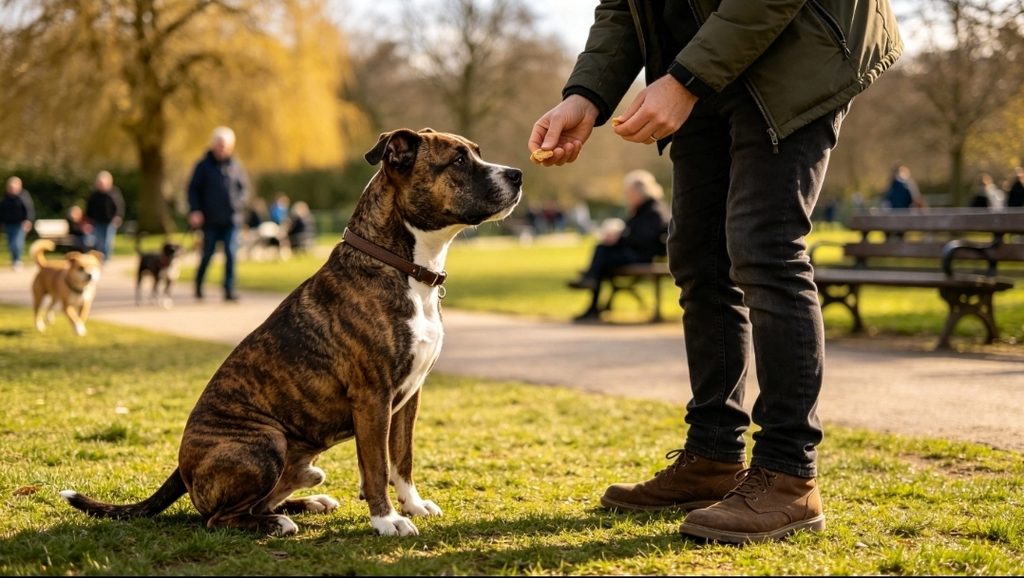
Practise in Different Environments
A dog doesn’t automatically generalise a behaviour.
Your dog may sit perfectly in the kitchen.
Then you ask for a sit in the park and they appear to have forgotten everything.
They haven’t necessarily forgotten.
The environment is simply much more difficult.
New smells.
New sounds.
Other dogs.
People.
Movement.
The level of distraction has changed.
Practise gradually in different environments.
Increase the Difficulty Gradually
Dog training should progress.
You can increase:
- Distance
- Duration
- Distractions
- Environment
- Movement
- Number of people
- Number of dogs nearby
But don’t increase everything simultaneously.
If you increase distance, keep the environment easy.
If you introduce more distractions, reduce the distance.
If you move somewhere busy, reduce the duration.
This gives your dog a better chance of succeeding.
What If Your Dog Doesn’t Respond?
Don’t immediately assume your dog is being stubborn.
Ask yourself:
Does my dog understand the behaviour?
Have I practised it enough?
Is the environment too distracting?
Have I increased the difficulty too quickly?
Is my reward motivating enough?
Have I given a clear cue?
If your dog struggles, make the exercise easier.
Successful repetitions help build reliable behaviour.
How Often Should You Train?
You don’t need to spend hours training.
Short, regular sessions can be extremely effective.
You could practise:
- Sit for a few minutes
- Stay for a few minutes
- Recall for a few minutes
Then finish.
Training can also be incorporated into normal everyday life.
Ask for a sit before opening the door.
Practise stay while preparing food.
Practise recall during safe training sessions.
Reward calm behaviour throughout the day.
Avoid Using Recall Only When You Need Your Dog
If the only time you say “come” is when your dog needs to stop doing something enjoyable, your dog may begin associating the cue with negative consequences.
Build recall into normal training.
Call your dog.
Reward them.
Release them.
Call them again later.
Make returning to you a normal and rewarding part of their day.
What Rewards Should You Use?
Food is useful for many dogs, but it isn’t the only reward available.
Depending on your dog, rewards can include:
- Food
- Praise
- Toys
- Play
- Interaction
- Access to an interesting area
- Sniffing opportunities
- Freedom to explore
The important thing is that your dog finds the reward worthwhile.
How Long Does It Take to Teach Sit, Stay and Come?
There isn’t a fixed timeframe.
A dog may understand sit very quickly.
Reliable stay can take considerably longer.
Reliable recall can require extensive practice around distractions.
There is a major difference between:
“My dog knows the command.”
and:
“My dog responds reliably when distracted.”
Reliability comes from repetition and gradually increasing difficulty.
GPK9 and Building Reliable Obedience
Learning how to teach a dog to sit, stay and come is about more than teaching three individual commands.
You’re building communication, engagement, obedience and reliability.
These skills become the foundation for more advanced training and better everyday control.
GPK9 90 Day Transformation
The GPK9 90 Day Transformation is the most relevant GPK9 course for this topic because sit, stay and recall require consistent training over time.
A structured 90-day training period provides an opportunity to practise obedience regularly, establish better communication and gradually introduce distractions as your dog’s reliability improves.
The objective isn’t simply to teach your dog three words.
It’s to develop behaviours that can be used reliably in everyday situations.
A Simple Sit, Stay and Come Training Plan
Step 1 — Teach Sit
Start somewhere quiet and reward the correct position.
Step 2 — Build the Sit
Practise until your dog can respond reliably.
Step 3 — Introduce Stay
Start with extremely short durations.
Step 4 — Increase Duration
Gradually ask your dog to remain in position for longer.
Step 5 — Add Distance
Take small steps away before returning and rewarding.
Step 6 — Teach Recall
Start at short distances and reward your dog for coming back.
Step 7 — Increase Recall Distance
Gradually increase the distance when your dog is reliable.
Step 8 — Add Distractions
Introduce increasingly difficult environments.
Step 9 — Combine the Behaviours
Practise:
Sit → Stay → Come.
Step 10 — Keep Practising
Regular repetition builds reliability.
Final Thoughts: How to Teach a Dog to Sit, Stay and Come
Learning how to teach a dog to sit, stay and come provides your dog with three valuable obedience behaviours.
But the words themselves aren’t the important part.
Your dog needs to understand what each cue means.
They need to learn that responding to you is worthwhile.
They need opportunities to practise.
And they need gradually increasing distractions.
Start somewhere easy.
Teach one behaviour at a time.
Reward correct responses.
Build duration.
Build distance.
Introduce distractions.
Then combine the behaviours.
Most importantly, don’t rush reliability.
A dog that can sit in a quiet room has learned the beginning of the behaviour.
A dog that can sit, stay and come reliably around real-world distractions has developed something far more valuable.
Clear communication.
Reliable obedience.
Better engagement.
A stronger working relationship between dog and handler.


